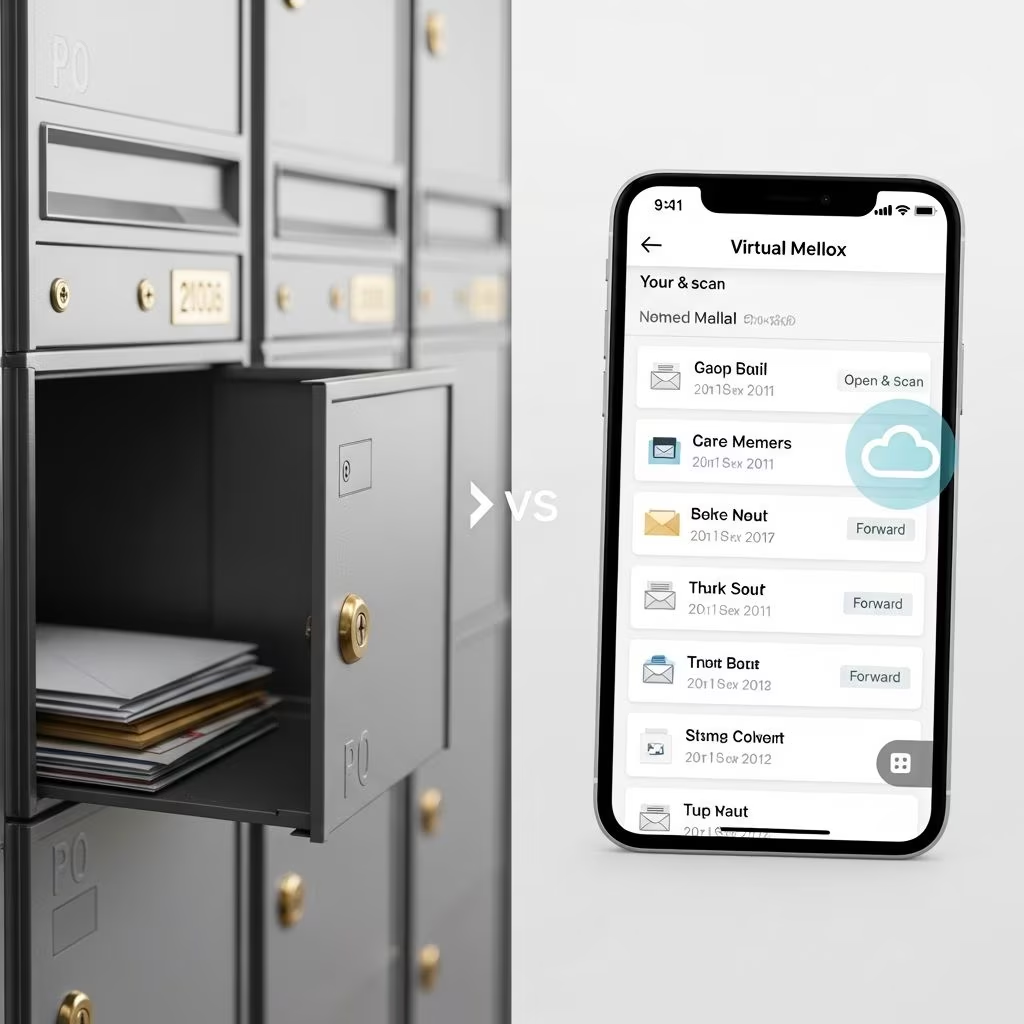
Business owners and individuals often need a reliable mailing solution that balances privacy, convenience, and professionalism. Traditional PO Boxes from the United States Postal Service (USPS) have long served this purpose, but virtual mailboxes offered by private providers are gaining popularity for their advanced features. This article explores their core distinctions, helping you decide based on your specific needs like remote access, package delivery, and business registration requirements.
Defining Traditional PO Boxes
A PO Box is a secure locker rented from a local post office, providing a numbered address for receiving mail through USPS. It’s ideal for basic mail collection without revealing your home address. Users must visit during business hours to retrieve items, which suits those near a post office seeking affordability.
- Secure storage: Mail is held in a locked compartment accessible only by the renter.
- Low cost: Starting at around $20 per quarter for small sizes.
- Privacy basics: Hides residential details from correspondents.
However, limitations include restricted hours—typically 9 AM to 5 PM weekdays—and no acceptance of packages from private carriers like UPS or FedEx, as PO Boxes aren’t physical street locations.
Understanding Virtual Mailboxes
Virtual mailboxes operate through commercial mail receiving agencies (CMRAs) that provide a real street address. Mail and packages arrive at a staffed facility, where professionals scan envelopes, upload images to an online portal, and offer options like forwarding or shredding. This digital management enables worldwide access via app or web.
- Street address: Appears professional, e.g., ‘123 Main St Suite 456’ instead of ‘PO Box 789’.
- Multi-carrier support: Accepts deliveries from USPS, FedEx, UPS, DHL.
- Remote control: View scans, request opens, or forward items 24/7.
Providers like those compliant with USPS regulations ensure security through background-checked staff and encrypted platforms.
Core Comparisons: Features Side-by-Side
To highlight differences, consider this table summarizing key aspects:
| Feature | PO Box | Virtual Mailbox |
|---|---|---|
| Address Type | PO Box # (e.g., PO Box 123) | Street Address (e.g., 456 Oak Ave #100) |
| Access Hours | Post office business hours | 24/7 online from any device |
| Package Carriers | USPS only | All major carriers |
| Mail Management | Physical pickup only | Scan, forward, shred, notify |
| Business Use | Often not allowed for registration | Compliant for official filings |
| Cost Range | $20–$100/quarter | $10–$50/month + fees |
This comparison shows virtual options excel in flexibility, while PO Boxes prioritize simplicity and cost savings.
Accessibility and Daily Use
PO Box users face rigid schedules, closing early evenings, weekends, and holidays, requiring trips that disrupt workflows—especially for travelers. Virtual services notify via email or app instantly upon receipt, displaying high-res scans of exteriors with sender details, dimensions, and weights. Users instruct actions remotely: ‘forward to hotel’ or ‘shred junk.’ For digital nomads, this eliminates physical boundaries.
In high-volume scenarios, virtual dashboards consolidate tracking, reducing administrative burden. PO Boxes demand manual sorting on-site, amplifying time costs.
Privacy and Security Measures
Both shield home addresses, but virtual mailboxes enhance protection. Facility staff handle items professionally, using secure vaults and USPS Form 1583 for authorization. Digital scans employ encryption, preventing unauthorized views. PO Boxes offer basic locks but expose users to public post office traffic during pickup.
Businesses benefit from spam filtering; instruct providers to discard solicitations without opening, maintaining a clean inbox equivalent.
Handling Packages and Restrictions
PO Boxes’ USPS exclusivity stems from lacking a street address, blocking couriers and imposing size limits (e.g., no items over 18x13x8 inches typically). Virtual addresses, as commercial suites, welcome all deliveries, vital for e-commerce receiving inventory or client samples.
Virtual perks include consolidation—bundle multiple packages into one shipment worldwide, slashing costs—and local pickup options at the facility for urgent needs.
Costs and Value Analysis
PO Boxes start cheap but add fees for holds or keys. Virtual plans range $15–$75 monthly, with add-ons like $2–$5 per scan or forward. Calculate total value: a remote worker saves hours weekly versus driving, offsetting premiums. Startups weigh image: street addresses build trust on websites or Google listings.
| User Type | Best Choice | Reason |
|---|---|---|
| Local Solopreneur | PO Box | Low cost, easy pickup |
| Remote Freelancer | Virtual Mailbox | Global access, notifications |
| E-commerce Store | Virtual Mailbox | Multi-carrier packages |
| Registered Business | Virtual Mailbox | Street address compliance |
Legal Considerations for Businesses
Many states (e.g., California, Delaware) mandate street addresses for LLC formations, rejecting PO Boxes per Secretary of State rules. Virtual addresses, via CMRAs, qualify if properly notarized. Banks and IRS often prefer physical locations too. Always verify local statutes; non-compliance delays filings.
Federal regulations require virtual users to complete USPS 1583, ensuring legitimate use—not for evading laws.
Setting Up Your Mailing Solution
Steps for PO Box
- Visit postoffice.usps.com, search locations.
- Apply online or in-person with ID.
- Pay and receive keys/combination.
Steps for Virtual Mailbox
- Choose provider (e.g., compliant with USPS).
- Sign up online, select address.
- Notarize/submit Form 1583.
- Activate account for scans.
Setup times: PO Box instant; virtual 1–3 days for approval.
Real-World Applications and Scenarios
Freelancers use virtual for client proposals, appearing established. Non-profits leverage forwarding during events. E-commerce scales with inventory holds. Travelers consolidate mail quarterly. PO Boxes fit retirees or locals with light USPS mail.
Hybrid approaches exist: PO Box for personal, virtual for business.
Frequently Asked Questions
Can I use a PO Box for my business registration?
No, most states require a street address; virtual mailboxes provide compliant alternatives.
Are virtual mailboxes secure for sensitive documents?
Yes, with encrypted platforms, background-checked staff, and strict access protocols.
How much does a virtual mailbox cost compared to a PO Box?
Virtual: $10–$50/month; PO Box: $5–$25/month equivalent, but fewer features.
Can virtual mailboxes receive international packages?
Yes, from all carriers including DHL, with customs handling options.
Do I need to visit a virtual mailbox location?
No, everything is remote; optional pickup available.
Choosing the Right Option for Growth
Evaluate lifestyle: locals favor PO Boxes’ economy; globals prefer virtual versatility. As businesses expand, upgrade for scalability—professional image drives partnerships. Test short-term rentals to assess fit.
References
- Publication 158, Commercial Mail Receiving Agencies — United States Postal Service. 2023-01-01. https://pe.usps.com/text/pub158/welcome.htm
- Domestic Mail Manual Section 508 — United States Postal Service. 2025-10-01. https://pe.usps.com/text/dmm300/508.htm
- Virtual Mailbox Services — Federal Trade Commission Consumer Advice. 2024-06-15. https://consumer.ftc.gov/articles/virtual-mailbox-services
- PO Box vs Virtual Address Comparison — Anytime Mailbox Blog. 2024-03-20. https://www.anytimemailbox.com/blog/virtual-address-po-box-comparison
- Private Mailbox vs Virtual Mailbox — VirtualPostMail. 2023-11-10. https://www.virtualpostmail.com/blog/article/private-mailbox-vs-virtual-mailbox/
- PO Box Service Guide — USPS. 2025-01-15. https://faq.usps.com/s/article/PO-Box-General-Information