
The Peril of a Human Rights Hierarchy: Why Universality Matters in Global Policy
When religious liberty and property rights are elevated above all else, who is left behind? A deep dive into the indivisibility of human rights.
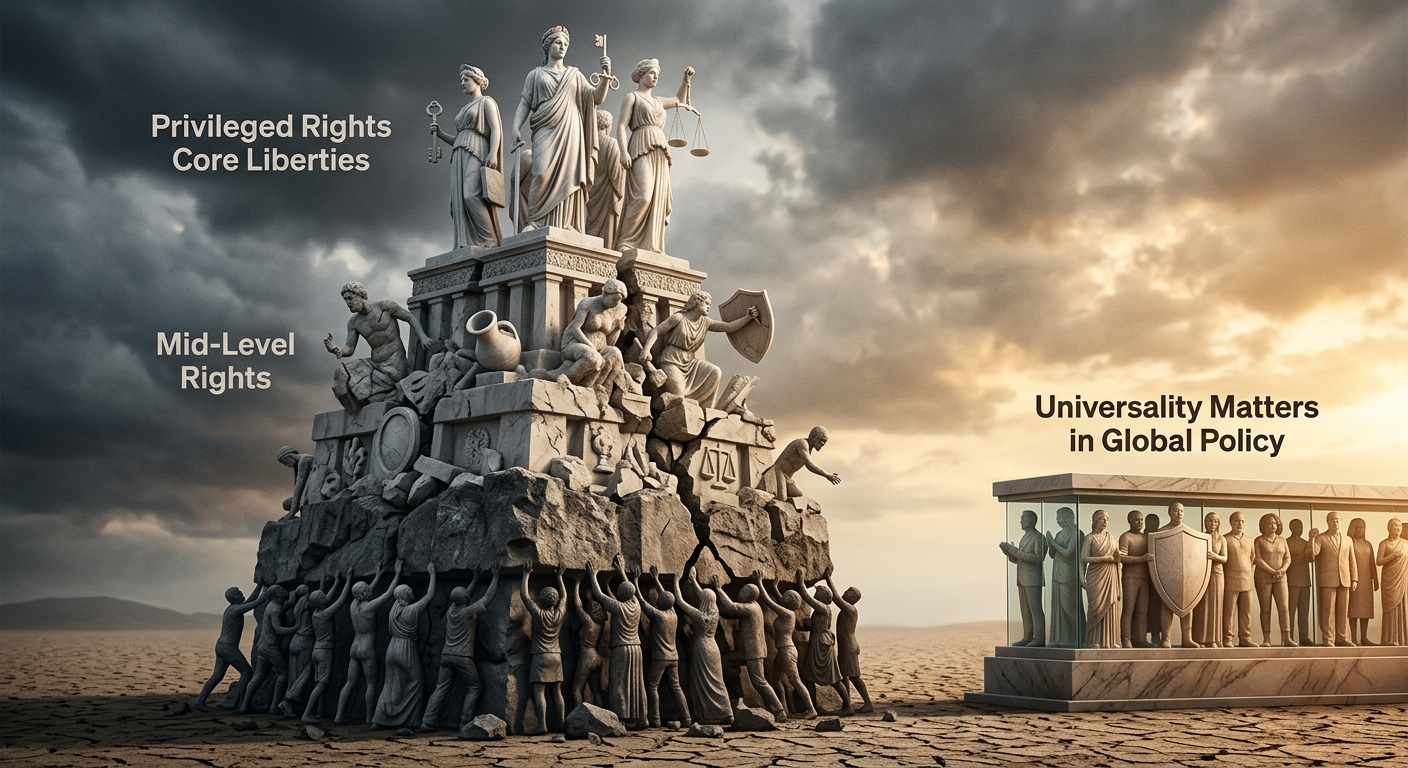
The global discourse surrounding human rights is continuously evolving, yet it remains anchored to a singular, foundational principle: universality. At the core of international law and diplomatic relations is the understanding that all individuals, regardless of their background, geography, or status, are inherently entitled to a baseline of dignity and protection. However, in recent years, a troubling trend has emerged in international policy corridors, challenging this deeply established consensus. The concept of creating a “hierarchy” of human rights—where certain rights, such as property ownership and religious liberty, are elevated above others—has sparked intense debate and concern among global advocates.
For decades, the international community has operated on the premise that human rights are indivisible and interdependent. This means that one set of rights cannot be fully realized without the other. Civil and political liberties are inextricably linked to economic, social, and cultural rights. Yet, when policymakers attempt to dissect these rights, prioritizing a select few that align with specific political, economic, or cultural ideologies, the entire framework is destabilized. This ideological shift threatens to dismantle decades of progress, turning a universal shield into a selective privilege. By categorizing human rights into tiers, governments risk undermining global equality, jeopardizing marginalized communities, and inadvertently providing diplomatic cover for authoritarian regimes.
The Universal Declaration of Human Rights and the Principle of Indivisibility
To understand the gravity of hierarchical rights, one must first look at the foundation of modern international human rights law: the Universal Declaration of Human Rights (UDHR). Adopted by the United Nations General Assembly in 1948 in the direct aftermath of the atrocities of World War II, the UDHR was designed as a comprehensive safeguard for human dignity. It was born from the collective realization that peace and stability could only be maintained if the rights of the individual were globally recognized and protected.
According to the United Nations, human rights possess four fundamental characteristics: they are universal, inalienable, indivisible, and interdependent. The principle of indivisibility is particularly crucial in this context. It asserts that there is no hierarchy among rights. The right to free speech is not inherently superior to the right to education, just as the right to a fair trial cannot be decoupled from the right to health and adequate living standards. When an administration or government attempts to slice the UDHR into “core” rights and “secondary” rights, they directly violate the very architecture of the 1948 consensus. Human rights were designed to be a package deal, recognizing that a person cannot truly exercise their political freedoms if they are starving, and they cannot enjoy economic prosperity if they are silenced by the state.
The Danger of Constructing a Rights Hierarchy
The temptation to rank human rights often stems from a desire to align foreign and domestic policy with specific historical or cultural narratives. A prominent recent example of this was the U.S. State Department’s 2020 Commission on Unalienable Rights. The initiative sought to reexamine the scope of human rights through the lens of classical natural law and early American foundational documents. While exploring historical contexts can be academically valuable, translating this into modern foreign policy creates a perilous diplomatic framework.
When a government decides that only a limited subset of rights is truly “unalienable,” while categorizing other widely recognized international rights as “ad hoc” or “contestable political preferences,” it sets a dangerous precedent. This process of cherry-picking rights allows state actors to evade accountability for widespread abuses by claiming that the violated rights were never truly fundamental to begin with. It transforms human rights from a binding international standard into a subjective menu from which governments can choose what they wish to enforce based on political convenience.
Elevating Religion and Property: A Selective Prioritization
In various attempts to restructure human rights priorities, religious liberty and property rights are frequently placed at the apex. There is no denying that freedom of religion is a cornerstone of a free society, protecting individuals from state-sponsored spiritual coercion. Similarly, the right to own property without arbitrary government seizure is essential for economic stability and personal autonomy. However, treating these two concepts as supreme rights creates profound legal and ethical dilemmas when they inevitably intersect with other human rights.
When property rights are treated as absolute and unassailable, they can easily be weaponized to block socio-economic justice initiatives. For instance, aggressive elevation of property rights has historically been used to combat environmental protections, labor rights, and equitable housing policies. On the other hand, elevating religious liberty to the status of a “super right” often sets the stage for legal loopholes where faith-based objections are utilized to bypass anti-discrimination laws. A balanced human rights framework recognizes that while you have the right to practice your religion and own property, these rights cannot be exercised in a way that infringes upon the health, safety, and equality of others.
Comparing Frameworks: Holistic vs. Hierarchical
To better understand the practical differences between a unified human rights approach and a tiered system, consider the following structural comparisons:
| Feature | Holistic Human Rights Framework | Hierarchical Human Rights Framework |
|---|---|---|
| Foundation | Universal Declaration of Human Rights (UDHR) and UN treaties | Selective nationalistic, historical, or religious interpretations |
| Core Principle | All rights are indivisible, interdependent, and equal | Certain rights are fundamental; others are viewed as secondary |
| Vulnerable Groups | Centers the protection of marginalized communities globally | Often marginalizes groups under the guise of religious exemptions |
| Global Impact | Fosters a unified, consistent standard of international law | Provides authoritarian regimes with a playbook to dismiss certain rights |
| Socio-Economic View | Economic and social rights are vital to sustaining civil liberties | Property rights are paramount; socio-economic rights are often sidelined |
Disproportionate Impacts on Marginalized Communities
The real-world consequences of a hierarchical rights system fall most heavily on the shoulders of vulnerable and marginalized populations. When religious liberty is structurally positioned above the right to equal protection under the law, it frequently leads to the erosion of protections for women, girls, and the LGBTQ+ community. International human rights organizations, such as Human Rights Watch and Amnesty International, have consistently warned against policies that use freedom of religion as a cloak to permit discrimination.
For the LGBTQ+ community, the prioritization of religious exemptions over non-discrimination laws can result in denial of healthcare, housing, and employment. If a healthcare provider or social service agency can legally refuse service based on a “supreme” religious objection, the human rights of the marginalized individual are effectively nullified. Similarly, reproductive rights are frequently caught in the crosshairs of this hierarchy. Access to reproductive healthcare is a widely recognized human right intricately linked to a woman’s right to health, privacy, and bodily autonomy. However, under a framework that places conservative religious interpretations at the top, reproductive freedoms are often demoted to mere “political controversies,” stripping women of essential protections under international law.
Authoritarian Playbooks and Global Diplomacy
The impact of a major democracy redefining human rights extends far beyond its own borders; it sends a powerful, destructive signal to the rest of the world. Global diplomacy relies heavily on the moral authority of nations that champion human rights. When leading democracies begin to publicly state that not all international rights are valid, they hand authoritarian regimes a golden diplomatic playbook.
Autocratic leaders closely monitor these policy shifts. If a prominent Western nation argues that human rights should be filtered through the lens of “national traditions” or “religious heritage,” authoritarian states will gleefully apply the same logic. A regime in Eastern Europe or the Middle East might use the exact same hierarchical justification to crack down on political dissidents, journalists, and minorities, arguing that they are simply prioritizing their own “traditional values” and “state security” over the “secondary” rights of free speech and assembly. By abandoning the universality of the UDHR, democratic nations lose the leverage needed to hold human rights violators accountable on the world stage.
Restoring the Balance: Why We Must Reject Categorization
The strength of the international human rights system lies in its uncompromising breadth. It is an ecosystem where the right to vote is nourished by the right to an education, and the freedom of worship is balanced by the freedom from discrimination. Any attempt to untangle this ecosystem and place certain rights on a pedestal while discarding others is not a refinement of human rights—it is a dismantling of them.
Moving forward, the international community, civil society, and policymakers must aggressively reaffirm the principles of indivisibility and interdependence. We must reject the false dichotomy that forces a choice between religious liberty and social equality, or between property rights and economic justice. True freedom requires a holistic commitment to the dignity of every human being, recognizing that an infringement on the rights of the most vulnerable among us is an infringement on the universal framework that protects us all.
Frequently Asked Questions (FAQs)
What does it mean for human rights to be indivisible?
Indivisibility means that all human rights—whether civil, political, economic, social, or cultural—are equal in importance. No single right can be fully enjoyed without the realization of the others. For example, the right to political participation is severely compromised if individuals are denied the right to basic education or health.
Why is prioritizing property rights controversial in human rights law?
While the right to own property is a recognized human right, elevating it above all others can lead to severe imbalances. Historically, treating property rights as absolute has been used to oppose labor rights, equitable housing initiatives, and environmental regulations, prioritizing wealth accumulation over broad socio-economic justice.
How does a hierarchy of rights impact LGBTQ+ individuals?
When frameworks place religious liberty significantly above equal protection, it often creates legal loopholes that permit discrimination. In such systems, businesses, healthcare providers, or state-funded agencies might cite religious beliefs to legally deny services, housing, or employment to LGBTQ+ individuals, undermining their fundamental human rights.
What was the Universal Declaration of Human Rights (UDHR) designed to achieve?
Adopted in 1948 in the wake of World War II, the UDHR was designed to establish a common standard of achievements for all peoples and all nations. It aimed to secure universal recognition and observance of fundamental human rights to prevent future atrocities and promote global peace, equality, and dignity.
References
- Explainer: a guide to the Universal Declaration of Human Rights — United Nations. 2023-12-10. https://www.un.org/en/about-us/udhr/foundation-of-international-human-rights-law
- Human Rights Day: 5 key things to know — UN News. 2024-12-09. https://news.un.org/en/story/2024/12/1158146
- US Should Focus on Rights for All, Not Rights for Some — Human Rights Watch. 2020-07-30. https://www.hrw.org/news/2020/07/30/us-should-focus-rights-all-not-rights-some
- USA: State Department’s flawed ‘unalienable rights’ report undermines international law — Amnesty International. 2020-07-16. https://www.amnesty.org/en/latest/news/2020/07/usa-state-departments-flawed-unalienable-rights-report-undermines-international-law/
- Draft Report of the Commission on Unalienable Rights — U.S. Department of State. 2020-07-17. https://geneva.usmission.gov/2020/07/17/draft-report-of-the-commission-on-unalienable-rights/
Similar Articles








Read full bio of Sneha Tete


