
The Passenger’s Defense: Asserting Your Fourth Amendment Rights on Public Transit
Learn how to confidently navigate law enforcement encounters and protect your constitutional rights while traveling.
The Unexpected Stop: Law Enforcement on Public Transit
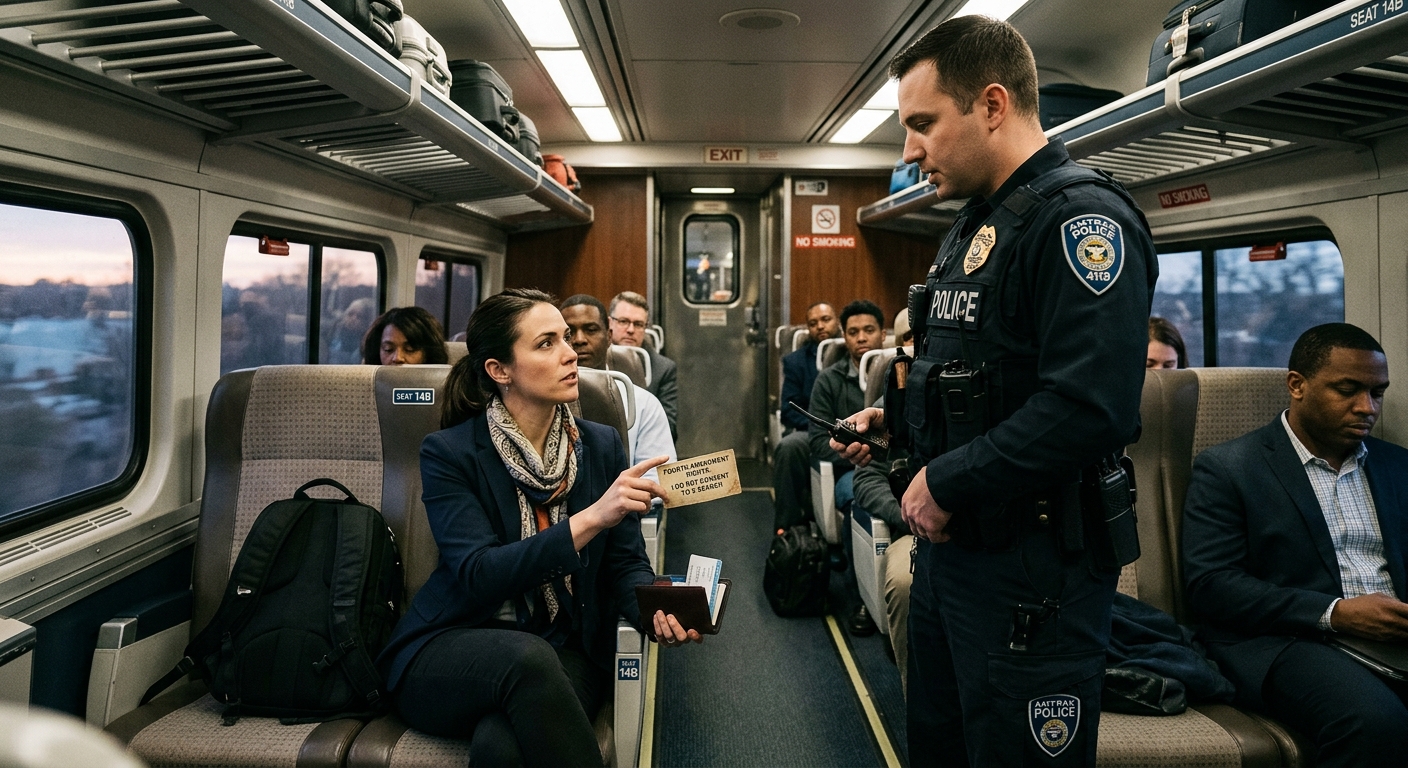
Boarding a commercial bus or train usually marks the beginning of a quiet, uninterrupted journey. Passengers stow their luggage, settle into their seats, and surrender control to the driver, trusting they will reach their destination without incident. However, this expectation of undisturbed travel is frequently shattered when a transit vehicle is unexpectedly boarded by federal or local law enforcement agents. In these tense moments, the confined space of a bus aisle can quickly feel like an interrogation room.
For decades, travelers across the United States have faced sudden, unannounced transportation checks. Officers, often dressed in tactical uniforms, may walk down the aisles asking questions about citizenship, demanding to see identification, or requesting to search personal belongings. Because of the inherent authority projected by law enforcement, most passengers immediately comply, unaware that their compliance is often legally considered voluntary.
The sudden appearance of authorities in a confined, moving vehicle creates a profound power imbalance. Yet, the United States Constitution travels with you. Understanding the limits of law enforcement authority and recognizing your own constitutional protections can fundamentally alter the dynamic of these encounters. When a passenger knows their rights, an intimidating interrogation can be swiftly reduced to a polite, albeit firm, refusal.
Demystifying the 100-Mile Border Zone
To understand why federal agents frequently board domestic transit vehicles, one must examine the legal framework surrounding the nation’s borders. Under federal regulations, specifically Title 8 of the Code of Federal Regulations, the government defines a “reasonable distance” from the border as 100 air miles from any external boundary of the United States. This includes not just land borders with Mexico and Canada, but also the entire coastal perimeter of the country.
This 100-mile border zone encompasses approximately two-thirds of the American population. Major metropolitan hubs, including New York City, Los Angeles, Miami, and Chicago, all fall within this jurisdiction. Within this expansive area, U.S. Customs and Border Protection (CBP) is granted broadened statutory authority under the Immigration and Nationality Act. This statute permits agents to board vessels, railway cars, aircraft, and conveyances to search for individuals residing in the country without legal authorization.
However, there is a critical distinction between a statutory grant of authority and a suspension of constitutional rights. While Congress has authorized federal agents to operate within this zone and establish temporary checkpoints, the United States Supreme Court has repeatedly affirmed that the Fourth Amendment remains entirely intact. The Fourth Amendment protects all individuals from unreasonable searches and seizures, meaning that an agent’s right to board a vehicle does not automatically grant them the right to search your luggage or force you to answer questions without reasonable suspicion or probable cause.
The Illusion of the “Consensual Encounter”
When law enforcement officers board a commercial bus without a warrant or probable cause, they are almost entirely reliant on a legal doctrine known as the “consensual encounter.” In the eyes of the law, not every interaction between a police officer and a civilian constitutes a seizure or a detention.
A consensual encounter occurs when an officer approaches a person in a public space, asks them questions, requests to see identification, or asks for permission to search their belongings. As long as the officer does not use physical force, block the individual’s exit, or use coercive language that would make a “reasonable person” feel they are not free to leave, the interaction does not trigger Fourth Amendment scrutiny. In these scenarios, the officer is technically just asking for a favor, and the civilian is voluntarily choosing to cooperate.
The psychological reality of a bus boarding, however, rarely feels consensual. When armed agents block the narrow aisle of a bus, looming over seated passengers, the environment is inherently coercive. Despite this, the Supreme Court ruled in cases like Florida v. Bostick that police may approach bus passengers at random to ask questions and request consent to search luggage, provided they do not convey that compliance is mandatory. The burden, therefore, falls entirely on the passenger to recognize the encounter as optional and to affirmatively decline the officer’s requests.
Understanding Police Encounters
| Type of Encounter | Law Enforcement Requirement | Passenger’s Legal Position |
|---|---|---|
| Consensual Encounter | No suspicion required. Officer may approach anyone and ask questions. | Free to leave, free to refuse to answer, free to decline searches. |
| Investigative Detention (Terry Stop) | Reasonable, articulable suspicion that a crime is occurring or about to occur. | Not free to leave temporarily. May be patted down for weapons, but full searches still require consent or a warrant. |
| Arrest | Probable cause that the individual has committed a crime, or an active warrant. | Subject to search incident to arrest. Right to remain silent remains intact. |
A Passenger’s Toolkit: How to Assert Your Rights
Knowing the legal theory is only half the battle; executing it under pressure requires preparation. When faced with an unexpected transit check, passengers should rely on a specific set of responses to safeguard their liberties.
- Determine Your Status: The most crucial question you can ask an officer is, “Am I being detained, or am I free to go?” If the officer states you are not being detained, the encounter is consensual. You are under no legal obligation to continue the conversation.
- Invoke the Right to Remain Silent: The Fifth Amendment protects you from self-incrimination, but you must invoke it clearly. You are not required to answer questions about your travel plans, your place of birth, or your citizenship status (unless you are actively crossing an international border at a designated port of entry). Simply state, “I am choosing to remain silent.”
- Refuse Searches Explicitly: Agents may ask to look in your bag or may begin squeezing the exterior of your luggage (a practice legally considered a search). You must verbally state, “I do not consent to a search of my belongings.” Remaining silent while an officer opens your bag can be legally interpreted as implied consent.
- Maintain Composure: Asserting your rights should never involve physical resistance, raised voices, or aggressive behavior. Calm, polite, and firm verbal boundaries are your most powerful legal tools. Arguing with an officer or physically interfering with a search can lead to criminal charges, even if the search itself is later deemed unconstitutional.
The Ripple Effect of Bystander Intervention
The assertion of constitutional rights in a public setting often generates a powerful ripple effect. When an entire bus of passengers is subjected to a transportation check, the atmosphere is usually dictated by fear and confusion. Passengers look to one another for cues on how to behave, and when the majority quietly complies with unconstitutional searches, a norm of submission is established.
However, it only takes one informed individual to break this psychological spell. A passenger who clearly, calmly, and audibly asserts their rights can instantly educate everyone else in the vicinity. By stating aloud, “I do not consent to this search, and I am choosing to remain silent,” an individual not only protects their own privacy but reminds their fellow travelers that they possess the exact same rights. There have been numerous documented instances where a single passenger’s vocal refusal to produce identification without suspicion empowered the rest of the bus to follow suit, effectively forcing agents to abandon their arbitrary sweep.
Collective knowledge is the ultimate safeguard against government overreach. Law enforcement agencies rely heavily on the public’s ignorance of the law to conduct broad, suspicionless sweeps. When communities educate themselves and each other, the utility of these sweeps drastically diminishes.
Corporate Accountability in Transit
The defense of civil liberties on public transit is not solely the responsibility of the individual passenger; transit companies themselves play a pivotal role. For many years, major commercial bus lines routinely allowed federal immigration agents to board their vehicles and utilize their private property to interrogate customers. The companies often claimed they were legally obligated to cooperate with federal authorities.
This deference to law enforcement was fundamentally flawed. The Fourth Amendment protects private businesses from unwarranted government intrusion just as it protects individuals. A bus company has the absolute right to refuse law enforcement access to the non-public areas of their property—including the interior of their buses—unless the agents present a judicially signed warrant.
Sustained public pressure, grassroots organizing, and high-profile litigation have successfully forced corporate policy changes. A landmark example occurred when the Washington State Attorney General filed a lawsuit against Greyhound Lines Inc. for allowing unwarranted and suspicionless immigration sweeps on its buses, which subjected passengers to discrimination. The resulting $2.2 million settlement and consent decree required the company to implement strict corporate reforms, including creating a clear policy denying agents permission to board buses without warrants or reasonable suspicion. This legal victory underscored a vital precedent: private transit companies cannot passively surrender their customers’ constitutional rights for the sake of convenience.
Frequently Asked Questions (FAQ)
Can border patrol agents legally board a domestic bus?
Yes, under federal law, CBP agents have the authority to board conveyances within 100 miles of an external boundary. However, to access non-public areas of a transit facility or board a private commercial bus, they generally need the consent of the transit company or a judicial warrant. Even if they do board, passengers retain their Fourth Amendment rights against unreasonable searches.
Do I have to show my ID if a federal agent asks for it on a bus?
If the encounter is consensual and you are traveling domestically within the United States, you generally do not have to show your ID unless the officer has reasonable, articulable suspicion that you are involved in criminal activity. Simply ask if you are being detained. If the answer is no, you can decline the request.
Can an officer search my luggage if I don’t consent?
No, not without probable cause or a valid warrant. If an officer asks to search your bag, or begins to manipulate the exterior of your bag, clearly state, “I do not consent to a search of my belongings.” If they search it anyway, do not physically resist, but clearly repeat your lack of consent. The legality of the search will have to be challenged later in court.
Does my immigration status change my constitutional rights during a transit stop?
The core protections of the Fourth Amendment (against unreasonable search and seizure) and the Fifth Amendment (the right to remain silent) apply to all people within the borders of the United States, regardless of their citizenship or immigration status. You have the right to remain silent and to refuse consent to search your belongings.
Conclusion
The preservation of civil liberties requires continuous, active participation from the public. Rights written on parchment offer little protection if they are not invoked in the face of authority. Encounters with law enforcement on public transit are intentionally designed to be intimidating, leveraging the confined environment to secure voluntary compliance. By memorizing your legal protections, remaining calm under pressure, and confidently asserting your boundaries, you transform yourself from a passive subject into an active defender of the Constitution. In doing so, you protect not only your own privacy but the collective freedom of everyone traveling alongside you.
References
- 8 CFR 287.1 — Definitions — Electronic Code of Federal Regulations (eCFR). 2025-09-05. https://www.ecfr.gov/current/title-8/chapter-I/subchapter-B/part-287/section-287.1
- United States v. Martinez-Fuerte, 428 U.S. 543 — U.S. Supreme Court / Justia. 1976-07-06. https://supreme.justia.com/cases/federal/us/428/543/
- Florida v. Bostick, 501 U.S. 429 — U.S. Supreme Court / Justia. 1991-06-20. https://supreme.justia.com/cases/federal/us/501/429/
- Greyhound must stop allowing warrantless and suspicionless immigration sweeps, pay $2.2 million to end AG Ferguson’s lawsuit — Washington State Office of the Attorney General. 2021-09-27. https://www.atg.wa.gov/news/news-releases/greyhound-must-stop-allowing-warrantless-and-suspicionless-immigration-sweeps
Similar Articles








Read full bio of Sneha Tete


