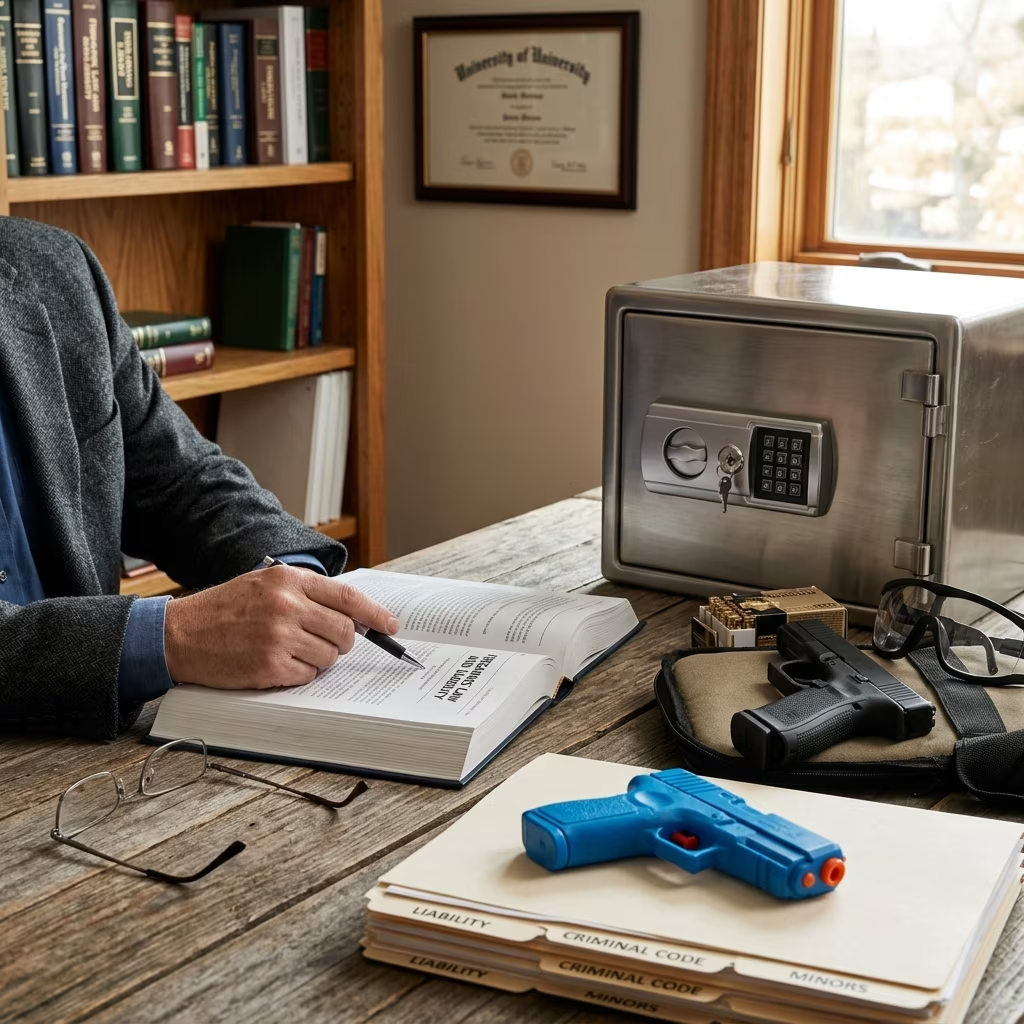
Parents sometimes think of a firearm as a family heirloom, a hunting tool, or a training item for a child who is old enough to learn safe handling. The law, however, treats firearms and minors with much more caution than many families expect. Federal rules, state age limits, and child-access laws can change what is allowed, what is restricted, and what can become a criminal or civil case if something goes wrong.
This article explains the legal framework in plain language. It focuses on the difference between ownership and possession, the limited situations where a minor may use a gun, and the serious consequences that can follow if a firearm is poorly stored or handed over without care.
Why the Legal Rules Matter
Firearm laws are built around a simple idea: children are not treated the same as adults when it comes to dangerous weapons. A parent may believe that a gun bought for a teenager is still under adult control, but legal systems often look at who actually has the firearm, who can access it, and whether the adult took reasonable steps to prevent misuse.
That distinction matters because a lawful purchase does not automatically mean lawful transfer, lawful storage, or lawful use. A parent who buys a gun for a child may still face legal exposure if the child carries it in an unauthorized setting, uses it unsafely, or leaves it accessible to others.
Federal Law: The Basic Framework
Federal law does not give minors the same firearm rights that adults have. Under federal rules, people under 18 cannot buy firearms from licensed dealers, and handguns have stricter age limits than long guns. In practice, this means that age and type of firearm both matter when deciding whether a transaction is legal.
There is also an important difference between buying a gun and possessing it. A parent can purchase a firearm, but that does not always mean the child can legally keep it, carry it, or use it whenever and however they want. Federal law creates narrow exceptions for limited uses, and those exceptions are not the same as a blanket right to own or carry a gun.
| Issue | General federal rule |
|---|---|
| Buying long guns from licensed sellers | Generally limited to adults 18 and older |
| Buying handguns from licensed sellers | Generally limited to adults 21 and older |
| Minor possession | Restricted, with narrow exceptions |
| Parental involvement | Allowed only in limited circumstances and often with conditions |
When a Parent May Lawfully Allow Use
Some firearm use by minors is permitted when it happens within a tightly controlled context. Federal rules have historically recognized situations where a child may use a firearm for hunting, target practice, instruction, or work-related purposes on a ranch or farm. Military service can also create a separate path for lawful possession when a firearm is officially issued as part of service duties.
These exceptions are not casual loopholes. They are tied to specific purposes, and the adult’s consent or supervision usually matters. A child who is using a firearm for sport or training is not automatically allowed to carry that firearm into ordinary daily life. The lawful purpose must match the lawful exception.
- Use for hunting may be allowed in limited circumstances.
- Use for target practice may be allowed when supervision and context are appropriate.
- Instructional use, such as a riflery class, may fit within an exception.
- Farm or ranch work can create a separate justification for use in the operation of the property.
- Military-issued firearms are governed by service rules, not ordinary consumer ownership rules.
What Parents Often Get Wrong
One common mistake is assuming that gifting a firearm to a minor is the same as gifting a bicycle, game console, or other household item. Firearms are regulated objects, so the law may look at the transaction as a transfer of dangerous property rather than a simple family present. Another mistake is believing that if the parent bought the gun, the child can automatically use it anywhere the parent approves.
A second misunderstanding is confusing “supervision” with “permission.” A child may be allowed to fire a weapon at a range or during a hunting activity, yet still be barred from having the gun in a vehicle, bedroom, backpack, or other setting that falls outside the narrow exception. The legal question is not only whether an adult said yes, but whether the circumstances fit the rule.
State Law Can Be Stricter Than Federal Law
Federal law sets the floor, not the ceiling. States may add their own age limits, storage rules, transfer restrictions, or child-access prevention laws. That means a parent who follows one federal rule may still violate a state rule, even if the parent believed the transaction was safe and responsible.
In some states, the law focuses on preventing access by minors. In others, liability can arise only after a child actually uses the gun and causes harm. Still others punish reckless conduct by adults who leave firearms unsecured. The result is a patchwork system where the legality of the same family decision can depend heavily on geography.
Storage Is Often the Biggest Legal Risk
Even when a parent lawfully buys or stores a firearm, unsafe storage can create serious consequences. A locked cabinet, secured safe, trigger lock, or separate ammunition storage may help reduce risk, but local law may require more or less depending on the state. If a child gains access and someone is injured, prosecutors and civil plaintiffs often focus on whether the adult took reasonable precautions.
This is where legal risk and practical safety overlap. A firearm left loaded, unsecured, or easy to find can be central to both criminal negligence allegations and civil claims. Courts and juries may examine how the gun was stored, who had access to keys or codes, and whether the adult knew children were likely to encounter the firearm.
- Store firearms unloaded unless there is a lawful and immediate reason not to.
- Keep ammunition separate when possible and lawful.
- Use a lockbox, safe, or other secure storage method.
- Limit access to adults who genuinely need it.
- Recheck storage after travel, guests, or routine cleaning.
Criminal Liability for Adults and Minors
Firearm-related incidents involving children can lead to criminal investigations of more than one person. A parent may face charges if the law views the transfer, storage, or supervision as reckless or unlawful. In some cases, a child may also face juvenile charges or delinquency proceedings if the minor unlawfully possesses or uses the weapon.
That possibility surprises many families because they assume the child’s age will prevent a serious criminal case. In reality, minors can still be charged when their conduct causes injury, death, or unlawful possession. The fact that the firearm came from a parent does not eliminate the child’s own potential exposure.
Civil Lawsuits After a Firearm Injury
Criminal charges are not the only risk. If a child injures another person with a gun, the victim or the victim’s family may file a civil lawsuit. Those claims often argue that the adult owed a duty of care, breached that duty by failing to secure the firearm, and caused foreseeable harm.
These cases can be especially serious when a firearm is left where a child can easily find it and use it without permission. Even when a criminal conviction is not secured, a civil case can still succeed under a lower standard of proof. The adult may then face money damages, court costs, and long-term legal consequences.
How Courts Think About Responsibility
Courts often ask whether the adult acted reasonably under the circumstances. That analysis can include the child’s age, the child’s training, the type of gun, how it was stored, whether the weapon was loaded, and whether the parent knew there was a risk that the child would use it unsafely. The more foreseeable the danger, the harder it becomes for the adult to argue that the incident was unpredictable.
This is why families should avoid informal assumptions like “my child is mature” or “we have trained for years.” Training helps, but it does not erase legal duties. A responsible approach is to combine training with physical security and a clear understanding of the rules that apply in the family’s state.
Practical Questions Parents Should Ask Before Buying
Before buying a firearm for a minor, a parent should consider not just whether the purchase is possible, but whether the child’s intended use is lawful and whether the home is prepared for safe storage. Parents should also ask whether the gun is for supervised sport, property use, or some other limited purpose. That answer can determine whether the arrangement stays inside the law.
Families should also think about what happens after the initial purchase. Who will control the safe? Where will the gun be stored? Who knows the combination? What happens during travel, sleepovers, hunting trips, or visits from younger siblings? These details matter because legal responsibility often turns on practical control, not just ownership on paper.
Frequently Asked Questions
Can a parent buy a gun as a gift for a child?
Sometimes a parent can lawfully purchase a firearm with the intent that the child will use it in a limited, permitted setting. But a legal purchase does not automatically mean the child may possess or carry the gun freely.
Is there a minimum age for a child to own a gun?
Federal law focuses more on purchase and possession restrictions than on a single universal ownership age for every situation. State law may add its own age limits, so the answer depends on where the family lives.
Can a minor use a gun for hunting or target practice?
In many situations, yes, if the use fits a recognized legal exception and the surrounding circumstances comply with federal and state law. Supervision, location, and purpose are all important.
What if the parent did not mean for the child to access the gun?
Intent is important, but it is not always enough to avoid liability. Poor storage, easy accessibility, or failure to secure the weapon can still create legal problems even without an intent to cause harm.
Can a parent be sued if a child misuses the gun?
Yes. If a court finds that the parent failed to use reasonable care, the parent may face civil liability for resulting injuries or deaths.
A Safer Legal Approach for Families
The safest path is to treat a firearm as a highly regulated item that demands both legal research and secure storage. Parents should confirm the rules in their state before buying or transferring a gun to a minor, and they should assume that possession rules may be stricter than purchase rules. When in doubt, training, supervision, and storage should all be reviewed together rather than separately.
For families who want a child to learn firearm safety, the law generally favors controlled, limited, and supervised exposure over casual access. That approach reduces the chances of a criminal case, a civil lawsuit, or a tragic accident.
References
- Bureau of Alcohol, Tobacco, Firearms and Explosives (ATF) — Federal Firearms Regulations Reference Guide — U.S. Department of Justice. 2023-01-01. https://www.atf.gov/firearms/docs/guide/federal-firearms-regulations-reference-guide-2023-edition/download
- Gun Safety — Centers for Disease Control and Prevention. 2025-01-01. https://www.cdc.gov/firearm-violence/prevention/index.html
- Child Access Prevention Laws — Giffords Law Center to Prevent Gun Violence. 2025-01-01.
- Firearm Storage and Children — American Academy of Pediatrics. 2024-01-01. https://www.healthychildren.org/English/safety-prevention/all-around/Pages/Gun-Safety.aspx
- Preventing Firearm Injuries in Children and Adolescents — American Academy of Pediatrics. 2024-11-01. https://publications.aap.org/pediatrics/article/154/5/e2024062119/199896/Firearm-Related-Injuries-and-Deaths-in-Children-and