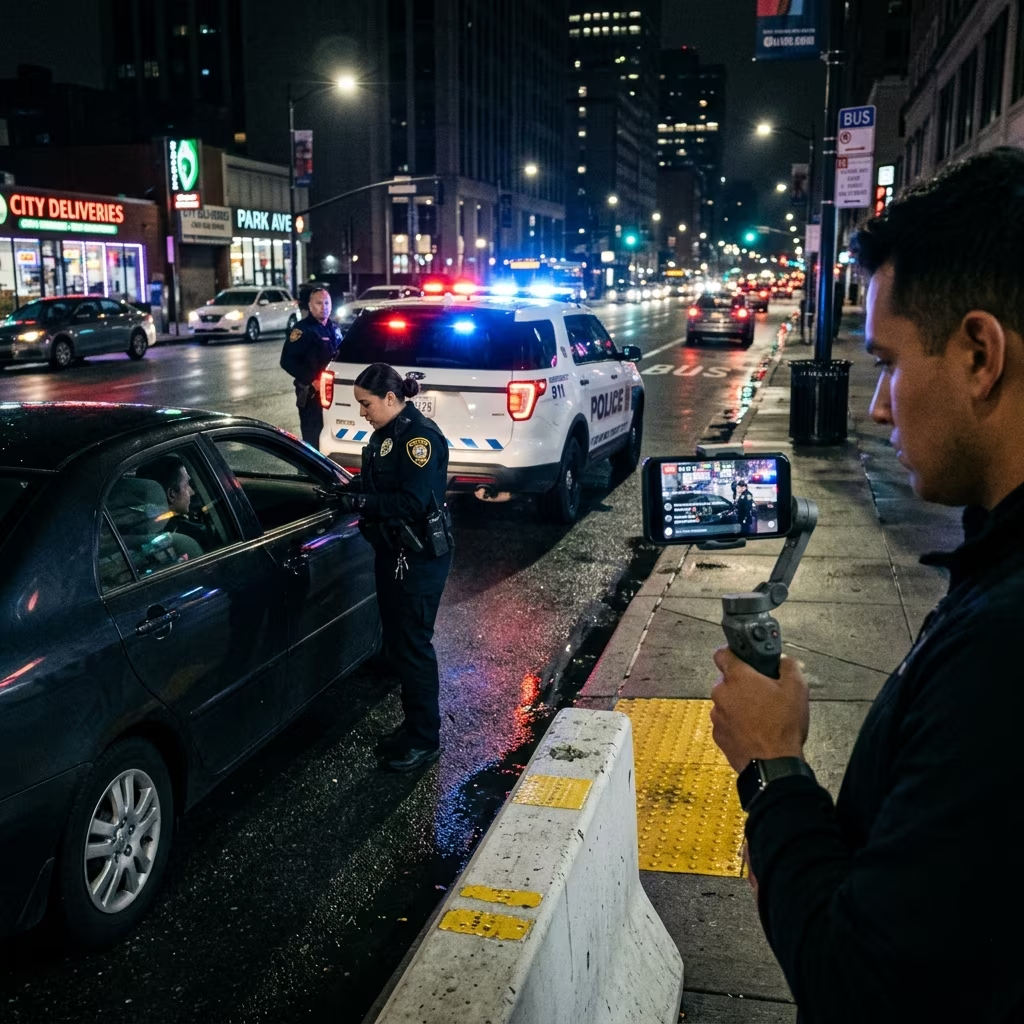
The First Amendment protects more than spoken or written words; it also covers modern ways of gathering and sharing information, including video recording and livestreaming encounters with the police. Recent decisions from federal courts, particularly the United States Court of Appeals for the Fourth Circuit in Sharpe v. Winterville Police Department, have clarified that livestreaming a traffic stop can be a form of protected speech.
This article explains what that ruling means, how it fits into the broader right to record police conduct, and where lawful limits on livestreaming may still exist.
Background: Recording Police and the First Amendment
Over the last decade, multiple federal appellate courts have recognized a First Amendment right to record police officers performing their duties in public. These decisions rest on two basic ideas:
- Public oversight of government – Video recordings of police activity provide information that fuels public discussion and accountability.
- Protection of expressive conduct – Using a camera to capture and preserve events is treated as conduct that facilitates speech under the First Amendment.
Courts in the First, Third, Fifth, Seventh, Ninth, Tenth, and Eleventh Circuits have all acknowledged a right to record police, putting substantial weight behind the notion that documenting law enforcement is constitutionally protected.
From Recording to Livestreaming: Why the Distinction Matters
Until recently, most cases focused on recording footage for later use rather than livestreaming events as they unfold. Livestreaming adds two key elements:
- Real-time dissemination – Rather than storing video for later, the content is broadcast immediately to an audience.
- Audience participation – Viewers may comment, share, or react instantly, sometimes influencing both public perception and behavior in the moment.
Some law enforcement agencies argued that this real-time element creates safety risks, such as drawing crowds to an active scene or revealing officer locations. That argument led to policies or on-the-spot instructions attempting to bar livestreaming during traffic stops, even where recording was allowed.
The Sharpe Case: How the Fourth Circuit Addressed Livestreaming
In Sharpe v. Winterville Police Department, a passenger used Facebook Live to broadcast a traffic stop and subsequent interaction with officers. Officers told him to stop livestreaming, though they did not prohibit him from recording the encounter for later use.
Sharpe later brought a civil rights lawsuit, arguing that the police department maintained an unconstitutional policy forbidding livestreaming, and that officers violated his First Amendment rights when they stopped his broadcast.
Expressive Conduct: Livestreaming as Speech
The Fourth Circuit held that livestreaming a traffic stop is protected expressive conduct under the First Amendment.
- Creating information – Recording generates data about governmental affairs, including how officers treat individuals during stops.
- Disseminating information – Livestreaming not only captures events but instantly shares them, often preserving a record that others can access later.
The court observed that speech does not lose protection simply because it is transmitted through new or digital media, or because it is broadcast in real time rather than after the fact.
Qualified Immunity for the Officers
Although the Fourth Circuit recognized the First Amendment interest in livestreaming, it ruled that the individual officers were shielded from damages by qualified immunity.
Qualified immunity protects government officials from personal liability for constitutional violations unless the right at issue was “clearly established” in light of existing precedent at the time of their conduct.
Because no prior Supreme Court, Fourth Circuit, or state high court decision had squarely addressed livestreaming during traffic stops, the court concluded that the officers could not reasonably have known that stopping the broadcast violated the First Amendment.
Policy Challenge: Department Liability
While individual officers received qualified immunity, the court allowed Sharpe’s claim against the police department to proceed. The reasoning was:
- If a department maintained a formal or informal policy banning livestreaming, that policy could be unconstitutional.
- Municipal liability does not turn on qualified immunity; it depends on whether a policy or custom caused the constitutional violation.
The case therefore sent a clear message to agencies within the Fourth Circuit: blanket policies forbidding livestreaming are legally vulnerable and may need revision.
How Sharpe Fits into the National Landscape
Sharpe is the first federal appellate decision to directly hold that livestreaming police encounters is protected by the First Amendment. At the same time, it builds on a broader national trend recognizing a right to record officers.
| Issue | Recording (Non-Live) | Livestreaming |
|---|---|---|
| Primary purpose | Create a record for later use and publication. | Simultaneously create and broadcast a record in real time. |
| Judicial recognition | Widely recognized across multiple federal circuits. | Explicitly recognized by the Fourth Circuit in Sharpe. |
| Safety concerns | Generally minimal; concerns focus on interference or obstruction. | Potential for crowd formation and real-time location disclosure. |
| Regulation standard | Subject to reasonable time, place, and manner limits. | May face tailored restrictions when safety or order is genuinely at risk. |
Limits on the Right: When Can Livestreaming Be Restricted?
The First Amendment does not guarantee an absolute right to record or livestream police encounters. Courts recognize that officers may impose reasonable, narrowly tailored restrictions in certain situations.
Time, Place, and Manner Regulation
Under established First Amendment doctrine, the government may regulate expressive activity in public spaces through content-neutral time, place, and manner rules if they serve important interests and leave open alternative channels of communication.
Applied to livestreaming a traffic stop, this can include:
- Directing individuals to stand at a safe distance from officers, vehicles, or active lanes of traffic.
- Prohibiting conduct that physically interferes with the stop, such as obstructing an officer’s movements or ignoring lawful commands.
- Restricting livestreaming in rare situations where real-time broadcast creates a concrete threat, such as revealing tactical positions during ongoing operations.
Officer and Public Safety Concerns
Law enforcement advocates have argued that livestreaming can pose unique dangers, especially when it may attract hostile third parties to a location in real time or disclose sensitive information about officers.
In an amicus brief submitted to the Supreme Court, a police organization emphasized that the constitutional question in Sharpe ultimately turns on reasonableness: whether particular restrictions are justified by genuine safety or operational needs.
Any restriction still must be carefully tailored and cannot be used as a broad justification to silence criticism or shield misconduct from public view.
Practical Guidance for Individuals: Livestreaming Your Own Traffic Stop
For people within the Fourth Circuit’s jurisdiction, Sharpe confirms that livestreaming a traffic stop is generally covered by the First Amendment, subject to reasonable limits. Even outside that region, many courts treat recording as protected, and Sharpe is likely to influence future rulings.
Best Practices If You Choose to Livestream
- Keep the device stable – Hold or mount your phone so you are not reaching in ways that appear threatening or interfere with the stop.
- Inform the officer calmly – You may state that you are recording or livestreaming for documentation purposes, without escalating the interaction.
- Follow lawful orders – Comply with commands related to safety (such as stepping to a specific location) while maintaining your recording if possible.
- Avoid interference – Do not block movements, refuse to provide requested documents, or use the broadcast to encourage others to disrupt the scene.
- Preserve the record – Save the video or stream archive when possible, as it may be relevant later in complaints or litigation.
What Officers and Departments Should Consider
- Policy review – Agencies within the Fourth Circuit should re-examine policies that categorically forbid livestreaming to ensure they align with Sharpe.
- Training – Officers benefit from guidance on how to handle citizens recording or streaming without escalating conflict or infringing rights.
- Reasonableness standard – Restrictions should be based on specific, articulable safety concerns, not discomfort with being recorded.
Implications for Civil Rights and Public Accountability
Livestreaming police encounters can play a crucial role in exposing misconduct, documenting disputes, and shaping public debate about law enforcement practices.
- Transparency – Real-time broadcasts reduce opportunities to alter or suppress footage and can deter both misconduct and false accusations.
- Community engagement – Viewers can quickly share streams, amplify concerns, or help identify witnesses and evidence.
- Legal evidence – Streams, like recordings, may be used in later investigations, disciplinary proceedings, or lawsuits.
At the same time, livestreaming raises privacy questions for individuals who appear in broadcasts and operational concerns for officers. Courts and policymakers are still working through how to balance these interests while maintaining robust First Amendment protections.
Frequently Asked Questions (FAQs)
Can I always livestream a traffic stop?
No. While livestreaming is generally protected speech, officers may impose reasonable restrictions based on safety, interference, or operational concerns, and those limits will be evaluated under a reasonableness and tailoring standard.
Does the Sharpe decision apply nationwide?
Sharpe directly binds courts and law enforcement within the Fourth Circuit (Maryland, Virginia, West Virginia, North Carolina, and South Carolina). Other circuits may treat it as persuasive authority and could adopt similar reasoning in future cases.
Is recording different from livestreaming under the law?
Courts have long recognized a right to record police; Sharpe clarifies that livestreaming—creating and broadcasting a record in real time—is also protected expressive conduct. However, some safety-based limits may more readily arise with livestreaming because of its real-time nature.
Can officers prevent me from recording entirely?
Officers generally cannot ban recording solely because they object to being filmed, but they can enforce content-neutral rules that keep you at a safe distance or prevent interference with their duties.
What happens if a department has a policy banning livestreaming?
Under Sharpe, a department-wide policy that categorically prohibits livestreaming may be unconstitutional. Individuals may challenge such policies, and municipal liability is analyzed separately from qualified immunity for individual officers.
References
- Fourth Circuit Rules that the First Amendment May Protect a Vehicle Occupant’s Right to Livestream a Traffic Stop — University of North Carolina School of Government. 2023-02-27. https://nccriminallaw.sog.unc.edu/fourth-circuit-rules-that-the-first-amendment-may-protect-a-vehicle-occupants-right-to-livestream-a-traffic-stop/
- Can I Livestream my Own Police Traffic Stop? — Nobles & Yanez PLLC. 2023-03-02. https://noblesyanezlaw.com/can-i-livestream-my-own-police-traffic-stop/
- Livestreaming Police is a Critical First Amendment Right — American Civil Liberties Union. 2022-09-09. https://www.aclu.org/news/free-speech/livestreaming-police-is-a-critical-first-amendment-right
- Capturing the Truth: Navigating the Intersection of Freedom of Speech and Video Recording in Law Enforcement — DLG Learning Center. 2023-07-06. https://dlglearningcenter.com/capturing-the-truth-navigating-the-intersection-of-freedom-of-speech-and-video-recording-in-law-enforcement/
- Brief of Fraternal Order of Police as Amicus Curiae in Support of Petitioners, Winterville v. Sharpe — Supreme Court of the United States. 2023-10-19. https://www.supremecourt.gov/DocketPDF/23/23-272/285587/20231019172552063_FOP%20Amicus%20Brief%20-%20Winterville%20v.%20Sharpe.pdf