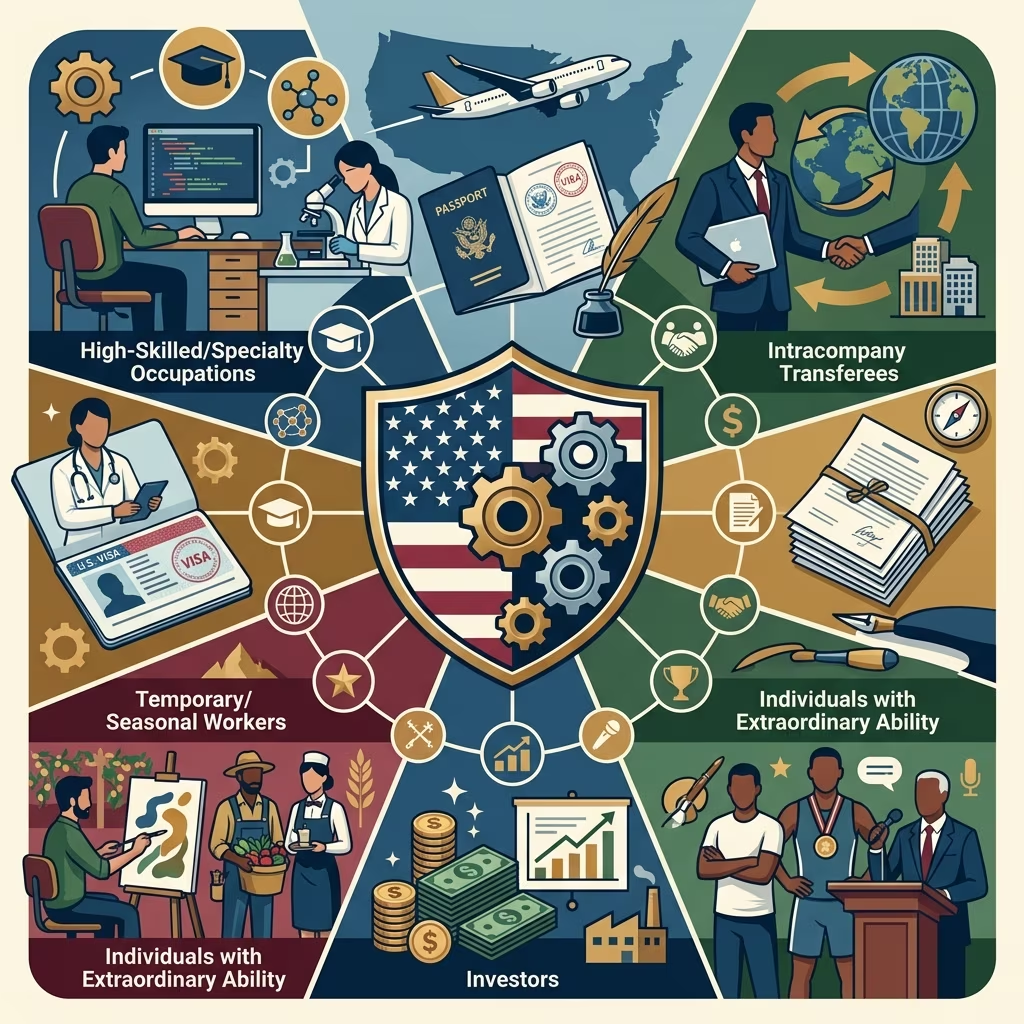
Foreign nationals who want to build a career in the United States usually need an employment visa that allows them to work legally for a specific employer, in a specific role, and for a defined period of time. Understanding the available visa categories, who can sponsor you, and how the application process works is essential before you accept a job offer or invest in a business.
1. How U.S. Employment Visas Are Organized
U.S. immigration law divides employment-related visas into two broad groups: temporary (nonimmigrant) work visas and permanent (immigrant) employment-based visas. Each group has multiple categories with different requirements, processing times, and rights.
1.1 Temporary vs. Permanent Work Authorization
| Feature | Temporary (Nonimmigrant) Work Visas | Permanent (Immigrant) Employment Visas |
|---|---|---|
| Primary purpose | Short-term employment or training for a limited period | Long-term employment and U.S. permanent residence |
| Typical documentation | Approved petition (Form I-129), DS-160, supporting evidence | Immigrant petition (Form I-140), DS-260, civil and financial documents |
| Status | Nonimmigrant status; no automatic path to a green card | Leads directly to a green card if approved and a visa number is available |
| Length of stay | Months to several years, often renewable within legal limits | Indefinite, subject to maintaining permanent resident status |
| Dependents | Many categories allow spouses and children under 21 to accompany | Spouses and minor children usually qualify for immigrant status as derivatives |
1.2 The Role of Sponsoring Employers
For most employment visas, a U.S. employer must sponsor the foreign worker by offering a job and filing a petition with U.S. Citizenship and Immigration Services (USCIS). There are limited exceptions, such as certain investor visas and specific immigrant categories that permit self-petition.
Employer sponsorship usually involves:
- Issuing a formal job offer with a detailed description of duties and salary
- Filing the appropriate USCIS form (often Form I-129 for temporary workers or Form I-140 for permanent workers)
- Providing supporting evidence about the company and position
- Complying with U.S. labor and wage rules, including any required labor certification
2. Major Temporary Work Visa Categories
Temporary worker visas allow you to work in the U.S. for a set period, after which you must either extend status, change to a different category, or depart. The U.S. Department of State lists 11 principal temporary worker categories, many of which are tied to specific occupations, skills, or purposes.
2.1 Specialty Occupation Professionals (H-1B)
The H-1B visa is designed for workers in a specialty occupation that requires highly specialized knowledge and at least a bachelor’s degree or equivalent.
Key points include:
- Employer must file a petition with USCIS demonstrating that the job qualifies as a specialty occupation
- Worker must have the relevant degree or equivalent experience
- Annual numerical caps apply, and demand frequently exceeds supply
- Initial approval can be up to three years, with possible extensions within legal limits
2.2 Seasonal and Temporary Labor (H-2A, H-2B)
H-2 visas support U.S. employers who need temporary workers when there are not enough domestic workers available.
- H-2A: Agricultural seasonal or temporary workers
- H-2B: Non-agricultural seasonal, peak load, or intermittent workers
Employers must usually obtain a temporary labor certification from the Department of Labor confirming that hiring foreign workers will not adversely affect U.S. workers’ wages and working conditions.
2.3 Intra-Company Transfers (L-1)
The L-1 visa allows multinational companies to transfer executives, managers, and specialized knowledge employees from a foreign office to a related U.S. entity.
- Requires a qualifying corporate relationship between the foreign and U.S. entities
- Worker must have been employed abroad for a qualifying period in the relevant capacity
- Blanket petitions are possible for larger organizations, simplifying individual transfers
2.4 Extraordinary Ability and Entertainment (O and P Visas)
Workers with exceptional achievements or specialized talents may qualify for:
- O-1: Individuals with extraordinary ability in sciences, arts, education, business, or athletics
- P-1: Recognized individual or team athletes, or members of established entertainment groups
These categories require detailed evidence of awards, recognition, and a sustained record of achievement, often supported by contracts and itineraries.
2.5 Trader and Investor Visas (E-1, E-2)
E-1 and E-2 visas are available to nationals of countries that maintain a qualifying treaty of commerce with the United States.
- E-1: For principal traders engaged in substantial trade with the U.S.
- E-2: For investors who have made, or are in the process of making, a substantial investment in a U.S. enterprise
These categories can be attractive for entrepreneurs and business owners who wish to direct and develop their U.S. operations.
2.6 Other Notable Temporary Work Categories
Additional visa types may apply depending on your situation:
- H-3: Trainees receiving training in fields other than graduate medical education or special education
- TN: Certain Canadian and Mexican professionals under the North American trade framework
- R-1: Religious workers serving in a qualifying religious organization
3. Employment-Based Immigrant Visas (EB Categories)
Employment-based immigrant visas provide a path to permanent residence (a green card) for workers filling qualifying positions in the United States. Each fiscal year, around 140,000 immigrant visas are available across five main preference categories.
3.1 The Five Employment-Based Preference Categories
- EB-1: Priority workers, including individuals of extraordinary ability, outstanding professors and researchers, and certain multinational executives or managers
- EB-2: Professionals with advanced degrees or exceptional ability; some may self-petition under a national interest waiver
- EB-3: Skilled workers, professionals, and certain other workers with permanent job offers
- EB-4: Special immigrants such as certain religious workers and employees of international organizations
- EB-5: Immigrant investors who create or preserve jobs through substantial investments in U.S. enterprises
3.2 Labor Certification and the PERM Process
In many EB-2 and EB-3 cases, the employer must obtain a labor certification from the U.S. Department of Labor before filing an immigrant petition. This process, often called PERM, is intended to ensure that:
- No qualified U.S. workers are available for the role
- The hiring will not negatively impact wages or working conditions of similarly employed U.S. workers
Employers apply using the Foreign Labor Application Gateway or Form ETA 9089, and once certified, they attach the certification to the Form I-140 immigrant petition.
3.3 Immigrant Petition and National Visa Center Processing
After USCIS approves an employment-based immigrant petition, the case is forwarded to the National Visa Center (NVC) if the applicant will process through consular channels abroad.
The NVC:
- Assigns a case number and monitors visa availability based on the applicant’s priority date
- Requests fees, the online immigrant visa application Form DS-260, and civil documents such as birth and marriage certificates
- Prepares the case for interview at a U.S. embassy or consulate
4. General Steps in the Work Visa Application Process
Although each visa category has specific rules, most employment-based cases follow a similar sequence combining USCIS petition adjudication and consular processing or change of status.
4.1 Step 1: Secure a Qualifying Job Offer or Business Plan
For employer-sponsored visas, the process begins when a U.S. organization offers you a job that fits the eligibility criteria of a particular visa category. Investor and certain extraordinary-ability cases may instead rely on a business plan or record of achievement.
4.2 Step 2: Employer Petition to USCIS
The sponsoring employer submits a petition to USCIS with detailed evidence about you and the position.
- Temporary workers: often Form I-129, Petition for a Nonimmigrant Worker
- Permanent workers: Form I-140, Immigrant Petition for Alien Workers, often accompanied by an approved labor certification
USCIS reviews eligibility, may issue requests for additional evidence, and eventually approves or denies the petition.
4.3 Step 3: Visa Application Through the Department of State
If you are outside the U.S., you must apply for a visa at a U.S. embassy or consulate after USCIS approves the petition.
For temporary workers, this typically involves:
- Completing the online Form DS-160, Nonimmigrant Visa Application
- Uploading a compliant photograph and printing the confirmation page
- Paying any required application fees
- Scheduling and attending a visa interview
For immigrant workers, the NVC instructs you to file Form DS-260, pay fees, and submit civil and financial documents before scheduling an interview.
4.4 Step 4: Consular Interview and Decision
At the visa interview, a consular officer verifies your eligibility, reviews documentation, and determines whether the visa category matches your purpose of travel.
- You must bring a valid passport, application confirmation pages, photographs, and any documents requested by NVC or the embassy
- The officer may ask additional questions or request more evidence
- If approved, your passport will be returned with the visa stamp
4.5 Step 5: Admission to the U.S. and Start of Employment
Holding a visa does not guarantee entry; Customs and Border Protection (CBP) officers inspect travelers at the port of entry and decide whether to admit them in the requested status.
Upon admission:
- You receive an electronic arrival record noting your class of admission and authorized period of stay
- You may begin work under the terms of your visa and any accompanying employment authorization
5. Employment Authorization Documents (EADs)
Some individuals in the U.S. may qualify to work without an employer-specific work visa by obtaining an Employment Authorization Document (EAD)].
An EAD is typically used by:
- Certain applicants for permanent residence
- Family members of foreign nationals with lawful nonimmigrant status
- Other categories specified by regulation, such as some students and humanitarian applicants
To request employment authorization, eligible individuals file Form I-765 with USCIS and, if approved, receive a card that serves as proof of permission to work for any employer consistent with the terms of their status.
6. Practical Tips for Choosing and Pursuing a Work Visa
Selecting the right employment visa and successfully navigating the process requires strategic planning. Consider these practical tips as you prepare:
6.1 Clarify Your Long-Term Immigration Goals
- If your goal is long-term residence, focus on visa options that support a transition to an employment-based immigrant category or directly grant a green card.
- If you seek short-term experience or training, a temporary nonimmigrant visa may be appropriate.
6.2 Coordinate Closely With Your Employer or Sponsor
- Confirm that the employer understands its obligations, including any labor certification requirements.
- Ensure job duties and offered wage align with the visa category’s legal standards.
6.3 Prepare Complete, Consistent Documentation
- Gather educational records, employment history, and civil documents early to avoid delays.
- Review all forms carefully for accuracy and consistency.
6.4 Monitor Visa Availability and Processing Times
- Employment-based immigrant visas may be subject to annual limits and priority-date backlogs.
- Temporary categories can face seasonal demand spikes or filing windows.
7. Frequently Asked Questions (FAQs)
7.1 Can I apply for a U.S. work visa on my own without an employer?
Most temporary employment visas require a sponsoring U.S. employer who files a petition with USCIS before you can apply at a consulate. Some categories, such as certain investor visas and specific EB-1 or EB-2 national interest waiver cases, may allow self-petition, but these are exceptions rather than the rule.
7.2 What is the difference between a work visa and an Employment Authorization Document?
A work visa is issued by a U.S. embassy or consulate and allows you to seek admission in a specific nonimmigrant or immigrant category tied to employment. An Employment Authorization Document is a card issued by USCIS inside the United States that confirms you are authorized to work, usually because of a separate underlying status such as a pending green card application or family-based classification.
7.3 Do I always need labor certification for an employment-based green card?
No. Labor certification is common for EB-2 and EB-3 cases, but some categories are exempt, including many EB-1 priority workers and EB-5 immigrant investors. Whether you need certification depends on the specific preference category and eligibility basis.
7.4 How long does the employment-based immigrant visa process take?
Timing varies based on USCIS processing, Department of Labor certification, NVC processing, and visa number availability. Applicants from countries with high demand may face longer waits due to annual numerical limits on immigrant visas.
7.5 Can my family accompany me on an employment visa?
Most employment-based categories allow spouses and unmarried children under 21 to accompany or follow to join the principal worker, either in derivative nonimmigrant status or as dependents on an immigrant visa. Specific rights, such as whether a spouse may work, depend on the underlying visa type and applicable regulations.
References
- Working in the United States — U.S. Citizenship and Immigration Services (USCIS). 2024-03-15. https://www.uscis.gov/working-in-the-united-states
- Temporary Worker Visas — U.S. Department of State, Bureau of Consular Affairs. 2024-02-05. https://travel.state.gov/content/travel/en/us-visas/employment/temporary-worker-visas.html
- Employment-Based Immigrant Visas — U.S. Department of State, Bureau of Consular Affairs. 2023-11-20. https://travel.state.gov/content/travel/en/us-visas/immigrate/employment-based-immigrant-visas.html
- Immigrant Visa to Work in the U.S. — USAGov. 2023-09-01. https://www.USA.gov/immigrant-work-visa
- Employment-Based Visa Categories in the United States: An Overview — American Immigration Council. 2022-08-10. https://www.americanimmigrationcouncil.org/fact-sheet/employment-based-visa-categories-united-states
- Guide to U.S. Work Visa Types: Find the Right Visa for Your Career Goals — Augustana College Career Development. 2025-12-09. https://careers.augustana.edu/blog/2025/12/09/guide-to-u-s-work-visa-types-find-the-right-visa-for-your-career-goals/
- How to Get a Work Visa in the United States — Illinois Institute of Technology (Illinois Tech). 2026-05-17. https://elevate.iit.edu/blog/2026/05/17/how-to-get-a-work-visa-in-the-united-states/