
Practical Checklist for Navigating Divorce
A structured, step-by-step divorce checklist to help you stay organized legally, financially, and emotionally from filing to final decree.
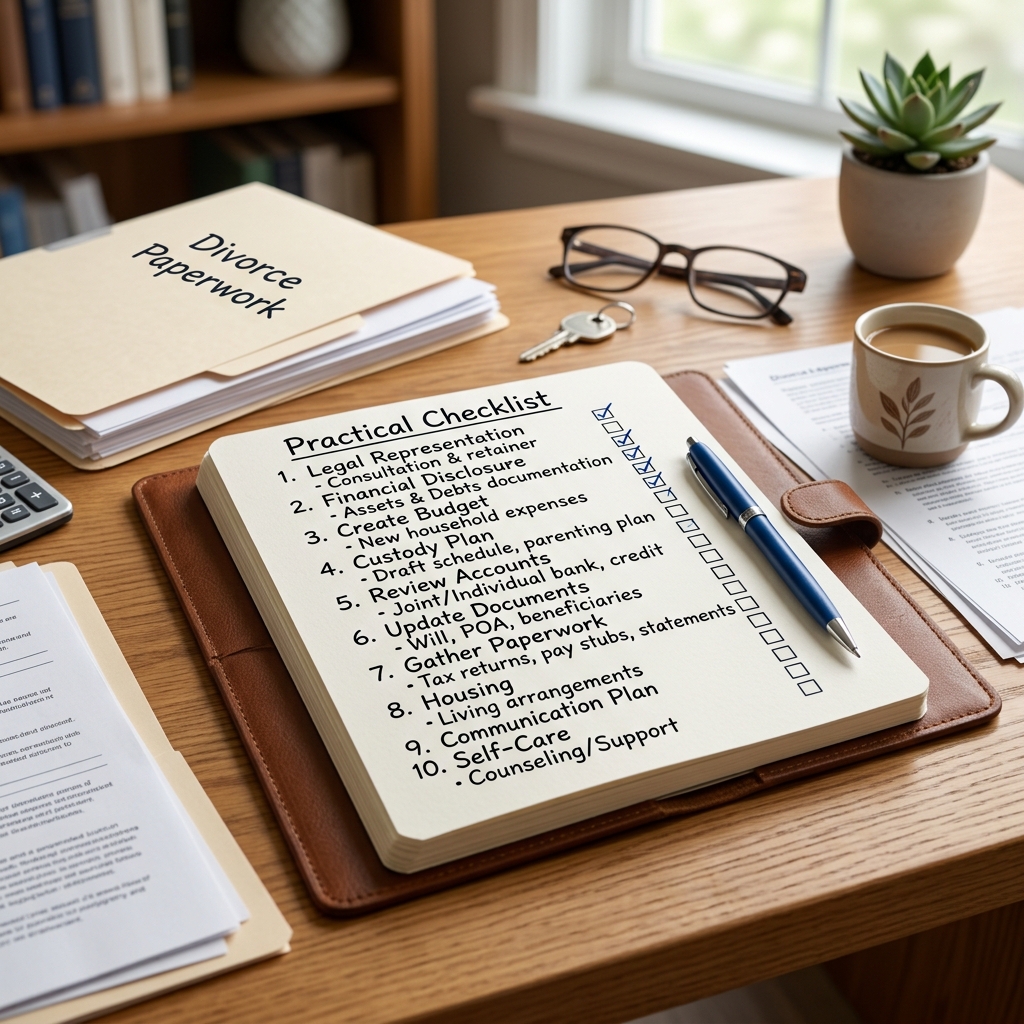
Divorce is not only an emotional transition; it is also a detailed legal and financial process that affects nearly every area of your life. This checklist-style guide is designed to help you move through each phase of divorce in a structured, informed way, from deciding to file through rebuilding after the final decree.
1. Clarify Your Situation Before You File
Before taking formal legal steps, it is important to understand your goals and whether you meet your state’s basic requirements for starting a divorce case.
1.1 Confirm Residency and Legal Grounds
In the United States, divorce law is largely controlled by individual states, and most states require that at least one spouse live in the state for a minimum period before filing. You also need a legally recognized reason for divorce, known as a ground.
- Residency check: Verify how long you or your spouse must live in the state before filing; six months is a common requirement.
- No-fault grounds: Many states allow divorce based on terms like “irretrievable breakdown” or “irreconcilable differences,” without assigning blame.
- Fault-based grounds: Some jurisdictions still allow fault-based reasons such as adultery, cruelty, or abandonment.
- Special rules: Military families and Foreign Service families may have unique rules related to domicile and overseas postings.
1.2 Decide How You Want to Approach the Divorce
Your strategic choices at the beginning often influence cost, stress, and timing. Consider which approach fits your situation.
- Uncontested divorce: You and your spouse agree on all key issues (property, custody, support). The process is typically faster and less expensive.
- Contested divorce: One or more issues are disputed, and a judge may need to decide after hearings or trial.
- Mediation: A neutral mediator helps both spouses reach mutually acceptable terms without a full courtroom battle.
- Collaborative divorce: Each spouse hires a lawyer trained in collaborative methods and commits to resolving matters without trial.
- Litigation: Traditional, court-driven process with motions, hearings, and possibly trial when negotiations fail.
1.3 Initial Professional Support Checklist
Not everyone needs the same level of professional help. Think about what support you may require.
- Consult a family law attorney to understand your rights and likely outcomes.
- Consider a financial planner or divorce-focused financial professional if you have complex assets.
- Seek mental health support if the emotional burden feels overwhelming.
2. Core Legal Steps in the Divorce Process
Although specific procedures vary by state, most divorces follow a common sequence: filing, service, response, information exchange, and final orders.
2.1 Preparing and Filing the Initial Papers
A divorce case usually starts when one spouse files a petition or complaint with the appropriate court.
- Identify the correct court: Divorce cases are typically filed in a state court that has jurisdiction over family matters.
- Complete the petition: Include information about both spouses, children, residency, and requested relief (property division, custody, support).
- Attach required forms: Many states require additional documents such as financial statements or parenting information forms.
- Pay the filing fee: A filing fee is usually charged, though fee waivers may be available for those with limited income.
2.2 Serving Your Spouse and Waiting for a Response
After filing, the other spouse must receive official notice that the case has begun. This is known as service of process.
- Arrange service: The petition and summons are delivered by a sheriff, process server, or other approved method.
- Deadlines for response: Your spouse typically has a specific number of days to respond, which may vary if they live out of state.
- If they agree: An answering document may state that your spouse accepts your proposed terms or signs an agreement.
- If they disagree: They file a response outlining different requests on custody, property, or support.
- If they do not respond: You may be able to request a default judgment, subject to court rules.
2.3 Temporary Orders During the Case
Because divorce can take months, courts often issue temporary orders to keep finances and parenting arrangements stable while the case proceeds.
- Child custody and parenting time: Temporary schedules for where children live and when they see each parent.
- Child support: Temporary financial support for children based on state guidelines.
- Spousal support: Short-term maintenance for a lower-earning spouse, when appropriate.
- Use of home and vehicles: Direction about who stays in the marital residence and who uses certain property.
- Safety-related orders: Protective orders if there is risk of harm or harassment.
2.4 Information Sharing and Negotiation
Courts generally expect both spouses to disclose financial information honestly, which forms the basis for any settlement or court decision.
- Exchange income information, including pay stubs, tax returns, and benefits statements.
- Provide details about assets: real estate, vehicles, bank accounts, investments, retirement plans.
- List all debts, such as credit cards, loans, and mortgages.
- Participate in mediation or settlement conferences if required or recommended by the court.
2.5 Final Orders and Decree of Divorce
Once all issues are either agreed or decided by the judge, the final paperwork is submitted and the court issues an order ending the marriage.
- Marital settlement agreement: In negotiated cases, this document summarizes all terms of property division, custody, and support.
- Final decree: The judge signs a formal order that legally dissolves the marriage and incorporates the agreed or decided terms.
- Waiting periods: Some states require a minimum waiting period from filing to finalization (for example, ninety days or six months), even if everything is agreed.
3. Financial Preparation Checklist
Careful financial planning is essential during divorce. It affects how assets are divided, how you meet your current needs, and how you rebuild afterward.
3.1 Gather Key Financial Documents
Start by collecting copies of important documents before accounts or files become harder to access.
- Recent tax returns and W-2 or 1099 forms
- Pay stubs or salary statements
- Bank statements for checking, savings, and certificates of deposit
- Statements for investment accounts (stocks, bonds, mutual funds)
- Information on retirement accounts (401(k), IRA, pensions)
- Credit card and loan statements, including mortgage and auto loans
- Any documentation for business interests or partnership shares
3.2 Understand Marital vs. Separate Property
Property division rules differ by state, but a common distinction is between marital property and separate property.
| Type of Property | Typical Characteristics |
|---|---|
| Marital property | Generally acquired during the marriage using either spouse’s earnings; often divided in divorce. |
| Separate property | Often includes assets owned before marriage, inheritances, or gifts to one spouse; may remain with that spouse. |
| Debts | Obligations incurred during the marriage can be shared or allocated between spouses. |
How property is divided—equally or in another proportion—depends on whether your state follows community property principles or equitable distribution rules.
3.3 Protect Your Credit and Financial Stability
Divorce can place strain on your credit history if joint accounts are not handled carefully.
- Review your credit report to identify all shared and personal accounts.
- Discuss how and when to close or refinance joint accounts to reduce future disputes.
- Consider paying down joint debt where possible before separation.
- If appropriate, explore options to freeze joint accounts to prevent new charges without both spouses’ consent.
3.4 Create a Post-Divorce Budget
Your financial situation will likely change after divorce. Planning ahead offers a clearer picture of what you can afford.
- Estimate your new housing costs, including rent or mortgage, utilities, and insurance.
- Adjust transportation costs if vehicles or commutes change.
- Include child-related expenses such as childcare, school fees, and medical costs.
- Review likely support payments you may pay or receive based on your state’s guidelines.
- Set realistic savings goals for emergencies and long-term needs.
4. Parenting, Custody, and Support Considerations
When children are involved, courts must decide—or approve your agreement on—custody, parenting time, and child support.
4.1 Designing a Practical Parenting Plan
A parenting plan outlines how major decisions will be made and how parenting time is shared.
- Specify legal custody: who makes decisions about education, medical care, and religion.
- Determine physical custody: where children primarily live and how much time they spend with each parent.
- Create a regular schedule for weekdays, weekends, and holidays.
- Include communication guidelines between parents and between each parent and the children.
- Plan for dispute resolution methods, such as mediation, if conflicts arise later.
4.2 Child Support Basics
Child support is typically calculated using state guidelines that consider each parent’s income, the number of children, and time spent with each parent.
- Identify applicable state child support guidelines or calculators.
- Account for health insurance and out-of-pocket medical costs for children.
- Consider education and childcare costs, such as tuition or daycare.
- Understand how child support orders can be modified if circumstances significantly change.
4.3 Co-Parenting Communication Tips
Healthy communication between co-parents supports children’s adjustment.
- Keep discussions child-focused and avoid revisiting past marital conflicts.
- Use written communication when needed to avoid misunderstandings.
- Be consistent about schedules and rules to create stability.
5. Housing, Insurance, and Legal Documents
Beyond the core legal orders, there are many practical details to update once you separate households.
5.1 Housing and Household Items
Housing changes can be immediate or gradual, depending on finances and court orders.
- Decide who will remain in the marital residence, at least temporarily.
- Plan for moving arrangements and related costs if one or both of you relocate.
- Create an inventory of household goods and furniture and discuss how to divide them.
5.2 Insurance Policies
Review all insurance policies and determine whether changes need to be made after divorce.
- Health insurance: Consider whether a spouse or children will need new coverage if they are currently on the other spouse’s plan.
- Life insurance: Evaluate beneficiary designations, especially when child support or spousal support is involved.
- Home and auto insurance: Update policies to reflect who owns and uses property.
5.3 Estate Planning and Official Documents
Divorce often changes who you want to handle your affairs and inherit your property.
- Review and update your will to reflect new beneficiaries and executors.
- Change powers of attorney or health care directives if they currently name your spouse.
- Update beneficiary designations on retirement accounts and life insurance, subject to court orders.
- Store important documents (divorce decree, support orders, property records) in a safe place.
6. Emotional Health and Support Systems
Legal and financial steps are only part of the experience. Emotional resilience can make the process more manageable.
6.1 Building a Support Network
Social and professional support can reduce stress and help you make thoughtful decisions.
- Lean on trusted friends and family who can listen without judgment.
- Seek counseling or therapy to work through grief, anger, or anxiety.
- Explore support groups for people experiencing divorce in your community.
6.2 Self-Care During the Process
Sustaining basic self-care practices can improve your ability to handle negotiations and parenting responsibilities.
- Maintain regular sleep, nutrition, and physical activity.
- Limit major new commitments while you are handling legal deadlines.
- Set boundaries around discussions to avoid constant conflict.
7. Frequently Asked Questions About Divorce
7.1 How long does a divorce usually take?
The length of a divorce varies. Some states have mandatory waiting periods—from several months up to half a year—before a divorce can be finalized, even if both spouses agree to terms. Contested cases can take longer if complex issues must be decided by a judge.
7.2 Do I need a lawyer for my divorce?
There is no universal requirement to hire an attorney, but legal advice is often helpful, especially when you have children, significant assets, or disagreements. Many courts provide self-help resources and standardized forms that self-represented parties can use.
7.3 What happens if my spouse does not respond to the divorce papers?
If your spouse is properly served but does not respond within the deadline, you may be able to ask the court for a default judgment. The judge will still review your filings and may require a brief hearing before issuing a final decree.
7.4 Can we change our agreement after the divorce is final?
Some aspects of a divorce order, such as child custody and child support, can often be modified if circumstances significantly change, subject to state law. Property division orders are usually more difficult or impossible to change once they become final.
7.5 Is divorce law the same everywhere in the United States?
No. Marriage and divorce are governed by state law, not federal law. Each state has its own rules for residency, grounds, property division, and procedure, so it is important to consult local information or an attorney in your state.
References
- Divorce guide — Washington Law Help. 2023-06-01. https://www.washingtonlawhelp.org/en/divorce-guide
- Divorce in the United States — Various contributors, summarized from state sources. 2024-01-10. https://en.wikipedia.org/wiki/Divorce_in_the_United_States
- The Divorce Process & Legal Requirements — Justia. 2022-09-15. https://www.justia.com/family/divorce/the-divorce-process/
- What are the basic steps for filing for divorce? — WomensLaw.org. 2023-05-12. https://www.womenslaw.org/laws/de/divorce/basic-info/what-are-basic-steps-filing-divorce
- The divorce process — California Courts Self-Help Guide. 2023-08-01. https://selfhelp.courts.ca.gov/divorce
- Divorce and Separation — U.S. Department of State, Global Community Liaison Office. 2021-04-20. https://www.state.gov/global-community-liaison-office/foreign-service-life/divorce-and-separation
- 6 Things to Consider Before Filing for Divorce — MetLife. 2022-07-18. https://www.metlife.com/stories/legal/filing-for-divorce/
Similar Articles








Read full bio of medha deb


