
Criminal Investigation: 5 Key Stages, Rights, And Case Building
A clear, practical guide to how criminal investigations begin, unfold, and lead into the criminal justice process.
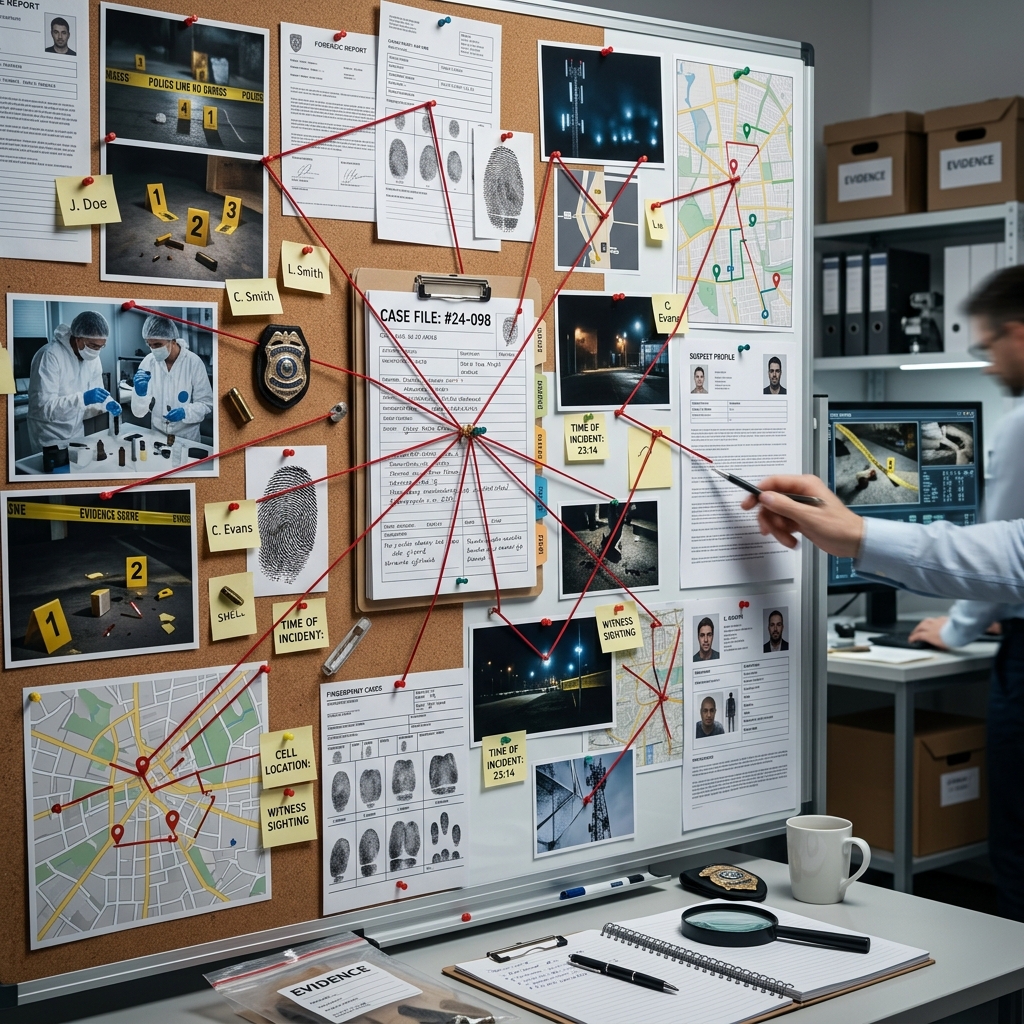
Criminal investigations are the backbone of the criminal justice system. They provide the facts and evidence that determine whether a crime occurred, who was responsible, and whether charges can be proven in court beyond a reasonable doubt. When law enforcement conducts a criminal investigation, it must balance effective fact-finding with strict legal protections for the rights of suspects, victims, and the public.
What Is a Criminal Investigation?
A criminal investigation is the structured process through which law enforcement gathers, analyzes, and organizes information to determine whether a crime has been committed and, if so, who committed it. This process involves collecting physical and digital evidence, interviewing witnesses, evaluating leads, and building a coherent theory of the case that can stand up in court.
In practice, criminal investigations serve several key purposes:
- Clarifying what happened — establishing the sequence of events and whether they meet the legal definition of a crime.
- Identifying potential suspects — determining who may be responsible based on evidence and information gathered.
- Protecting the community — stopping ongoing harm and deterring future criminal activity.
- Supporting prosecution or clearance — providing a reliable basis either to file charges or to close a case when evidence is insufficient.
Although popular media often focuses on dramatic arrests, the investigative function is far broader. It includes methodical documentation, legal review, and collaboration with prosecutors, forensic experts, and other agencies.
Typical Stages of a Criminal Investigation
Real-world investigations rarely move in a perfectly linear sequence, but most cases involve several recurring phases. These phases can overlap, and investigators may revisit earlier steps as new evidence appears.
1. Initiation and First Response
An investigation usually begins when law enforcement learns about a potential crime. This can happen through:
- A victim or witness reporting an incident.
- An officer observing a crime in progress.
- Information from another agency or confidential source.
- Automated alerts or systems, such as financial fraud detection.
Once notified, officers or investigators respond to assess the situation. Their early tasks often include securing the scene, ensuring safety, and preserving potential evidence from contamination or loss.
2. Evidence and Scene Management
The evidence phase focuses on finding, documenting, and safeguarding items or information that may have legal value. Common activities include:
- Photographing and video recording the scene.
- Creating sketches or diagrams.
- Collecting physical evidence (such as fingerprints, DNA samples, weapons, or trace materials).
- Preserving digital data (such as surveillance footage, phone records, or computer files).
- Maintaining a chain of custody so that each item can be reliably traced from collection to courtroom.
Investigators must follow established procedures and legal rules to prevent evidence from being excluded in court due to improper collection or handling.
3. Information Gathering and Witness Interviews
Alongside physical evidence, investigators collect testimonial evidence from people who may have relevant information. This includes:
- Interviewing victims to understand the harm suffered and the circumstances.
- Questioning witnesses about what they saw, heard, or did.
- Reviewing prior reports, criminal histories, and related cases.
Witness testimony can be direct (an eyewitness describing the crime itself) or circumstantial (information about events before or after the crime). Both types can be important, but they carry different weight and are assessed differently by courts and prosecutors.
4. Suspect Development and Evaluation
Once investigators have a foundation of evidence and information, they begin the suspect phase. This stage involves:
- Generating possible suspects based on leads, motive, opportunity, and connections to the crime.
- Prioritizing suspects according to risk, available evidence, and investigative resources.
- Verifying alibis, checking timelines, and looking for inconsistencies.
- Conducting non-custodial interviews or, where legally appropriate, interrogations of suspects.
Investigators must remain open to alternative explanations, testing their working theories against new information and adjusting when evidence points in a different direction.
5. Building the Case and Offender Identification
In the offender phase, investigators focus on proving who committed the crime and how. They work closely with prosecutors to:
- Integrate physical evidence, witness statements, and expert analyses into a coherent case file.
- Identify legal elements of the offense and map evidence to each required element.
- Assess whether the available proof could meet the standard of proof in court.
At this stage, the investigation may lead to search warrants, arrest warrants, or, in some circumstances, immediate arrest when probable cause exists.
Legal Foundations: Probable Cause, Warrants, and Rights
Investigators are bound by constitutional and statutory limits. These rules protect individuals from unreasonable searches, arbitrary arrests, and coercive tactics. A solid understanding of these concepts is crucial.
Probable Cause
Most significant investigative actions, such as searches and arrests, require probable cause — a reasonable basis, grounded in facts and circumstances, to believe that a crime has been committed and that evidence or a suspect is located in a particular place.
Probable cause does not require absolute certainty, but it does demand more than speculation. It is evaluated by judges when they review requests for warrants or determine whether an arrest was lawful.
Search Warrants
Under the Fourth Amendment, searches of homes, vehicles, and other private areas generally require a warrant issued by a neutral judge. To obtain a search warrant, investigators typically must:
- Provide sworn statements outlining the facts supporting probable cause.
- Describe with particularity the place to be searched and the items to be seized.
- Demonstrate that the search is reasonably related to suspected criminal activity.
Exceptions exist, such as certain exigent circumstances or consent searches, but these are narrowly construed and often scrutinized in court.
Arrests and Arrest Warrants
Arrests also require probable cause. In many cases, officers seek an arrest warrant before taking a suspect into custody. However, if officers directly observe a crime, or if urgent circumstances exist, they may arrest without a warrant, subject to jurisdictional rules.
After an arrest, the suspect must be brought before a judge within a short period for an initial appearance, during which the court reviews whether probable cause exists and addresses issues like bail and release conditions.
Rights of Suspects and Witnesses
Throughout an investigation, individuals retain fundamental rights, including:
- The right against unreasonable searches and seizures.
- The right to remain silent and avoid self-incrimination in custodial settings.
- The right to counsel during critical stages of the process.
Investigators must respect these rights, both to uphold the law and to preserve the integrity of the case. Violations can lead to evidence being excluded or other legal consequences.
How Investigations Connect to the Criminal Justice Process
A criminal investigation is only one part of the larger criminal justice system. Once investigators gather sufficient evidence, the case moves into prosecutorial and court phases.
From Investigation to Charging
Prosecutors review investigative files to decide whether charges should be filed. They evaluate:
- Whether the evidence supports each legal element of the suspected offense.
- The credibility and reliability of witnesses.
- The likelihood of proving the case to a jury beyond a reasonable doubt.
In federal cases, prosecutors may present the case to a grand jury, which decides whether to issue an indictment based on the evidence presented.
Court Proceedings After an Investigation
Once charges are filed, several standard steps follow:
| Stage | Purpose |
|---|---|
| Initial appearance | The defendant is informed of the charges and issues like bail are addressed. |
| Arraignment | The defendant receives a formal copy of the charges and enters a plea. |
| Discovery and motions | Both sides exchange information and may file legal motions regarding evidence or procedure. |
| Plea bargaining | The parties may negotiate a resolution without trial, such as a guilty plea to reduced charges. |
| Trial | Evidence and witnesses are presented to determine guilt or innocence beyond a reasonable doubt. |
| Sentencing and appeal | If found guilty, the defendant is sentenced and may pursue appellate review. |
Evidence gathered during the investigation becomes central at trial, where it is tested through cross-examination and legal argument. The quality of the initial investigation often determines the strength of the prosecution’s case and the fairness of the outcome.
Common Challenges in Criminal Investigations
Investigations rarely unfold in ideal conditions. Investigators face practical and legal challenges that can affect outcomes.
- Incomplete or contaminated evidence — physical or digital evidence may be lost, damaged, or never discovered.
- Uncooperative or fearful witnesses — people may hesitate to come forward or may provide inconsistent accounts.
- Resource constraints — limited personnel, time, or technology can slow or narrow the investigation.
- Complex legal issues — overlapping jurisdictions, specialized offenses, or evolving legal standards may complicate decisions.
- Cognitive bias — investigators must guard against focusing too quickly on a single theory and ignoring alternative explanations.
To mitigate these risks, many agencies implement structured investigative models, training on evidence handling, and oversight mechanisms.
FAQs About Criminal Investigations
How long does a criminal investigation usually take?
There is no fixed timeline. Minor cases may be resolved quickly, while complex investigations involving multiple suspects, forensic testing, or financial analysis can take months or years. The duration depends on the volume of evidence, legal issues, and available resources.
Can someone be arrested before an investigation is complete?
Yes. If officers have probable cause to believe a person committed a crime, they may arrest even while other aspects of the investigation continue. In some situations, arrest is the first step, followed by further evidence gathering and prosecutorial review.
What is the difference between direct and circumstantial evidence?
Direct evidence supports a fact without the need for inference, such as an eyewitness who saw the crime occur. Circumstantial evidence involves information from which the fact is inferred, such as a person’s presence near a crime scene or actions before and after the event. Both types are commonly used in investigations and trials.
Do victims have a role during the investigation and court process?
Victims can provide crucial information and may be kept informed of major developments. In many jurisdictions, victims have rights to be notified of hearings, attend certain proceedings, and express views on release decisions or sentencing. These rights are designed to ensure victims are not treated as bystanders.
What should someone do if they are contacted by investigators?
Individuals contacted by law enforcement, whether as potential witnesses or suspects, generally benefit from understanding their rights, including the right to consult an attorney. Providing truthful information is important, but people should feel free to seek legal advice to navigate complex questions or potential exposure.
References
- The Criminal Investigation Process: An In-Depth Overview — American Military University. 2020-06-10. https://www.amu.apus.edu/area-of-study/criminal-justice/resources/the-criminal-investigation-process/
- Criminal Investigations — Texas State University, Center for Geospatial Intelligence and Investigation. 2019-03-15. https://www.txst.edu/gii/research/criminal-investigations.html
- Chapter 4: The Process of Investigation — Introduction to Criminal Investigation (BCCampus Pressbooks). 2015-01-01. https://pressbooks.bccampus.ca/criminalinvestigation/chapter/chapter-4-the-process-of-investigation/
- Investigation — United States Department of Justice, U.S. Attorneys. 2017-11-17. https://www.justice.gov/usao/justice-101/investigation
- A Brief Description of the Federal Criminal Justice Process — Federal Bureau of Investigation. 2021-04-06. https://www.fbi.gov/how-we-can-help-you/victim-services/a-brief-description-of-the-federal-criminal-justice-process
- The Legal Process in the United States: A Criminal Case — Animal Legal Defense Fund. 2013-09-01. https://aldf.org/article/the-legal-process-in-the-united-states-a-criminal-case/
- The Criminal Investigation Process Volume III: Summary and Policy Implications — National Institute of Justice (NCJRS). 1980-01-01. https://www.ojp.gov/pdffiles1/Digitization/148118NCJRS.pdf
Similar Articles








Read full bio of medha deb




