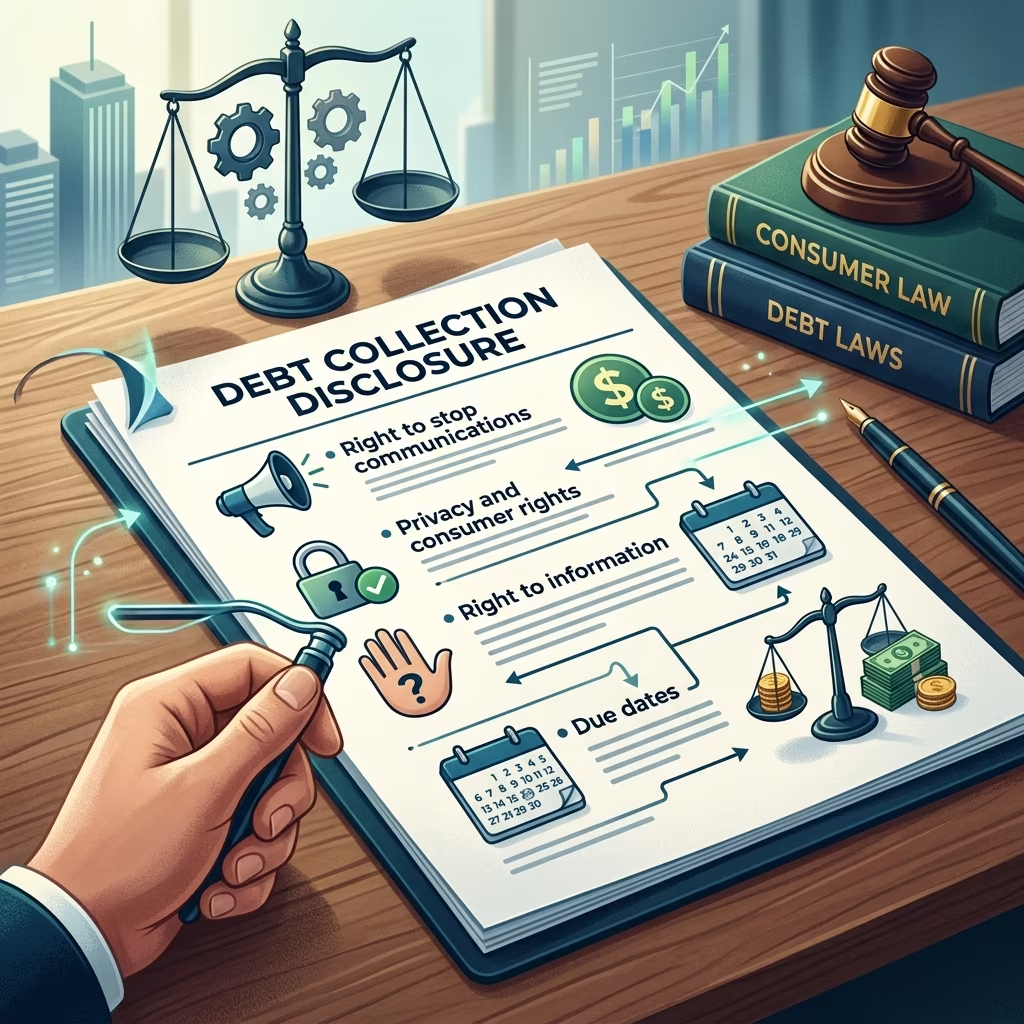
When a debt collector contacts you for the first time about a consumer debt, federal law requires a specific warning often called the Mini-Miranda disclosure. This statement is meant to ensure you know who is contacting you, why, and how any information you share can be used. Knowing how these disclosures work can help you protect your rights and respond more confidently to collection attempts.
What Is the Mini-Miranda Disclosure?
The Mini-Miranda disclosure is a legally required notice that must appear in a debt collector’s initial communication with a consumer, whether that contact is by phone, letter, email, text message, or other means. It is derived from the Fair Debt Collection Practices Act (FDCPA), the main federal law governing third-party debt collection practices.
In essence, the disclosure must clearly state three key points:
- The person or company contacting you is a debt collector.
- The communication is an attempt to collect a debt.
- Any information obtained from you will be used for that debt collection purpose.
This warning is similar in concept to the well-known criminal Miranda rights, which inform arrested individuals that anything they say can be used against them in court. In the debt collection context, Mini-Miranda disclosures highlight that what you say to a collector may affect how your account is handled, including disputes, settlements, or potential litigation.
Legal Foundation Under the FDCPA
The FDCPA is a federal statute codified at 15 U.S.C. §§ 1692 et seq. that regulates the conduct of third-party debt collectors. Among other things, it prohibits harassment, deceptive practices, and certain unfair methods of collecting consumer debts.
Two provisions are especially important for Mini-Miranda disclosures:
- Section 807(11): requires collectors, in the initial communication, to disclose that they are attempting to collect a debt and that information obtained will be used for that purpose.
- Section 806(6): requires meaningful disclosure of the collector’s identity, ensuring consumers know they are dealing with a debt collector and not someone misrepresenting themselves.
Furthermore, the law requires a follow-up written validation notice within five days of the first contact, stating the amount of the debt, the name of the creditor, and information on how to dispute the debt. Taken together, these rules aim to prevent surprise and deception in debt collection.
When Must Mini-Miranda Be Given?
Mini-Miranda disclosures must appear in the initial communication with the consumer and in later contacts in a more limited form.
| Type of Communication | Disclosure Requirement |
|---|---|
| First phone call (oral contact) | Full Mini-Miranda: identify as a debt collector, state that the purpose is to collect a debt, and that information obtained will be used for that purpose. |
| First written communication (letter, email, text) | Same full disclosure must appear in the message. |
| Later communications | Collector must disclose that the communication is from a debt collector; the full initial-language about information obtained is typically not required again. |
| Validation notice (within five days) | Separate written notice with detailed information about the debt and dispute rights, as required by FDCPA Section 809. |
Importantly, Mini-Miranda requirements apply to third-party debt collectors, not usually to original creditors collecting their own debts, provided the creditor clearly identifies itself. However, some courts have scrutinized communications by creditors that include debt-collection language, finding that certain statements may bring those communications under FDCPA scrutiny as well.
Which Debts and Collectors Are Covered?
The FDCPA primarily governs consumer debts, such as credit cards, medical bills, personal loans, and residential mortgage debts owed by individuals for personal, family, or household purposes. Commercial or business debts are generally outside its scope.
Key coverage points include:
- Covered entities: third-party collection agencies, collection law firms, and debt buyers collecting on consumer accounts.
- Typically not covered: original creditors collecting their own debts (unless they use a different name suggesting a third party) and most purely business or commercial debts.
- Jurisdiction: FDCPA is a federal law. Some states have additional debt collection statutes that may require similar or even stricter disclosures.
Because state rules can vary, collectors may adopt practices that meet both federal and state requirements, such as repeating Mini-Miranda language in every contact in certain jurisdictions.
Why Mini-Miranda Disclosures Matter for Consumers
Mini-Miranda disclosures serve several consumer-protection functions:
- Preventing false pretenses: Collectors cannot pose as survey callers, customer service representatives, or government officials to gather information without revealing the true collection purpose.
- Clarifying the nature of the call: You immediately know that the communication relates to a debt, which may affect whether and how you respond.
- Highlighting the consequences of sharing information: Understanding that what you say can be used to pursue the debt may lead you to seek legal advice or verify the debt before making statements or promises.
- Supporting informed decision-making: Along with the validation notice, the disclosure helps you decide whether to dispute, negotiate, or pay the debt.
Research conducted for the Consumer Financial Protection Bureau (CFPB) underscores that consumers often struggle to understand collection communications, and specific disclosures like Mini-Miranda can improve clarity when designed and presented effectively.
Common Mini-Miranda Language in Practice
While the FDCPA does not prescribe exact wording, most agencies use standardized phrases that cover the required elements. For example, a collector might say something along these lines on a first call:
- “This is a call from a debt collector.”
- “We are attempting to collect a debt.”
- “Any information obtained will be used for that purpose.”
In subsequent contacts, the collector typically needs only to remind you that the communication is from a debt collector. That repeated identification requirement helps ensure you are not misled about who is contacting you.
Limitations of Mini-Miranda and Other FDCPA Protections
Mini-Miranda disclosures are one part of a broader framework of consumer protections under the FDCPA. While important, they do not by themselves prevent all abusive practices. Other key FDCPA rules include:
- Restrictions on contact times: Collectors generally may not contact you at unusual times, commonly interpreted as outside the hours of 8 a.m. to 9 p.m. local time.
- Limits on workplace contact: Collectors should not contact you at work if they know or should know that your employer prohibits such calls.
- Prohibition on harassment or abuse: Repeated calls intended to annoy or harass, use of threats, obscene language, or false claims of arrest or legal action may violate the FDCPA.
- Ban on third-party disclosure: Collectors generally cannot reveal your debt to unrelated third parties, such as neighbors or co-workers, except in limited circumstances.
- No unauthorized charges: Collection efforts must be limited to amounts lawfully owed; adding bogus fees or interest is prohibited.
Together, these rules create a framework for fair and transparent collection, with Mini-Miranda disclosures acting as a crucial transparency tool at the outset of contact.
Your Rights if a Collector Ignores Mini-Miranda Rules
If a debt collector contacts you without providing the required Mini-Miranda disclosure, or otherwise violates FDCPA requirements, you may have several options:
- Document the communication: Write down the date, time, method of contact, and what was said. Save any letters, emails, or texts.
- File a complaint: You can complain to federal or state regulators, including the Consumer Financial Protection Bureau (CFPB) and the Federal Trade Commission (FTC).
- Consider private legal action: FDCPA § 1692k allows consumers to sue debt collectors in federal or state court for violations. Available remedies may include actual damages, statutory damages (up to a specified cap per case), and attorney’s fees.
- Seek legal advice: Consumer-law attorneys or legal aid organizations can help evaluate your situation and advise whether litigation or negotiation is appropriate.
Court decisions and enforcement actions show that regulators and judges take misrepresentations and deceptive practices seriously, including failures to provide clear Mini-Miranda disclosures.
Practical Tips for Consumers Dealing With Collection Calls
Understanding Mini-Miranda is useful, but applying that knowledge in real conversations is just as important. Consider these practical steps when you receive a collection call or letter:
- Listen for the disclosure: In the first contact, check whether the caller identifies themselves as a debt collector and mentions that they are attempting to collect a debt.
- Verify the caller: Ask for the collector’s name, company, mailing address, and phone number. A legitimate collector should be willing to provide this information.
- Request written confirmation: If you are unsure about the debt, wait for the validation notice or request information in writing before agreeing to pay.
- Be careful what you say: Because any information can be used for collection purposes, avoid making admissions or promises until you have confirmed the legitimacy and amount of the debt.
- Know your dispute rights: You generally have the right to dispute the debt in writing and request verification within a specific time period after receiving the validation notice.
- Keep records: Maintain your own file of communications, which may be important if a dispute or lawsuit arises.
Frequently Asked Questions About Mini-Miranda
Does the Mini-Miranda disclosure have to be read every time a collector calls?
No. The full Mini-Miranda statement is required in the initial communication only. In later contacts, the collector must still identify the communication as being from a debt collector, but does not need to repeat the entire initial warning.
Does Mini-Miranda apply if my original creditor calls me?
Generally, no. The FDCPA and the Mini-Miranda requirements focus on third-party collectors. If you are speaking directly with the original creditor, and that company clearly identifies itself as such, it typically does not have to provide a Mini-Miranda disclosure.
Are text messages and emails covered?
Yes. If a third-party collector chooses to use text messages or emails to contact you about a consumer debt, Mini-Miranda requirements still apply to the initial communication. Regulators have cautioned collectors not to use deceptive digital messages to avoid these disclosures.
What if I contacted the collector first?
Even if you initiate the conversation, such as by calling a number listed on a letter, the collector must still provide the Mini-Miranda disclosure during the first communication about the debt. The obligation is tied to the first communication, not to who initiates it.
Can I sue a collector for failing to give the Mini-Miranda disclosure?
Possibly. Failure to provide required disclosures can be an FDCPA violation, and consumers may bring private lawsuits seeking damages and attorney’s fees under 15 U.S.C. § 1692k. Whether a lawsuit is appropriate depends on the facts of your case, so legal advice is recommended.
Mini-Miranda and Evolving Case Law
Courts continue to interpret how Mini-Miranda requirements apply in specific contexts. For example, the U.S. Court of Appeals for the Eleventh Circuit has held that monthly mortgage statements required under other federal laws may constitute debt collection communications if they contain language like “this is an attempt to collect a debt” and request payment by a certain date. Such decisions highlight that including Mini-Miranda-style language in written communications may bring those messages within the scope of FDCPA regulation.
Because case law and regulatory guidance can evolve, both consumers and collectors benefit from staying informed about current interpretations and best practices.
References
- 3 dos, 3 don’ts, and 1 don’t-even-think-about-it — Federal Trade Commission. 2015-05-15. https://www.ftc.gov/business-guidance/blog/2015/05/3-dos-3-donts-1-dont-even-think-about-it
- What is Mini-Miranda? — CallMiner. 2020-06-01. https://callminer.com/blog/what-is-mini-miranda
- Understanding Your Mini-Miranda Rights When Dealing with Debt Collectors — Excel Law. 2021-09-10. https://excel.law/understanding-your-mini-miranda-rights-when-dealing-with-debt-collectors/
- The Mini Miranda and Fair Debt Collections Act — Jibrael Law. 2019-03-05. https://jibraellaw.com/the-mini-miranda-and-fair-debt-collections-act/
- Eleventh Circuit: Mini-Miranda Warning on Periodic Statements Can Be Considered Debt Collection Under FDCPA — Troutman Pepper Consumer Financial Services Law Monitor. 2022-11-02. https://www.consumerfinancialserviceslawmonitor.com/2022/11/eleventh-circuit-mini-miranda-warning-on-periodic-statements-can-be-considered-debt-collection-under-fdcpa/
- CFPB Debt Collection Cognitive Interviews — Consumer Financial Protection Bureau. 2017-12-01. https://files.consumerfinance.gov/f/documents/cfpb_debt-collection_fmg-cognitive-report.pdf