
Understanding Criminal Theft and Civil Theft
Explore how criminal theft and civil theft differ in purpose, proof, penalties, and remedies, and why the same conduct can lead to two separate legal cases.
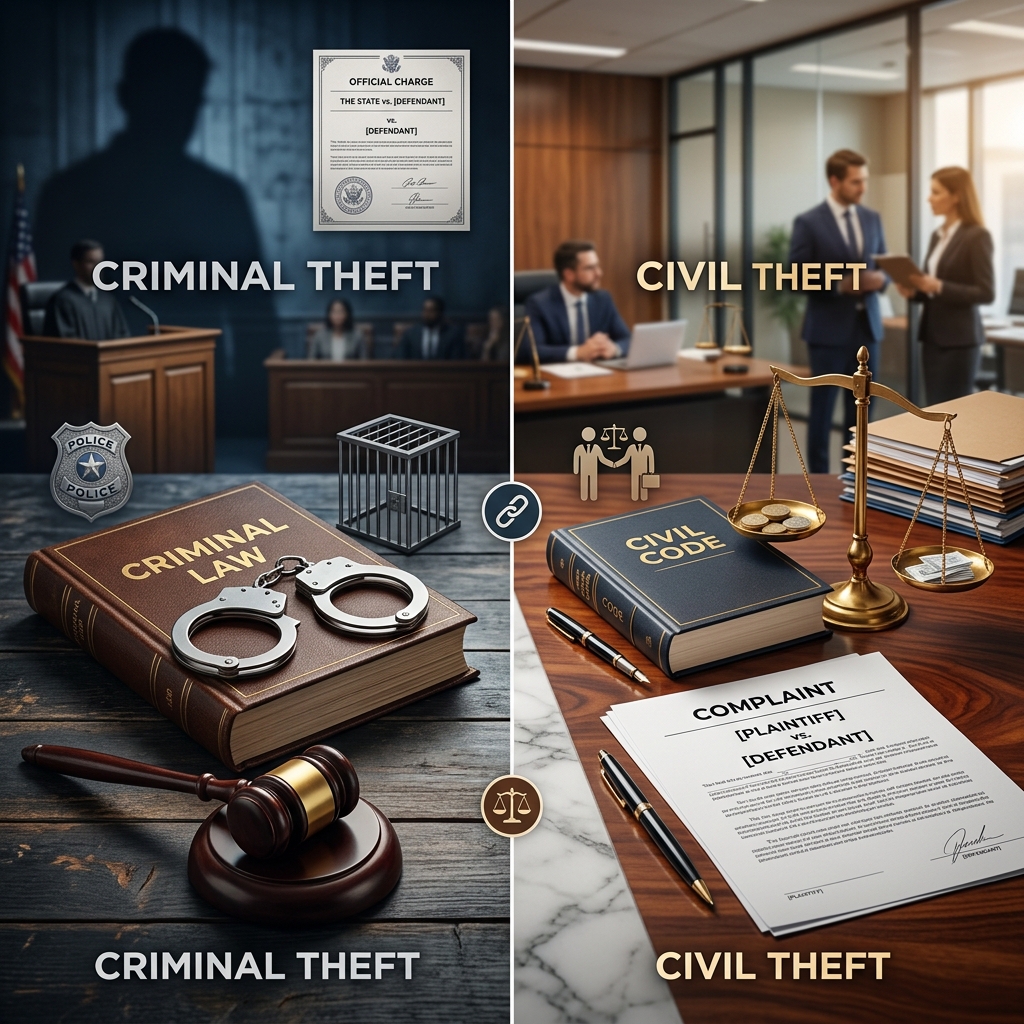
The word theft sounds straightforward: someone takes property that does not belong to them. In law, however, the same act of taking can trigger two very different kinds of cases — criminal theft and civil theft. Although they arise from the same conduct, they are handled in separate courts, involve different rules, and lead to different consequences.
This article explains how criminal and civil theft work, how they differ, and what those differences mean for defendants and victims. It draws on general principles seen across U.S. law, while specific details may vary by state.
Foundations: What “Theft” Usually Means in Law
Most U.S. states define theft broadly as intentionally taking, using, or controlling another person’s property without consent, with the intent to deprive the owner of it. This definition covers a wide range of conduct, including simple shoplifting, stealing lost property, and more complex schemes.
- Property: Usually personal property such as money, goods, vehicles, or valuables.
- Lack of consent: The owner did not agree to the taking or continued possession.
- Intent to deprive: The person meant to keep the property or deny the owner its use, either permanently or for a significant time.
States often separate theft into different degrees based largely on the value of the property and, in some cases, the way it was taken.
- Misdemeanor theft: Lower-value property, typically below a statutory threshold such as $500 or $1,000.
- Felony theft (often called grand theft or larceny): Higher-value property or particularly serious circumstances, such as stealing a car, large sums of money, firearms, or explosives.
Regardless of degree, theft can be addressed in both the criminal and civil systems at the same time.
Criminal Theft: Public Prosecution and Punishment
Criminal theft refers to theft prosecuted as a crime by the government. The main goals are to punish wrongful conduct and protect the public.
Who Brings a Criminal Theft Case?
In a criminal case, the party bringing the case is the state or, in federal matters, the United States. Local prosecutors, such as district attorneys or state attorneys, file charges on behalf of the government.
- The victim is a witness and complainant, not the party officially filing the case.
- Prosecutors decide whether to charge, which charges to bring, and whether to offer plea deals.
Elements and Types of Criminal Theft
Criminal codes break theft into specific offenses (for example, shoplifting, theft by deception, receiving stolen property), but each generally contains similar elements:
- The defendant obtained or used property belonging to another.
- The defendant did so without consent or legal authority.
- The defendant acted with intent to deprive the owner, either permanently or for a significant time.
Criminal law recognizes many variations, such as:
- Grand theft / felony theft: Higher-value property or special items like vehicles or firearms.
- Theft of lost or mislaid property: Keeping property found in circumstances where the finder knows or should know it belongs to someone else, and fails to try to return it.
- Constructive theft: Situations where the person initially obtained property legally (for example, through a loan or as a bailee) but later formed criminal intent to keep it unlawfully.
Burden of Proof in Criminal Theft
To convict someone of criminal theft, the prosecution must prove every element of the offense beyond a reasonable doubt. This is the highest burden of proof in the U.S. legal system.
- Jurors must be firmly convinced of guilt based on the evidence.
- Any reasonable doubt about key elements — such as intent or ownership — should lead to acquittal.
This high standard reflects the risk of losing liberty through jail or prison if convicted.
Criminal Penalties for Theft
The penalties for criminal theft depend on the degree of the offense, prior record, and state sentencing rules.
- Misdemeanor theft
- Short jail terms, probation, fines, and community service.
- Felony theft
- Prison sentences, higher fines, and longer probation.
- Collateral consequences
- Criminal record affecting employment, housing, professional licensing, and immigration status.
Courts may order restitution to repay the victim, but this is limited to the criminal process and usually does not fully address all civil damages.
Civil Theft: Private Lawsuit and Financial Recovery
Civil theft is a claim brought in civil court by an individual or business seeking money damages or return of property because of theft-related conduct. It is not a criminal charge; it is a civil cause of action.
Who Brings a Civil Theft Case?
In civil theft, the party bringing the case is the private victim — a person, company, or other entity that alleges their property was taken. They file a lawsuit seeking compensation and other remedies.
- The government is not a party unless it is itself the victim.
- The victim controls whether to sue, what claims to assert, and whether to settle.
Legal Basis for Civil Theft Claims
Many states recognize civil theft either through specific statutes or through common-law causes of action closely related to theft, such as conversion. Statutory civil theft provisions typically:
- Define the conduct that qualifies as civil theft (usually mirroring criminal theft definitions).
- Specify available damages, sometimes including multiple or treble damages and attorney’s fees.
- Require procedural steps, such as a written demand to the defendant before filing suit.
For example, one state statute allows victims of theft to sue for three times the value of the property taken, plus attorney’s fees and costs, if they can prove civil theft under the statute.
Burden of Proof in Civil Theft
Civil cases generally use lower burdens of proof than criminal cases. Depending on the jurisdiction and the statute, civil theft must be proven by either:
- Preponderance of the evidence — it is more likely than not that the defendant committed the theft.
- Clear and convincing evidence — a higher civil standard requiring a firm belief in the truth of the allegations, but still below “beyond a reasonable doubt.”
This lower burden reflects the fact that civil cases involve money and rights, not incarceration.
Civil Remedies and Financial Consequences
Unlike criminal cases, civil theft lawsuits focus on compensating the victim and shifting financial loss to the wrongdoer.
- Return of property or its value.
- Compensatory damages for the economic loss caused by the theft.
- In some states, treble (triple) damages as a penalty and deterrent.
- Attorney’s fees and court costs, when authorized by statute.
Civil judgments can be enforced by collection methods such as wage garnishment or liens. While civil theft does not generally impose jail, the financial impact can be substantial.
Side-by-Side Comparison: Criminal vs. Civil Theft
| Feature | Criminal Theft | Civil Theft |
|---|---|---|
| Who brings the case? | Government prosecutors (state or federal). | Private victim or business. |
| Main purpose | Punish wrongdoing, protect public, deter crime. | Compensate victim and shift financial loss. |
| Burden of proof | Beyond a reasonable doubt. | Preponderance or clear and convincing evidence (varies by statute). |
| Possible consequences | Jail/prison, fines, probation, criminal record. | Money judgments, treble damages, attorney’s fees. |
| Control of case | Prosecutor controls charges and plea offers. | Victim (plaintiff) controls claims and settlement. |
| Goal for victim | Public justice, possible restitution. | Direct financial recovery and return of property. |
| Can both occur? | Yes, alongside a civil case. | Yes, even if criminal charges are never filed or are dismissed. |
Parallel Proceedings: How Criminal and Civil Theft Interact
The same act of theft can lead to both a criminal case and a civil lawsuit. The two systems operate independently.
- Separate courts: Criminal cases proceed in criminal court; civil theft cases are filed in civil court.
- Different standards: An acquittal in criminal court does not automatically defeat a civil case, because the civil plaintiff faces a lower burden of proof.
- Timing: Civil cases may be filed while criminal charges are pending, after a criminal conviction, or even when prosecutors decline to charge.
Defendants may face strategic challenges if both cases run at the same time, including concerns about self-incrimination in the civil case while criminal charges are pending.
Common Misunderstandings About Civil Theft
Because theft sounds like a purely criminal concept, several myths persist about civil theft. Clarifying these misunderstandings helps victims and defendants understand their options.
- Myth: If there is no criminal case, there is no theft.
In reality, victims can pursue civil remedies even when prosecutors decline to file charges or when evidence is insufficient for a criminal case. - Myth: Theft is either civil or criminal, but not both.
Many acts are simultaneously crimes and civil wrongs; theft is one of them. - Myth: A criminal acquittal proves the defendant did nothing wrong.
An acquittal simply shows the prosecution did not meet the high criminal standard. The same facts can still support a civil judgment under a lower burden of proof.
When Victims Consider Civil Theft Claims
Victims often look to civil theft when criminal remedies do not fully address their losses. Situations include:
- The prosecutor declines to file criminal charges.
- Criminal evidence is borderline, but civil proof may still be strong.
- The victim wants not only the property’s value but also additional damages and attorney’s fees.
- Business disputes where wrongdoing crosses into theft-like conduct, such as misappropriation of company funds.
In some states, victims must send a written demand to the alleged wrongdoer before filing a civil theft claim, giving them an opportunity to pay and avoid litigation.
Civil Theft vs. Conversion: Related but Distinct
Conversion is a long-established civil claim for wrongful interference with personal property. It is closely related to civil theft but not identical.
- Conversion focuses on the unauthorized exercise of control over property that causes the owner to lose its use, without necessarily requiring a criminal motive.
- Civil theft generally requires proof of intent that closely tracks criminal theft, suggesting a more blameworthy mental state.
Some jurisdictions allow victims to choose between conversion and statutory civil theft, or to plead both. Civil theft may offer enhanced damages, while conversion may be simpler to prove in certain situations.
Defenses Commonly Raised in Civil Theft Cases
Defendants in civil theft suits may contest either the facts or the legal basis of the claim.
- Lack of intent: Arguing the taking was accidental, mistaken, or lacked the felonious intent required for civil theft.
- Consent or authority: Asserting the owner gave permission, or that the defendant had contractual or legal rights to possess the property.
- Ownership disputes: Contesting who actually owned the property at the time of the alleged theft.
- Contract remedies only: Some courts restrict civil theft claims when the dispute arises primarily from a contract that provides its own remedies.
Because civil theft statutes can be technical, both plaintiffs and defendants often benefit from legal advice before filing or responding to such claims.
Practical Takeaways for Defendants and Victims
Understanding the divide between criminal and civil theft helps in making informed decisions.
- For victims
- Criminal charges seek punishment and may provide some restitution, but they do not guarantee full compensation.
- Civil theft and related claims offer direct financial recovery and, in some states, enhanced damages and attorney’s fees.
- Both avenues can be pursued in parallel, subject to advice from counsel regarding timing and strategy.
- For defendants
- A theft allegation may expose them to jail in criminal court and substantial financial liability in civil court.
- Statements made in the civil case can have consequences in the criminal case, and vice versa, making coordinated legal strategy important.
FAQs About Criminal vs. Civil Theft
Can the same theft lead to both criminal charges and a civil lawsuit?
Yes. The same conduct can be prosecuted as a crime while the victim sues for civil theft or related claims. The two cases occur in different courts and follow different rules.
If criminal charges are dismissed, can a civil theft case still move forward?
Yes. A dismissal or acquittal in criminal court does not automatically bar a civil case. The civil plaintiff faces a lower burden of proof and may still prevail.
Does civil theft mean someone goes to jail?
No. Civil theft is a civil lawsuit focused on money and property. While a civil judgment can be financially damaging, jail or prison arises only from criminal convictions.
Is civil theft a separate crime from criminal theft?
Not in the criminal sense. Civil theft is a civil cause of action that uses theft-like elements to justify damages, but it is enforced through private lawsuits rather than criminal prosecution.
What should a victim do if they believe they have suffered theft?
Victims should consider both reporting the incident to law enforcement and consulting a lawyer about possible civil claims. Deadlines (statutes of limitations) and procedural requirements vary by jurisdiction.
References
- Criminal Theft vs. Civil Theft — LegalMatch. 2023-05-01. https://www.legalmatch.com/law-library/article/criminal-theft-vs-civil-theft.html
- Civil Theft v. Criminal Theft in Florida — Michael White, Esq. 2023-08-10. https://www.michaelwhiteesq.com/civil-theft-vs-criminal-theft-florida/
- Difference Between Civil Theft and Criminal Theft — Bradenton Injury Law. 2022-06-15. https://www.bradentoninjurylaw.com/difference-between-civil-theft-and-criminal-theft/
- Civil Theft — Jimerson Birr. 2022-09-01. https://www.jimersonfirm.com/services/business-litigation/civil-theft/
- Conversion and Civil Theft: What’s the Difference? — Turnpike Law. 2021-03-20. https://www.turnpikelaw.com/conversion-and-civil-theft-whats-the-difference/
- Federal Criminal Theft Laws — Congressional Research Service. 2021-10-28. https://www.congress.gov/crs-product/IF12914
- Since when is theft a civil, not criminal, matter?! — Avvo Legal Answers. 2013-04-01. https://www.avvo.com/legal-answers/since-when-is-theft-a-civil-not-criminal-matter–1858559.html
Similar Articles








Read full bio of medha deb




