
Police Searches of Commercial Vehicles: What the Law Really Allows
How the Fourth Amendment, safety regulations, and court rulings shape when and how police can stop and inspect commercial trucks and other work vehicles.
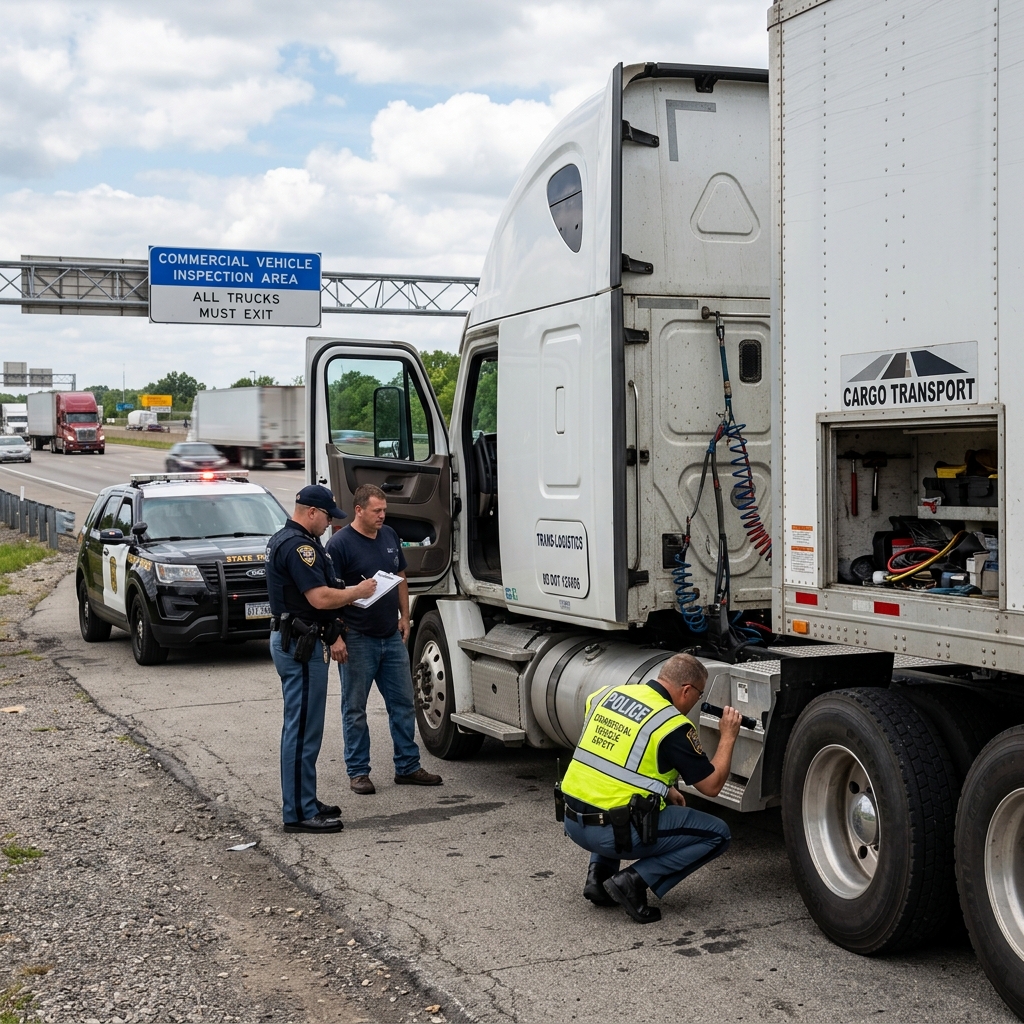
Commercial drivers spend their working lives under the watchful eye of law enforcement and regulators. That can raise a pressing question: can police stop and search a commercial vehicle without any cause? The answer is more nuanced than a simple yes or no. It depends on the type of stop, the purpose of the inspection, and the legal framework authorizing the officer’s actions.
This article explains how the Fourth Amendment applies to trucks, buses, and other commercial vehicles, why courts treat them differently from private cars, and what limits still protect drivers and carriers from overreaching searches.
Fourth Amendment Basics on the Road
The Fourth Amendment to the U.S. Constitution protects people from unreasonable searches and seizures. When a police officer stops any vehicle—commercial or personal—that stop is legally considered a seizure and must meet constitutional standards.
- Vehicle stop: A seizure requiring at least reasonable suspicion or a valid non-criminal inspection authority.
- Vehicle search: A deeper intrusion into privacy that usually requires probable cause, a warrant, consent, or a recognized exception to the warrant requirement.
Court decisions emphasize that even commercial drivers do not lose all Fourth Amendment rights simply because they operate in a regulated industry.
Private vs. Commercial Vehicles: Different Expectations of Privacy
Commercial vehicles operate in what courts call a pervasively regulated industry. Trucking, bus operations, and other commercial transport fields are subject to extensive safety rules, licensing, and inspection regimes. This regulatory context affects how much privacy drivers and companies can reasonably expect.
| Type of Vehicle | Privacy Expectation | Typical Legal Standard for Stops |
|---|---|---|
| Private passenger car | Higher expectation of privacy | Reasonable suspicion (or probable cause) for traffic stop. |
| Commercial motor vehicle (CMV) | Reduced expectation of privacy due to regulatory oversight | Reasonable suspicion or valid administrative inspection authority. |
Courts recognize that commercial carriers consent to some degree of inspection by choosing to participate in a heavily regulated industry, but that consent is not unlimited. Regulatory schemes must still be crafted—and applied—in ways that respect constitutional boundaries.
When Police Can Stop Commercial Vehicles
There are two main paths for law enforcement to stop a commercial vehicle:
- Traditional traffic enforcement, based on suspected violations of criminal or traffic laws.
- Administrative inspections, based on safety and regulatory programs designed for commercial carriers.
1. Stops Based on Reasonable Suspicion or Probable Cause
For ordinary traffic stops, the standards for commercial and personal vehicles are the same. Courts have repeatedly held that a traffic stop is a seizure that must be justified by reasonable suspicion of unlawful conduct, grounded in specific and articulable facts.
Key points for enforcement-based stops:
- Officers must be able to point to particular facts suggesting a law violation, such as speeding, lane violations, or observable safety problems.
- In some situations, probable cause—for example, clearly seeing a violation—is present and easily supports the stop.
- Without at least reasonable suspicion, a stop premised solely on a hunch or vague suspicion is unconstitutional, even for commercial trucks.
An appellate decision from the Fourth Circuit, for example, held that stopping a truck solely because the officer believed it might lack a required permit was not enough, absent specific facts supporting that belief. That ruling reinforces that commercial drivers are still protected from arbitrary seizures.
2. Stops Under Administrative Inspection Programs
The more complex issue is whether an officer can stop a commercial vehicle without cause under a regulatory inspection program. Courts have approved warrantless administrative inspections in some circumstances, but only when certain safeguards exist.
To be constitutional, a commercial vehicle inspection program usually must:
- Target a pervasively regulated industry, such as trucking or hazardous materials transport.
- Provide clear statutory or regulatory authority, putting carriers and drivers on notice that they are subject to inspections.
- Limit officer discretion by specifying when, where, and how inspections may occur, so the program acts as a functional substitute for a warrant.
- Serve a genuine regulatory purpose, such as safety or compliance, rather than being a disguised hunt for ordinary criminal evidence.
If those conditions are met, officers may conduct random or scheduled inspections of commercial vehicles without the same level of individualized suspicion required for a regular traffic stop.
But if a statute is too broad or gives officers unchecked discretion, courts may strike it down or refuse to rely on it to justify a stop. That tension is at the heart of debates over laws that allow police to stop commercial vehicles “without cause.”[10]
From Stop to Search: What Officers May Inspect
Stopping a commercial vehicle is one step; searching it is another. Courts distinguish between:
- Inspection-level access to documents, safety equipment, and regulated areas of the vehicle.
- Full searches aimed at uncovering contraband or evidence of crime, which require stronger justification.
Administrative Safety Inspections
Under valid regulatory programs, officers or inspectors may examine:
- Driver’s license and qualification records.
- Logbooks and hours-of-service documentation.
- Vehicle condition, including brakes, lights, tires, and load securement.
- Required permits and registration documents.
Because commercial operators are on notice that these aspects of their vehicle and operations are subject to inspection, courts treat this as a lesser intrusion on privacy than a criminal search.
Searches for Contraband or Criminal Evidence
When an officer wants to look beyond regulatory materials and safety equipment—into cargo, personal belongings, or hidden compartments—the usual Fourth Amendment rules resurface. In general, an officer needs one of the following:
- Probable cause to believe the vehicle contains contraband or evidence of a crime, allowing a warrantless search under the “automobile exception” recognized by the Supreme Court.
- Valid consent from the driver or person in control of the vehicle, obtained voluntarily and without coercion.
- A warrant, particularly if the search goes beyond the scope of any recognized exception.
The “automobile exception” permits officers to search a readily mobile vehicle without a warrant if they have probable cause, because the vehicle and evidence could quickly be moved or destroyed. This doctrine applies to commercial vehicles as well, provided the officer can articulate a factual basis for probable cause.
Consent searches are also common during traffic stops and commercial vehicle inspections. Courts have held that officers may ask for consent to search even when that request is unrelated to the original reason for the stop, as long as it does not improperly prolong the encounter or coerce the driver.
Reduced Privacy Does Not Mean No Rights
Some commentators, and even some officers, claim that commercial drivers have virtually no Fourth Amendment protection. That view overstates the legal reality.
Courts emphasize several guardrails that still apply:
- Commercial vehicle stops are seizures and must be justified by either reasonable suspicion or a valid administrative inspection scheme.
- Administrative schemes must be clearly defined, limited in scope, and tied to regulatory purposes, not mere criminal investigation.
- Searches for criminal evidence normally require probable cause, a warrant, or a recognized exception such as consent.
- Evidence obtained from unconstitutional stops or searches can be suppressed, as in cases where courts found no adequate basis for the initial stop.
In short, commercial status reduces privacy expectations but does not erase constitutional rights. The legal system continues to scrutinize how far states can go in authorizing random inspections and broad search powers.[10]
Key Court Principles Shaping Commercial Vehicle Searches
Several core principles from appellate decisions guide how courts evaluate commercial vehicle stops and searches:
- Objective justification rule: To assess the validity of a traffic stop, courts ask whether the stop was objectively justified, regardless of the officer’s subjective motives.
- Notice and scope requirements: For administrative searches, statutes must put affected individuals on notice and define the scope of inspections, limiting officer discretion.
- Separation of regulatory and criminal purposes: Inspections grounded in regulatory schemes cannot simply serve as pretexts for criminal investigations without meeting the higher standards of suspicion required for criminal enforcement.
- Totality of the circumstances: Courts look at all facts surrounding a stop or search, rather than isolated details, when deciding if reasonable suspicion or probable cause existed.
These principles help balance the need for highway safety and regulatory compliance with the constitutional protections guaranteed to all individuals, including commercial drivers.
Practical Takeaways for Commercial Drivers and Carriers
For those who operate or manage commercial vehicles, understanding the legal landscape helps reduce risk and protect rights. Consider the following practical points, drawn from established Fourth Amendment doctrine and commercial vehicle enforcement practices:
- Expect inspections: Participation in commercial transport means accepting that your vehicles and operations may be inspected under state or federal programs.
- Know inspection authority: Familiarity with your jurisdiction’s statutes and regulations can clarify what officers are allowed to examine and under what circumstances.
- Document compliance: Maintaining organized logs, permits, and safety records can speed inspections and reduce suspicion when stopped.
- Understand consent: You may choose whether to consent to a search beyond the regulatory inspection scope; that decision can have legal consequences if evidence is later challenged.
- Consult counsel after problematic stops: If a stop or search seems arbitrary or overly intrusive, legal advice can help determine whether your rights were violated and whether evidence can be challenged.
FAQs: Police Searches of Commercial Vehicles
Can police stop my commercial truck without any reason at all?
Generally, officers need either reasonable suspicion of a violation or authority under a valid administrative inspection program to stop your vehicle. Purely arbitrary stops that lack both are vulnerable to constitutional challenge.
Do my Fourth Amendment rights disappear when I drive a commercial vehicle?
No. Your privacy expectations are reduced because of heavy regulation, but you still retain Fourth Amendment protections against unreasonable searches and seizures. Courts require that both stops and searches be justified under recognized legal standards.
Can an officer search my cargo during a routine safety inspection?
An officer’s authority during a safety inspection generally focuses on regulatory and equipment checks. To search cargo for criminal evidence, the officer typically needs probable cause, valid consent, or another recognized exception to the warrant requirement.
Is consent to search always voluntary during a traffic stop?
Courts examine the circumstances to decide if consent was voluntary, considering factors like the officer’s tone, whether the driver was informed of the right to refuse, and whether the request extended the stop beyond its lawful duration. Coercive or unduly prolonged encounters may undermine the validity of consent.
What happens if a court finds the stop of my commercial vehicle unconstitutional?
If a stop or search violates the Fourth Amendment, evidence collected as a result may be excluded from court proceedings, as seen in appellate decisions that suppressed evidence after unlawful commercial vehicle stops.
References
- The Automobile Exception & Mobility – Eighth Circuit — DLG Learning Center. 2021-06-29. https://dlglearningcenter.com/the-automobile-exception-mobility/
- Search and Seizure of Commercial Vehicles — Safety Carriers (CMV Legal Resource). 2016-01-01. https://www.safecarriers.org/media/t0imljrt/cmv-search-seizure.pdf
- Fourth Circuit: Commercial Vehicle Permit Requirement Insufficient Grounds to Initiate Traffic Stop — Criminal Legal News. 2021-01-15. https://www.criminallegalnews.org/news/2021/jan/15/fourth-circuit-commercial-vehicle-permit-requirement-insufficient-grounds-initiate-traffic-stop/
- United States v. Herrera — U.S. Court of Appeals for the Tenth Circuit via Justia. 1996-01-03. https://law.justia.com/cases/federal/appellate-courts/F3/444/1238/546314/
- Eighth Circuit Upholds Consent to Search During Traffic Stop — Legal & Liability Risk Management Institute. 2022-07-12. https://www.llrmi.com/articles/legal_updates/2022_us_v_salkil/
- Farmer Fights Commercial Vehicle Searches at Eighth Circuit — Courthouse News Service. 2016-12-15. https://www.courthousenews.com/farmer-fights-commercial-vehicle-searches-in-eighth-circuit/
- Case Note; United States v. Alvester Fort — SMU Law Review (SMU Scholar). 1995-01-01. https://scholar.smu.edu/cgi/viewcontent.cgi?article=1830&context=lbra
Similar Articles








Read full bio of Sneha Tete




