
When ATM Robberies Become Federal Bank Robbery
Understanding when crimes at or near ATMs cross the line from local theft into serious federal bank robbery charges under U.S. law.
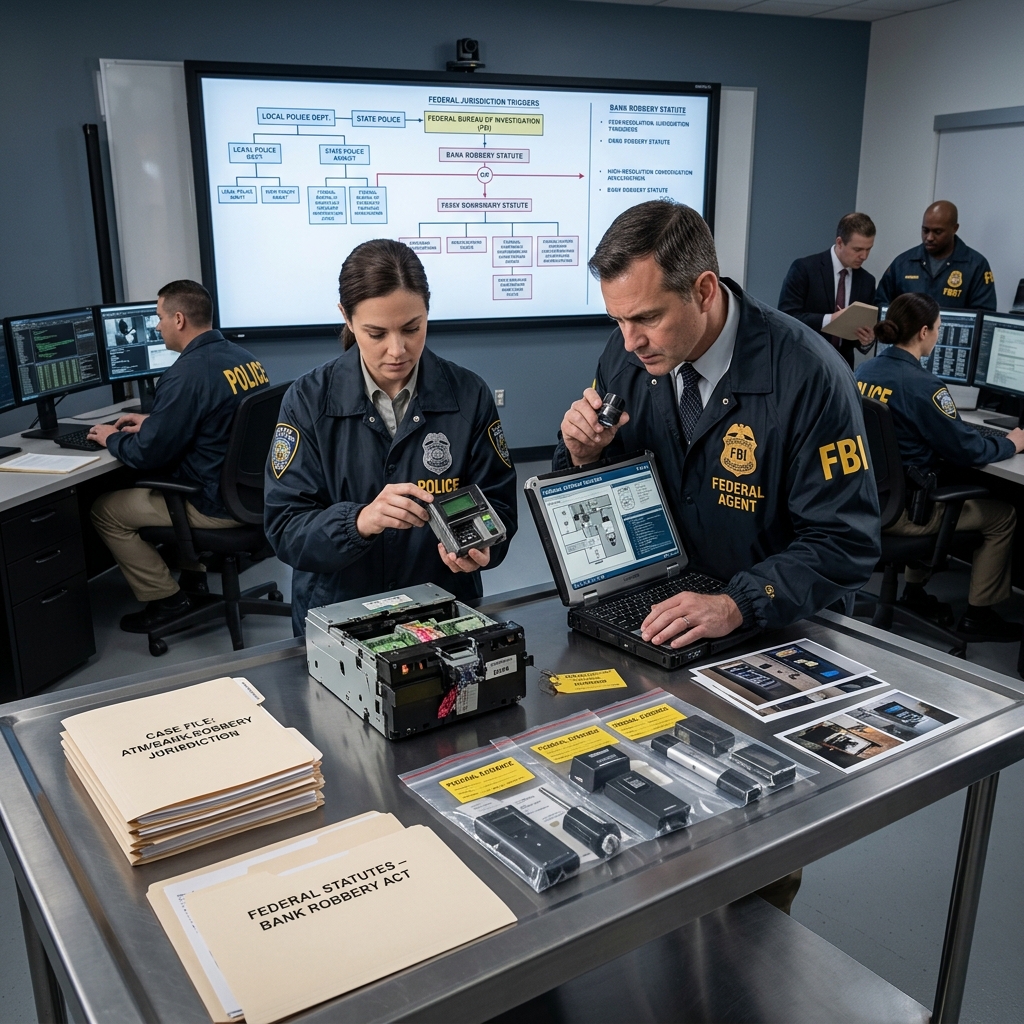
Most people assume that crime at an ATM is a local matter handled under state robbery or theft laws. In many situations, that is true. But in specific circumstances, an ATM incident can trigger federal bank robbery charges carrying decades in prison. Understanding where that line is drawn is critical for lawyers, law students, and anyone who uses ATMs.
Why ATM Crimes Raise Special Legal Questions
ATMs sit at the intersection of traditional street crime and complex banking regulation. They are physical machines located in public or semi-public spaces, but they are also a direct interface with funds held by federally insured financial institutions.
The federal bank robbery statute, 18 U.S.C. § 2113, does not only protect bank buildings. It protects property “belonging to, or in the care, custody, control, management, or possession” of a bank, credit union, or similar institution. That broad language allows prosecutors to treat some ATM-related conduct as a robbery of the bank itself rather than merely a theft from a customer.
- Local vs. federal jurisdiction: Many ATM incidents are prosecuted under state robbery, burglary, or theft statutes.
- Bank control over funds: When money remains in the bank’s custody at the time of the crime, federal charges are more likely.
- Public safety concerns: Congress and federal agencies view attacks on financial infrastructure as a national concern, especially as ATM crime trends rise.
Key Legal Concepts in ATM-Related Bank Robbery
To understand when an ATM incident becomes federal bank robbery, three concepts are central: care and custody of funds, use of force or intimidation, and who is being robbed.
Care and Custody of Bank Funds
The phrase “care, custody, control, management, or possession” is the gateway into federal jurisdiction. The more clearly money remains under a bank’s control, the stronger the argument that the crime is a bank robbery rather than a simple street robbery.
Federal guidance has drawn an important distinction:
- If a customer has already completed a withdrawal and is robbed after walking away from the ATM, the money is generally considered to be in the customer’s possession, not the bank’s.
- If a robber forces a customer to go to the ATM and withdraw money, the customer can be treated as an “unwilling agent” and the funds as remaining under the bank’s care until taken by the robber.
This distinction is not merely theoretical; it often determines whether an incident is charged under § 2113 (bank robbery) or under state robbery laws and possibly other federal statutes such as bank larceny.
Force, Violence, and Intimidation
Federal bank robbery requires a taking “by force and violence, or by intimidation.” At ATMs, common fact patterns include:
- Threats with weapons to demand a withdrawal and immediate handover of cash.
- Physical assault to force a PIN entry or to drag a victim to an ATM.
- Verbal threats that would cause a reasonable person to fear bodily harm.
Even if no weapon is used, intimidation alone can support a robbery charge so long as the victim reasonably perceives a threat.
Who Is the Target of the Robbery?
Another subtle but important issue is whether the criminal act is legally viewed as robbing the customer or robbing the bank. Federal law and case analysis often examine:
- Whether the victim is being used as a conduit to access bank-held funds.
- Whether the bank is still exercising control over the money at the time of the crime.
- Whether the victim has completed a transaction and obtained unfettered control of the cash.
These questions are directly tied to the “care and custody” concept and influence whether a case falls under federal bank robbery, federal bank larceny, or purely state-level offenses.
Common ATM Crime Scenarios and How They Are Charged
ATM-related criminal conduct can take several distinct forms, each raising different legal issues. The classification below is simplified but helps illustrate how the same location—an ATM—can give rise to very different charges.
| Scenario | Money’s Status | Typical Legal Treatment |
|---|---|---|
| Robbing a customer who just finished a withdrawal and left the ATM area | Cash is in customer’s possession | Usually state robbery; bank robbery statute generally inapplicable |
| Forcing a customer at gunpoint to drive to an ATM, withdraw funds, and hand them over | Funds arguably in bank’s custody until taken by robber | May be charged as federal bank robbery under 18 U.S.C. § 2113 |
| Breaking into an ATM to access its internal cash vault | Funds are still held by the financial institution | Federal bank larceny (§ 2113(b)) or related offenses; sometimes bank robbery depending on force used |
| Using stolen cards or PINs for unauthorized ATM withdrawals | Funds in bank’s control; transaction fraudulent | Typically charged as bank larceny or fraud, not traditional robbery |
| Ambushing ATM service technicians and stealing cash being loaded | Cash is still in bank’s care via its agents | Can support federal charges, including robbery or larceny, depending on facts |
The Federal Bank Robbery Statute and ATMs
Section 2113 of Title 18 is the core federal law governing bank robbery. While originally drafted with traditional bank holdups in mind, its language is broad enough to cover modern scenarios involving ATMs.
Basic Elements Under 18 U.S.C. § 2113
To obtain a conviction for federal bank robbery, prosecutors must generally prove:
- Property or money was taken or attempted to be taken from the person or presence of another.
- The property belonged to, or was in the care or custody of, a bank, credit union, or similar institution whose deposits are federally insured.
- The taking occurred by force, violence, or intimidation.
ATM-related cases hinge on whether the second element is met at the precise moment of the taking. If the victim is considered an “unwilling agent” being used to access the bank’s funds, courts and federal guidance have concluded that § 2113 may apply.
Guidance from the Department of Justice
Internal guidance for federal prosecutors has specifically addressed ATMs. It notes that:
- Robberies occurring after a customer has withdrawn funds and left the ATM are usually outside the scope of § 2113(a) because the money is then in the customer’s possession.
- If a customer is forced to go to an ATM and withdraw funds at gunpoint, bank robbery may be charged because the perpetrators are using the victim and their bank card as tools to rob the bank.
- Taking money directly from an off-premises ATM with intent to steal may constitute bank larceny under § 2113(b), even if no customer is involved.
This guidance illustrates how federal law draws lines based on control and timing rather than the physical location alone.
Conflicting Views in Federal Courts
Despite DOJ guidance, federal appellate courts have not always agreed on how to treat forced ATM withdrawals. Legal scholars have documented a split among circuits regarding whether such conduct is a violation of § 2113(a).
Broadly:
- Some circuits have held that forcing a customer to withdraw funds from an ATM and surrender them amounts to a bank robbery because the money remains in the bank’s care until the moment of taking.
- Others have concluded that at the time of the handover, the money is in the customer’s possession, making the incident more akin to a traditional street robbery.
This disagreement creates uncertainty, especially in cross-jurisdictional cases. It also underlines why careful analysis of facts is essential—when the withdrawal happened, where the victim stood, and how the robber used threats all matter.
Penalties for ATM-Related Bank Robbery and Larceny
When ATM conduct is charged as federal bank robbery, the potential consequences are severe. Under § 2113(a), a standard bank robbery conviction can carry up to 20 years in federal prison and substantial fines.
Aggravated forms of bank robbery, such as those involving dangerous weapons or kidnapping, are addressed under § 2113(d) and § 2113(e) and can substantially increase sentencing exposure.
In addition:
- Bank larceny under § 2113(b), including certain ATM break-ins, also carries serious penalties, though typically less than the maximum for violent robbery.
- State law penalties for ATM-related robbery or burglary can range from several years to decades, depending on the jurisdiction, use of weapons, and the amount taken.
- Other federal statutes may apply as well, including fraud-related laws when stolen cards or PINs are used.
Recent enforcement actions illustrate that federal authorities do aggressively pursue ATM-related schemes, particularly organized operations targeting multiple states or attacking ATM technicians and large amounts of cash.
Emerging Policy: Extending Federal Protection to ATMs
Recognizing the growth in ATM crime and the ambiguity in current law, lawmakers have proposed reforms to explicitly bring standalone ATMs under a federal protective umbrella. One bipartisan legislative proposal would ensure robberies involving off-site ATMs receive federal penalties comparable to those imposed for robberies of bank branches.
Key motivations for such proposals include:
- Increasing deterrence by signaling that attacking ATMs is not a low-risk, local crime.
- Clarifying jurisdictional questions that currently hinge on nuanced “care and custody” analysis.
- Protecting access to cash in communities that rely heavily on ATM networks rather than traditional bank lobbies.
While legislative outcomes can change over time, the policy trend is clear: federal authorities are paying close attention to ATM crime and considering broader federal involvement.
Practical Implications for Defendants and Counsel
For individuals accused of ATM-related crimes, the distinction between state and federal treatment is more than academic. It directly affects potential sentencing, available plea options, and the complexity of defense strategy.
Factors That Influence Charging Decisions
Prosecutors examine a range of factors when deciding whether to seek federal bank robbery charges:
- How the victim reached the ATM: Was the victim already there, or forced to go there?
- Timing of the withdrawal: Did the robbery occur before or after the victim completed a transaction and left the ATM area?
- Nature of threats or violence: Were weapons used? Was serious bodily harm inflicted or threatened?
- Ownership and operation of the ATM: Is the machine directly operated by a federally insured bank or credit union?
- Pattern of conduct: Is the incident part of an organized scheme targeting multiple locations or jurisdictions?
In borderline cases, defense counsel may argue that funds were already in the customer’s possession and that any robbery should be treated under state law rather than federal bank robbery statutes, reducing the potential exposure.
Potential Defenses in ATM-Related Cases
The availability of defenses depends heavily on specific facts, but common issues include:
- Identity and evidence challenges: Questioning whether the accused was correctly identified, particularly where video footage or eyewitness testimony is limited.
- Search and seizure: Challenging how cards, devices, or other evidence were obtained and whether Fourth Amendment protections were violated.
- Intent: Disputing whether the accused intended to steal or whether conduct was misinterpreted in tense situations.
- Coercion or duress: In rare circumstances, arguing that the accused was compelled by threats from others to participate in the crime.
Because federal penalties are high, early legal advice is important. Even in apparently minor ATM incidents, subtle facts can mean the difference between state-level charges and a federal bank robbery prosecution.
Practical Safety Considerations for ATM Users
While this article focuses on legal classification, many of the scenarios described begin with ordinary people withdrawing cash. Although legal rules govern what happens after a crime, basic precautions can reduce risk of being targeted at ATMs.
- Use ATMs located in well-lit, visible areas, ideally attached to bank branches during business hours.
- Stay aware of surroundings; consider leaving if someone is loitering unusually close to the machine.
- Avoid counting cash in public view; secure it promptly and leave the area.
- Consider limits on the amount withdrawn at any one time if circumstances feel unsafe.
- Report suspicious activity to the bank and, where appropriate, to law enforcement.
These precautions cannot eliminate risk, but they can make opportunistic ATM targeting less likely.
FAQs: ATM Robbery and Federal Law
Does every crime near an ATM count as federal bank robbery?
No. Many crimes at or near ATMs are prosecuted under state robbery, theft, or assault laws. Federal bank robbery charges usually require that the funds were still in the bank’s care or custody and that force or intimidation was used to take them.
If I am robbed after I walk away from the ATM, is the bank considered the victim?
Typically not. Federal guidance has indicated that once you have withdrawn funds and they are in your possession, a subsequent robbery is not charged as a bank robbery under § 2113(a) because the money is no longer in the bank’s control.
Can breaking into an ATM itself be a federal crime?
Yes. When someone breaks into an ATM to access cash held by a federally insured institution, that conduct can be treated as bank larceny under § 2113(b), and in some circumstances may involve other federal charges as well.
What is an “unwilling agent” in the ATM context?
Some courts and commentators use the term “unwilling agent” to describe a customer forced to withdraw funds at an ATM and hand them over to a robber. In that situation, the customer is viewed as a tool used to access bank funds, supporting the argument that the bank is the entity being robbed.
Are lawmakers trying to change how ATM crimes are treated?
Yes. Recent legislative proposals aim to extend federal protections and penalties to robberies involving off-site ATMs, reflecting concern about rising ATM crime and the need for clearer federal involvement.
References
- 1358. Bank Robbery — Automated Teller Machines (ATMs) — U.S. Department of Justice, Justice Manual. 2010-05-21. https://www.justice.gov/archives/jm/criminal-resource-manual-1358-bank-robbery-automated-teller-machines-atms
- Care and Custody in Federal Bank Robbery — Hastings Law Journal (UC Law SF). 2022-01-01. https://repository.uclawsf.edu/cgi/viewcontent.cgi?article=4079&context=hastings_law_journal
- Federal Bank Robbery – 18 USC 2113 — Wallin & Klarich. 2023-04-01. https://www.wklaw.com/practice-areas/federal-crimes/federal-bank-robbery-18-usc-2113/
- ATM Related Robbery Charges — Keith Oliver Criminal Law. 2021-11-10. https://www.njcriminaldefensefirm.com/monmouth-county-fraud-theft/atm-robbery-charges/
- Gallego, Cruz Introduce Bipartisan Bill to Apply Federal Penalties to ATM Crime — Office of Senator Ruben Gallego. 2023-09-27. https://www.gallego.senate.gov/news/press-releases/gallego-cruz-introduce-bipartisan-bill-to-apply-federal-penalties-to-atm-crime/
- ATMs Could Gain Federal Protection with New Bill — Loomis U.S. 2023-10-05. https://www.loomis.us/resources/insights/ATMs-could-gain-federal-protection
- ATM Burglary Tips — Federal Bureau of Investigation. 2022-08-01. https://forms.fbi.gov/atmburglarytips
Similar Articles








Read full bio of medha deb




