
Have Supreme Court Rulings Weakened Your Miranda Rights?
Recent Supreme Court decisions leave Miranda rights technically intact but harder for individuals to enforce when police violate them.
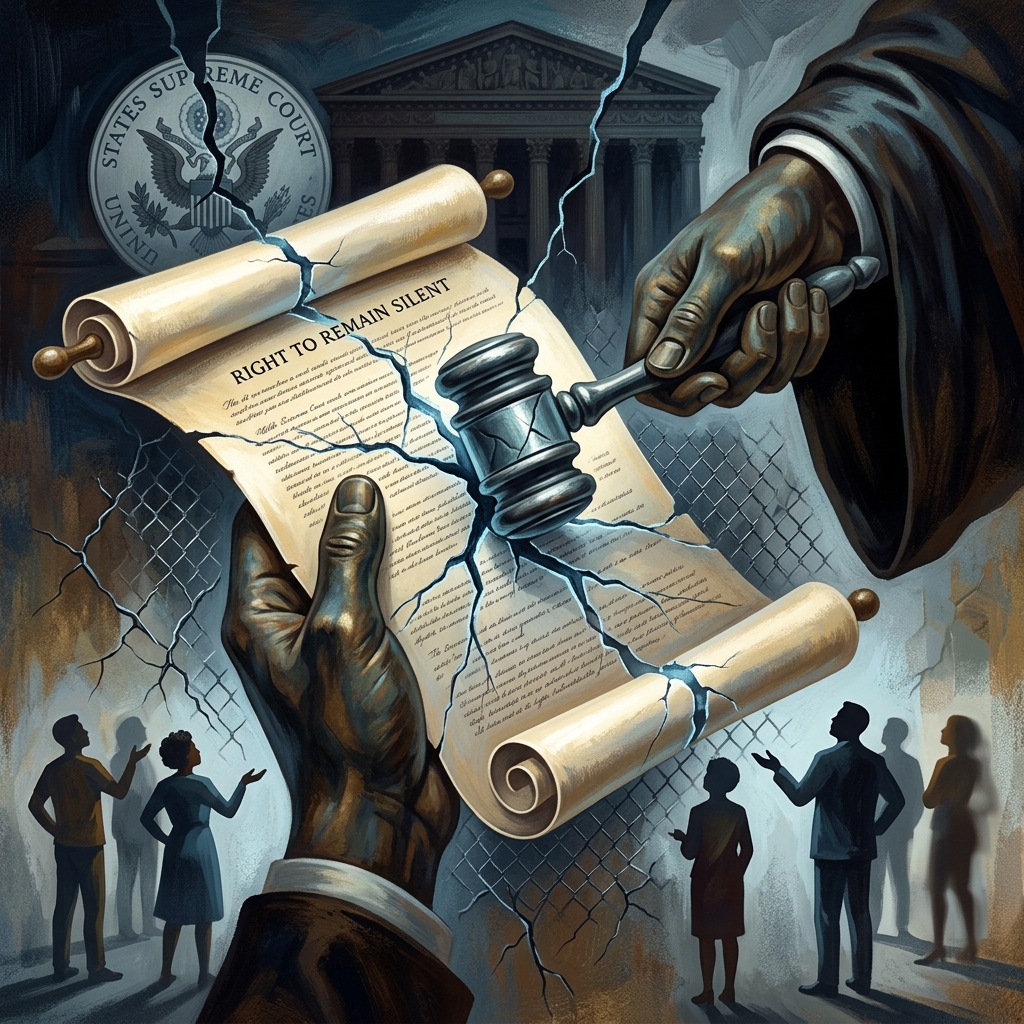
For decades, Americans have relied on the familiar warning from police — you have the right to remain silent — as a powerful shield against self‑incrimination and coercive questioning. Recent Supreme Court decisions, however, have reshaped how those rights can be enforced, raising an important question: are your Miranda rights weaker today than they used to be?
This article explains what Miranda rights are, how the Supreme Court’s 2022 decision in Vega v. Tekoh changed the legal landscape, and what those changes mean for anyone questioned by law enforcement.
1. A Quick Refresher: What Are Miranda Rights?
Miranda rights come from the 1966 Supreme Court case Miranda v. Arizona. In that case, the Court held that the Fifth Amendment privilege against self‑incrimination requires police to warn suspects about key rights before conducting a custodial interrogation — questioning a person who is in custody or otherwise significantly deprived of freedom.
1.1 The Core Warnings You Should Hear
The Court required law enforcement to give a clear, simple set of warnings before questioning a person in custody. While the exact wording can vary, the essential points are:
- Right to remain silent – You do not have to answer questions from police.
- Use of your statements – Anything you say can be used as evidence against you in court.
- Right to an attorney – You have the right to consult with a lawyer and have that lawyer present during questioning.
- Right to appointed counsel – If you cannot afford a lawyer, one will be appointed for you before questioning, if you want one.
If these warnings are not given and a suspect does not validly waive them, statements obtained during custodial interrogation generally cannot be used by the prosecution at trial.
1.2 Why the Supreme Court Created Miranda
In Miranda v. Arizona, the Court emphasized the “inherently compelling pressures” of police interrogation in custody, noting that without safeguards, those pressures could overcome a person’s will and lead to involuntary or unreliable confessions. The justices concluded that simply relying on a case‑by‑case assessment of whether a confession was voluntary was not enough protection.
To address this, the Court established a set of procedural safeguards — the Miranda warnings — that must be applied whenever law enforcement conducts custodial interrogation. If the warnings are not given, the prosecution may not use the resulting statements at trial, unless it can show the suspect knowingly and voluntarily waived those rights.
2. Miranda Rights vs. Constitutional Rights: Why the Distinction Matters
A key legal debate has always been whether Miranda rights are themselves constitutional rights or whether they are judge‑made procedures designed to protect underlying constitutional guarantees, particularly the Fifth Amendment privilege against self‑incrimination and the Sixth Amendment right to counsel.
Over the years, the Supreme Court has described Miranda in different ways. In some cases, the Court treated a failure to warn as a constitutional problem, especially when unwarned statements were used at trial. In others, it emphasized that Miranda warnings were a set of prophylactic rules — legal tools created by the Court to safeguard the Constitution rather than rights explicitly written in the Constitution itself.
2.1 What Is a “Prophylactic Rule”?
A prophylactic rule is a judicially created rule that is not directly required by the Constitution’s text but is designed to prevent violations of constitutional rights. In the Miranda context, the Court has sometimes said that while the Constitution forbids compelled self‑incrimination, the particular requirement to recite specific warnings is a judicial measure meant to safeguard that underlying protection.
This characterization matters because it affects whether a violation of Miranda can itself be the basis for a lawsuit, or whether the only remedy is to exclude unwarned statements from criminal trials.
3. Vega v. Tekoh: What the Supreme Court Changed in 2022
In Vega v. Tekoh (2022), the Supreme Court confronted a critical question: can a person whose Miranda rights were violated by police sue the officer for money damages under a federal civil rights statute, 42 U.S.C. § 1983?
Section 1983 allows people to sue state officials who violate their federal rights while acting under color of law. The issue in Vega was whether a Miranda violation counts as the violation of a federal constitutional right that can be enforced through this statute.
3.1 The Court’s Holding
The Supreme Court held, in a 6–3 decision, that a failure to provide Miranda warnings does not give rise to a damages claim under § 1983. The majority reasoned that Miranda warnings are a prophylactic measure, not themselves a constitutional right. Therefore, even if a suspect is questioned without warnings and their statements are later used against them at trial, that Miranda violation is not the kind of constitutional violation that supports a § 1983 lawsuit.
In practical terms:
- You still have the right to receive Miranda warnings before custodial interrogation.
- Statements taken in violation of Miranda can still be suppressed and excluded at trial.
- But you generally cannot sue an officer for money damages under § 1983 merely because you were not warned and your unwarned statement was used against you in court.
3.2 The Majority’s Reasoning in More Detail
The majority in Vega emphasized that previous decisions treated Miranda as a safeguard rather than a direct reading of the Constitution’s text. Because of this, they concluded that Miranda violations are not violations of a protected constitutional “right” for § 1983 purposes.
The Court also expressed concern that allowing damages actions for Miranda violations would be inconsistent with prior decisions that had limited or qualified the use of unwarned statements in certain contexts, such as for impeachment of a defendant who testifies at trial. This reasoning underscored the Court’s view that Miranda is a flexible, judge‑made doctrine rather than an absolute constitutional rule.
3.3 The Dissent’s View
The dissenting justices argued that the decision in Vega undercuts the practical force of Miranda. They stressed that the Court had previously described the use of unwarned statements at trial as a violation of a constitutional guarantee, and that denying § 1983 remedies would leave individuals without meaningful recourse when their rights are violated.
From the dissent’s perspective, if Miranda is essential to enforcing the Fifth Amendment in custodial interrogation, then a violation of Miranda should be treated as a violation of a constitutional right — and be actionable under § 1983.
4. What Vega v. Tekoh Means for You in Practice
Vega does not erase Miranda warnings, and it does not authorize police to ignore the requirement to provide them. But it does change how those rights are enforced and what remedies are available when they are violated.
4.1 What Has Not Changed
Despite Vega, several core features of Miranda remain intact:
- Police obligations – Officers are still required to give Miranda warnings before custodial interrogation if they intend to use the suspect’s statements in the prosecution’s case‑in‑chief at trial.
- Suppression of statements – If statements are obtained in violation of Miranda, the defense can ask the court to suppress those statements so they cannot be used in the prosecution’s main case.
- The core warning content – The basic rights (silence, attorney, appointed counsel) remain the same.
4.2 What Has Changed: Limits on Civil Remedies
The major shift is about enforcement. Under Vega, a person who experiences a Miranda violation generally cannot seek damages from the officer under § 1983, even if an unwarned statement is used against them at trial and they are later acquitted.
That means:
- If your case never goes to trial, there may be no formal remedy at all for the Miranda violation.
- If your unwarned statement is never introduced in court, the violation might never be reviewed by a judge.
- If your statement is used at trial but the conviction is reversed because of the violation, you still may not have a monetary remedy against the officer.
4.3 Comparison: Before and After Vega
| Issue | Before Vega v. Tekoh | After Vega v. Tekoh |
|---|---|---|
| Requirement to give Miranda warnings | Required for custodial interrogation if statements to be used at trial. | Unchanged; still required. |
| Use of unwarned statement at trial | Typically excluded from prosecution’s main case; some limited exceptions. | Unchanged; suppression remains the main remedy. |
| Civil damages under 42 U.S.C. § 1983 | Some lower courts allowed § 1983 suits for Miranda violations. | Supreme Court bars § 1983 damages solely for Miranda violations. |
| Characterization of Miranda | Sometimes treated like a constitutional rule. | Explicitly framed as prophylactic, not itself a constitutional right. |
5. Does This “Water Down” Your Miranda Rights?
Whether Vega “waters down” Miranda depends on how one understands rights and remedies. In one sense, the substantive protections — your right to remain silent and to have a lawyer — are unchanged. Police still risk losing the ability to use your unwarned statements if they do not advise you of your rights.
In another sense, however, Vega arguably makes Miranda rights harder to enforce because it removes an important tool: civil lawsuits for damages under § 1983 when officers fail to provide warnings and unwarned statements are used in court.
Legal commentators note that when the only remedy is suppression of evidence at trial, there may be no consequence for Miranda violations in cases that never reach trial or in situations where the prosecution does not rely heavily on the unwarned statements. This can weaken the incentive for consistent compliance.
6. How to Protect Yourself During Police Encounters
Given the limits that Vega places on civil remedies, it is more important than ever for individuals to understand and actively invoke their rights during encounters with law enforcement.
6.1 Clearly Assert Your Rights
If you are questioned by the police in circumstances that may amount to custody, consider taking these steps:
- Ask if you are free to leave. If the officer says yes, you may walk away. If they say no, you are likely in some form of custody.
- State that you wish to remain silent. Simply remaining quiet may not always be enough; clear words make your choice unambiguous.
- Request a lawyer. Say you want to speak with an attorney and that you will not answer questions without one present.
- Do not volunteer information beyond basic identifying details, unless you have talked to counsel.
Under Miranda doctrine, once a suspect clearly invokes the right to silence or counsel, police are supposed to stop interrogation or wait until counsel is present.
6.2 Document What Happened
If you believe your Miranda rights were violated, documenting what happened can be critical later:
- Write down the time, place, and officers involved as soon as you can.
- Note exactly what you were told — or not told — about your rights.
- Record whether you asked for a lawyer or said you did not want to talk.
Even though Vega restricts § 1983 damages for Miranda violations, these details may still matter for suppression motions, appeals, or other legal strategies your lawyer may use.
7. Key FAQs About Miranda Rights After Vega v. Tekoh
7.1 Do police still have to read me my rights?
Yes. Law enforcement must still provide Miranda warnings before interrogating a suspect who is in custody if they want to use that person’s statements in their case‑in‑chief at trial.
7.2 What happens if they don’t give me a Miranda warning?
If you are in custody and interrogated without warnings, your lawyer can ask the court to suppress any statements you made so they cannot be used against you in the prosecution’s main case. There are limited exceptions, but this suppression remains the primary remedy.
7.3 Can I sue the police for not reading me my rights?
After Vega v. Tekoh, you generally cannot obtain damages under 42 U.S.C. § 1983 solely because an officer failed to provide Miranda warnings and your unwarned statement was used in court. Other legal theories might be available if the officer’s conduct independently violated constitutional rights, but a bare Miranda violation is not enough for a § 1983 claim.
7.4 Are my Miranda rights part of the Constitution?
Your underlying rights — such as the privilege against self‑incrimination under the Fifth Amendment and the right to counsel in certain stages of criminal proceedings — are constitutional. Miranda warnings are judicially created procedures designed to protect those constitutional rights. The Supreme Court in Vega emphasized this distinction.
7.5 Should I still ask for a lawyer during questioning?
Yes. Requesting a lawyer remains one of the most important ways to protect yourself in a criminal investigation. Once you clearly invoke your right to counsel, interrogation is supposed to cease until an attorney is present.
8. The Future of Miranda: Stability or Erosion?
Some scholars argue that by labeling Miranda a mere prophylactic rule and restricting civil remedies, the Supreme Court has positioned itself to narrow or even overturn Miranda in future cases. Others point out that Miranda has been in place for decades, is deeply woven into police practice, and remains popular with the public and many law‑enforcement agencies because it offers clear guidance.
For now, Miranda warnings remain a central feature of American criminal procedure. But Vega v. Tekoh underscores that the strength of those protections does not depend only on what rights exist on paper, but also on whether individuals have effective tools to enforce them when violations occur.
References
- Supreme Court limits ability to enforce Miranda rights — CNN Politics. 2022-06-23. https://www.cnn.com/2022/06/23/politics/supreme-court-miranda-rights
- Miranda v. Arizona Facts and Case Summary — United States Courts. 2019-10-30. https://www.uscourts.gov/about-federal-courts/educational-resources/educational-activities/fifth-amendment-activities/miranda-v-arizona/facts-and-case-summary-miranda-v-arizona
- Miranda v. Arizona — Oyez, IIT Chicago-Kent College of Law. 2019-01-01. https://www.oyez.org/cases/1965/759
- Supreme Court Ruling Rejects the Promise of Miranda Rights — American Civil Liberties Union (ACLU). 2022-06-23. https://www.aclu.org/news/civil-liberties/supreme-court-rejects-promise-miranda-rights
- The U.S. Supreme Court’s Impending Destruction of Miranda Rights — Boston College Law Review. 2023-02-20. https://bclawreview.bc.edu/articles/3135
- Miranda Rights Supreme Court Cases — Justia US Supreme Court Center. 2021-06-01. https://supreme.justia.com/cases-by-topic/miranda-rights/
Similar Articles








Read full bio of medha deb




