
Pandemics, Prejudice, and the Price of Scapegoating
How health crises trigger xenophobia, and why solidarity is our best defense.
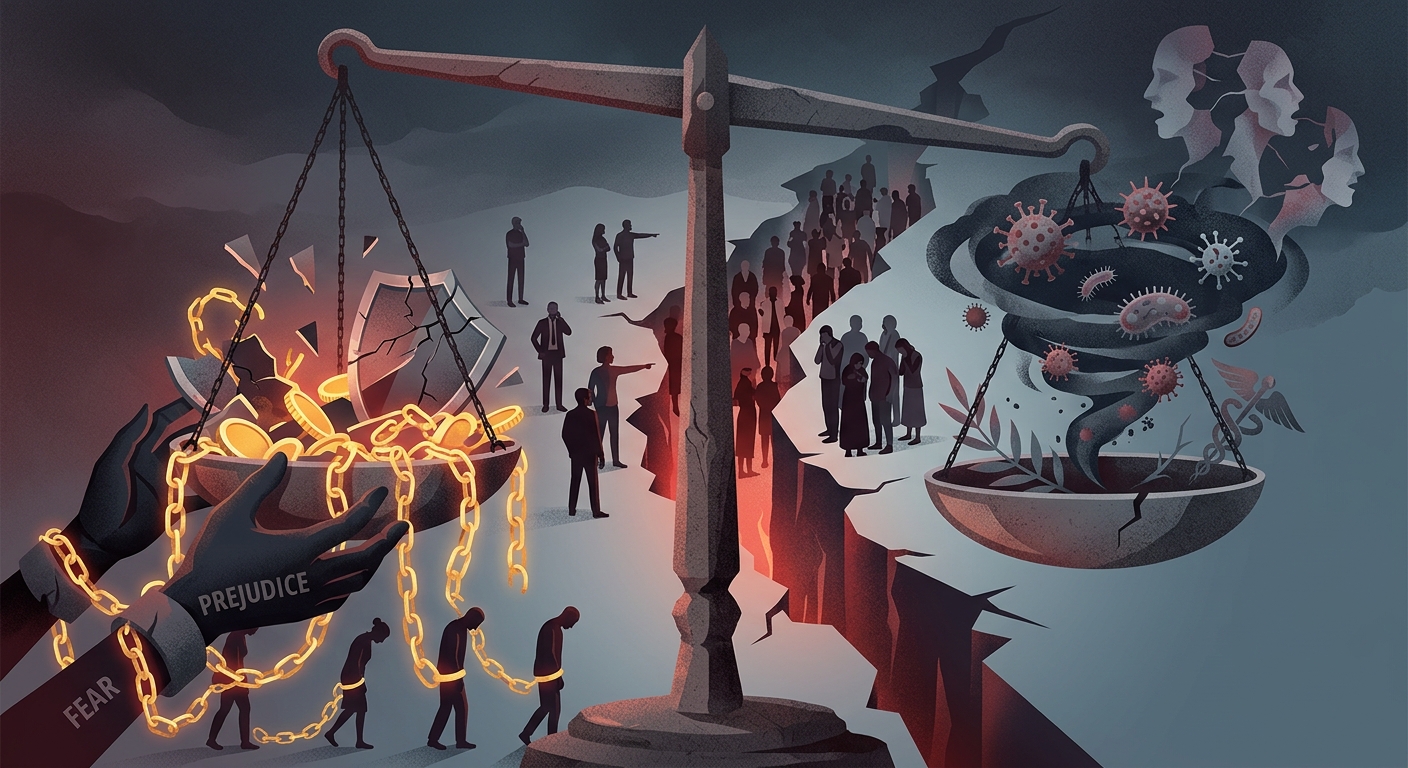
When a novel infectious disease sweeps across the globe, it brings with it two parallel epidemics: the rapid transmission of a biological pathogen and the equally swift contagion of fear. Pandemics routinely test the resilience of public health infrastructures, but they also serve as ultimate stress tests for societal cohesion. The intersection of a sudden global health emergency and preexisting social prejudices frequently creates a toxic environment where fear eclipses rational thought. When an invisible threat disrupts daily life, causes widespread illness, and paralyzes economies, human societies often fall back on a deeply flawed psychological defense mechanism: scapegoating.
Medical scapegoating involves projecting the blame for an outbreak onto a specific marginalized group, geographic region, or minority population. Instead of focusing on the complex, scientific realities of viral transmission, populations often seek a visible enemy. This phenomenon is not merely an unfortunate byproduct of anxiety; it is a dangerous societal reflex that undermines public health responses, fuels hatred, and creates deep divisions precisely when collective solidarity is most needed. By understanding the historical roots, psychological drivers, and real-world consequences of disease-related xenophobia, we can better equip ourselves to fight both the pathogen and the prejudice. It requires a conscious effort to dismantle the myths that equate specific demographics with disease.
The Historical Precedents of Medical Scapegoating
The reflex to scapegoat marginalized communities during a public health crisis is a deeply entrenched historical pattern. Long before modern epidemiology existed to map the mechanisms of viral and bacterial transmission, human societies sought to rationalize the terrifying randomness of illness by blaming the ‘other.’ These historical precedents highlight how quickly social contracts dissolve under the pressure of mass mortality.
One of the most documented and tragic examples occurred during the catastrophic spread of the bubonic plague, or the Black Death, across Europe in the 14th century. Desperate to explain the staggering mortality rates, panicked populations frequently targeted Jewish communities. Academic research into the economic and social history of the plague reveals that regions with latent, preexisting biases were significantly more likely to see these prejudices manifest as violent mass persecutions and massacres during the outbreak . Instead of mitigating the disease, this horrific violence only compounded the human tragedy of the era.
During the 19th century, waves of cholera swept through the United States and Europe. Because the waterborne nature of the disease was not yet understood, society looked for scapegoats. Immigrant populations, particularly Irish Catholic immigrants who were already facing intense nativist discrimination, were blamed for the outbreaks. They were falsely accused of bringing filth and disease into urban centers, leading to widespread social ostracization.
In the late 20th century, the early days of the HIV/AIDS epidemic showcased a similar, devastating pattern. The disease was initially heavily stigmatized and inaccurately branded as a virus exclusive to the LGBTQ+ community and specific minority groups. This cruel mischaracterization not only fueled intense, violent homophobia but also critically delayed widespread public health interventions, federal funding, and vital scientific research that could have saved countless lives early in the epidemic. The political reluctance to address the crisis was directly tied to the societal marginalization of the victims.
The Mechanics of Fear and Political Blame
Understanding why scapegoating occurs requires examining the intersection of human psychology and political opportunism. At a psychological level, human beings possess a deep-seated need to maintain a sense of order and control over their environment. An invisible, fast-spreading virus obliterates this illusion of control. By assigning blame to a specific demographic, individuals construct a false narrative of safety; they convince themselves that by simply avoiding or isolating the scapegoated group, they can avoid the disease itself.
This psychological vulnerability is often exploited by political figures and institutions looking to deflect from their own systemic failures. When healthcare systems are overwhelmed and public health policies falter, the weaponization of rhetoric becomes a convenient distraction. By attaching geographic or racial identifiers to a pathogen, leaders can redirect public anger away from administrative shortcomings and toward a vulnerable minority.
The tangible result of this rhetoric is a sharp increase in targeted violence and discrimination. During recent global health emergencies, the use of geographically and racially charged terminology directly correlated with a surge in hate crimes. For example, data published by the U.S. Department of Justice and the FBI indicated a massive spike in hate crime incidents during 2020, with significant increases in violence directed at Asian American communities . This data underscores that words have profound real-world consequences, transforming a biological crisis into a human rights emergency.
The Real-World Cost of Xenophobia During Health Crises
The consequences of medical scapegoating extend far beyond interpersonal prejudice; they represent a direct threat to the efficacy of the public health response itself. When a specific demographic or geographic group is stigmatized and blamed for an outbreak, a dangerous environment is created that ultimately accelerates the spread of the disease.
Public health organizations point out that disease-related stigma actively hinders outbreak management. According to guidelines formulated by public health experts, when people fear harassment or discrimination, they are significantly less likely to seek out medical care, report symptoms, or participate in contact tracing initiatives . A stigmatized individual might hide their illness to avoid social ostracization, which inadvertently leads to wider community transmission. In this way, prejudice actively sabotages epidemiological containment strategies.
Beyond the epidemiological impact, xenophobia inflicts severe economic damage on targeted communities. During the onset of health crises, businesses owned by members of the scapegoated demographic often face devastating boycotts. Consumers, driven by irrational fear and racist rhetoric, avoid these establishments, leading to widespread closures and economic disenfranchisement for minority business owners who are completely unconnected to the pathogen’s spread.
Furthermore, the mental health toll on the scapegoated population is immense. Marginalized individuals are forced to navigate the universal anxiety of a global pandemic while simultaneously enduring the trauma of hyper-vigilance against racial harassment and violence. This compounded stress leads to elevated rates of anxiety, depression, and isolation, creating a secondary public health crisis of psychological trauma.
Institutional Strategies for Fostering Solidarity
Combating the dual threats of a pandemic and xenophobia requires proactive, systemic interventions. The scientific and international community has begun to recognize that the language used to describe a disease is just as critical as the medical interventions used to treat it.
A crucial first step involves responsible disease nomenclature. In May 2015, the World Health Organization (WHO) published standardized best practices for the naming of new human infectious diseases. The WHO guidelines explicitly instruct scientists, national authorities, and the media to avoid using geographic locations, cultural references, occupational titles, or animal names when identifying a novel pathogen . By implementing neutral, scientifically accurate terminology, global health bodies aim to strip the disease of any associative stigma that could harm specific populations.
Beyond institutional naming conventions, society must actively construct robust frameworks of support. Effective strategies include:
- Responsible Nomenclature: Utilizing scientifically accurate, neutral terminology that avoids cultural or geographic associations in daily conversation and policy.
- Community Bystander Intervention: Equipping citizens with the tools to safely interrupt and report instances of health-related discrimination or harassment in public spaces.
- Fact-Based Journalism: Ensuring media outlets prioritize epidemiological facts over sensationalized origin stories, thereby neutralizing panic.
- Inclusive Public Health Messaging: Creating campaigns that emphasize shared human vulnerability and remind the public that viruses do not respect borders, classes, or ethnicities.
Moving Forward: Collective Immunity Against Hate
When we examine the anatomy of a global health crisis, the biological devastation is often matched by the social fallout. As the global community reflects on recent pandemics, it is imperative to acknowledge that while a virus does not discriminate, the human response frequently does. The impulse to scapegoat is a symptom of a larger societal vulnerability—a fracture that pathogens readily exploit. History has repeatedly shown us that divided societies are sicker societies. True resilience against future health emergencies requires more than just robust medical infrastructure, advanced vaccine distribution, and stockpiles of personal protective equipment; it demands a profound cultural commitment to empathy, equity, and unyielding solidarity in the face of fear. Only by standing together can we inoculate our communities against the ultimate dual threat: the virus itself, and the hatred it can inspire.
Frequently Asked Questions
What exactly is medical scapegoating?
Medical scapegoating is the sociological phenomenon where a specific population, often a marginalized or minority group, is unfairly blamed for the origin or transmission of a disease. This shifts focus away from the biological nature of the pathogen and directs societal anxiety into prejudice and discrimination.
Why do hate crimes tend to rise during global health emergencies?
Health emergencies generate massive amounts of public fear, uncertainty, and economic instability. When political leaders or public figures use divisive language to attribute the disease to a specific ethnic or geographic group, it validates underlying prejudices, which can quickly escalate into harassment, discrimination, and hate crimes.
How do organizations like the WHO attempt to prevent disease-related stigma?
In 2015, the World Health Organization implemented best practices for naming newly discovered infectious diseases. These guidelines explicitly avoid naming diseases after places, people, or cultures (e.g., avoiding names like ‘Spanish Flu’ or ‘Middle East Respiratory Syndrome’) to prevent unintended stigmatization and economic harm to those regions and their populations.
How does stigma actively harm the public health response?
When a disease is heavily stigmatized, individuals who experience symptoms may hide their illness to avoid social backlash, job loss, or physical violence. This reluctance to seek testing and treatment allows the virus to spread unchecked in the community, making contact tracing and overall containment nearly impossible.
References
- World Health Organization Best Practices for the Naming of New Human Infectious Diseases — World Health Organization. 2015-05. https://apps.who.int/iris/bitstream/handle/10665/163636/WHO_HSE_FOS_15.1_eng.pdf
- Addressing Disease-Related Stigma During Infectious Disease Outbreaks — National Institutes of Health / PMC. 2020. https://www.ncbi.nlm.nih.gov/pmc/articles/PMC7159871/
- 2020 FBI Hate Crimes Statistics — U.S. Department of Justice. 2023-04-04. https://www.justice.gov/crs/highlights/2020-hate-crimes-statistics
- Negative Shocks and Mass Persecutions: Evidence from the Black Death — George Washington University. 2017-03-07. https://www2.gwu.edu/~iiep/assets/docs/papers/2017WP/JedwabIIEPWP2017-4.pdf
Similar Articles








Read full bio of Sneha Tete


