The Enduring Struggle for an Inclusive Democracy
The right to cast a ballot is widely celebrated as the fundamental pillar of American democracy, a civic duty that supposedly guarantees every eligible citizen a voice in shaping their government. However, for tens of millions of Americans living with disabilities, the journey to the ballot box is frequently obstructed by a labyrinth of physical, technological, and bureaucratic hurdles. While the promise of universal suffrage is foundational to the nation’s ethos, the practical reality reveals a deeply unequal electoral landscape. Voters with mobility impairments, visual and hearing deficits, cognitive disabilities, and chronic illnesses routinely encounter systemic friction that makes casting a private and independent ballot a monumental task.
To fully grasp the scope of this disenfranchisement, one must look beyond the simplified narrative of voter apathy. Recent demographic analyses demonstrate that the disability community constitutes a massive and growing segment of the American electorate. According to data compiled by the U.S. Election Assistance Commission (EAC) in partnership with Rutgers University, an estimated 15.8 million citizens with disabilities participated in the 2022 midterm elections. Despite this robust participation, a persistent turnout gap remains between citizens with and without disabilities. This gap is not the result of disinterest, but rather the direct consequence of an electoral infrastructure that repeatedly fails to prioritize accessibility.
Addressing these disparities requires more than passive acknowledgment; it demands a rigorous examination of the structural barriers embedded within our election administration. From crumbling municipal infrastructure and poorly trained poll workers to draconian state laws that strip voting rights from those under guardianship, the obstacles are as diverse as the disability community itself. This comprehensive analysis explores the multifaceted challenges that voters with disabilities face and highlights the urgent systemic reforms necessary to achieve a genuinely inclusive democratic process.
The Legislative Framework: Promises and Shortfalls
The fight for accessible voting is underpinned by two crucial pieces of federal legislation: the Americans with Disabilities Act (ADA) of 1990 and the Help America Vote Act (HAVA) of 2002. The ADA is a sweeping civil rights law that explicitly prohibits discrimination on the basis of disability in all areas of public life, including state and local government services. Because elections are fundamentally a public service, jurisdictions are legally mandated to ensure that their polling places, voter registration processes, and election materials are fully accessible. The ADA requires election officials to make reasonable modifications to their policies and practices to prevent disenfranchisement.
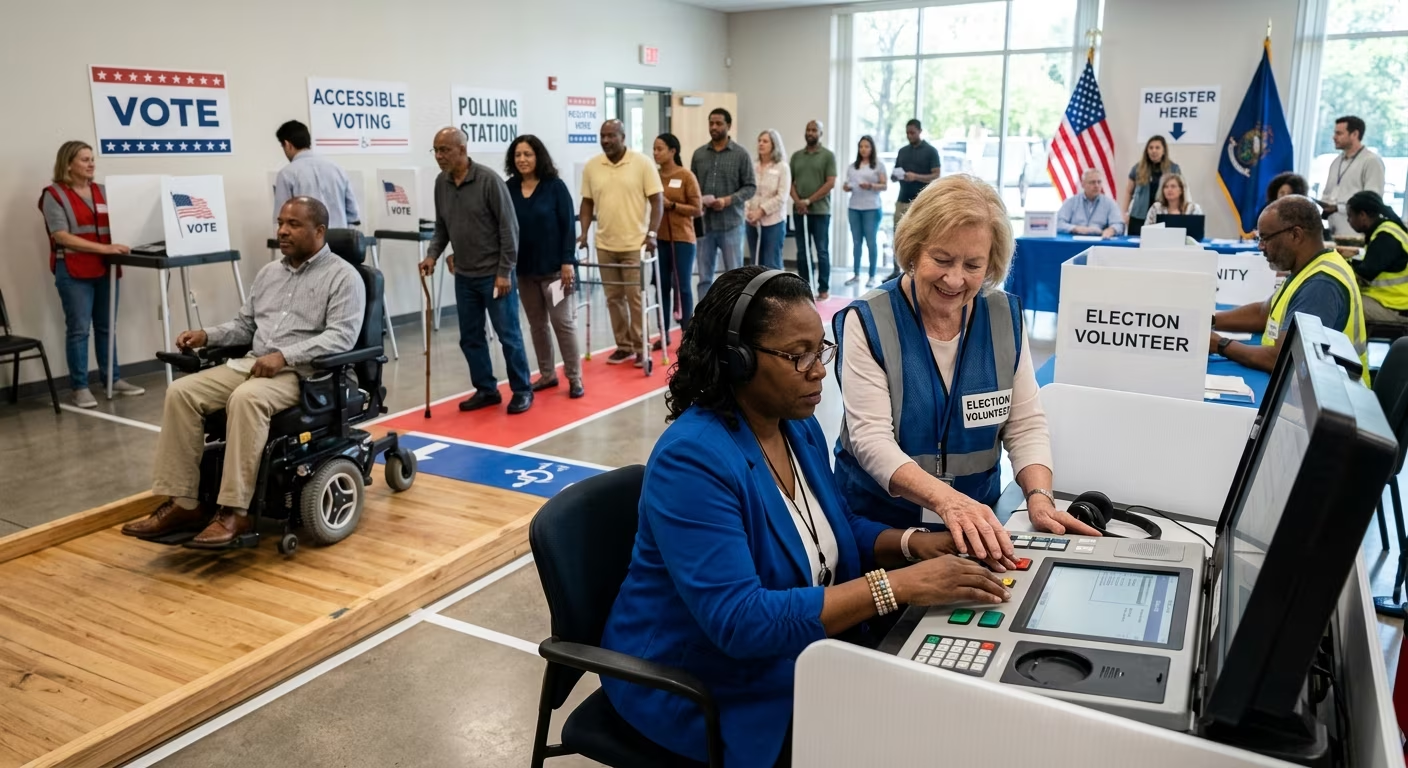
More than a decade after the ADA, Congress enacted HAVA to overhaul the nation’s election administration following the controversies of the 2000 presidential election. HAVA introduced specific, actionable mandates designed to safeguard the rights of disabled voters. Chief among these was the requirement that every jurisdiction conducting federal elections must provide at least one accessible voting system—such as a Ballot Marking Device (BMD)—at each polling location. Furthermore, HAVA explicitly guarantees that these accessible systems must afford voters with disabilities the same opportunity for privacy and independence as any other voter.
Despite the clarity of these federal mandates, widespread compliance remains frustratingly elusive. The existence of a law on paper does not automatically translate to a barrier-free experience on Election Day. Federal agencies, including the Department of Justice, routinely issue guidance and conduct audits, yet many local jurisdictions point to funding deficits, aging infrastructure, and decentralized election administration as excuses for their failure to comply. Consequently, the burden of enforcing these civil rights often falls on the shoulders of disabled voters and advocacy organizations through exhausting and protracted litigation.
Navigating the Built Environment: Physical Barriers at the Polls
One of the most visible manifestations of voting inequity lies in the physical environment of the polling places themselves. Across the country, elections are frequently hosted in schools, community centers, religious institutions, and historical buildings. While these venues are central to community life, they are frequently plagued by architectural barriers that render them hostile to individuals utilizing wheelchairs, walkers, or other mobility aids. A polling place cannot be considered truly democratic if a segment of the population cannot cross its threshold.
The Department of Justice’s ADA Checklist for Polling Places provides rigorous standards for physical accessibility, yet audits frequently reveal glaring violations. Common issues include the absence of designated accessible parking spaces with appropriate access aisles, heavily graded or uneven walkways, lack of curb ramps, and exterior doors that are either too heavy to open independently or lack functional automatic openers. Inside the venue, voters often navigate narrow corridors, inadequate lighting for those with low vision, and voting booths that do not accommodate the turning radius of a wheelchair.
Election administrators frequently attempt to bypass permanent architectural modifications by utilizing temporary measures on Election Day, such as portable ramps, propped doors, and temporary signage. While these low-cost solutions are legally permissible under certain conditions, they are notoriously prone to human error. A portable ramp left in a storage closet, a temporary sign blown over by the wind, or a heavy door allowed to swing shut can instantly disenfranchise a voter. When the built environment fails, voters with physical disabilities are forced to rely on the assistance of strangers or abandon their attempt to vote entirely.
Curbside voting is occasionally offered as an alternative for individuals unable to enter a polling facility. However, this accommodation is inconsistently applied and often poorly executed. Voters frequently report waiting in their vehicles for extended periods, struggling to alert poll workers to their presence, and ultimately sacrificing the privacy of their ballot as it is handed back and forth through a car window. True accessibility means having the option to vote side-by-side with one’s neighbors in a dignified, integrated setting.
Technological Disparities and Administrative Failures
In the modern era, technological innovations should theoretically eradicate many traditional barriers to accessible voting. Ballot Marking Devices (BMDs) and electronic voting interfaces are designed with vital features such as audio-tactile keypads, sip-and-puff compatibility, high-contrast screens, and text-to-speech functionality. These technologies are intended to allow voters with visual, auditory, and manual dexterity impairments to navigate the ballot and make their selections autonomously. Unfortunately, the presence of technology does not guarantee its usability.
A recurring nightmare for voters with disabilities is arriving at a polling place only to discover that the mandated accessible voting machine is non-operational. In many instances, the machines are simply left unplugged, positioned in corners lacking privacy, or missing essential peripheral equipment like headphones. These failures are rarely malicious; rather, they are the byproduct of systemic administrative neglect and inadequate preparation by local election boards.
The human element of election administration—the poll workers—often represents the weakest link in the accessibility chain. Poll workers are typically volunteers who undergo limited training shortly before Election Day. When confronted with an unfamiliar accessible voting machine, inadequately trained staff may express frustration, attempt to dissuade the voter from using the device, or worse, inappropriately offer to mark the paper ballot on the voter’s behalf. This direct violation of the voter’s right to cast a private and independent ballot transforms a technologically solvable problem into a degrading civic experience. Comprehensive, hands-on training regarding disability etiquette and accessible equipment operation is not an optional luxury; it is a critical necessity.
The Double-Edged Sword of Mail-In Voting
For millions of Americans with disabilities, the expansion of absentee and mail-in voting has been a crucial lifeline. Voting by mail bypasses the insurmountable physical barriers of traditional polling places, eliminates the anxiety of interacting with untrained poll workers, and allows individuals with chronic fatigue or pain to complete their ballots at their own pace. During the 2020 election cycle, the dramatic expansion of mail-in voting correlated with a notable surge in participation among voters with disabilities. Yet, this vital accommodation is currently under unprecedented legislative attack.
Under the guise of election security, numerous state legislatures and federal proposals—such as the debated SAVE America Act—have introduced stringent requirements that disproportionately penalize disabled voters. Strict signature matching protocols are particularly insidious. Conditions such as Parkinson’s disease, multiple sclerosis, severe arthritis, or visual impairments can cause a person’s signature to degrade or fluctuate significantly over time. When an absentee ballot is rejected due to a perceived signature mismatch, the voter is often unaware of the disenfranchisement until it is too late to cure the ballot.
Furthermore, new restrictions often demand that voters provide photocopies of government-issued identification or secure witness signatures to accompany their mail-in ballots. For an individual who is homebound, visually impaired, or lacks access to a printer or scanner, these administrative hurdles act as a modern-day poll tax. The bureaucratic labyrinth required to successfully cast a mail-in ballot under these restrictive regimes transforms an accessibility tool into a gauntlet of insurmountable paperwork, effectively silencing some of the nation’s most marginalized voices.
Even the design of the paper ballot itself can be exclusionary. Standard mail-in ballots require fine motor control to fill in tiny ovals and fold the document precisely into multiple security envelopes. The push toward electronic ballot delivery and return systems—which allow a voter to receive, mark, and return their ballot using their own assistive technology at home—is gaining traction, but is currently limited to a handful of states or restricted strictly to military and overseas voters.
Invisible Disabilities and the Guardianship Trap
The discourse surrounding voting accessibility frequently defaults to physical and sensory impairments, inadvertently overlooking the severe legal discrimination faced by individuals with cognitive, intellectual, and psychiatric disabilities. These “invisible” disabilities present unique challenges, but the most egregious barrier is not logistical—it is legal. In many states, archaic guardianship and conservatorship laws automatically strip individuals of their fundamental right to vote.
When a court appoints a guardian to assist an individual with financial or medical decisions, state constitutions often dictate an automatic loss of the ward’s electoral franchise. This blanket disenfranchisement operates on the flawed, discriminatory assumption that an individual requiring support in one area of life inherently lacks the capacity to express a political preference. Capacity is a highly nuanced, task-specific concept. The ability to manage a complex financial portfolio is entirely distinct from the ability to recognize a preferred candidate on a ballot.
Advocates have long fought to sever the automatic link between guardianship and disenfranchisement, arguing that voting rights should only be removed if a court specifically determines, by clear and convincing evidence, that the individual cannot communicate a desire to participate in the voting process. Until these archaic statutes are universally reformed, thousands of citizens with intellectual and developmental disabilities will remain legally barred from participating in the democratic processes that heavily dictate the social services and policies governing their lives.
Expanding the Electorate: Voter Turnout Data
Despite the relentless barrage of obstacles, the disability electorate has proven to be a highly motivated and expanding force in American politics. Extensive data analysis provides a clear picture of this demographic’s determination. Reports published by the U.S. Election Assistance Commission, in collaboration with Rutgers University, indicate that 15.8 million voters with disabilities cast a ballot in the 2022 elections. This immense voting bloc has the numerical power to swing local, state, and federal elections.
However, the data also highlights the persistent systemic friction. While turnout increased among disabled voters in recent cycles—largely due to temporary pandemic-era expansions of mail-in voting—a measurable turnout gap of approximately 1.5% remained in 2022 when compared to the non-disabled electorate. This gap is a direct metric of the suppression caused by inaccessible infrastructure, broken machinery, and restrictive absentee policies.
If citizens with disabilities voted at the precise same rate as citizens without disabilities with similar demographic characteristics, millions of additional votes would be cast. The data clearly suggests that when systemic barriers are lowered—such as through the universal provision of no-excuse absentee voting and the deployment of functional accessible technologies—the disability community engages at historic rates. The civic apparatus must evolve to meet the electorate where they are, rather than demanding the electorate overcome legislative and physical hurdles just to participate.
Paving the Path to an Inclusive Democracy
Achieving a truly accessible democracy requires a holistic, proactive approach from all levels of government. It demands a shift in perspective among election officials: accessibility cannot be treated as an afterthought or a tedious compliance checklist. It must be woven into the very fabric of election administration from the initial planning stages.
State and federal legislatures must prioritize the allocation of dedicated funding for election infrastructure, enabling local municipalities to replace outdated, inaccessible voting machines and permanently modify public buildings to meet ADA standards. Furthermore, rigorous, standardized poll worker training must be mandated across all jurisdictions. A poll worker must be as proficient in operating an audio-tactile keypad as they are at checking a voter registry.
Finally, the defense of expansive, accessible mail-in voting is paramount. Lawmakers must reject restrictive identification and signature matching laws that disproportionately harm disabled citizens. By embracing inclusive design, expanding electronic ballot return options, and dismantling discriminatory guardianship laws, the United States can move closer to realizing its foundational promise: a government that is truly of, by, and for all its people, without exception.
Frequently Asked Questions (FAQs)
- What does the Help America Vote Act (HAVA) mandate regarding accessibility?
HAVA requires that every jurisdiction responsible for conducting federal elections provide at least one accessible voting system (such as a Ballot Marking Device) at each polling place. These systems must allow voters with disabilities to cast their ballots privately and independently. - Can a voter with a disability bring someone to assist them at the polls?
Yes. Under the Voting Rights Act, any voter requiring assistance due to blindness, disability, or inability to read or write has the right to be assisted by a person of their choice. The only restriction is that the assistant cannot be the voter’s employer or an agent of their union. - How do strict signature matching laws impact voters with disabilities?
Strict signature matching requirements for mail-in ballots can unfairly disenfranchise voters whose fine motor skills or vision degrade or fluctuate due to conditions like Parkinson’s disease, multiple sclerosis, or arthritis. These natural variations can trigger erroneous ballot rejections. - What is curbside voting?
Curbside voting is an accommodation where poll workers bring a ballot or a portable voting machine out to a voter’s vehicle if they are physically unable to enter the polling location. While helpful, advocacy groups stress it should not replace the mandate to make the physical building fully accessible. - Do individuals under guardianship lose their right to vote?
It depends on state law. In some states, being placed under full guardianship automatically strips an individual of their right to vote. Advocates are actively fighting to change these laws so that cognitive capacity to vote is evaluated separately from the need for financial or medical guardianship.
References
- Disability and Voter Turnout in the 2022 Elections — U.S. Election Assistance Commission & Rutgers University. 2023-07. https://www.eac.gov/sites/default/files/2023-07/EAC_Rutgers_Disability_Voter_Turnout_2022.pdf
- The Americans with Disabilities Act and Other Federal Laws Protecting the Rights of Voters with Disabilities — U.S. Department of Justice. 2024-04-18. https://www.ada.gov/resources/protecting-voter-rights/
- Voters with Disabilities — National Conference of State Legislatures (NCSL). 2026-06-02. https://www.ncsl.org/elections-and-campaigns/voters-with-disabilities
- The SAVE America Act Threatens Accessible Voting for People With Disabilities — The Arc. 2026-03-20. https://thearc.org/blog/the-save-america-act-threatens-accessible-voting-for-people-with-disabilities/