
Oklahoma Service Animals and ESA Laws Guide
Comprehensive guide to Oklahoma's regulations on service dogs, emotional support animals, public access rights, and penalties for misrepresentation.
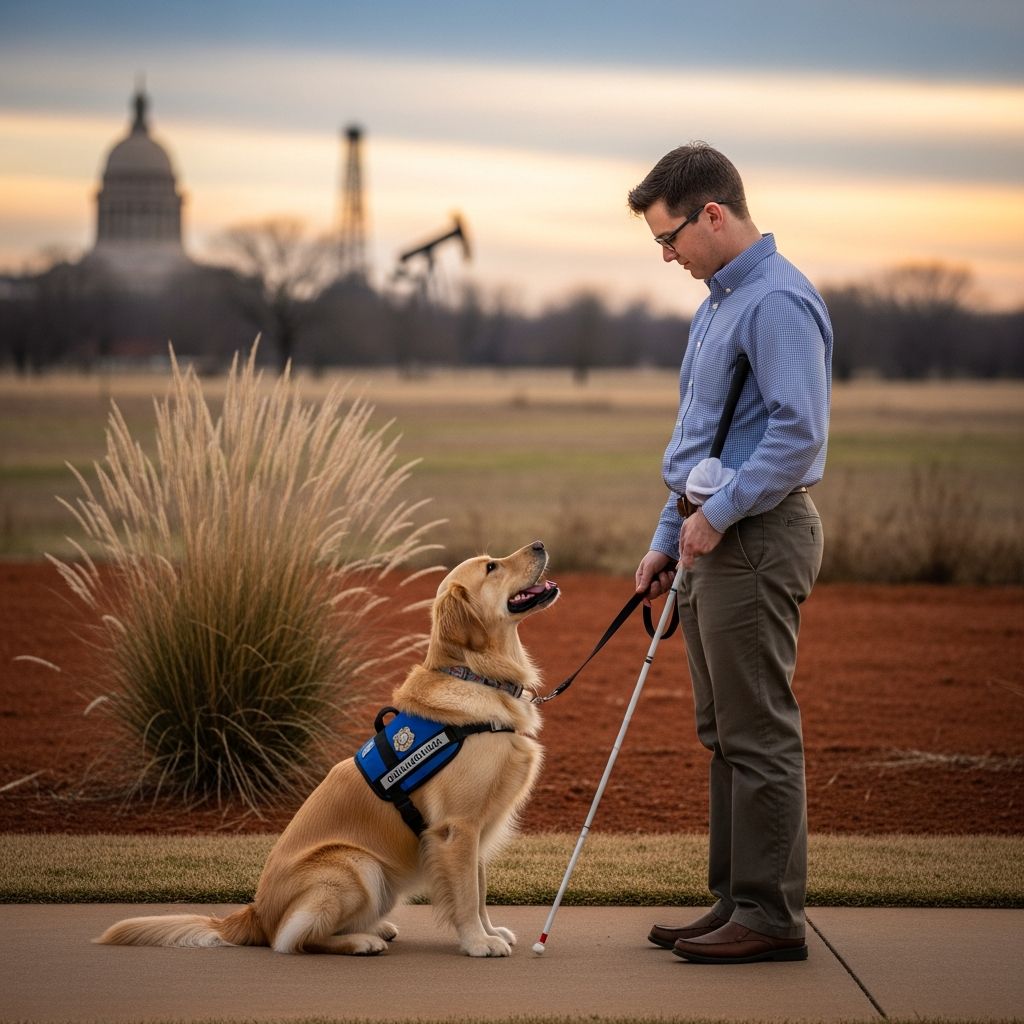
Oklahoma aligns closely with federal Americans with Disabilities Act (ADA) standards for service animals while enacting state-specific measures to protect legitimate users and curb misuse. Service animals, primarily dogs trained for disability-related tasks, enjoy broad public access, unlike emotional support animals (ESAs) limited mostly to housing.
Defining Service Animals in Oklahoma
Under both federal ADA and Oklahoma law, a
service animal
is a dog individually trained to perform specific tasks mitigating a person’s disability. This excludes animals providing mere comfort. Oklahoma Statutes §4-801 explicitly adopts the ADA definition from 28 C.F.R. §36.104, clarifying that service animals do not include ESAs or therapy animals.- Dogs of any breed or size qualify if trained for tasks like alerting to seizures, guiding the blind, or retrieving items.
- Miniature horses may qualify under ADA if trained, housebroken, under control, and feasible for the facility.
- Tasks must directly relate to the disability; emotional comfort alone does not suffice.
For instance, a dog trained to detect oncoming panic attacks and intervene differs from one offering passive companionship. Oklahoma’s HB 1178, effective November 1, 2025, reinforces this by penalizing misrepresentation of pets as service animals.
Distinctions: Service Animals vs. Emotional Support Animals
| Aspect | Service Animal | Emotional Support Animal (ESA) |
|---|---|---|
| Training | Individually trained for disability-specific tasks | No task training required; provides comfort |
| Public Access | Allowed in public places (ADA/Oklahoma law) | No public access rights beyond housing |
| Housing | Protected under FHA and state law | Protected under FHA with documentation |
| Legal Definition | ADA §36.104; OK Stat. §4-801 | Animal for emotional disability support, not task-performing |
ESAs reside with individuals to alleviate psychiatric symptoms but lack public access privileges. Oklahoma defines ESAs as non-task-performing animals not always accompanying the person. Therapy animals, used for visits to facilities, are distinct personal pets.
Public Access Rights for Service Animals
Service animals must accompany handlers in all public accommodations, including restaurants, stores, hospitals, schools, and hotels, unless their presence fundamentally alters operations (e.g., sterile surgical areas). Oklahoma Stat. §4-801 permits businesses to ban non-service animals but requires conspicuous signage stating service animals are allowed.
Businesses posting no-pet policies must comply with ADA inquiry limits. Recent HB 1178 mandates such signage and adherence to federal guidelines.
Business and Staff Responsibilities
Public venues cannot demand proof of training, certification, or vests—common misconceptions. Staff may only ask two questions:
- Is this a service animal required for a disability?
- What task or work is it trained to perform?
Prohibited actions include requesting demonstrations, medical details, or registration. Vests do not certify legitimacy. Businesses may remove animals only if out of control (uncontrollable by handler) or not housebroken.
Handlers ensure control via leash/harness/tether, or voice/signals if equipment interferes with tasks or disability.
Housing Protections for Assistance Animals
The federal Fair Housing Act (FHA) supersedes in Oklahoma, mandating “no pet” housing accept service animals and ESAs as reasonable accommodations. Landlords verify ESAs via professional letters but cannot charge pet fees for verified animals.
Service animals gain entry without documentation due to task-training presumption. Evictions require proof of undue burden, rare for single animals. Oklahoma follows FHA without stricter state overrides.
State-Specific Protections and Recent Legislation
Local governments can require licensing/vaccination if applied to all animals, or voluntary registration, but not mandatory service animal certification. HB 1178 (2025) introduces misdemeanor penalties for knowingly misrepresenting pets to access privileges, deterring fraud and protecting genuine users.
Effective November 1, 2025, it mandates signage and federal compliance, joining 33 states with such measures. Sen. David Bullard emphasized preventing obstacles for disabled Oklahomans.
Handler Obligations and Best Practices
- Maintain control and housebreaking at all times.
- Respond calmly to permitted inquiries.
- Train consistently; self-training is valid under ADA.
- Clean up waste promptly.
Voluntary registration aids identification but is not required.
Consequences of Misrepresentation
Misrepresenting a pet as a service animal is now a misdemeanor under HB 1178, addressing exploitation that burdens businesses and undermines trust. Civil remedies remain available. Penalties safeguard access for true handlers.
Frequently Asked Questions
Can Oklahoma require service dog certification?
No, mandatory certification violates ADA; voluntary only.
Do service animals need vests in Oklahoma?
No, vests are optional and not proof of status.
Are ESAs allowed in Oklahoma public places?
No, only service animals; ESAs limited to housing.
What if a service dog is disruptive?
Businesses can request removal if uncontrollable or unhousedbroken.
Does HB 1178 affect housing?
No, it targets public access misrepresentation.
Training and Resources for Oklahomans
Organizations like Oklahoma ABLE Tech provide guidance. Handlers should know rights; businesses train staff on ADA/OK laws. Recent laws like HB 1178 enhance clarity and enforcement.
References
- What You Should Know About Service Animals — Oklahoma ABLE Tech. Accessed 2026. https://www.okabletech.org/what-you-should-know-about-service-animals/
- Service Animal Protection Bill Becomes Law — Oklahoma House of Representatives. 2025-05-30. https://www.okhouse.gov/posts/news-20250530_3
- Oklahoma Statutes §4-801 (2024) — Justia / State of Oklahoma. 2024. https://law.justia.com/codes/oklahoma/title-4/section-4-801/
- Senator’s proposed bill would prevent service animal misrepresentation — Guthrie News Page. Accessed 2026. https://guthrienewspage.com/senators-proposed-bill-would-prevent-service-animal-misrepresentation/
- HB3930 | Oklahoma 2026 | Service animals — TrackBill. Accessed 2026. https://trackbill.com/bill/oklahoma-house-bill-3930-service-animals-definition-written-notice-fines-effective-date/2775677/
Similar Articles








Read full bio of medha deb


