
Understanding Oklahoma Gambling and Gaming Laws
Learn how Oklahoma regulates casinos, tribal gaming, charitable games, and betting, and what activities are illegal.
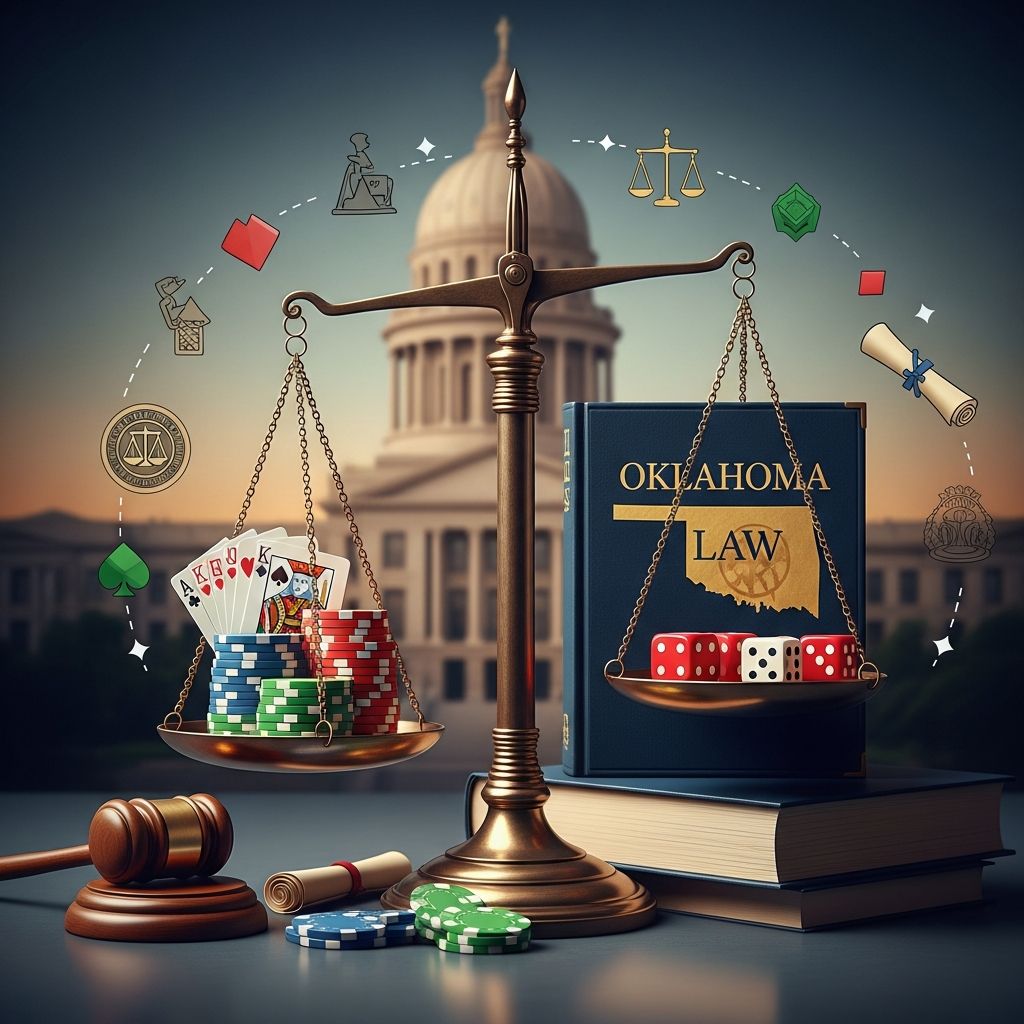
Oklahoma has one of the largest tribal gaming markets in the United States, yet many forms of gambling remain tightly restricted under state law. Understanding the difference between legal, regulated gaming and criminal gambling activity is essential for players, businesses, and charitable organizations operating within the state.
This guide explains how Oklahoma defines gambling, which activities are allowed, how tribal casinos are regulated, and what penalties apply when the law is violated.
1. How Oklahoma Law Defines Gambling
Oklahoma criminal law generally prohibits betting money or anything of value on games of chance or on the outcome of events, unless a specific statute authorizes the activity. While the exact statutory language is technical, most gambling offenses share three core elements:
- Consideration – the player risks money or something of value to take part in the game or wager.
- Chance – the outcome depends largely on luck (even if skill has some role).
- Prize – the player can win money, property, or another thing of value.
If all three elements are present and no statute specifically allows the activity, it is typically treated as illegal gambling under Oklahoma law.
2. Legal vs. Illegal Gambling at a Glance
The table below summarizes the general status of common gambling activities in Oklahoma. Always confirm current law before relying on this summary, as the legislature and tribal-state compacts can change.
| Activity | Legal Status (Overview) | Primary Legal Basis / Notes |
|---|---|---|
| Tribal casinos (slot-style games, table games) | Legal on tribal lands under compacts | State–tribal gaming compacts govern Class III games and exclusivity fees. |
| State lottery | Legal | Authorized by constitutional amendment and enabling statutes. |
| Charitable bingo and raffles | Legal with license | Nonprofit organizations may operate under specific licensing and prize limits. |
| Private social games at home (no house profit) | Generally tolerated if no one makes a profit as operator | Still subject to criminal statutes if run as a business or house takes a cut. |
| Commercial (non-tribal) casinos | Illegal | Operating a gambling house outside authorized tribal operations is a crime. |
| Unlicensed sports betting (bookmaking) | Illegal | Sports wagering remains prohibited under state law; legislative efforts are ongoing. |
| Online casinos & offshore betting sites | Not authorized | No state-licensed internet casinos; offshore sites operate outside state regulation. |
3. Tribal Gaming and Compacts in Oklahoma
The backbone of legal gambling in Oklahoma is tribal gaming. Under the federal Indian Gaming Regulatory Act (IGRA), Native American tribes may offer certain forms of gaming on tribal lands if they enter into compacts with the state for Class III games (such as slot-style machines and table games).
3.1 State–Tribal Gaming Compacts
Oklahoma has signed compacts with numerous federally recognized tribes, allowing them to operate casinos and electronic gaming facilities. In return for the exclusive right to offer key Class III games, tribes pay the state a percentage of revenues, known as exclusivity fees.
- Exclusivity payments are based on a sliding scale of Class III gaming revenues.
- For electronic games, tribes generally pay between 4% and 6% of specified revenue brackets.
- For table games, tribes pay a higher percentage, often around 10% of monthly net win.
According to the Oklahoma Gaming Compliance Unit, tribal gaming generated more than $3.64 billion in Class III gaming revenue for fiscal year 2025, resulting in over $221 million in exclusivity fees to the state. These funds support state programs and help fund regulatory oversight.
3.2 Games Allowed at Tribal Casinos
Under the compacts and federal law, tribal facilities in Oklahoma may offer a wide range of games, including:
- Electronic or slot-style devices that mimic traditional slots or bingo-based systems.
- Table games such as blackjack, poker variations, and certain card games, as permitted by the compact.
- Some tribes also operate racetrack casinos (“racinos”) that combine horse racing with casino-style gaming.
Each compact specifies the types of games allowed, technical standards, auditing rules, and minimum internal controls. Tribes must also adhere to federal regulations enforced by the National Indian Gaming Commission.
3.3 State Oversight and Compliance
The Gaming Compliance Unit within the Oklahoma Office of Management and Enterprise Services monitors compliance with state-tribal compacts. Its responsibilities include:
- Verifying accuracy of exclusivity fee calculations and payments.
- Reviewing auditing and accounting procedures used for gaming revenue.
- Ensuring licensing and background checks for certain employees meet compact and state standards.
- Enforcing minimum standards for game integrity, liability insurance, and dispute procedures.
Although tribes primarily regulate their own casinos through gaming commissions, state oversight ensures that compact obligations, including revenue-sharing, are satisfied.
4. Sports Betting in Oklahoma: Still a Work in Progress
Sports wagering remains one of the most active and unsettled areas of Oklahoma gaming policy. As of 2025, no statewide legal sports betting market has launched, but multiple bills and negotiations have sought to change that.
4.1 Legislative Efforts
In recent legislative sessions, state lawmakers have repeatedly introduced bills to authorize sports betting, primarily through tribal casinos.
- House Bill 1047 would supplement the Model Tribal Gaming Compact to permit tribes to offer sports wagering in exchange for a 10% exclusivity payment to the state on sports betting revenue.
- House Bill 1101 proposes a statewide voter referendum on sports betting, mirroring many provisions of HB 1047 and providing a mechanism for tribes to adopt compact supplements if approved.
- Both measures advanced through the Oklahoma House of Representatives, but stalled in the Senate during the 2025 session and were not enacted into law by the deadline for consideration.
According to legislative updates, these proposals are expected to be revisited in future sessions, with policymakers and tribal leaders continuing negotiations on issues such as mobile betting boundaries and regulatory “guardrails.”
4.2 Key Policy Questions
Current debates about Oklahoma sports betting focus on several core questions:
- Whether tribes should hold exclusive rights to both in-person and mobile sports wagering.
- How mobile betting would be limited geographically (for example, only on tribal lands, within tribal territories, or statewide under geolocation rules).
- Tax rates on retail and mobile wagers, licensing fees for any non-tribal market participants, and how revenues will be distributed.
- Funding for problem gambling prevention and treatment, which legislators have tied to sports betting proposals.
Until a bill is enacted and compacts are updated, any sports betting conducted in Oklahoma outside of narrow exceptions (such as bets made under law in other jurisdictions) is considered illegal under state law.
5. Charitable Gaming: Bingo, Raffles, and Fundraising Games
While commercial gambling is largely prohibited, Oklahoma allows certain games of chance for charitable and nonprofit purposes under specific conditions. These activities usually require registration or licensing and are subject to prize limits and reporting rules.
5.1 Typical Requirements for Charitable Games
Charitable gaming statutes are designed to ensure that the majority of proceeds benefit legitimate nonprofit causes, rather than private operators. Common regulatory requirements include:
- The sponsoring organization must be a qualified nonprofit (such as a religious, educational, veterans, or civic organization).
- Games such as bingo and raffles may only be offered in accordance with state law, with appropriate licensing or registration.
- Net proceeds must be used for charitable, educational, or similar nonprofit purposes.
- Administrative expenses and compensation to workers are often capped or tightly limited.
Organizations that fail to follow these rules risk loss of their license and potential criminal penalties, especially if games are used as a cover for commercial gambling.
6. Criminal Offenses and Penalties
Oklahoma criminal statutes prohibit both participating in illegal gambling and operating gambling businesses that are not authorized by law. Penalties vary depending on the type of conduct and whether the defendant is a player, a promoter, or an operator.
6.1 Common Gambling-Related Offenses
While the specific statute numbers are not reproduced here, Oklahoma gambling crimes typically include:
- Keeping a gambling house – operating or assisting in the operation of a place where unlawful gambling occurs.
- Commercial gambling – running or profiting from a gambling enterprise that is not authorized by law, such as taking a share of the pot or charging a fee for illegal games.
- Bookmaking – accepting or laying off bets on sporting events or other contests outside of legal channels.
- Possession of gambling devices – owning or controlling slot machines or similar devices intended for illegal use.
- Cheating and fraud – using marked cards, loaded dice, or other means to defraud players or casinos.
Some offenses are misdemeanors punishable by fines and short jail terms, while large-scale or repeated violations, especially those involving organized operations, may be charged as felonies.
6.2 Enforcement and Regulatory Coordination
Gambling law enforcement in Oklahoma involves multiple agencies, sometimes in coordination with federal authorities:
- Local police and county sheriffs investigate small-scale gambling operations, such as unlicensed card rooms or sports betting rings.
- The Oklahoma Bureau of Narcotics and Dangerous Drugs Control and other state investigative bodies may become involved when gambling intersects with organized crime, money laundering, or other serious offenses.
- On tribal lands, tribal gaming commissions and law enforcement agencies regulate casino operations and partner with state and federal officials when criminal activity arises.
- The National Indian Gaming Commission participates in enforcement of federal gaming laws under IGRA.[IGRA]
Because gambling activities often cross state lines or involve electronic communications, federal agencies such as the FBI or U.S. Department of Justice may also become involved in major cases.
7. Consumer Protection and Problem Gambling
While Oklahoma permits extensive gaming through tribal casinos, both state and tribal authorities emphasize the need to address gambling-related harms. Legislative proposals and compacts frequently include provisions for prevention and treatment of problem gambling.
7.1 Funding for Treatment
Recent sports betting bills have explicitly preserved or expanded funding for compulsive gambling treatment. For example, House Bill 1047 maintained a monthly allocation of $20,833 to the Oklahoma Department of Mental Health and Substance Abuse Services for the treatment of gambling addiction.
These funds support services such as:
- Counseling and therapy for individuals with gambling disorder.
- Public education campaigns about the risks of excessive gambling.
- Training for clinicians to recognize and treat gambling-related conditions.
7.2 Recognizing Gambling Disorder
The American Psychiatric Association classifies gambling disorder as a behavioral addiction with features similar to substance use disorders.[DSM5] Signs may include:
- Increasing amounts wagered to achieve excitement.
- Repeated unsuccessful efforts to cut back or stop.
- Chasing losses and gambling to relieve distress.
- Jeopardizing relationships, jobs, or finances because of gambling.
Individuals who experience these symptoms are encouraged to seek professional help or contact state-supported helplines.
8. Practical Tips for Staying Within the Law
Because Oklahoma’s gambling laws combine state statutes, tribal compacts, and federal regulations, misunderstandings are common. The following guidelines can help individuals and organizations avoid inadvertent violations:
- Use only licensed tribal casinos or state-authorized games for wagering. These facilities are regulated for fairness and consumer protection.
- Avoid unlicensed online casinos or offshore betting sites claiming to accept Oklahoma players. These platforms operate outside state regulation and offer no legal recourse.
- Confirm charitable gaming rules with state authorities before running a bingo night, raffle, or similar fundraiser.
- If hosting home games, ensure they are truly social: no house rake, no admission or seat fee, and no one profiting as a promoter.
- Consult an Oklahoma-licensed attorney when planning any business model involving games of chance or betting to ensure compliance with current law.
9. Frequently Asked Questions (FAQs)
Q1: Are online casinos legal for Oklahoma residents?
No. Oklahoma has not authorized any state-licensed internet casino platforms. Offshore websites that accept Oklahoma players are not regulated by the state and may violate Oklahoma gambling laws.
Q2: Can I legally bet on sports in Oklahoma?
As of the most recent legislative session, statewide sports betting has not yet launched. Proposed bills would authorize tribal sports betting and possibly mobile wagering, but those measures have not been enacted into law.
Q3: Are poker games at home legal?
Small, private poker games are generally less likely to be prosecuted if no one operates the game as a business, no rake or house fee is charged, and all money goes back to players. However, any game can become illegal if run commercially or if local law enforcement determines it violates state gambling statutes.
Q4: How many tribal casinos operate in Oklahoma?
Oklahoma has dozens of tribal gaming facilities operated by multiple federally recognized tribes, making it one of the nation’s largest tribal gaming markets. Exact numbers can change as facilities open, close, or expand, so consult current state or tribal resources for up-to-date figures.
Q5: Where does the money from tribal gaming go?
Tribal gaming revenues primarily support tribal government services such as health care, education, housing, and infrastructure. Under the state–tribal compacts, a portion of Class III gaming revenue is paid to the State of Oklahoma as exclusivity fees, which exceeded $221 million in fiscal year 2025.
References
- Gaming Compliance Report 2025 — Oklahoma Office of Management and Enterprise Services. 2025-06-30. https://oklahoma.gov/content/dam/ok/en/omes/documents/gaming-compliance-report-2025-UA.pdf
- House Passes Bills for Sports Betting and Gaming Compact Supplements — Oklahoma House of Representatives. 2025-03-27. https://www.okhouse.gov/posts/news-20250327_1
- Oklahoma sports betting bills stall in 2025 session — The Journal Record. 2025-06-02. https://journalrecord.com/2025/06/02/sports-betting-oklahoma-2025-legislation-stalls/
- Oklahoma Casinos | 2025 Updates — 500 Nations. 2025-04-03. https://www.500nations.com/Oklahoma_Casinos.asp
- Oklahoma Sports Betting: Legal OK Sportsbooks & Legislation — Legal Sports Report. 2025-04-20. https://www.legalsportsreport.com/sports-betting-states/oklahoma/
- Diagnostic and Statistical Manual of Mental Disorders, Fifth Edition (DSM-5) — American Psychiatric Association. 2013-05-18. https://doi.org/10.1176/appi.books.9780890425596
Similar Articles








Read full bio of medha deb


