
Nunchucks And The Law: Practical Guide For Owners In 2025
Understand how U.S. law treats nunchucks, from state restrictions to self-defense rules and responsible ownership.
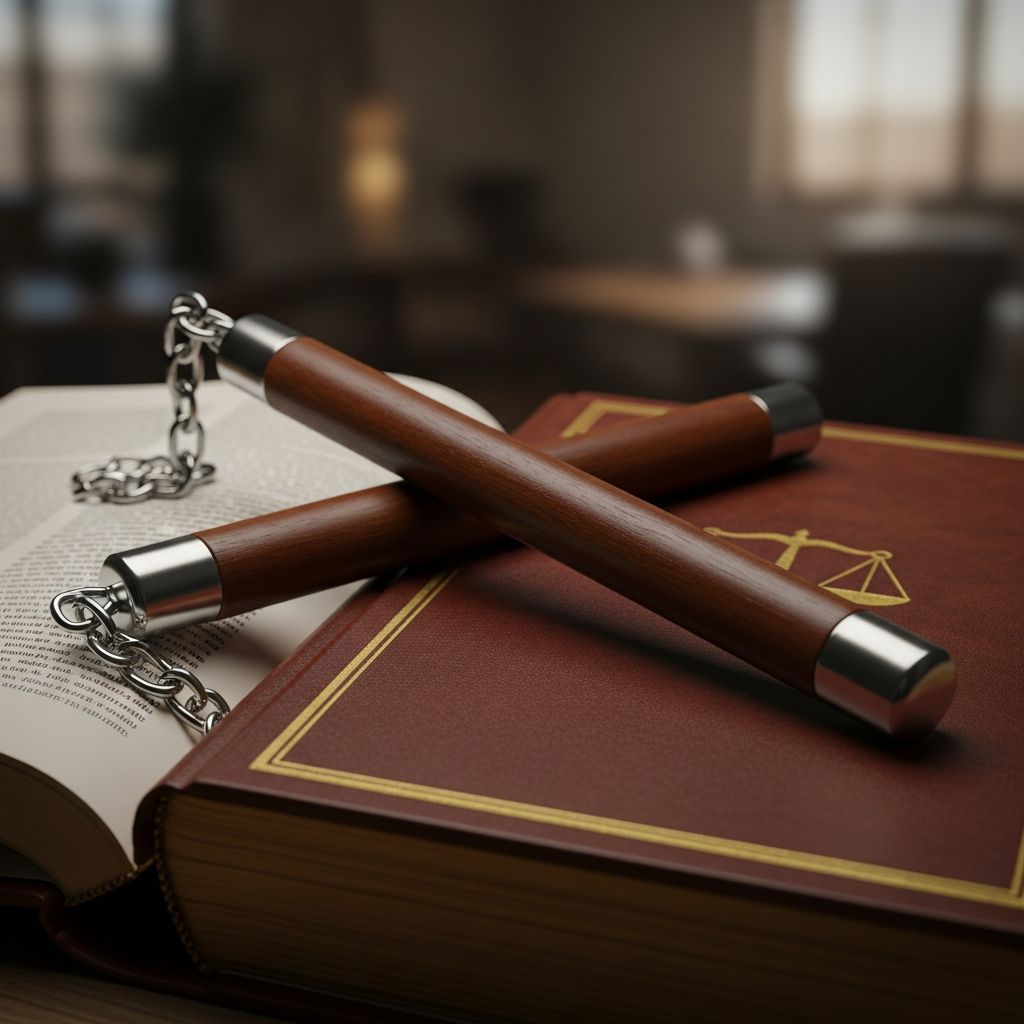
Nunchucks, also known as nunchaku, are iconic martial arts tools that sit at the crossroads of sport, culture, and weapons law. Although many people associate them with movies and training halls, in the eyes of the law they are often treated as dangerous weapons, heavily regulated or even banned in certain jurisdictions. Understanding when and where you may legally own, carry, or use nunchucks is essential for martial artists, collectors, and anyone interested in self-defense.
This guide explains how U.S. law approaches nunchucks, what restrictions still exist, how self-defense principles apply, and what steps you can take to minimize legal risk while practicing responsibly.
What Are Nunchucks from a Legal Perspective?
In everyday language, nunchucks are two sticks connected by a rope, cord, or chain and used in various martial arts traditions. Legally, however, they are frequently classified as a form of impact weapon or “dangerous weapon,” similar to batons or clubs.
While each jurisdiction defines them slightly differently, many criminal codes focus on three key characteristics:
- Two or more rigid handles
- Joined by a flexible connector (chain, rope, cord, or strap)
- Designed or used for striking, choking, or restraining
Because nunchucks concentrate force into a small striking surface and can be rapidly swung, lawmakers often treat them as weapons with a high potential for serious injury.
Why Did Nunchucks Become Regulated?
Starting in the 1970s, several U.S. states passed laws restricting or banning nunchucks outright. Legislatures often cited fears about youth violence and the perceived rise of “street gangs” adopting martial arts weapons, with relatively little hard data to back those concerns.
Common policy concerns included:
- Severity of potential injuries from blunt-force trauma to the head or limbs
- Ease of concealment compared with larger impact weapons like baseball bats
- Pop culture influence making nunchucks fashionable among teenagers without training
- Lack of legitimate non-martial uses compared to tools like pocketknives
Over time, however, courts and lawmakers began reassessing blanket bans, especially where nunchucks were primarily used for lawful martial arts training and there was little evidence they were commonly used in crime.
Overview of U.S. Nunchuck Laws
Today, nunchuck regulations in the United States vary widely. Broadly, states fall into three categories:
- States with strict bans or near-bans on possession
- States that regulate carrying but allow ownership
- States with minimal or no specific restrictions
State-Level Trends
Historically, four states enacted broad bans on civilian ownership of nunchucks: New York, California, Arizona, and Massachusetts. Court challenges and legislative reforms have since dismantled three of those prohibitions:
- New York: Its statewide ban on nunchucks was struck down in 2018 on Second Amendment grounds.
- Arizona: Previously treated nunchucks as prohibited weapons, but legalized them in 2019.
- California: Repealed its longstanding prohibition in 2021, making nunchucks generally legal with typical weapons limitations.
- Massachusetts: Still classifies nunchucks as “dangerous weapons,” with significant restrictions remaining in place.
In many other states, nunchucks are lawful to own but may be regulated when carried in public, brought onto school property, or possessed by minors.
| Legal Status Category | Typical Features | Example Situations |
|---|---|---|
| Broad Prohibition | Possession treated as criminal in most settings, with narrow exceptions for martial arts schools or law enforcement. | Carrying nunchucks in public or keeping them at home may be illegal without special authorization. |
| Regulated Possession | Owning at home usually allowed; restrictions on concealed carry, public display, or possession on school grounds. | Legal to keep for training, but unlawful to carry into government buildings or concealed on your person. |
| Minimal Restrictions | No specific nunchuck statute; general weapon and assault laws still apply. | Owning and transporting is typically lawful, but using them to threaten or attack is still criminal. |
Because legal rules are highly local, city or county ordinances may impose additional limits even in states that otherwise permit nunchucks. Anyone interested in ownership should research both statewide and local codes.
Nunchucks and the Second Amendment
Legal debates around nunchucks increasingly intersect with constitutional law. The U.S. Supreme Court has held that the Second Amendment protects ownership of “bearable arms” commonly used by law-abiding citizens for lawful purposes, not just firearms.
Recent decisions affecting nunchuck laws have emphasized that:
- “Arms” under the Second Amendment include more than guns, extending to other carried weapons such as knives and impact weapons.
- Where a weapon is widely used in lawful activities, like martial arts training or home defense, outright bans face greater constitutional scrutiny.
- Regulations focusing on how, where, and by whom weapons are carried may be more defensible than broad prohibitions on simple possession in the home.
Nonetheless, the Second Amendment does not automatically invalidate every restriction. Courts continue to weigh factors such as historical regulations, public safety concerns, and the nature of the weapon when evaluating challenges.
Owning Nunchucks: Key Legal Considerations
If you are considering acquiring nunchucks, you should think carefully about where you live, what you plan to do with them, and who might have access to them.
Questions to Ask Before You Buy
- Is possession legal in my state and city?
Check criminal codes and any weapon-specific statutes. Some states still treat nunchucks as prohibited or restricted weapons. - Are there age limitations?
Retailers may restrict sales to adults, and some jurisdictions forbid minors from possessing certain weapons. - Are there location-based restrictions?
Even where ownership is legal, bringing nunchucks onto school grounds, into courthouses, airports, or other secure facilities may be a crime. - Will I transport them in public?
Carrying nunchucks openly or concealed can trigger additional legal issues, particularly if law enforcement believes they are intended for use as a weapon.
Safe Storage and Handling
To reduce both safety risks and potential legal problems:
- Store nunchucks in a secure location, away from children or untrained individuals.
- Transport them in a closed bag or case, especially when traveling to and from training.
- Avoid carrying them casually in public spaces, even if legal, as this may draw police attention and lead to difficult encounters.
- Use foam or training versions in beginner classes or demonstrations where injuries are more likely.
Nunchucks in Martial Arts Training
For many practitioners, nunchucks are not a weapon of choice for real-world confrontations but a training tool for coordination, timing, and historical study. Schools that incorporate nunchucks typically emphasize:
- Hand–eye coordination and rhythm
- Grip transitions and control
- Spatial awareness to avoid self-injury
- Respect for the potential for harm
Because some jurisdictions ban or heavily restrict nunchucks, martial arts schools may need permits, special storage arrangements, or written policies to comply with local law. In some places, exemptions are written directly into the law for recognized dojos, clubs, or instructors.
Self-Defense and Use of Force with Nunchucks
Even if it is legal to possess nunchucks, using them against another person can expose you to serious criminal liability unless the use of force meets strict self-defense criteria. U.S. self-defense law varies by state, but there are common themes reflected in state criminal codes and model standards.
General Principles of Self-Defense
Most jurisdictions require that defensive force be:
- Necessary: You reasonably believed force was required to prevent imminent unlawful harm.
- Proportional: The level of force (including use of a weapon) was not clearly excessive compared to the threat.
- Not initiated by the defender: You were not the aggressor or, if you started the confrontation, you clearly withdrew before using force.
- Directed at an unlawful threat: The other person was not acting under legal authority (such as a police officer performing a lawful duty).
Because nunchucks can inflict serious injury, using them may be viewed as deadly force or at least as force likely to cause grave bodily harm. Courts may therefore expect a correspondingly severe threat—such as a credible fear of serious injury or death—before accepting their use as reasonable.
Practical Risks of Defensive Use
- Perception by police and juries: A trained martial artist using a specialized weapon may be portrayed as more dangerous than a layperson improvising with whatever is at hand.
- Injury severity: Head strikes or joint attacks can result in permanent damage, increasing the likelihood of severe criminal charges.
- Civil liability: Even if prosecutors decline charges, the injured person (or their family) may file a civil lawsuit seeking damages.
For these reasons, many instructors stress that nunchucks should be treated primarily as training implements and heritage weapons, not primary tools for everyday self-defense.
Criminal Charges Related to Nunchucks
Depending on the circumstances and jurisdiction, behavior involving nunchucks can lead to a range of criminal charges beyond simple weapons violations. These may include:
- Unlawful possession of a weapon: Where nunchucks are restricted or banned, mere possession may constitute a misdemeanor or felony.
- Carrying a dangerous weapon: Even in states where ownership is lawful, carrying nunchucks in certain public places or concealed can be criminal.
- Assault or aggravated assault: Threatening someone with nunchucks or striking them can support assault charges, with penalties increased when a weapon is involved.
- Disorderly conduct: Brandishing nunchucks in public or using them in a way that causes fear or disruption can lead to public order offenses.
Convictions can bring fines, probation, imprisonment, and a criminal record that may affect employment, travel, and firearm rights.
Practical Tips for Staying on the Right Side of the Law
Anyone who trains with or collects nunchucks should take proactive steps to remain compliant and minimize legal risk.
- Verify current law in your jurisdiction.
Legal landscapes change. Court decisions and legislative reforms in the past decade have significantly altered nunchuck regulations in several states. - Keep documentation for training purposes.
Membership cards, dojo enrollment, or instructor certifications may help show a legitimate, non-criminal use if questions arise. - Avoid unnecessary public display.
Practice in appropriate private or gym settings rather than in parks, streets, or parking lots. - Use training-grade equipment when possible.
Foam or padded nunchucks reduce injury risk and may be viewed more leniently in some contexts. - Seek legal advice if charged or questioned.
If law enforcement seizes your nunchucks or you face charges, consult a qualified attorney familiar with local weapon laws.
Frequently Asked Questions About Nunchuck Laws
Q: Are nunchucks legal everywhere in the United States?
No. Nunchuck laws are highly state-specific, and some jurisdictions still treat them as dangerous or prohibited weapons. While several state bans have been struck down or repealed, at least one state continues to heavily restrict possession, and local ordinances may add further limitations.
Q: Can I keep nunchucks at home for martial arts practice?
In many states, yes—provided there is no active ban or special permit requirement. However, where nunchucks are classified as prohibited or highly restricted weapons, even keeping them at home without authorization can be illegal. Always check your state and local codes before purchasing or possessing them.
Q: Are training nunchucks (foam or plastic) treated differently under the law?
Some laws define nunchucks broadly enough to include any two rigid handles joined by a flexible connector, regardless of material. Other jurisdictions may focus on whether the item is capable of causing serious injury. Foam trainers may be viewed more leniently, but you should not assume they are exempt unless your local law clearly says so.
Q: Can I carry nunchucks for self-defense?
Carrying nunchucks in public for self-defense is risky legally. In some places, carrying them at all may be illegal; in others, officers and courts may interpret visible or concealed carry as evidence of intent to use a dangerous weapon. Even where possession is lawful, using nunchucks in a confrontation can expose you to serious criminal charges if your actions are not clearly justified under self-defense law.
Q: Do Second Amendment rulings mean all nunchuck bans are unconstitutional?
Not automatically. Courts have applied Second Amendment principles to strike down some broad bans, especially where evidence shows that law-abiding citizens commonly use nunchucks for lawful purposes such as martial arts. However, regulations on how and where they may be carried, or restrictions in sensitive places, may still be upheld. Each law must be evaluated on its own terms.
References
- Federal Court Overturns NYS Nunchuck Ban — Neil H. Greenberg, The NHG Law Group. 2019-04-01. https://www.nhglaw.com/wp-content/uploads/2019/04/Nunchucks.pdf
- Massachusetts Is The Only State That Still Bans Nunchucks. Could A Recent Court Decision Change Impact Weapons Laws? — Boston Institute for Nonprofit Journalism. 2025-04-11. https://binj.news/2025/04/11/massachusetts-is-the-only-state-that-still-bans-nunchucks-court-a-recent-court-decision-impact-weapons-laws/
- Nunchaku — Wikipedia (summary of legal status with citations to statutes and cases). Last updated 2024-05-27. https://en.wikipedia.org/wiki/Nunchaku
- Legal Notice — The American Nunchaku Company. 2021-10-01 (approx.). https://usanunchaku.com/legal-notice/
- Nunchucks Legality by State 2025 — World Population Review. 2025-01-01 (approx.). https://worldpopulationreview.com/state-rankings/nunchucks-legality-by-state
Similar Articles








Read full bio of medha deb


