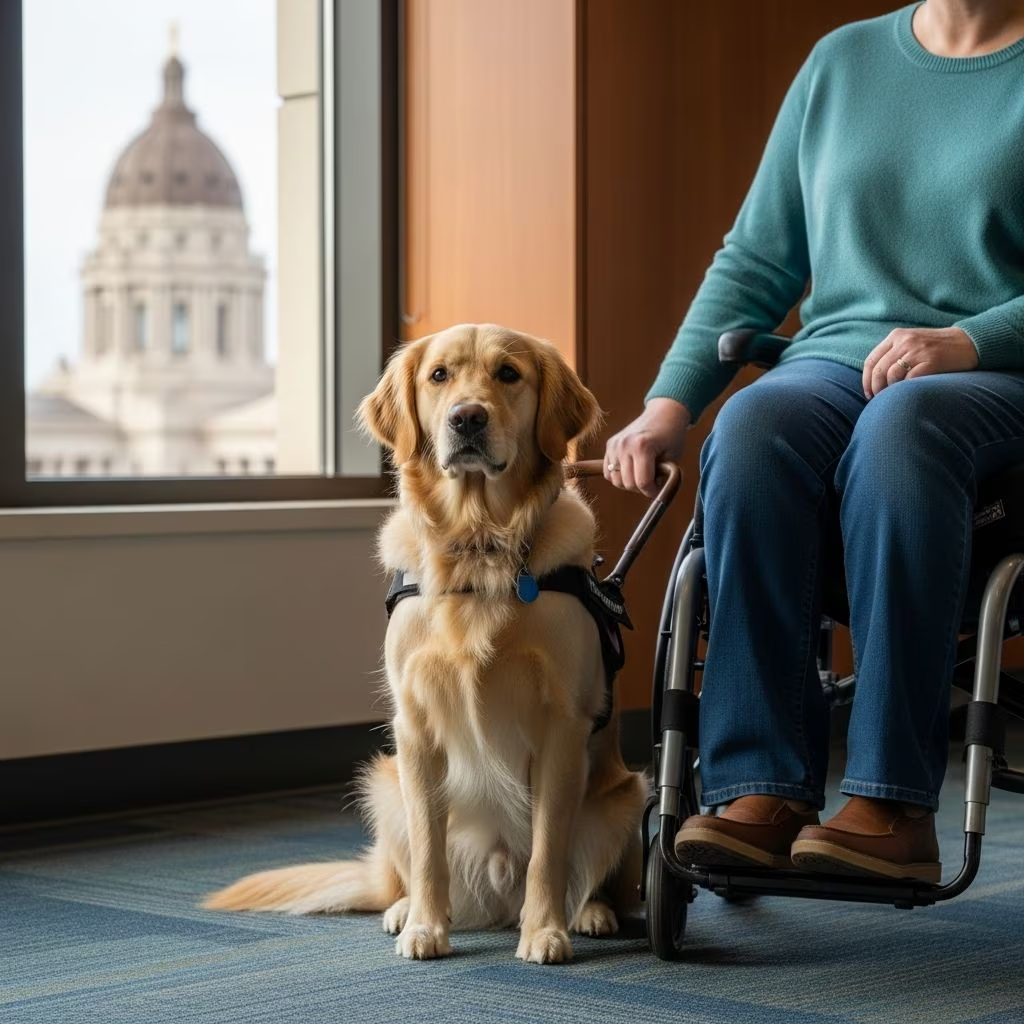
Individuals with disabilities in North Dakota benefit from robust legal protections for service animals in public settings and emotional support animals (ESAs) in residential environments. These rights stem from both state statutes and federal regulations, ensuring equal access without discrimination.
Understanding Service Animals Under State Law
North Dakota defines a **service animal** exclusively as a dog that undergoes specific training to execute tasks, perform work, or offer assistance directly linked to an individual’s disability. This encompasses a broad spectrum of impairments, including physical and mental conditions that substantially limit major life activities.
Examples of qualifying tasks include guiding the visually impaired, alerting the hearing impaired to sounds, pulling wheelchairs, providing stability for mobility issues, retrieving dropped items, detecting seizures or blood sugar fluctuations, interrupting harmful behaviors tied to psychiatric conditions, and offering physical or sensory support during medical episodes.
The state’s definition aligns closely with the federal Americans with Disabilities Act (ADA), which also prioritizes dogs but permits miniature horses in limited scenarios if they meet behavioral and size criteria.
Public Access Protections for Service Animals
North Dakota law mandates that service animals accompany their handlers in all public accommodations, common carriers, healthcare facilities, and any venue open to the general public. This includes retail stores, restaurants, hotels, theaters, medical offices, buses, taxis, and government buildings.
Federal ADA guidelines reinforce this by covering private entities affecting commerce, such as:
- Places of lodging like inns and hotels
- Food service establishments
- Sales or rental venues for goods
- Recreational facilities including gyms and parks
- Educational institutions
- Social service centers
- Public transportation depots
These protections prohibit denial of entry based on the animal’s presence, ensuring handlers receive the same services as others.
Landlord Obligations for Assistance Animals in Housing
Both the federal Fair Housing Act (FHA) and North Dakota statutes bar housing providers from discriminating against tenants needing service animals or ESAs. Landlords must grant reasonable accommodations, allowing these animals even in no-pet complexes.
| Allowed Accommodation | Prohibited Actions |
|---|---|
| Full access to units, common areas, and amenities | Extra fees, deposits, or pet rent |
| Waiver of breed, size, or weight restrictions | Requiring vests, tags, or certifications |
| Approval based on ESA letter from licensed professional | Demanding medical records or diagnosis details |
Tenants remain responsible for damages caused by their animals, but no surcharges apply solely for the animal’s presence. North Dakota’s N.D. Cent. Code § 47-16-07.5 specifically outlines documentation needs for rental properties.
Verification Rules: What Businesses and Landlords Can Ask
Public venues cannot inquire about the handler’s disability, request certifications, or demand proof of training. They may only pose two questions: (1) Is this a service animal required for a disability? (2) What tasks does it perform?.
No special gear like vests or leashes is mandated under ADA or state law. In housing, landlords verify via an ESA letter but skip detailed health info if the need is obvious. Recent 2025 amendments by the North Dakota Assembly refined these documentation standards for assistance animals.
Access for Trainers of Service Animals
North Dakota uniquely extends public access to trainers working with service animals in training. Requirements include:
- Notifying the onsite manager of the animal’s presence
- Presenting photo ID from a nationally recognized training program
- Assuming liability for any property damage
This provision supports the development of skilled service dogs without restricting training opportunities.
Control, Liability, and Exclusion Criteria
Handlers must maintain control of their service animal using voice commands, signals, or leash (except when it interferes with tasks). Exclusion is permissible only if the animal:
- Poses a direct threat to health or safety
- Causes substantial facility damage not mitigated
- Is out of control and unresponsive to correction
- Lacks housebreaking
Violating access rights constitutes a class A misdemeanor under N.D. Cent. Code § 25-13-04. Handlers cover damages, but no admission fees apply.
Distinctions: ESAs vs. Service Animals in Public
**Emotional support animals** provide comfort through presence alone, without task training, granting them no public access rights. ESAs are pets under ADA and state law for non-housing contexts. Misrepresenting an ESA as a service animal in public venues is prohibited.
In contrast, service animals earn access via proven task performance.
Consequences of Misrepresentation and Fraud
North Dakota addresses service animal fraud via civil infractions, not criminal charges. Prohibited acts include:
- Falsely claiming a pet as a service animal for entry or housing perks
- Using fake vests, IDs, or certificates
- Verbal misrepresentations to bypass rules
Penalties: Fines up to $1,000 per violation, emphasizing deterrence without jail or criminal records. This 2019 law diverges from stricter criminal approaches in other states.
State Agencies and Additional Resources
The North Dakota Department of Health and Human Services offers guidance on service animals, including FAQs for compliance. For housing disputes, contact the state’s human rights division. Federal resources like the ADA National Network provide further support.
Frequently Asked Questions
Can my emotional support cat live in no-pet housing in North Dakota?
Yes, with a valid ESA letter from a licensed mental health professional, landlords must accommodate it without pet fees, overriding no-pet policies.
Does my service dog need a vest or certification in stores?
No, neither state nor federal law requires special identification; only task verification if not obvious.
What if my service dog bites someone in a restaurant?
The establishment can exclude it as a direct threat, and you may face liability.
Are miniature horses allowed as service animals in North Dakota public places?
Federal ADA allows them case-by-case; state law focuses on dogs but defers to federal standards.
Can landlords ban pit bulls for service animals?
No, breed restrictions do not apply to verified assistance animals.
This guide synthesizes protections to empower North Dakota residents. Always consult legal experts for personalized advice, as laws evolve—e.g., 2025 documentation updates.
References
- Service Dog & Emotional Support Animal Laws in North Dakota — Nolo. 2023. https://www.nolo.com/legal-encyclopedia/north-dakota-laws-on-service-dogs-and-emotional-support-animals.html
- North Dakota ESA Letter: ESA Laws in North Dakota — Service Dogs. 2023. https://www.servicedogs.com/states/north-dakota-esa-letter/
- North Dakota Century Code Title 25 Chapter 13 — North Dakota Legislative Branch. 2023. https://ndlegis.gov/cencode/t25c13.pdf
- Service Animals & Emotional Support Animals Fact Sheet — North Dakota Protection and Advocacy Project. 2021-07. https://ndpanda.org/sites/www/files/documents/Service%20Animals%20&%20Emotional%20Support%20Animals%20Fact%20Sheet%207.2021.pdf
- North Dakota Assembly amends disability documentation requirements for assistance animals — Citizen Portal. 2025-02-13. https://citizenportal.ai/articles/2305428/North-Dakota/North-Dakota-Assembly-amends-disability-documentation-requirements-for-assistance-animals
- Service Animals — North Dakota Department of Health and Human Services. 2025. https://www.hhs.nd.gov/food-and-lodging/service-animals