
North Dakota Estate Plan: Essential Guide To Wills And Trusts
Understand wills, probate, and key North Dakota estate planning rules to protect your family and your property.
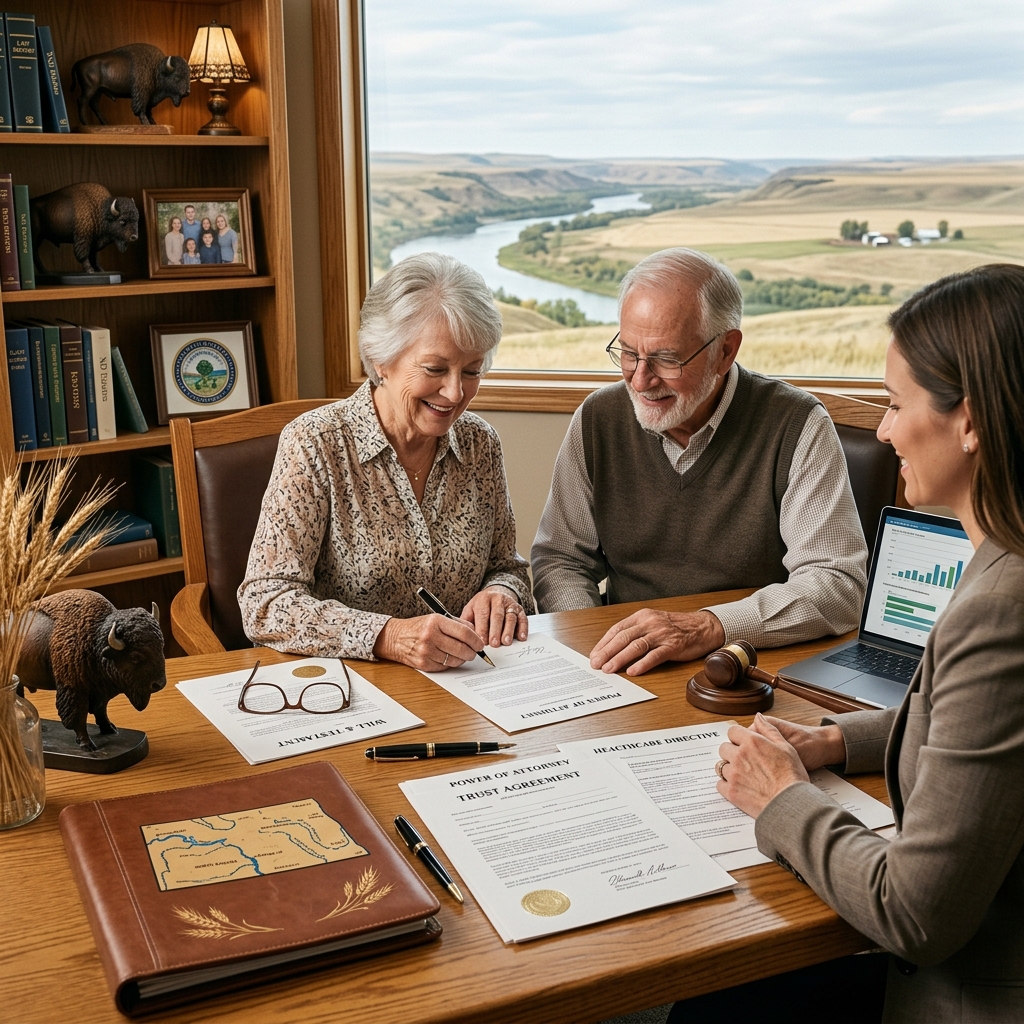
Planning what happens to your property and responsibilities after you die is not only about money. A thoughtful North Dakota estate plan can protect your family, reduce stress during a difficult time, and make sure the people you trust are in charge when it matters most. It can also help avoid disputes and unnecessary court involvement.
This guide explains the key elements of estate planning in North Dakota, including wills, intestate succession (what happens if you leave no will), probate, tax considerations, and core planning tools such as powers of attorney and health care directives.
Why Estate Planning Matters in North Dakota
North Dakota follows a statutory framework that determines where your property goes if you die without a valid plan. If you do not take steps in advance, state law — not you — will control:
- Who receives your property
- Who serves as guardian for minor children (subject to court approval)
- Who manages your estate during probate
- How long the process takes and how much it costs
Creating an estate plan allows you to:
- Choose beneficiaries and decide how and when they receive assets
- Provide instructions for minor or vulnerable beneficiaries
- Reduce the risk of family conflict and litigation
- Coordinate life insurance, retirement accounts, and beneficiary designations with your will or trust
- Set up decision-makers for finances and health care if you become incapacitated
Key Components of a North Dakota Estate Plan
Most residents will benefit from a basic set of coordinated documents. At a minimum, North Dakota courts and legal services commonly highlight the importance of:
- Last will and testament
- Durable power of attorney for finances
- Health care directive or medical power of attorney
- Beneficiary designations for life insurance and retirement plans
- Possibly a revocable living trust for more complex situations
Who Can Make a Will in North Dakota?
North Dakota law allows any person who meets basic requirements to create a will. In general:
- You must be at least 18 years old
- You must be of sound mind, meaning you understand what your property is, who your natural beneficiaries are, and the effect of signing a will
North Dakota recognizes several types of wills, including traditional written wills, handwritten (holographic) wills, and electronic wills under specific statutory conditions.
Formal Written Wills
A typical North Dakota will is a written document that meets the signature and witnessing requirements of the North Dakota Century Code. To be valid, a will must be:
- In writing (typed or printed is common)
- Signed by the person making the will (the testator), or by someone else signing in the testator’s name at the testator’s direction and in their conscious presence
- Witnessed by either:
- At least two competent witnesses who observe the signing or the testator’s acknowledgment of the will, or
- A notary public who attests to the testator’s signature, which can substitute for witnesses under North Dakota law
Using independent, disinterested witnesses is advisable even though North Dakota allows a person who receives a gift under the will to serve as a witness. Interested witnesses can create grounds for later challenges, such as claims of undue influence.
Holographic (Handwritten) Wills
North Dakota recognizes holographic wills if specific conditions are met. A holographic will must be entirely or materially handwritten and signed by the testator. Unlike formal wills, witnesses are not required if the statute’s handwriting requirements are satisfied.
Although holographic wills can be valid, they frequently cause disputes and interpretation problems. They are usually best viewed as a last resort, not a replacement for a carefully prepared formal will.
Electronic Wills
North Dakota allows for electronic wills that meet detailed statutory rules. An electronic will must be in a record that is readable as text at the time of signing, signed by the testator, and properly witnessed or notarized in a manner authorized by law. This modern option reflects the trend toward digital estate planning but requires careful compliance with technical requirements.
Spouses, Children, and Inheritance Rights
Estate planning often raises questions about whether a spouse or child can be left out of a will. North Dakota provides important protections for surviving spouses but offers much less guaranteed inheritance for children.
Protection for Surviving Spouses
In North Dakota, you typically cannot completely disinherit your spouse without their consent. The law provides a minimum share of the estate called an elective share, which the surviving spouse may claim if they receive less than that share under the will. A spouse may also be entitled to:
- Homestead rights (continued occupancy of the family residence)
- A reasonable family allowance during estate administration
- Exempt personal property up to statutory limits
These protections are designed to prevent one spouse from leaving the other destitute, especially in long-term marriages.
Disinheriting Children
Children do not have the same automatic inheritance rights as spouses. Under North Dakota law, a parent generally may disinherit a child in a valid will. However, to reduce the risk of litigation, it is prudent to:
- State clearly that you are intentionally not leaving property to that child
- Avoid ambiguous phrasing that could suggest the omission was accidental
- Consider smaller bequests or trusts that can still protect family harmony
If a child believes the will is invalid due to undue influence, fraud, or lack of capacity, they may challenge it in probate court. Clear drafting and good recordkeeping help defend against such claims.
What Happens If You Die Without a Will? (Intestate Succession)
If you die in North Dakota without a valid will, you are said to die intestate. State statutes then determine who inherits your property, based largely on family relationships.
Key features of North Dakota intestate succession rules include:
- Priority for surviving spouses, children, and parents
- Shares that change depending on whether there are children from other relationships
- Inheritance passing to more distant relatives (like grandparents or their descendants) if there are no close heirs
| Family Situation | Who Inherits |
|---|---|
| Spouse, no descendants or surviving parents | Spouse generally receives the entire estate |
| Spouse and descendants, all shared with that spouse; no stepchildren | Spouse often receives the entire estate under statutory rules |
| Spouse, descendants, and spouse has children from another relationship | Spouse receives a fixed dollar amount plus a portion of the balance; remaining share goes to descendants |
| No spouse, but descendants | Descendants inherit the entire estate, generally in equal shares by representation |
| No spouse or descendants; parents living | Parents inherit, often with varying shares depending on other relatives |
| No identifiable family | Property ultimately reverts to the state (a rare outcome) |
North Dakota also follows a 120-hour survival rule: an heir generally must survive the decedent by at least 120 hours to inherit under intestate rules, which can simplify the treatment of closely timed deaths.
Probate in North Dakota
Probate is the court-managed process of validating a will, appointing a personal representative, paying debts and taxes, and distributing assets to heirs and beneficiaries. North Dakota has adopted a version of the Uniform Probate Code, which provides for both formal and informal procedures depending on the complexity of the estate.
When Probate Is Required
Probate is typically required when:
- There is property titled solely in the decedent’s name without a beneficiary designation
- The estate includes real estate that does not automatically pass by survivorship
- There are disputes about the will or heirship
Certain assets usually bypass probate, including:
- Property held in joint tenancy with right of survivorship
- Accounts with valid payable-on-death (POD) or transfer-on-death (TOD) designations
- Life insurance proceeds with named beneficiaries
- Assets titled in a properly funded revocable living trust
Self-Proving and Pre-Death Validation
North Dakota allows wills to be made self-proving through a signed affidavit from the testator and witnesses, or through notarial acknowledgment. A self-proving will can speed up probate because the court does not need live testimony from witnesses to establish validity.
In addition, North Dakota law permits a person to ask a district court to declare their will valid while they are still alive, a process sometimes called ante-mortem probate or pre-death validation. This can provide extra certainty for complex or high-value estates.
Estate and Inheritance Taxes Affecting North Dakota Residents
Many people worry about losing a large portion of their estate to taxes. For most North Dakota residents, federal and state tax rules are not as burdensome as they fear.
North Dakota Estate and Inheritance Taxes
- North Dakota currently imposes no state estate tax.
- North Dakota also has no state inheritance tax (a tax paid by the person receiving the property).
However, if a North Dakota resident owns property in another state that levies an inheritance or estate tax, the laws of that other state may apply to that particular property.
Federal Estate Tax
The federal estate tax applies only to larger estates whose value exceeds the federal exemption amount. The exemption is set at a level high enough that only a small percentage of estates owe federal estate tax. The Tax Cuts and Jobs Act significantly increased the exemption through 2025, with a scheduled reduction beginning in 2026 unless Congress changes the law.
For individuals whose property may approach or exceed the federal exemption, advanced planning strategies—such as lifetime gifting, charitable planning, and trust structures—may help manage potential tax exposure. Consultation with a qualified tax or estate planning professional is essential in these cases.
Beyond the Will: Other Essential Planning Tools
A will is a core document, but it does not address every scenario. Effective North Dakota estate planning usually includes tools that operate during your lifetime as well as at death.
Durable Power of Attorney
A durable power of attorney for finances allows you to appoint an agent to manage your financial affairs if you become incapacitated. Without it, your family may need to seek a court-appointed conservator or guardian to handle routine tasks such as paying bills, managing investments, or selling property.
Health Care Directive
North Dakota residents can name a health care agent and document their medical treatment preferences through a health care directive or similar advance directive form. This document guides medical professionals and family members when you cannot speak for yourself, covering issues such as:
- Life-sustaining treatment
- Pain management and comfort care
- Organ donation preferences
Revocable Living Trusts
A revocable living trust is a flexible arrangement where you transfer assets into a trust that you typically manage as trustee during your lifetime. At your death or incapacity, a successor trustee follows your instructions for managing and distributing those assets. Potential advantages include:
- Reducing or avoiding probate for trust assets
- Providing ongoing management for minor or vulnerable beneficiaries
- Maintaining privacy, as trust administration is usually not part of the public court record
Whether a will-based or trust-based plan is best depends on your goals, family situation, and asset mix.
Practical Tips for North Dakota Residents
To build a practical and effective plan tailored to North Dakota law, consider the following steps:
- Inventory your assets: Include real estate, bank accounts, investments, retirement accounts, business interests, and personal property.
- Clarify your goals: Who should receive which assets, and on what timelines?
- Choose fiduciaries carefully: Select executors, trustees, agents, and guardians who are trustworthy, organized, and willing to serve.
- Coordinate non-probate assets: Make sure beneficiary designations and joint ownership arrangements match your overall plan.
- Review regularly: Update your plan after major life events such as marriage, divorce, birth of a child, significant financial changes, or relocation.
Frequently Asked Questions About North Dakota Estate Planning
Do I need a lawyer to make a will in North Dakota?
North Dakota law does not require you to use a lawyer to create a will; you may draft your own as long as it meets statutory requirements for validity. However, professional advice is strongly recommended if you have significant assets, a blended family, a business, or concerns about future challenges to your plan.
Can I store my will with the court before I die?
You do not have to file your will with a North Dakota court during your lifetime, and courts generally accept wills only as part of a case (such as probate or will validation). State law does allow you to deposit a will with a county recorder for safekeeping if you choose.
What happens to my digital assets?
Online accounts, social media, and digital files can be difficult to manage after death without proper planning. While North Dakota law and federal privacy rules may limit access, your estate plan can:
- Authorize a trusted person to handle digital accounts within the limits of applicable law
- List important accounts and devices in a separate, secure document
- Coordinate with provider-specific tools (such as legacy contacts) where available
How often should I update my estate plan?
A common rule of thumb is to review your plan every three to five years or after any major life event, such as marriage, divorce, birth or adoption of a child, death of a key beneficiary, significant changes in assets, or relocation to or from North Dakota.
What if I move away from North Dakota?
Most properly executed North Dakota wills remain legally valid in other states. However, since each state has its own property, probate, and tax rules, it is wise to have a lawyer in your new state review and, if necessary, update your plan.
References
- Guide to North Dakota Inheritance Laws — SmartAsset. 2024-01-02. https://smartasset.com/financial-advisor/north-dakota-inheritance-laws
- How to Make a Will in North Dakota FAQ — FindLaw. 2023-09-15. https://www.findlaw.com/forms/resources/estate-planning/last-will-and-testament/how-to-make-a-will-in-north-dakota-faq.html
- A Legal Research Guide for North Dakota Wills — North Dakota Legal Self Help Center (N.D. Courts). 2022-06-01. https://www.ndcourts.gov/Media/Default/Legal%20Resources/Legal%20Self%20Help/Probate/Wills%20Research%20Guide.pdf
- North Dakota Estate Planning — Nolo. 2024-03-10. https://www.nolo.com/legal-encyclopedia/north-dakota-estate-planning
- Wills — Legal Services of North Dakota. 2024-04-01. https://lsnd.org/wills/
- Estate Planning & Probate — Dwyer Law Office, PLLC. 2023-07-01. https://www.dwyerlawofficend.com/estate-planning-probate
- Is a Will or a Trust the Best Option for My North Dakota Estate Plan? — German Law. 2022-11-15. https://germanlawgf.com/blog/trusts/is-a-will-or-a-trust-the-best-option-for-my-north-dakota-estate-plan/
Similar Articles








Read full bio of Sneha Tete


