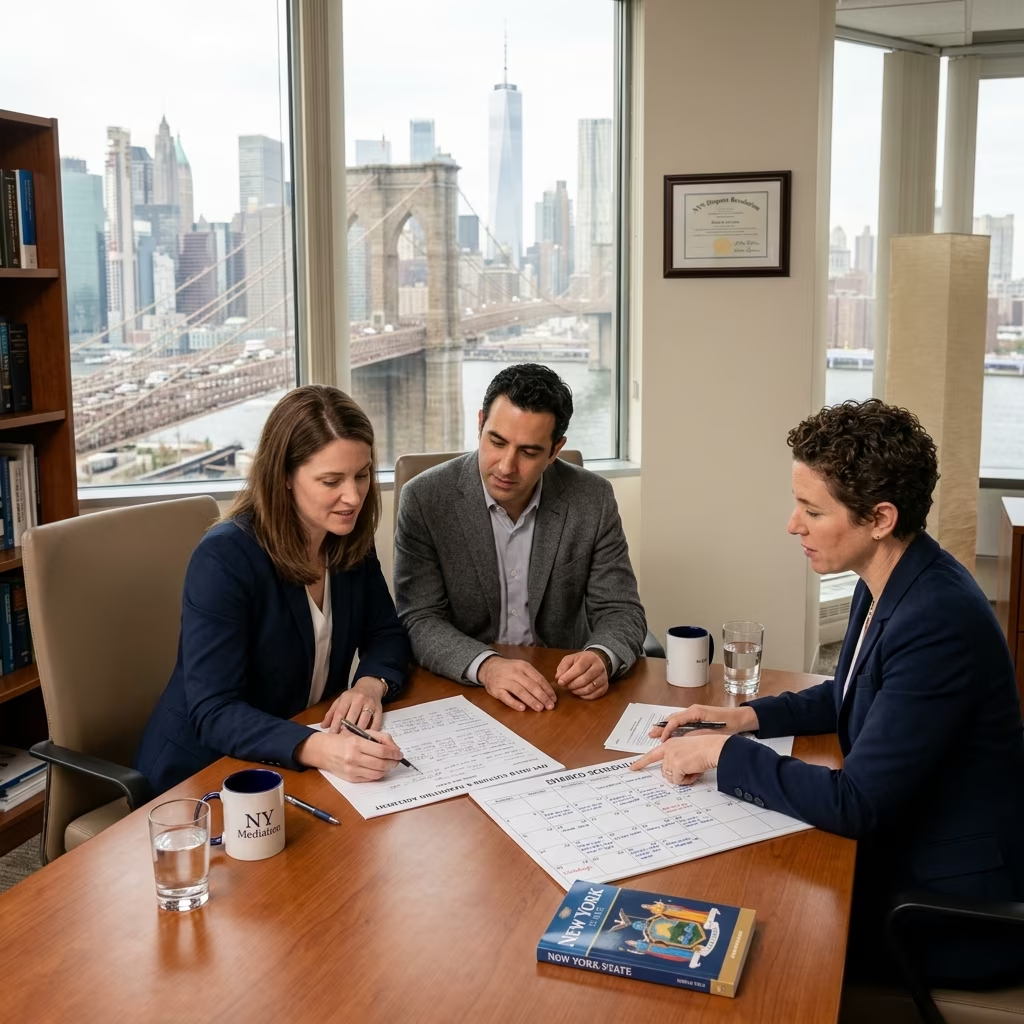
Many parents in New York want to settle child custody peacefully, without the stress, cost, and uncertainty of a courtroom trial. New York law allows parents to reach their own custody arrangements, and in many cases those agreements can be recognized and enforced by the courts if they are properly drafted and submitted.
This article explains how parents can negotiate and formalize a child custody agreement in New York without going to court for a contested trial, what legal standards apply, and how to reduce the risk of future disputes.
Understanding Child Custody in New York
Before designing any agreement, it helps to understand the basic custody concepts used in New York courts.
- Physical custody (residency) – where the child primarily lives and who provides day-to-day care.
- Legal custody – who makes major decisions about the child’s health care, education, religion, and overall welfare.
- Visitation / parenting time – the schedule for the parent who does not have primary physical custody to spend time with the child.
New York recognizes different custody arrangements:
- Sole legal custody – one parent has authority to make major decisions. The other parent may receive information (for example, school or medical records) but does not decide.
- Joint legal custody – parents share major decision-making and must communicate effectively about the child.
- Primary physical custody – the child lives mostly with one parent, while the other has scheduled parenting time.
- Shared physical custody – the child spends significant time with each parent, sometimes close to 50/50.
Regardless of labels, every New York custody arrangement is evaluated under the “best interests of the child” standard, which is the guiding principle for judges and should also guide parents when negotiating out of court.
Can Parents Make Custody Arrangements Without Going to Court?
In New York, parents do not need an immediate court order to decide how they will raise their child. When parents communicate well, they can create informal or written arrangements on their own.
However, there is an important distinction:
| Type of Arrangement | How It Is Created | Is It Legally Enforceable? |
|---|---|---|
| Informal agreement | Verbal or casual written understanding between parents | Generally not enforceable if a dispute arises; each parent retains equal rights without a court order.[10] |
| Privately written plan | Detailed written parenting plan, signed but not filed with court | Helpful as evidence of past practice, but still difficult to enforce without a court order.[10] |
| Court-approved agreement | Parents negotiate terms, then submit to Family Court or Supreme Court for approval | Becomes a formal custody order, fully enforceable by the court if one parent violates it. |
So while you can negotiate and draft your entire custody agreement outside of court, you will typically need a judge to review and sign it if you want the agreement to be legally enforceable.
Key Legal Principles Parents Should Know
Equal Rights When There Is No Custody Order
Under New York law, if there is no custody order in place, neither parent has a greater right to custody. Either parent can keep the child absent a court order stating otherwise. This can lead to confusion or conflict if the relationship deteriorates.
Because of this, many parents choose to convert their out-of-court agreement into a court-approved order once the terms are stable, even if they never go through a contested hearing.
Best Interests of the Child
New York courts decide custody based on what arrangement is best for the child’s safety, stability, and emotional development. Factors may include:
- Each parent’s ability to provide a safe, stable home.
- The child’s relationship with each parent and other family members.
- History of domestic violence, substance abuse, or neglect.
- Each parent’s willingness to support the child’s relationship with the other parent.
- The child’s needs regarding school, medical care, and special circumstances.
Parents negotiating outside of court should use these same factors as a checklist when evaluating whether their plan truly serves the child’s best interests.
Parental Rights for Unmarried Parents
Unmarried parents in New York generally have the same custody rights and obligations as married parents, but establishing paternity can be important for legal clarity. Once legal parentage is established, both parents can negotiate or seek custody and visitation in the same way as married parents.
Ways to Reach a Custody Agreement Without a Contested Court Case
New York encourages parents to resolve custody issues through cooperative methods whenever possible, avoiding adversarial trials.
Direct Negotiation Between Parents
Some parents can meet, discuss their schedules, and develop a parenting plan on their own. This approach works best when there is:
- Low conflict and relatively strong communication.
- Mutual trust that each parent will follow the plan.
- No history of domestic violence or coercion.
Parents should still reduce agreements to writing and consider obtaining legal advice before signing.
Mediation
Mediation uses a neutral third party to help parents reach a voluntary agreement about custody and visitation without a trial. The mediator does not decide the case but facilitates conversation.
Advantages of mediation include:
- Lower emotional and financial cost than a contested hearing.
- Opportunity to customize schedules around work, school, and activities.
- Greater sense of control and cooperation.
In some New York courts, judges may refer parents to mediation to see if an agreement can be reached before scheduling a trial.
Collaborative Law or Attorney-Assisted Negotiation
Parents who prefer legal guidance can hire attorneys to negotiate on their behalf. In collaborative family law, both parties and their attorneys commit to resolving issues without going to trial, using meetings and joint planning sessions instead.
This approach can be especially useful where there is moderate conflict, complex schedules, or concerns about safety or communication.
Drafting a Practical Parenting Plan
A strong parenting plan is detailed enough to prevent misunderstandings but flexible enough to accommodate normal changes in life.
Core Elements to Include
When drafting a New York custody agreement, consider addressing at least the following topics:
- Physical residence schedule – Which days and nights the child spends with each parent, including weekends, weekdays, and school breaks.
- Holiday and vacation schedule – How major holidays, birthdays, and vacation periods are shared or alternated.
- Exchange logistics – Where and when exchanges occur, who is responsible for transportation, and what happens if someone is late.
- Legal decision-making – Whether decisions are made jointly or by one parent, and how disputes over school, medical care, or activities are resolved.
- Communication rules – How parents will share information, notify each other of emergencies, and handle phone or video calls with the child.
- Relocation or travel provisions – Requirements for notice and consent if a parent wants to move or travel with the child out of state.
Sample Parenting Plan Topics in Table Form
| Topic | Questions to Answer |
|---|---|
| Weekly schedule | Where will the child stay on school days? Who handles drop-off and pick-up? |
| Weekends | Will weekends alternate, or will one parent have specific weekends each month? |
| Holidays | How will holidays such as Thanksgiving, winter break, and religious holidays be shared? |
| Summer vacation | Can parents schedule extended trips? How far in advance must they give notice? |
| Decision-making | Who decides on medical procedures, tutoring, therapy, or changes in school? |
| Dispute resolution | Will parents try mediation or attorney consultation before filing in court if disagreements arise? |
Turning Your Agreement Into an Enforceable Order
Even if all negotiations happened outside the courtroom, parents generally need to take certain steps to have their agreement formally recognized by a New York court.
Filing in Family Court or Supreme Court
New York has different courts that may handle custody issues:
- Family Court – Handles custody and visitation for unmarried parents, or for parents who are separated but not divorcing.
- Supreme Court – Handles custody as part of a divorce case for married parents.
Parents can file a custody or visitation petition in Family Court using official forms provided by the New York State Unified Court System. If they already have a written agreement, they can present it to the court and ask that it be approved and incorporated into a formal order.
What Judges Look For When Approving Agreements
Judges usually welcome parent-made agreements because they often reflect practical realities and reduce conflict. However, a judge will only approve the agreement if it meets the child’s best interests and appears fair.
In reviewing an agreement, a judge may consider whether:
- Both parents understand the terms and entered the agreement voluntarily.
- The plan keeps the child safe and emotionally supported.
- The schedule is realistic given the child’s age, school, and needs.
- Provisions address potential sources of conflict, such as holidays and decision‑making.
Once approved, the agreement is typically converted into a custody order that both parents are legally required to follow.
What Happens If a Parent Violates the Agreement?
When a court has approved a custody agreement and issued an order, it becomes legally enforceable. If one parent fails to follow the order, the other parent has options.
Steps a Non‑Violating Parent Can Take
- Attempt communication or mediation – Many issues can be resolved through direct discussion or mediation, especially if the violation is minor or occurs once.
- File an enforcement petition – If violations continue, the parent can ask the court to enforce the order or modify it.
- Seek changes to custody or visitation – Repeated or serious violations may lead the court to adjust the parenting schedule or decision‑making authority.
- Contempt of court – In serious cases, judges may find a parent in contempt for willfully violating the order, with possible fines or other penalties.
Informal agreements that are never approved by the court are much harder to enforce; in most cases, demands based on purely informal understandings cannot be enforced without a custody order.[10]
Special Situations: Non‑Parent Caregivers and Temporary Arrangements
Sometimes, relatives or other adults may temporarily care for a child. New York law allows certain non‑parents to seek custody in specific circumstances and also provides tools for temporary caregiving without full court proceedings.
Non‑Parents Seeking Custody
Relatives or friends may ask for custody, but they must show “extraordinary circumstances” before a court will consider giving them custody over a parent. Examples include:
- Abandonment or prolonged disruption of custody.
- Persistent neglect or serious unfitness.
- Surrender of custody by the parent.
If extraordinary circumstances are proven, the court will still apply the best interests standard to decide whether non‑parent custody is appropriate.
Temporary Delegation of Parental Powers
New York provides a form known as a Designation of Person in Parental Relationship, which allows a parent to delegate certain powers to another adult to care for the child temporarily without a full custody case. This can help relatives handle school and medical matters while parents are unavailable.
Frequently Asked Questions (FAQs)
1. Do we need a lawyer to make a custody agreement in New York?
No law requires you to hire a lawyer to draft a custody agreement, but legal advice is strongly recommended. Attorneys can help ensure the agreement meets New York standards and is likely to be approved by the court. This is particularly important if your situation involves safety concerns, complex schedules, or potential relocation.
2. Can we avoid going to court entirely?
You can negotiate and live by a custody arrangement without filing a case, especially if both parents cooperate and follow the plan. However, informal agreements are difficult to enforce; if a dispute arises, you usually need to file in Family Court or Supreme Court to obtain a formal order.[10]
3. What if we reach agreement after filing a custody petition?
If a case is already filed, parents can still negotiate outside of court and present their agreement to the judge. Courts generally encourage settlements and may adopt the agreed parenting plan as the official order if it serves the child’s best interests.
4. Is joint custody always preferred in New York?
New York does not automatically favor joint custody, but courts often approve joint legal custody when parents can communicate and cooperate adequately. If there is serious conflict or domestic violence, a judge may find that sole legal custody is in the child’s best interests.
5. How can we modify our agreement later?
Parents may agree in writing to adjust schedules informally, but lasting or significant changes should be submitted to the court. To formally modify a custody order, a parent usually files a petition and shows a substantial change in circumstances and that the new arrangement is better for the child.
References
- Child Custody and Visitation in New York — Legal Assistance of Western New York, Inc. Last updated 2023-03-01. https://www.lawny.org/page/8/child-custody-and-visitation-new-york
- Child Custody and Visitation in New York — LawHelpNY / Pro Bono Net. 2022-11-10. https://www.lawhelpny.org/resource/child-custody-and-visitation-in-new-york
- New York Custody — WomensLaw.org (National Network to End Domestic Violence). 2023-04-05. https://www.womenslaw.org/laws/ny/custody/all
- Family Forms — New York State Unified Court System. 2024-01-15. https://www.nycourts.gov/family-forms
- Physical Custody in New York State — New York Divorce Attorney (Jimenez Law Firm). 2022-09-12. https://newyorkdivorceattorney.com/physical-custody-ny/
- Child Custody Without a Court Order in Albany — The Colwell Law Group, LLC. 2023-02-20. https://colwell-law.com/albany-child-custody-lawyer/no-court-order/
- If One Parent Doesn’t Adhere to the Custody Agreement, What Can Be Done in New York? — Scharoff & Zarfes, P.C. 2022-01-06. https://scharofflaw.com/if-one-parent-doesnt-adhere-to-the-custody-agreement-what-can-be-done-in-new-york/