
North Carolina Power Of Attorney: What You Need To Know
Essential guide to creating, executing, and managing powers of attorney under North Carolina's Uniform Power of Attorney Act.
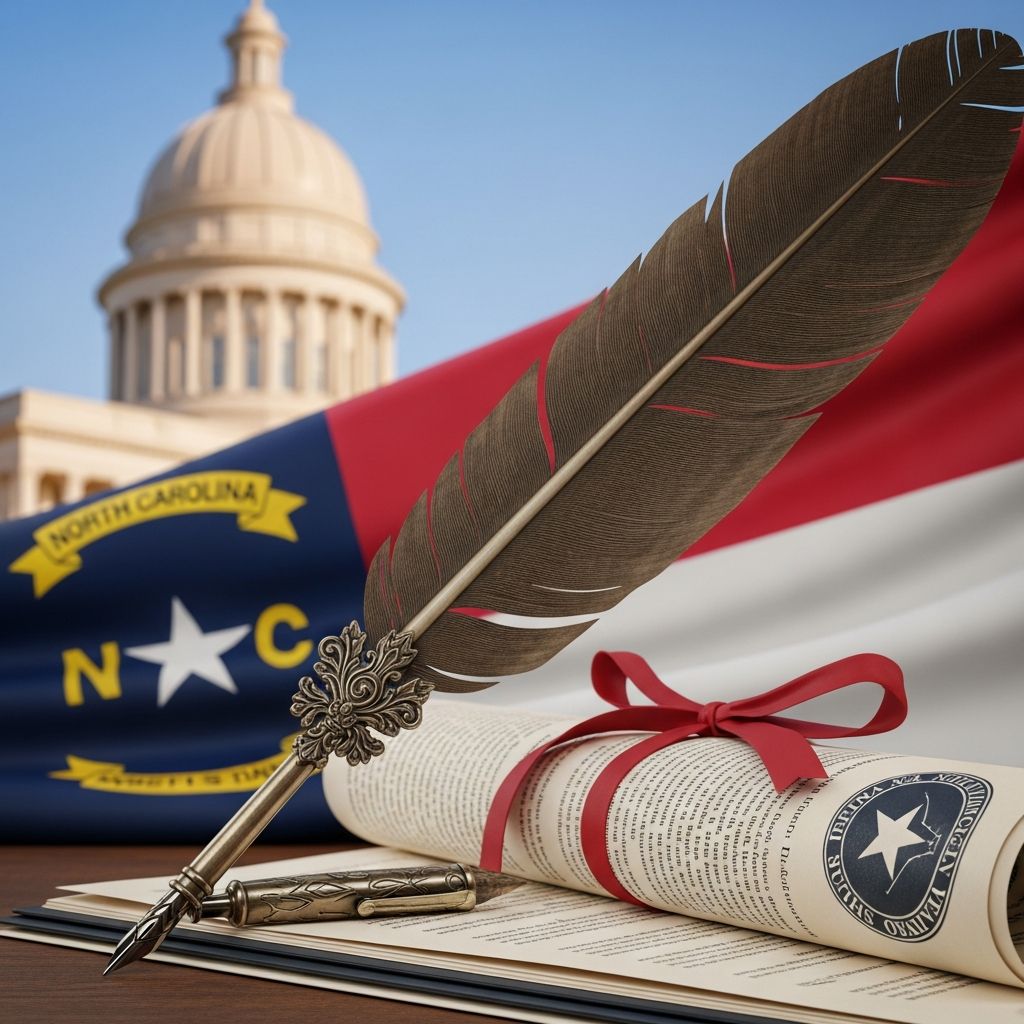
North Carolina’s power of attorney (POA) framework underwent significant updates with the adoption of the Uniform Power of Attorney Act (UPOAA) on January 1, 2018, reshaping how individuals appoint agents to manage their affairs. This legislation standardizes POA creation, execution, and enforcement, prioritizing durability and principal protection while distinguishing general financial POAs from health care directives.
Understanding Power of Attorney Fundamentals
A power of attorney is a legal instrument allowing a principal—typically an adult of sound mind—to designate an agent (or attorney-in-fact) to handle specified decisions or transactions on their behalf. Governed by North Carolina General Statute Chapter 32C, POAs cover financial matters like banking, real estate, and investments but exclude health care powers, which fall under separate statutes.
Principals must be at least 18 years old and mentally competent, grasping the document’s implications and voluntarily granting authority. Agents, similarly aged 18 or older, assume fiduciary duties, acting solely in the principal’s best interests with loyalty and prudence.
Key Distinctions: Durable vs. Non-Durable POAs
Under the pre-2018 law, POAs terminated upon the principal’s incapacity unless recorded with the county register of deeds to make them ‘durable’. The UPOAA reverses this: all POAs are now automatically durable, surviving incapacity unless explicitly stated otherwise. This shift acknowledges that disability does not equate to inability to manage property.
Springing POAs, activating only upon incapacity, require clear definitions of ‘incapacity’—often tied to inability to manage financial affairs, determined by physicians or courts. For real estate dealings, recording remains mandatory regardless of durability.
Execution and Validity Requirements
To be enforceable, a POA demands a written document signed by the principal, with notarized acknowledgment. Pre-2018 POAs validly witnessed (without notary) retain legality, but new ones post-January 1, 2018, mandate notary presence—no additional witnesses needed.
- Principal’s Capacity: Must understand the authority conferred and its consequences.
- Clear Intent: Explicitly name the agent and outline powers granted.
- Signature: Principal and agent sign; notary verifies identity and voluntariness.
- Optional Enhancements: Though not required, two witnesses bolster acceptance by institutions.
Store originals securely and distribute copies to agents and relevant parties like banks.
Defining Agent Powers and Limitations
POAs delineate general or specific authorities. Standard powers include managing bank accounts, paying bills, filing taxes, and handling investments. Agents must adhere strictly to granted scopes, avoiding self-dealing.
| Common POA Powers | Description |
|---|---|
| Financial Transactions | Access accounts, write checks, buy/sell assets |
| Real Estate | Mortgage, sell, or lease property (requires recording) |
| Government Benefits | Apply for Social Security, Medicare, or veterans’ aid |
| Tax Matters | File returns, pay taxes (use NCDOR forms for specific cases) |
Hot Powers: Explicit Authorization Required
The UPOAA introduces ‘hot powers’—high-risk authorities needing explicit inclusion to prevent abuse. Absent specification, agents cannot exercise these, applying retroactively to older POAs unless rights are substantially impaired.
- Create or alter rights of survivorship on accounts or property.
- Change beneficiary designations on insurance, retirement plans, or payable-on-death accounts.
- Make gifts of the principal’s property.
- Delegate POA authority to others.
- Waive rights to joint survivor annuities or retirement survivor benefits.
- Exercise fiduciary powers the principal holds.
- Renounce or disclaim property interests, including powers of appointment.
- Trust-Specific: Modify revocable trusts per G.S. 36C-6-602.1 or consent to irrevocable trust changes under G.S. 36C-4-411(a).
Review existing POAs for these provisions, especially trusts where agents must specify asset use for trust creation or funding.
Choosing and Empowering Your Agent
Select trustworthy agents—family, friends, or professionals—capable of fiduciary responsibilities. Name successors to activate if primaries resign, die, or become incapacitated. Multiple agents can serve jointly or severally, but clarify to avoid disputes.
Agents owe duties of good faith, reasonable care, and full disclosure. They cannot commingle funds, make unauthorized gifts, or prioritize personal interests. Liability arises from breaches, potentially leading to court removal or damages.
Revocation, Termination, and Overrides
Competent principals can revoke POAs anytime via written notice to agents and third parties. Termination occurs upon:
- Principal’s death.
- Principal’s revocation.
- Agent’s resignation, death, or incapacity (without successor).
- Court order declaring invalidity.
- POA’s specified expiration date.
No one overrides a valid POA except the principal while competent. Post-death, wills or estates take precedence.
Statutory Forms and Customization
North Carolina provides a statutory general POA form and limited real estate version, optional for simple needs. However, these generic templates overlook complex scenarios like blended families or business interests. Customized POAs, drafted by attorneys, better address unique circumstances. Avoid over-reliance on forms; tailor for comprehensive protection.
Practical Scenarios and Best Practices
Real Estate Transactions: Record POA with the county register before agent acts.
Banking and Investments: Institutions may request certified copies; notify them proactively.
Incapacity Planning: Pair financial POAs with advance health directives and wills.
Best practices include annual reviews, especially post-2018, and attorney consultations for updates. Digital storage aids accessibility, but physical originals prove authenticity.
Frequently Asked Questions
Does a POA need witnesses in North Carolina?
Notarization suffices for post-2018 POAs; pre-2018 witnessed ones remain valid. Witnesses enhance credibility.
Can POAs handle health decisions?
No, financial POAs exclude medical choices; use separate health care powers.
How do I prove agent authority to banks?
Present original or certified copy; some require ‘agent certification’ affidavits.
Is recording always required?
Only for real property actions; otherwise, optional for durability (now automatic).
Can agents create trusts?
Only if explicitly authorized as a hot power.
Navigating Challenges and Reforms
Since 2018, the UPOAA has streamlined POAs, reducing guardianship needs by empowering proactive planning. Challenges persist with reluctant institutions or ambiguous springing triggers. Courts interpret POAs favorably toward principals, enforcing explicit terms.
For tax-specific POAs, use NCDOR forms. Professionals aiding principals cannot serve as health agents.
References
- New North Carolina Uniform Power of Attorney Act — Maynard Nexsen. 2018-01-01. https://www.maynardnexsen.com/publication-New-for-NC-Uniform-Power-of-Attorney-Act
- Power of Attorney Rights and Limitations in North Carolina — Teddy & Meekins Law Firm. Accessed 2026. https://www.teddyandmeekins.com/estate-planning/power-of-attorney-rights-and-limitations/
- Durable Power of Attorney — Trusts and Estates Law Group. Accessed 2026. https://ncestateplanning.com/estate-planning/durable-power-of-attorney/
- What Is Power of Attorney? — State Employees’ Credit Union (NCSECU). Accessed 2026. https://www.ncsecu.org/resources/learn/power-of-attorney.html
- Is Your Durable Power of Attorney Powerful Enough in North Carolina? — Carolina Family Estate Planning. Accessed 2026. https://www.carolinafep.com/library/is-your-durable-power-of-attorney-powerful-enough-.cfm
- Power of Attorney — North Carolina Department of Revenue (NCDOR). Accessed 2026. https://www.ncdor.gov/poa
Similar Articles








Read full bio of Sneha Tete


