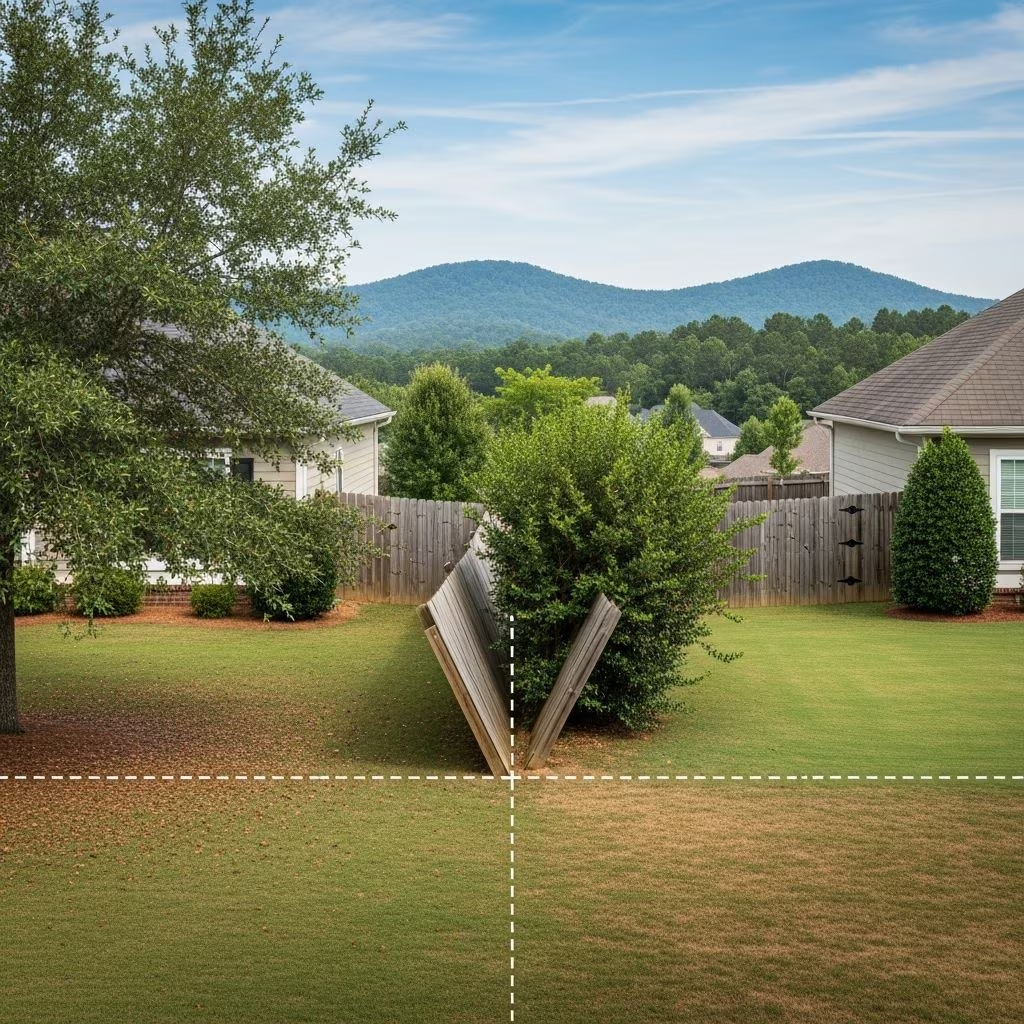
Property disagreements between neighbors in North Carolina can escalate quickly if not addressed properly. These conflicts often involve unclear boundaries, encroaching structures, damaged vegetation, or unauthorized land use. Understanding state-specific statutes and common law principles is crucial for protecting your rights and seeking fair resolutions. This guide explores key areas of contention, legal frameworks, and practical steps for resolution, drawing from established North Carolina General Statutes and judicial precedents.
Defining Property Boundaries in North Carolina
One of the most frequent sources of neighbor friction is uncertainty over property lines. In North Carolina, deeds, surveys, and physical markers define these limits, but discrepancies arise from outdated records or natural changes like erosion. N.C. Gen. Stat. Chapter 38 provides a structured process for owners to clarify disputed lines through court proceedings.
To initiate boundary determination, a landowner files a petition in superior court, naming adjacent owners as defendants. If uncontested, the court affirms the claimed line. Contested cases trigger a survey by a county-appointed professional, whose report and map guide the judge’s decision. This mechanism ensures objective resolution backed by evidence.
- Review existing documents: Deeds and prior surveys offer initial clarity, though they may require updates.
- Hire a licensed surveyor: Modern surveys using GPS provide precise measurements, serving as court-admissible evidence.
- Communicate early: Sharing survey results with neighbors can prevent escalation.
Failure to act promptly risks claims under adverse possession doctrines, where prolonged unchallenged use transfers title.
Adverse Possession: Claiming Land Through Time
Adverse possession allows non-owners to gain legal title after occupying land under specific conditions. North Carolina law demands proof of five elements: actual, open and notorious, exclusive, continuous, and hostile possession.
The standard period is 20 years for possession under visible boundaries (N.C. Gen. Stat. § 1-40), granting fee simple title. With ‘color of title’—a defective but seemingly valid deed—the period shortens to seven years (N.C. Gen. Stat. § 1-38). For 30 years under known lines, possession is indefeasible (N.C. Gen. Stat. § 1-37).
| Type of Possession | Required Period | Key Statute |
|---|---|---|
| Visible lines and boundaries | 30 years | N.C. Gen. Stat. § 1-37 |
| Color of title | 7 years | N.C. Gen. Stat. § 1-38 |
| General adverse possession | 20 years | N.C. Gen. Stat. § 1-40 |
Property owners can defend by documenting permission grants, interrupting continuity via notices, or disproving elements like exclusivity. Evidence such as tax payments, photos, and witness affidavits strengthens defenses.
Tree Disputes and Vegetation Conflicts
Trees straddling property lines or overhanging branches often spark arguments. North Carolina follows the ‘Hawaii Rule’ in some interpretations, where encroaching roots or branches can be trimmed by affected owners up to the boundary line, provided no tree death results. Intentional damage, however, invites liability.
Under N.C. Gen. Stat. § 106-701, victims recover actual damages—like replacement costs—for tree harm. No treble damages statute exists for willful acts, unlike some states, limiting recovery to proven economic loss. Courts assess negligence in cases of falling limbs or root intrusions causing property damage.
- Self-help remedies: Trim encroachments at your expense without crossing lines.
- Liability for falls: The tree owner isn’t liable for healthy trees unless negligence proven.
- Shared trees: Consent required for major actions like removal.
Document communications and hire arborists for valuations in disputes heading to litigation.
Fence Laws and Shared Barriers
Fences mark boundaries but also breed disputes over maintenance and placement. North Carolina lacks a strict ‘good neighbor’ fence law mandating shared costs for all boundary fences. Instead, the ‘North Carolina Partition Fence Law’ applies selectively to livestock enclosures.
Adjoining owners must contribute proportionally to partition fences enclosing animals (N.C. Gen. Stat. § 68-1 et seq.). For non-agricultural properties, voluntary agreements or spite fence statutes govern. Maliciously erected ‘spite fences’—over six feet, solely to annoy—can be abated via nuisance suits if proven.
Steps for resolution:
- Verify fence location via survey.
- Propose cost-sharing amicably.
- File for partition if livestock-related.
Encroachments like neighbor-built fences on your land may qualify for adverse possession if unchecked for 20 years.
Right to Farm Protections
Agricultural activities enjoy strong safeguards under North Carolina’s right-to-farm law (N.C. Gen. Stat. § 106-701.1 et seq.). Nuisance suits against farms operating for one year or more are dismissed if compliant with generally accepted practices. This shields odors, noise, and dust from suburban complaints.
Newcomers near established farms bear the burden, promoting rural preservation. Evidence of farm longevity and best practices defeats claims. Urban expansions must tolerate bona fide agriculture.
Resolving Disputes: Practical Strategies
Most conflicts resolve short of court through communication and professionals.
- Document everything: Photos, letters, surveys build cases.
- Send formal notice: Certified mail demanding cessation interrupts adverse claims.
- Mediation: Neutral facilitators offer cost-effective settlements.
- Litigation: Quiet title actions or ejectment suits enforce rights.
Classify disputes early—title, boundary, or easement—to tailor responses.
Legal Remedies and Court Processes
Courts provide:
- Declaratory judgment: Clarifies rights without damages.
- Injunctions: Halt ongoing encroachments.
- Damages: Compensate losses from trespass or nuisance.
Specific performance applies in contract breaches, like failed land sales. Eminent domain challenges ensure fair compensation.
Frequently Asked Questions
Can I remove a tree on the boundary line?
Consult neighbors first; unilateral removal of a shared tree risks liability for damages.
How long until adverse possession applies?
Typically 20 years, or 7 with color of title.
Who pays for a boundary survey?
The petitioner in court proceedings, but parties may share costs by agreement.
Are spite fences illegal in NC?
Yes, if malicious and over six feet, subject to abatement.
Does NC protect farms from neighbors?
Yes, via right-to-farm laws for established operations.
Consulting a real estate attorney early preserves options. Firms specializing in NC property law handle surveys, filings, and negotiations effectively.
References
- How Adverse Possession Works in North Carolina — Anderson Legal. 2023. https://www.andersonlegalnc.com/how-adverse-possession-works-in-north-carolina/
- North Carolina Laws on Property Disputes Between Neighbors — Nolo. 2023. https://www.nolo.com/legal-encyclopedia/north-carolina-laws-neighbor-property-disputes-65247.html
- NC General Statutes – Chapter 1 Article 4 — North Carolina General Assembly. 2025-01-01. https://www.ncleg.net/EnactedLegislation/Statutes/PDF/ByArticle/Chapter_1/Article_4.pdf
- Real Property Disputes — King Law Offices. 2024. https://kinglawoffices.com/blog/civil-disputes/real-property-disputes
- What are the first steps to take if there’s a legal problem involving a property NC — Pierce Law. 2023. https://piercelaw.com/news/real-estate-qa-series/what-are-the-first-steps-to-take-if-theres-a-legal-problem-involving-a-property-nc/
- NC General Statutes – Chapter 38 — North Carolina General Assembly. 2025-01-01. https://www.ncleg.gov/EnactedLegislation/Statutes/PDF/ByChapter/Chapter_38.pdf
- How to Handle Boundary Disputes with Your Neighbors in North Carolina — Koontz Law, PLLC. 2024. https://www.koontzlawnc.com/how-to-handle-boundary-disputes-with-your-neighbors-in-north-carolina