
North Carolina Marijuana Laws: Possession, Penalties, and Rights
Understand how North Carolina criminalizes marijuana possession, sale, and cultivation — and what penalties and defenses may apply.
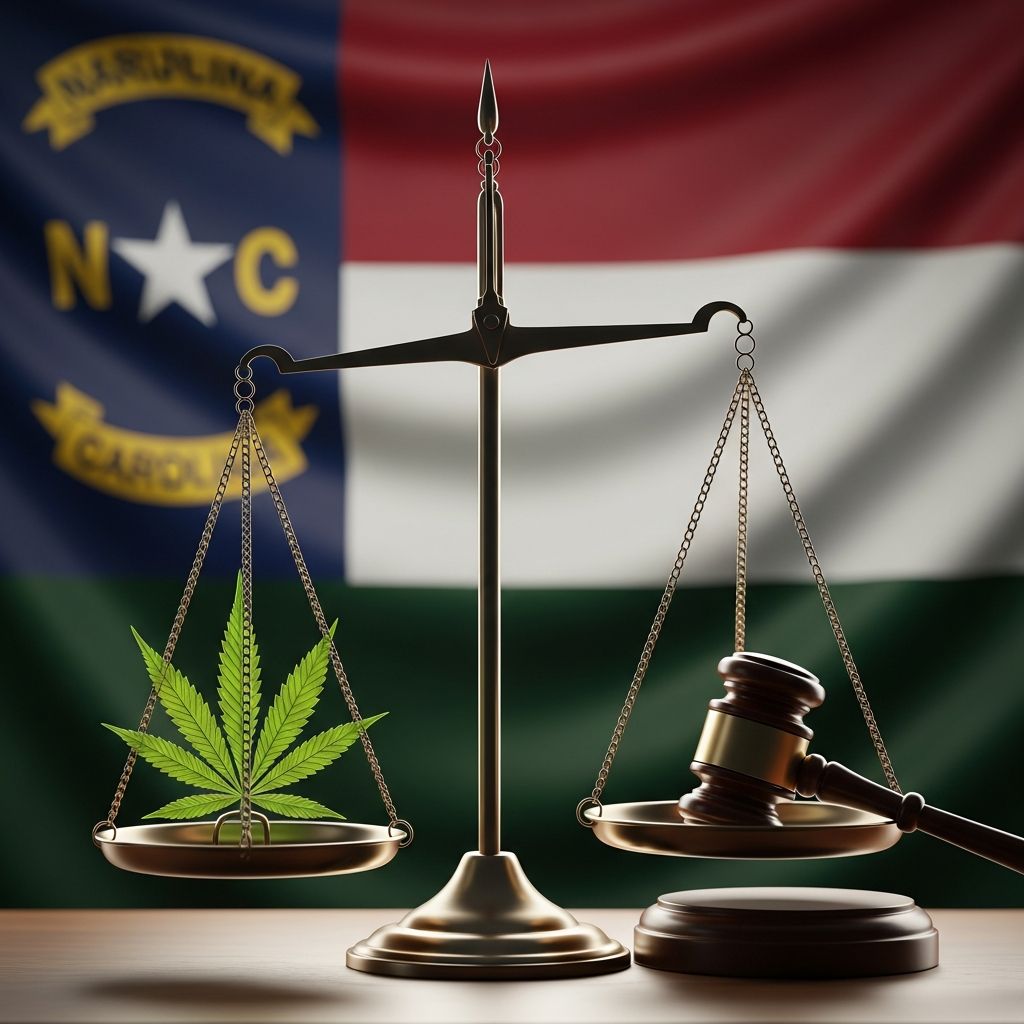
North Carolina treats marijuana as an illegal controlled substance under state law, and almost every form of possession, sale, or cultivation can lead to a criminal charge. While penalties for very small amounts are less severe than for trafficking-level quantities, no broad recreational or medical legalization exists at the state level.
This guide explains how North Carolina categorizes marijuana offenses, what penalties you may face, how hash and concentrates are treated, and practical steps to consider if you are accused of a cannabis-related crime. It is an educational resource only and is not a substitute for personalized legal advice.
1. Legal Status of Marijuana in North Carolina
Under North Carolina law, marijuana is classified as a Schedule VI controlled substance, grouped alongside tetrahydrocannabinol (THC), hashish, and hash oil. Unlike some states that have legalized or decriminalized broader use, North Carolina:
- Has not legalized recreational cannabis for adults.
- Has not implemented a full medical marijuana program at the state level.
- Continues to prosecute possession, sale, and cultivation under criminal statutes such as
N.C. Gen. Stat. § 90-95.
Although some policymakers have studied options to loosen penalties, including partial decriminalization for small amounts, those proposals have not yet transformed the core criminal framework.
2. How North Carolina Defines and Measures Marijuana Offenses
The most important factor in a marijuana case is typically the quantity involved. North Carolina law uses weight thresholds to determine whether an offense is a low-level misdemeanor or a serious felony, and whether it rises to the level of trafficking rather than simple possession.
2.1 Key Concepts
- Possession – Having marijuana on your person, in your home, vehicle, or other area you control.
- Constructive possession – You may be charged even if the drug is not on you physically, as long as the State argues you had the power and intent to control it.
- Intent to sell or deliver – Evidence such as packaging, scales, or large amounts of cash can elevate a charge from simple possession to possession with intent to distribute.
- Trafficking – Involves larger quantities defined in the statute; these offenses carry mandatory minimum prison terms and substantial fines.
2.2 Misdemeanor vs. Felony Thresholds
For marijuana (plant material), the rough dividing line in North Carolina is 1.5 ounces:
- Less than 1.5 ounces – Generally prosecuted as a misdemeanor.
- 1.5 ounces to 10 pounds – Typically a felony, even for a first offense.
- More than 10 pounds – Triggers trafficking statutes with enhanced penalties.
3. Possession of Marijuana: Penalties and Consequences
Possession charges are the most common marijuana-related offenses in North Carolina. The severity of punishment depends on the amount found and your prior record level under the state’s sentencing grid.
3.1 Personal Use Amounts
| Amount of Marijuana | Classification | Possible Custody Range* | Potential Fine |
|---|---|---|---|
| Up to 0.5 ounce | Misdemeanor (lowest level) | Typically 1–30 days, often suspended | Up to about $200 |
| 0.5 ounce to 1.5 ounces | Misdemeanor (higher level) | Up to 45–120 days, depending on record | Fines can reach $1,000 |
| More than 1.5 ounces to 10 pounds | Felony | Approx. 3–8 months or more | Discretionary fines and court costs |
*Actual sentences depend on prior convictions, aggravating or mitigating factors, and judicial discretion.
3.2 Collateral Consequences of a Possession Conviction
Even a low-level marijuana conviction can have effects beyond jail time or fines:
- Criminal record that appears in background checks for jobs, housing, and licensing.
- Possible driver’s license consequences if convicted of certain felony drug offenses, including felony possession and trafficking.
- Impact on immigration status for non-citizens.
- Limitations on professional licenses or public employment.
4. Sale, Delivery, and Trafficking of Marijuana
North Carolina law treats activities beyond personal use much more harshly. Selling, delivering, or transporting cannabis—even without taking payment—can result in felony charges.
4.1 Sale or Delivery Offenses
- Selling or delivering small amounts (10 pounds or less) is generally a felony with potential active prison time.
- Transferring marijuana to a minor or a pregnant person can trigger elevated sentencing ranges.
- Sales within 1,000 feet of schools, child care centers, or parks can carry additional penalties and mandatory minimums.
4.2 Trafficking Thresholds
Trafficking is defined largely by weight and is punished through mandatory minimum sentences under § 90-95(h). For marijuana flower, typical ranges include:
- More than 10 pounds but less than 50 pounds – Class H felony; mandatory minimum term of about 25 months and substantial fine.
- 50 to under 2,000 pounds – Class G felony; longer mandatory minimum sentence and higher minimum fine.
- 2,000 to under 10,000 pounds – Class F felony; mandatory minimum of approximately 70 months and a fine of at least $50,000.
- 10,000 pounds or more – Class D felony; mandatory minimum of roughly 175 months and at least $200,000 in fines.
Judges have limited flexibility in trafficking cases because of the statutory mandatory minimums written into the law.
5. Cultivation, Hash, and Concentrates
Not all marijuana offenses involve simple flower. North Carolina law also covers cultivation and processed forms of cannabis such as hash and concentrated THC products.
5.1 Growing or Cultivating Marijuana
Cultivating marijuana plants, even in a small home grow, is charged as a felony when the total weight of the harvested material falls into trafficking ranges or when there is evidence of intent to distribute. Penalties increase sharply as total weight increases, mirroring the trafficking thresholds described above.
5.2 Hashish and THC Concentrates
North Carolina law treats hashish, THC extracts, and certain concentrated forms of cannabis differently from loose plant material:
- Even small quantities of hash or THC concentrate can rapidly escalate the offense level.
- Possession of isolated or synthetic THC may be prosecuted as a felony regardless of weight in some scenarios.
- These products may be charged under separate weight categories from marijuana flower, often with stricter sentencing ranges.
6. Paraphernalia, Asset Forfeiture, and Related Offenses
In many marijuana cases, prosecutors do not stop with the drug charge alone. Additional statutes can expose a defendant to further penalties.
6.1 Drug Paraphernalia
North Carolina criminalizes possession, use, and sale of drug paraphernalia, including items allegedly used to ingest, store, or package marijuana.
- Possession of paraphernalia is typically a misdemeanor.
- Selling or manufacturing paraphernalia can result in more serious penalties and longer potential jail exposure.
- Selling paraphernalia to a minor several years younger may be charged as a felony.
6.2 Civil Asset Forfeiture
Vehicles, cash, and other property suspected of being used in a drug crime or obtained from drug proceeds may be seized under civil asset forfeiture procedures.
- Property can sometimes be forfeited even if the owner is not convicted.
- Challenging a forfeiture typically requires separate legal action, deadlines, and filings.
6.3 Special Circumstances
Certain situations can raise the severity of charges or add additional counts:
- Possession in a jail or prison can lead to a separate felony charge and additional incarceration.
- Using a minor in a drug transaction or exposing minors to drug activity can create distinct felony liability.
7. Limited Medical and Policy Developments
While North Carolina has not adopted a full medical cannabis program, there have been narrow exceptions and policy discussions related to marijuana and related substances.
- The state has allowed limited use of industrial hemp and hemp-derived products with low THC content in specific circumstances, in line with federal law changes.
- State officials and researchers have examined decriminalization options for small amounts of marijuana, particularly to reduce racial and socioeconomic disparities in enforcement.
- Despite these discussions, simple possession remains a criminal offense, and individuals can still be arrested and prosecuted for even small quantities of marijuana.
8. Defenses, Record Relief, and Practical Steps
A marijuana charge does not automatically mean a conviction. Several legal and procedural issues may affect the outcome of a case.
8.1 Possible Legal Defenses
- Illegal search or seizure – Evidence obtained in violation of the Fourth Amendment may be suppressed if police exceeded the scope of a warrant, lacked probable cause, or conducted an unlawful stop or search.
- Lack of knowledge or control – In constructive possession cases, the defense may argue you did not know about the marijuana or did not have the ability to control it.
- Insufficient evidence of intent – In cases alleging intent to sell or deliver, it may be possible to challenge whether the State has enough evidence to prove distribution rather than personal use.
- Weight disputes – Because penalties depend heavily on weight, contesting laboratory results or the inclusion of non-usable plant material can sometimes alter the charge level.
8.2 Diversion, Expungement, and Record Relief
North Carolina law allows certain defendants, especially those with limited or no criminal history, to pursue alternatives to conviction in some cases. While availability varies by county and by individual circumstances, options may include:
- Deferred prosecution or diversion programs for low-level possession offenses.
- Conditional discharge upon successful completion of probationary terms, education programs, or community service.
- Expungement (expunction) relief for qualifying dismissed charges or older, low-level convictions, subject to state expungement statutes and waiting periods.
Because these mechanisms are highly technical and change over time, individuals should consult qualified legal counsel for the most current eligibility criteria.
8.3 What to Do If You Are Charged
If you are arrested or receive a criminal summons for a marijuana offense in North Carolina, consider the following practical steps:
- Do not discuss the facts of your case with police or anyone else without speaking to a lawyer first.
- Request an attorney and, if you cannot afford one, ask the court to consider appointing counsel.
- Attend all court dates to avoid additional charges or arrest warrants.
- Keep records of all paperwork, citations, and bonds associated with your case.
- Discuss with your lawyer how a conviction could affect immigration, licensing, or employment.
9. Frequently Asked Questions About North Carolina Marijuana Laws
Q1: Is marijuana decriminalized in North Carolina?
No. While penalties for very small amounts are less severe than for trafficking, North Carolina still treats possession of marijuana as a criminal offense, and a conviction creates a record.
Q2: How much marijuana can I possess before it becomes a felony?
Possession of more than 1.5 ounces of marijuana is typically charged as a felony under North Carolina law, with potential active prison time and long-term consequences.
Q3: Does North Carolina have medical marijuana?
North Carolina does not have a comprehensive medical marijuana program like many other states. Certain low-THC or hemp-based products may be allowed under narrow circumstances, but these exceptions do not amount to full medical cannabis legalization.
Q4: Can I legally grow marijuana plants at home?
No. Growing marijuana remains illegal. Depending on the total weight and other evidence, cultivation can be charged as a felony and may fall under trafficking statutes with mandatory minimum sentences.
Q5: What happens if marijuana is found in my car?
Police may charge you with possession—and possibly paraphernalia—if marijuana or related items are found in your vehicle. The State must still prove you knowingly possessed or controlled the substance, but you can be arrested and prosecuted even if the drug was not on your person.
Q6: Are CBD products legal in North Carolina?
CBD products derived from hemp with very low THC content are generally treated differently than marijuana flower, especially after federal changes to hemp law. However, legality depends on THC levels and product type, and possessing products with higher THC content can still lead to criminal charges.
References
- North Carolina General Statutes § 90-95 — North Carolina General Assembly. 2023-03-06. https://www.ncleg.gov/EnactedLegislation/Statutes/HTML/BySection/Chapter_90/GS_90-95.html
- North Carolina Laws and Penalties — NORML. 2023-03-06. https://norml.org/laws/north-carolina-penalties-2/
- Everything You Should Know About North Carolina Marijuana Laws — Manning Law. 2023-02-01. https://manninglaw.com/criminal-law/north-carolina-marijuana-laws/
- Marijuana Crimes in North Carolina — Arnold & Smith PLLC. 2022-06-15. https://www.arnoldsmithlaw.com/marijuana-crimes.html
- North Carolina Drug Laws and Penalties — University of North Carolina School of the Arts. 2023-01-01. https://www.uncsa.edu/mysa-docs/nc-drug-laws-penalities.pdf
- Options to Decriminalize Marijuana Possession — North Carolina Department of Justice. 2020-11-04. https://ncdoj.gov/wp-content/uploads/2023/12/Marijuana-Decrim-Options-11.4.20.pdf
Similar Articles








Read full bio of Sneha Tete


