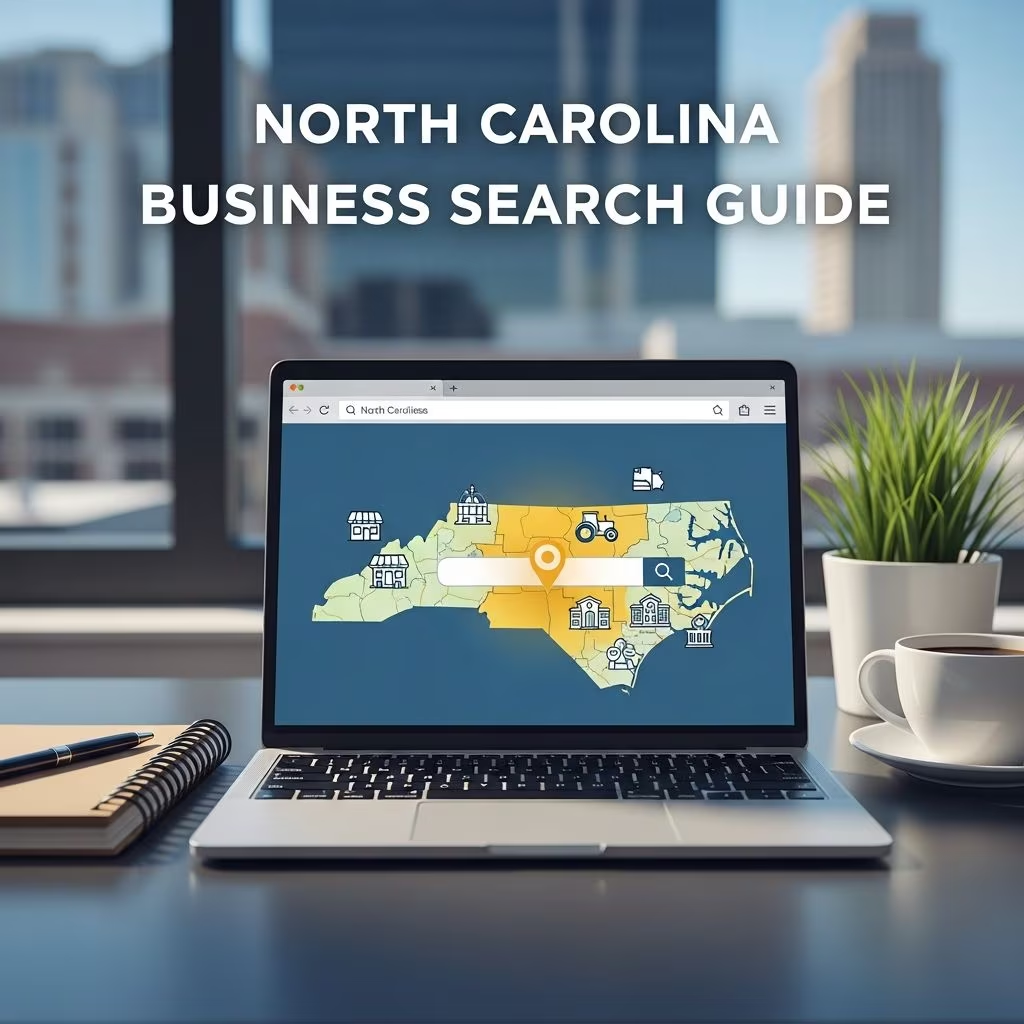
Conducting a thorough business search in North Carolina is a critical first step for entrepreneurs, investors, and legal professionals aiming to launch or evaluate companies in the state. The official tools provided by the North Carolina Secretary of State enable users to access vital information on registered entities, ensuring compliance and avoiding conflicts. This guide outlines the process, requirements, and best practices for effective searches.
Why Perform a Business Entity Search in North Carolina
Searching the North Carolina business registry serves multiple essential purposes that safeguard business operations and strategic decisions. Primarily, it confirms whether a proposed business name is available and distinguishable from existing registrations, a legal requirement under state law to prevent consumer confusion.
Additionally, these searches reveal an entity’s current status—such as active, dissolved, suspended, or in good standing—which is crucial for partnerships, investments, or vendor relationships. Users can retrieve key details including formation dates, registered agents, principal addresses, and filing histories, aiding in due diligence.
- Verify legitimacy: Ensure the business is properly registered and compliant.
- Assess risks: Identify suspended or dissolved entities before engaging.
- Support formation: Check name availability prior to filing articles of organization or incorporation.
- Track history: Review amendments, annual reports, and ownership changes.
Beyond startups, professionals in real estate, finance, and sales rely on these searches to validate counterparties and mitigate fraud risks.
Official Tools for North Carolina Business Searches
The primary resource is the North Carolina Secretary of State’s Business Entity Search portal, accessible via the official website under online services. This free, public database covers corporations, LLCs, partnerships, nonprofits, and assumed business names (DBAs).
Key search categories include:
- Entity names (exact or partial matches)
- SOSID (state-issued identification numbers)
- Registered agents
- Company officials
For county-level checks, especially DBAs, consult local Register of Deeds offices, as some filings occur at that level. The NC Department of Revenue portal handles tax-related registrations but not entity searches[10].
Step-by-Step Instructions for Entity Name Searches
Navigating the search tool requires precision to yield accurate results. Follow these steps to check business name availability effectively.
- Access the portal: Navigate to the NC Secretary of State website, select ‘Online Services,’ then ‘Business Search.’
- Select parameters: Choose ‘Company’ or ‘Assumed Business Name’ from the first dropdown. Opt for ‘Starting With’ or ‘Exact’ from the second to broaden or narrow results.
- Input query: Enter the proposed name without punctuation, designators like LLC, or extra spaces. Searches are case-insensitive.
- Execute search: Click ‘Search’ to generate a list of matches.
- Analyze results: Review entity type, status, jurisdiction, and ID. Click entries for detailed profiles including agents and addresses.
| Search Type | Use Case | Example Input |
|---|---|---|
| Starting With | Broad availability check | Carolina Clean |
| Exact | Precise match verification | Carolina Cleaning Services LLC |
| SOSID | Specific entity lookup | 1234567 |
Example: Searching ‘Pro Painting’ as ‘Starting With’ might reveal ‘Professional Painting LLC,’ indicating potential conflicts despite variations.
Understanding Search Results and Entity Details
Results display a table with columns for entity name, SOSID, status, type, jurisdiction, and filing date. Expand entries via ‘More Information’ for comprehensive data.
Critical details include:
- Status: Active (current), Dissolved, Suspended (non-compliant), or Revoked.
- Registered Agent: Name, address, and contact for legal service.
- Principals/Officers: Owners or managers listed.
- Filing History: Links to articles, amendments, and annual reports.
If no results appear, the name may be available, but conduct multiple variations (e.g., acronyms, reordered words) to confirm distinguishability.
North Carolina Business Name Requirements and Restrictions
State law mandates names be unique upon records and include entity designators. LLCs require ‘Limited Liability Company,’ ‘LLC,’ or abbreviations; corporations need ‘Corporation,’ ‘Inc.,’ etc..
Prohibited or restricted terms demand proof of qualification or agency approval:
- Financial: Bank, Banker, Banking, Mutual, Trust
- Professional Services: Architect, Engineer, CPA, Insurance, Lawyer, Pharmacy, Surveyor
- Other: Realtor, Cooperative, Wholesale
Names implying government affiliation (e.g., FBI, State) are banned. Fictitious words are allowed if not misleading. Violations lead to rejection during filing.
Handling Assumed Business Names (DBAs) in North Carolina
DBAs, or fictitious names, allow businesses to operate under aliases. Search availability via the ‘Assumed Business Name’ filter on the SOS portal.
Filing process:
- Confirm availability statewide and locally.
- Download the Assumed Business Name Certificate form from state resources.
- Submit to the county Register of Deeds with a $26 fee.
Unlike entities, DBAs are county-specific, so check multiple jurisdictions if operating broadly. Renewals may apply based on county rules.
Advanced Uses: Due Diligence and Compliance Checks
Beyond name checks, leverage searches for deeper insights. Investors review filing histories for stability; vendors confirm good standing before contracts.
Request official documents like Certificates of Existence ($10-30) via the portal for legal proof. For tax compliance, cross-reference with NCDOR after entity search[10].
Post-search actions:
- Reserve names (120 days, $30 fee) if available.
- Appoint a registered agent (in-state address required).
- Obtain EIN and state tax ID.
Common Pitfalls and Pro Tips for Accurate Searches
Avoid errors by:
- Searching variations: ‘Tech Solutions’ vs. ‘Solution Tech.’
- Ignoring case, punctuation, or designators.
- Combining state and county searches for DBAs.
- Documenting results with screenshots or prints.
If conflicts arise, modify with unique identifiers like locations or numbers. Consult attorneys for complex distinguishability issues.
Frequently Asked Questions
How often should I check business status?
Annually before filings or prior to major transactions to ensure ongoing compliance.
Is the search tool free?
Yes, basic searches are free; certified documents incur fees.
What if my name is taken?
Revise for distinguishability or reserve variations promptly.
Do I need to search trademarks too?
Yes, supplement with USPTO and state trademark databases beyond SOS.
Can out-of-state entities search?
Yes, the portal is public for all users.
References
- How to Conduct a North Carolina Business Search — LegalZoom. 2023. https://www.legalzoom.com/articles/how-to-conduct-a-north-carolina-business-search
- North Carolina Business Entity Search: A Step-by-Step Guide — Commenda. 2024. https://www.commenda.io/blog/north-carolina-business-entity-search
- How to Do a North Carolina Business Entity Search — Tailor Brands. 2024. https://www.tailorbrands.com/llc-formation/north-carolina-llc/business-search
- Business Entity Search — North Carolina Secretary of State’s Office. 2026-02-01. https://sosnc.gov/online_services/search/by_title/search_Business_Registration
- NC Secretary of State Business Search Explained — Enformion. 2024. https://go.enformion.com/api-search-tips/nc-secretary-of-state-business-search-explained/