
NFT Ecosystem: Creators, Collectors, and Motivations
Unpacking the NFT landscape: who drives the market, what fuels participation, and future trajectories in digital ownership.
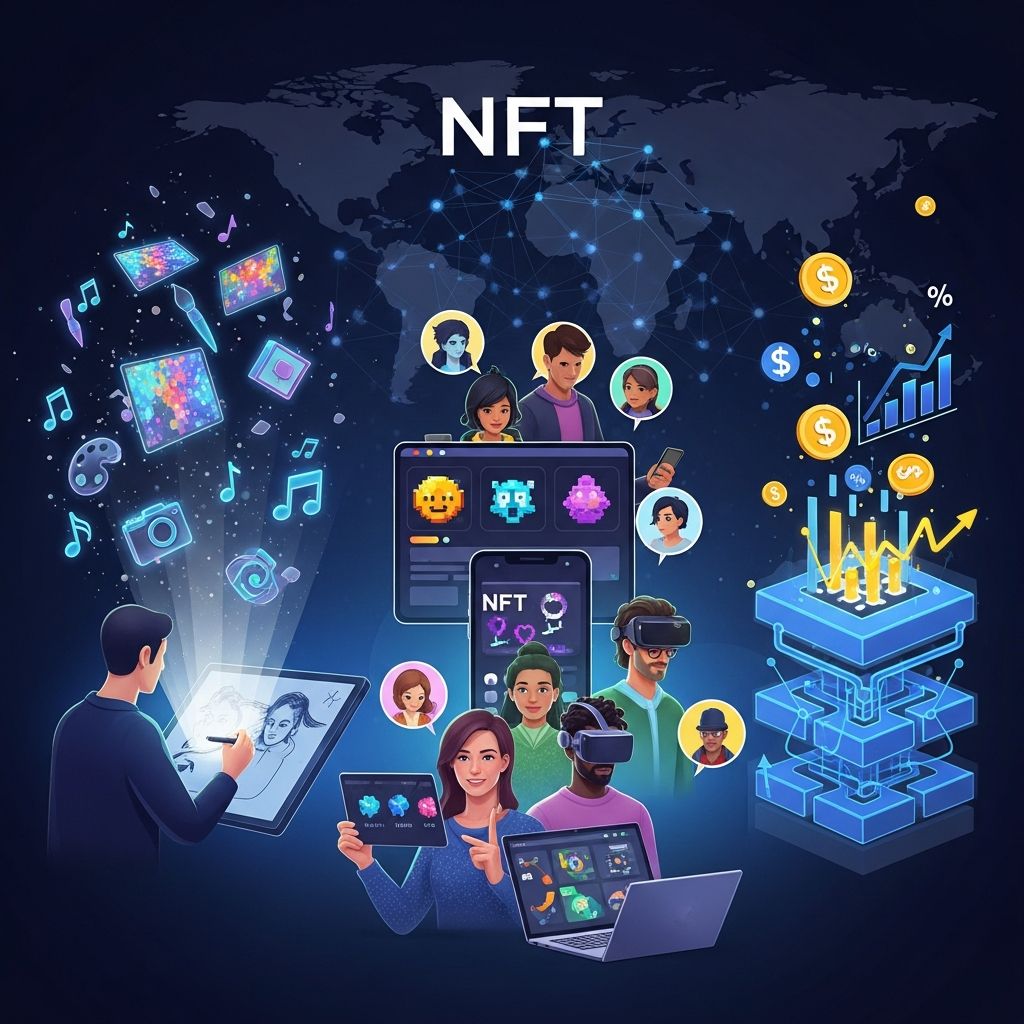
Non-fungible tokens (NFTs) represent unique digital assets on blockchain networks, enabling verifiable ownership of art, music, virtual items, and more. In 2026, the global NFT market has matured beyond speculation, reaching a projected value of $60.82 billion with a 41.2% CAGR from 2025, driven by utility in gaming, enterprise adoption, and real-world applications.
Understanding NFTs in the Modern Digital Economy
NFTs leverage blockchain technology to create scarcity and provenance for digital goods, contrasting with fungible cryptocurrencies like Bitcoin. Ethereum dominates with 62% of NFT contracts, followed by Solana at 18% and Polygon at 11%, enabling low-cost, high-speed transactions. This infrastructure supports diverse use cases, from play-to-earn gaming to tokenized real estate.
The market’s resilience is evident: despite a dip to $2.7 billion market cap earlier in 2026, sales volumes hit $2.8 billion in H1, signaling consolidation toward sustainable models. Institutional interest has surged 18% year-over-year in integrations like ticketing and loyalty programs.
Key Players Fueling NFT Creation
Digital artists lead NFT minting, tokenizing generative art and animations for global audiences. Musicians release limited-edition tracks with royalty-sharing smart contracts, generating $520 million in 2026 revenues. Gaming developers dominate with 38% of transaction volume, creating in-game assets like skins and weapons that players truly own.
Brands such as Nike and Starbucks enter via phygital NFTs—digital twins of physical products—boosting a sector with 60% transaction growth. Enterprises adopt white-label platforms, reducing development time by 70% for custom marketplaces valued at $254 million by 2034. Collectives like DAOs (Decentralized Autonomous Organizations) pool resources for community-driven projects.
- Artists and Creators: 28% market share in white-label adoption, focusing on provenance.
- Gaming Studios: 38% transaction dominance, emphasizing play-to-earn.
- Brands: Fashion NFTs at $890 million, linking digital wearables to luxury goods.
- Enterprises: 19% share, prioritizing branded solutions.
Who Are the Primary NFT Acquirers?
Collectors span demographics: 32% of white-label market users, seeking rarity and status. Asia leads with 2.8 million owners, India at 13.5% adoption rate. Retail investors chase flips, while institutions hedge via carbon credit NFTs ($300 million transactions) and real estate tokens ($1.4 billion market).
Institutional buyers, including funds and corporations, integrate NFTs for loyalty programs. Gamers acquire utility assets, and event organizers buy ticketing NFTs controlling 5.3% of U.S. venue sales. High-net-worth individuals collect blue-chip projects like “The Merge” at $91.8 million.
| Buyer Segment | Market Focus | 2026 Share/Trend |
|---|---|---|
| Collectors | Rarity & Status | 32% white-label |
| Gamers | In-Game Assets | 38% volume |
| Institutions | Utility & Hedging | 18% YoY growth |
| Asia Retail | Digital Goods | 2.8M owners |
Motivations Driving NFT Participation
Buyers seek ownership: true control over digital items, resale rights, and royalties (often 5-10% perpetual). Speculation persists but wanes; utility prevails in AI-powered NFTs (30% of projects) evolving via smart contracts. Social signaling—displaying rare avatars on social platforms—drives FOMO.
Creators monetize directly, bypassing galleries: platforms like OpenSea and Blur (38% ETH volume) facilitate instant global sales. Utility motivates gamers with interoperable assets across metaverses. Enterprises gain transparency in supply chains via tokenized deeds.
Sustainability appeals through carbon NFTs funding green initiatives. Phygitals bridge physical-digital, enhancing luxury resale with authenticity proofs.
Blockchain Dominance and Technical Foundations
Ethereum’s smart contracts enable complex royalties and upgradability, but layer-2s like Polygon cut fees. Solana’s speed suits high-volume gaming. Trends include NFTs as software: tokenizing borrow positions or AI identities.
White-label solutions from Antier and Blockchain App Factory hold 30% share, supporting multi-chain for artists and gamers. Projections show global NFT market at $701.15 billion by 2033, Asia-Pacific fastest-growing via gaming and metaverses.
Navigating NFT Market Challenges
Prices dropped to $2.7 billion cap amid ‘cleansing’—62% of 2021-2022 projects dormant. Yet, $720 million monthly ETH volume signals health. Risks include volatility, scams, and regulation; solutions lie in audited platforms and KYC.
Environmental concerns eased post-Ethereum Merge. Future-proofing involves ERC-8004 for AI agents and Coinbase-style IP acquisitions.
Practical Guide to Entering the NFT Space
Beginners: Choose wallets like MetaMask, fund with ETH/SOL. Scout collections on Blur or Magic Eden via floor prices and volume. Mint via white-label sites or create on Foundation. Trade strategically: DCA into blue-chips, track AI/gaming trends.
- Research blockchains and gas fees.
- Verify project roadmaps and teams.
- Use hardware wallets for security.
- Diversify across art, gaming, utility.
Frequently Asked Questions
What is the NFT market size in 2026?
The market is projected at $60.82 billion, with $5.6 billion cap and $2.8 billion H1 sales.
Who buys NFTs the most?
Asia (2.8M owners), gamers (38% volume), collectors (32% share).
Why create NFTs?
Direct monetization, royalties, global reach without intermediaries.
Are NFTs still viable investments?
Shifted to utility; gaming and AI trends promise growth despite corrections.
How do blockchains compare for NFTs?
Ethereum: 62% contracts; Solana: 18% speed; Polygon: 11% cost-efficiency.
Future Trajectories for NFTs
2026 predictions: Ethereum Foundation drops, Coinbase acquires IP, NFTs evolve as software. Institutional reshaping via enterprise integrations. Asia-Pacific leads CAGR at 11.2%. Phygitals, AI, and gaming will define a $245 billion market by 2029.
This ecosystem empowers creators with fair economics, collectors with ownership, and industries with innovation. As blockchain matures, NFTs transcend hype, embedding in daily digital life.
References
- NFT Market Size & Growth Statistics (2026 Data & Trends) — Colexion. 2026. https://colexion.io/nft/market-size-trends/
- WhiteLabel NFT Market Outlook 2026-2032 — Intel Market Research. 2026. https://www.intelmarketresearch.com/white-label-nft-marketplace-market-26007
- Why Are NFT Prices Dropping Today: A 2026 Market Analysis — WEEX. 2026. https://www.weex.com/questions/article/why-are-nft-prices-dropping-today-a-2026-market-analysis-12263
- 6 NFT Predictions for 2026 — Bankless. 2026. https://www.bankless.com/read/2026-nft-predictions
- NFT Market 2026: Dead or Just Different? — Earnpark. 2026. https://earnpark.com/en/posts/nft-market-2026-dead-or-just-different/
- Non-Fungible Tokens (NFTs) Market Size, Share, and Growth Analysis — SkyQuest Technology. 2026. https://www.skyquestt.com/report/non-fungible-token-NFT-market
Similar Articles








Read full bio of medha deb


