
New York LLC Creditor Rights and Member Liability
Understanding how New York creditors can pursue LLC member assets and what protections exist.
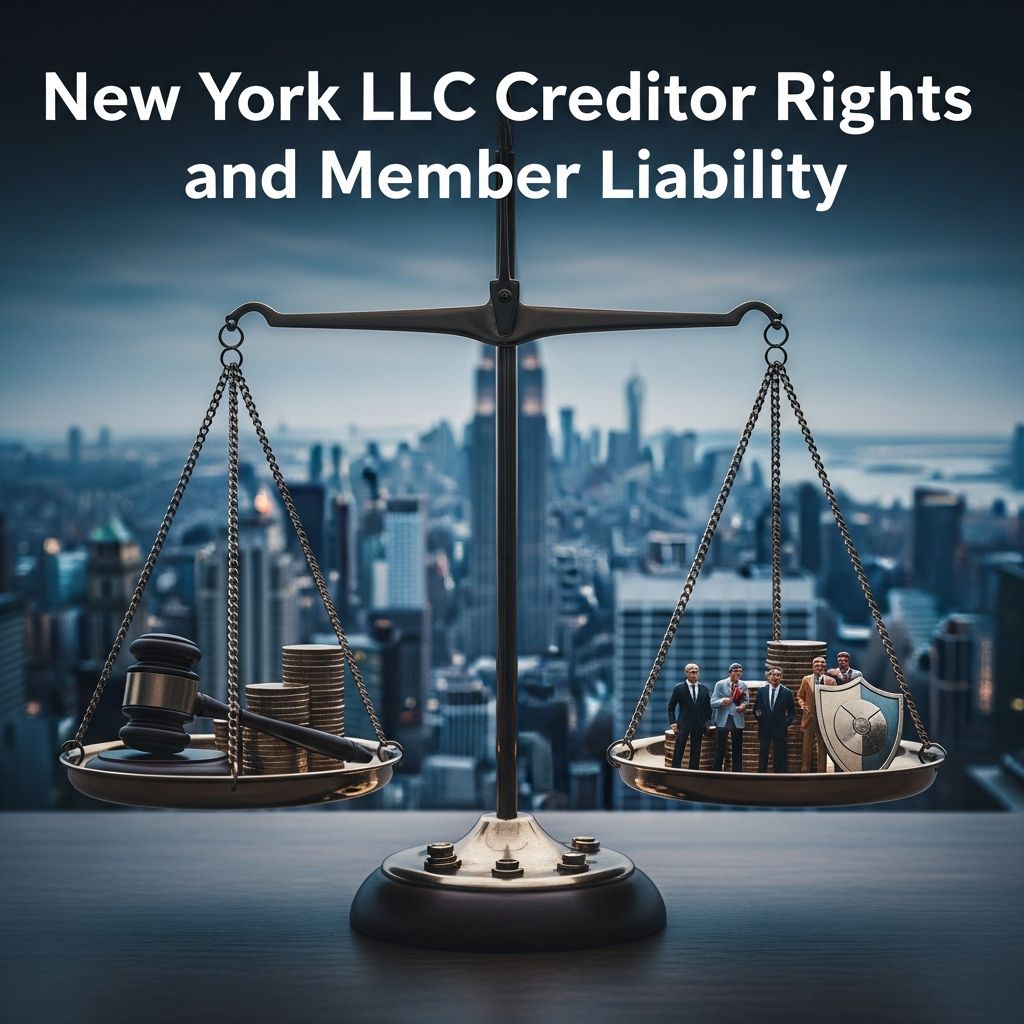
How Creditors Pursue New York LLC Members for Personal Debts
When an individual member of a limited liability company (LLC) incurs personal debt, creditors have multiple pathways to recover compensation beyond what is available in many other states. New York’s approach to creditor enforcement against LLC members is notably less restrictive than jurisdictions that limit remedies to a single option. Understanding these enforcement mechanisms is critical for anyone considering forming or operating an LLC in New York, as the state offers comparatively weaker protections against personal creditor claims.
The foundation of LLC asset protection is the legal separation between the business entity and its individual owners. When properly maintained, this separation shields personal assets from business liabilities. However, New York law creates a significant exception when creditors pursue debts owed by individual members rather than debts owed by the LLC itself. In these scenarios, creditors have discovered that New York provides them with multiple tools to access an indebted member’s interest in the LLC and sometimes even the LLC’s underlying assets.
Understanding Charging Orders as a Creditor Tool
A charging order represents a court-issued directive requiring an LLC to distribute any profits or income allocated to a debtor member directly to the creditor instead. Rather than giving the creditor ownership rights or control over the LLC, a charging order treats the creditor as an assignee of the membership interest. This means the creditor receives whatever distributions would have gone to the indebted member, but does not gain voting power or management authority within the company.
In many states across the country, charging orders serve as the exclusive remedy available to creditors. These jurisdictions have determined that limiting creditors to distribution rights provides adequate protection for creditors while preserving the LLC’s operational continuity and protecting non-debtor members from unwanted third-party involvement. However, New York has chosen a different path.
The limitations of relying solely on charging orders become apparent when an LLC generates no distributions or minimal distributions. A creditor may hold a charging order for years without receiving meaningful recovery if the business reinvests profits rather than paying them out to members. Recognizing this vulnerability, creditors operating in New York have advocated for and utilized additional enforcement mechanisms beyond the charging order remedy.
Foreclosure Rights: A Second Avenue for Creditor Recovery
When a charging order fails to produce adequate returns, New York creditors have successfully pursued foreclosure of an indebted member’s LLC interest. This process allows a creditor to obtain a court order directing the sale of the member’s membership stake to satisfy the outstanding judgment. Unlike a charging order, which preserves the member’s ownership interest while redirecting distributions, foreclosure effectively transfers ownership to the creditor or another buyer selected through judicial sale.
The foreclosure process requires the creditor to return to court and demonstrate that the charging order has not provided adequate means of collection. Courts examine factors such as the LLC’s distribution history, the likelihood of future distributions, and the amount of the outstanding judgment. When the record shows that a charging order remedy would be inadequate or ineffective, judges may authorize foreclosure proceedings.
Critically, foreclosure in New York does not automatically grant the creditor or the foreclosure purchaser management rights within the LLC. The new owner of the membership interest possesses only the economic rights associated with that interest. This distinction preserves some operational continuity, though the practical effect of losing ownership to a creditor-selected buyer often disrupts the member’s relationship with the business substantially.
Dissolution and Asset Liquidation: The Final Creditor Remedy
New York courts have further extended creditor enforcement options to include the possibility of ordering LLC dissolution when other remedies prove insufficient. This represents the most aggressive enforcement tool available to judgment creditors in the state. A creditor can petition the court to order the dissolution and liquidation of the entire LLC, with proceeds directed toward satisfying the judgment debt owed by the debtor member.
This remedy stands in stark contrast to the protections afforded in many other states, where state law explicitly prohibits using member personal debts as grounds for dissolving and liquidating the entire business entity. The availability of dissolution creates leverage in settlement negotiations, as an LLC facing forced liquidation may choose to settle the member’s personal debt rather than shut down operations and distribute assets.
The threat of dissolution affects all members, not just the debtor member. Non-debtor members face potential loss of their business investment through no fault of their own. This creates significant interdependency risk within multi-member LLCs in New York, as one member’s personal financial troubles can jeopardize the entire enterprise.
Comparing New York to States with Stronger Protections
The disparity between New York’s approach and that of more debtor-friendly states is substantial. Fifteen states have adopted statutory language explicitly limiting creditor remedies to charging orders, effectively prohibiting foreclosure and dissolution as collection mechanisms. These states have determined that the charging order remedy provides creditors with adequate recourse while protecting LLC integrity and non-debtor members’ interests.
States such as Florida and New Hampshire have implemented protective frameworks that distinguish between single-member and multi-member LLCs, providing enhanced protections to single-member arrangements where no other members exist to be affected. New York, by contrast, applies identical rules regardless of the number of members, meaning single-member LLC owners receive no heightened protections compared to those in multi-member arrangements.
For individuals prioritizing robust asset protection, the option exists to form an LLC in a protective state while conducting business in New York as a foreign LLC. However, this strategy carries uncertainty, as New York courts may decline to recognize the more favorable law of the formation state and instead apply New York’s weaker protections when disputes arise within the state.
Employee Wage Liability: A Critical Exception
Beyond creditor remedies related to member personal debts, New York law imposes personal liability on LLC members for specific obligations. Most significantly, members can be held personally responsible for unpaid salaries and wages owed to LLC employees. This exception applies regardless of whether the member personally authorized the wage violations or whether the non-payment resulted from management decisions made by other members.
This provision creates unique exposure for LLC members in New York that does not exist in many other states. Even members who maintain passive roles without involvement in payroll decisions may face personal liability if the LLC fails to compensate employees. The statutory language under New York Limited Liability Company Law Section 609 reflects a legislative determination that employee wage protection outweighs the general limited liability principle.
Safeguarding Your LLC Against Creditor Actions
Given New York’s permissive creditor enforcement environment, LLC members should implement protective strategies:
- Maintain corporate formalities: Keep business and personal finances completely separate. Commingling funds or treating the LLC as a personal bank account weakens the liability shield through the doctrine of “piercing the corporate veil.”
- Document everything: Maintain accurate records, file annual reports promptly, and comply with all state requirements to demonstrate that the LLC is a legitimate separate entity.
- Secure comprehensive insurance: Business liability insurance protects against claims that the LLC structure cannot shield, including negligence, professional malpractice, and contractual liability.
- Avoid personal guarantees: When borrowing on behalf of the LLC, resist creditor demands for personal guarantees that would expose personal assets directly.
- Monitor member conduct: In multi-member LLCs, ensure all members understand their fiduciary obligations and avoid activities that could trigger personal liability for fraud or misconduct.
- Consider multi-layered structures: Some business owners use multiple LLCs or trusts to compartmentalize assets and limit exposure.
The Role of LLC Operating Agreements in New York
While New York statutory law provides the baseline framework for creditor remedies, LLC operating agreements can address certain aspects of member relationships. However, operating agreements cannot override statutory creditor rights. Members cannot contractually eliminate a creditor’s ability to pursue a charging order, foreclosure, or dissolution. The agreement can specify how distributions are handled, define roles and responsibilities, and establish member exit procedures, but cannot restrict creditor enforcement mechanisms.
Operating agreements should clearly document member capital contributions, profit-sharing arrangements, and distribution policies. These details become relevant when creditors evaluate the likelihood of future distributions and the adequacy of charging order remedies. Transparent documentation of the LLC’s financial structure strengthens arguments that the entity is legitimate and separate from members’ personal finances.
Personal Liability Beyond Creditor Actions
Members can incur personal liability in New York LLCs through mechanisms unrelated to creditor enforcement for member debts. These include breaching fiduciary duties owed to the LLC or other members, personally guaranteeing business obligations, committing fraud or negligence, and failing to pay employment-related taxes. Additionally, if the LLC’s articles of organization explicitly provide for member liability for certain business debts, members lose their limited liability protection for those specified obligations.
The Limited Liability Company Law requires members or managers to act with care, loyalty, and good faith. Violations of these fiduciary standards can result in personal liability to the LLC or other members, entirely separate from creditor enforcement for personal debts.
Strategic Considerations for New York Business Owners
The weaker creditor protections in New York should factor into business structure decisions. Entrepreneurs considering multiple business ventures might use different formation states for different ventures, though this creates complexity in tax compliance and ongoing administration. Alternatively, combining LLC formation with robust insurance coverage and careful financial management can mitigate exposure.
Members should also understand that personal creditors of one member pose risks to all members’ investments in a multi-member LLC. Before entering into LLC membership agreements, individuals should assess not only their own financial stability but also the financial prudence of their co-members.
Frequently Asked Questions
Q: Can a creditor of an LLC member force the LLC to dissolve?
A: Yes, in New York, a judgment creditor can petition courts to dissolve and liquidate an LLC if other remedies prove inadequate. This represents one of the most aggressive creditor remedies available and distinguishes New York from states with stronger LLC protections.
Q: Does New York treat single-member and multi-member LLCs differently regarding creditor protection?
A: No, New York applies the same creditor remedies regardless of whether an LLC has one member or multiple members. Some other states provide enhanced protections to single-member LLCs.
Q: What is a charging order and how does it work?
A: A charging order directs the LLC to pay distributions that would go to the debtor member directly to the creditor instead. The creditor receives distribution rights but does not gain ownership or management control.
Q: Can LLC members be held personally liable for employee wages in New York?
A: Yes, New York law holds LLC members personally liable for unpaid salaries and wages owed to employees, regardless of individual involvement in payroll decisions.
Q: Can I protect my New York LLC by forming it in another state?
A: Forming an LLC in a more protective state while operating as a foreign LLC in New York may provide some benefit, but New York courts may apply their own less favorable law rather than recognizing the formation state’s protections.
Q: What happens if I commingle personal and business finances in my LLC?
A: Commingling funds weakens the liability protection by potentially allowing creditors to “pierce the corporate veil,” eliminating the separation between personal and business assets.
References
- LLC Protection for Members’ Personal Debt in New York — Nolo. 2024. https://www.nolo.com/legal-encyclopedia/llc-protection-members-personal-debt-new-york.html
- Protection for New York LLC Members’ Personal Assets — ZenBusiness. 2024. https://www.zenbusiness.com/llc-protection-new-york/
- New York Limited Liability Company Law § 607 and § 609 — New York State Legislature. https://www.nysenate.gov/legislation/laws/LLC
- Does an LLC Protect Personal Assets? — Rodriguez Law. https://lawrodriguez.com/articles/does-an-llc-protect-personal-assets/
- Is there Personal Liability of LLC Members? — Ratschko PLLC. https://www.newyorksmallbusinesslaw.com/is-there-personal-liability-of-llc-members/
- Corporations and Limited Liability Companies — NYC Bar Association. https://www.nycbar.org/get-legal-help/article/business-and-corporate-law/corporations-limited-liability-companies/
Similar Articles








Read full bio of Sneha Tete


