
Undefined New Mexico Intestate Succession: What To Know
Understand New Mexico's intestate laws: how assets distribute without a will, from spouses to distant relatives.
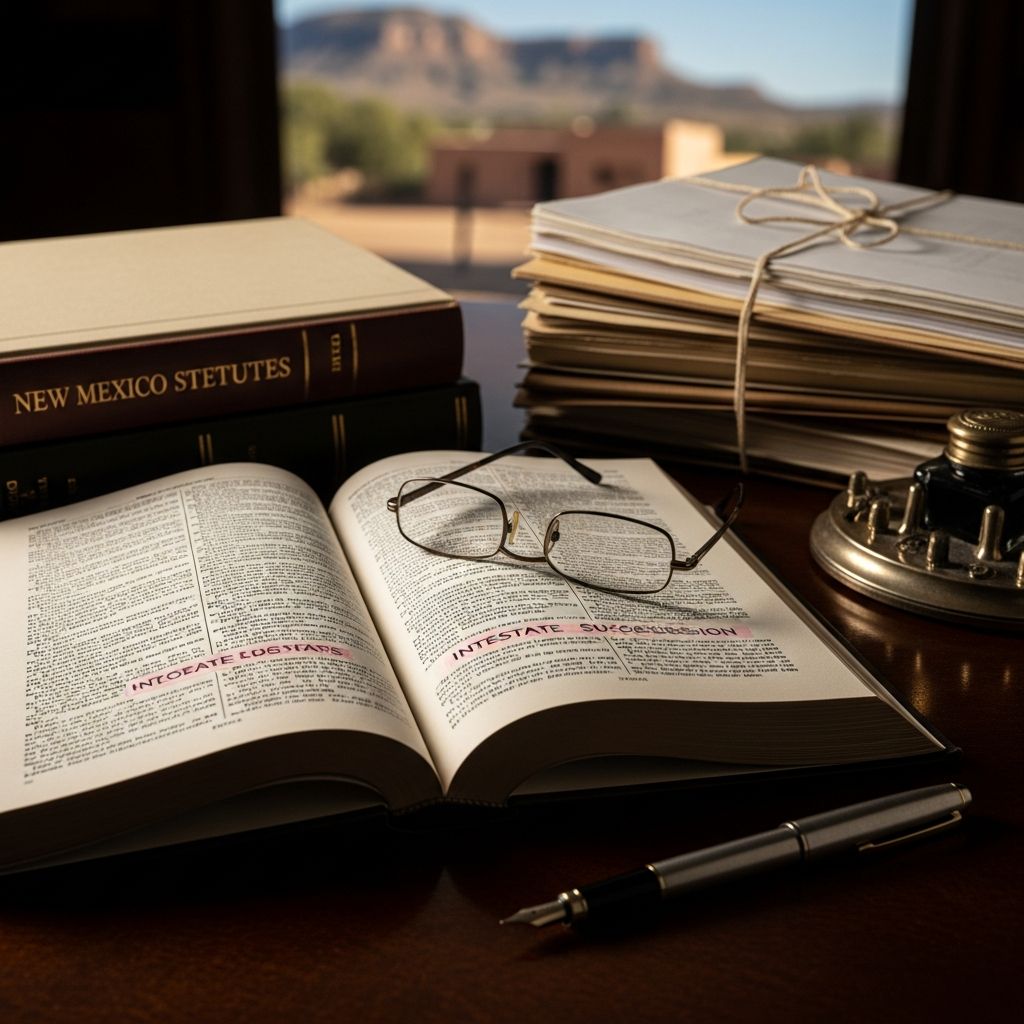
In New Mexico, dying without a valid will means your estate follows state intestate succession statutes. These laws prioritize close family members, distinguishing between community property—typically acquired during marriage—and separate property, such as pre-marital assets or inheritances. This guide explains the rules, hierarchies, exceptions, and planning strategies to help you navigate or avoid probate complexities.
Core Principles of Intestate Distribution in New Mexico
New Mexico’s intestate laws, outlined in the Uniform Probate Code (N.M. Stat. §§ 45-2-101 to 45-2-122), ensure assets pass to relatives in a predetermined order. A key requirement is the 120-hour survivorship period: heirs must outlive the decedent by 120 hours to inherit. Only probate assets are subject to these rules; non-probate items like joint accounts, life insurance, or beneficiary-designated property transfer directly.
Community property, owned equally by spouses, generally passes entirely to the surviving spouse. Separate property follows a tiered distribution favoring spouses and children first. Half-blood relatives inherit equally with whole-blood ones, promoting fairness.
Distinguishing Community and Separate Property
Understanding property classification is crucial:
- Community Property: Assets acquired during marriage, excluding gifts or inheritances to one spouse. The decedent’s share fully transfers to the surviving spouse.
- Separate Property: Pre-marital assets, gifts, inheritances, or post-marital acquisitions from separate sources. Distribution varies by surviving heirs.
Historical notes: Pre-1973 laws favored husbands, but modern statutes ensure equality. Courts classify ambiguous assets during probate.
Distribution Scenarios for Surviving Family
Intestate shares depend on family structure. Here’s a breakdown:
| Family Situation | Community Property | Separate Property |
|---|---|---|
| Spouse + Children | All to spouse | Spouse: 1/4; Children: 3/4 (equally) |
| Children (no spouse) | N/A (spouse owns their share) | All to children equally |
| Spouse (no children) | All to spouse | All to spouse |
| Parents (no spouse/children) | N/A | All to parents equally |
| Siblings (no closer heirs) | N/A | All to siblings/nieces/nephews by representation |
Data sourced from N.M. Stat. § 45-2-102 and § 45-2-103. Children include biological, adopted, and sometimes posthumous ones; stepchildren do not qualify unless legally adopted.
Line of Succession for Distant Relatives
If no spouse or children survive, assets descend further:
- Parents equally.
- Siblings and their descendants (per stirpes).
- Grandparents and their issue, split per lineage.
With no identifiable heirs, property escheats to the state—extremely rare, as laws extend to cousins and spouse’s descendants. Representation (per stirpes) means a deceased heir’s share passes to their children.
Special Rules and Exceptions
Survivorship and Simultaneous Death
The 120-hour rule prevents inheritance if heirs die nearly simultaneously, defaulting to simultaneous death assumptions.
Advancements and Half-Blood Heirs
Lifetime gifts to heirs count as advancements if declared contemporaneously, reducing their share. Half-blood relatives inherit identically to full-blood.
Property Exempt from Intestate Succession
- Joint tenancy with right of survivorship.
- Pay-on-death (POD) accounts.
- Transfer-on-death (TOD) deeds.
- Life insurance or retirement accounts with beneficiaries.
- Trust-held assets.
These bypass probate entirely. If beneficiaries predecease without alternates, assets may revert to intestate rules.
The Probate Process Overview
Intestate estates require court-supervised probate:
- Petition filing by personal representative (often spouse/child).
- Heir determination and notice.
- Asset inventory, debts payment.
- Distribution per statutes.
Small estates under $75,000 may use affidavits. Full probate can take 6-18 months; costs include fees and attorney expenses.
Why Create a Will? Benefits and Alternatives
Intestate laws may not align with your wishes—e.g., excluding stepchildren or favoring charities. A will allows customization, names executors, and appoints guardians. Alternatives include:
- Revocable Living Trusts: Avoid probate, control distributions.
- Beneficiary Designations: Quick transfers.
- Joint Ownership: Survivorship rights.
Even with a will, partial intestacy applies to omitted assets. Consult attorneys for holographic or formal wills’ validity.
Frequently Asked Questions (FAQs)
What if my spouse and I have no children?
Your spouse inherits all community and separate property.
Do grandchildren inherit if a child predeceases me?
Yes, via per stirpes representation.
Can unmarried partners inherit?
No, unless named beneficiaries or joint owners; domestic partnerships may qualify variably.
What about debts in intestate estates?
Heirs inherit assets subject to debts; personal liability is limited.
How recent are these laws?
Current as of 2024 per N.M. Stat. §§ 45-2-102; 45-2-103.
Planning Steps to Control Your Legacy
To sidestep intestate pitfalls:
- Draft a will or trust promptly.
- Review beneficiary designations yearly.
- Classify property clearly (e.g., transmutation agreements).
- Consider incapacity planning via powers of attorney.
New Mexico’s laws favor family but lack personalization. Proactive estate planning ensures your assets reach intended recipients efficiently.
References
- Intestate Succession – New Mexico — Tracts.co. 2024. https://tracts.co/help-center/intestate-succession-new-mexico/
- Probate & Intestate Succession — Roybal Mack & Cordova P.C. 2024. https://roybalmacklaw.com/services/estate-planning/probate-intestate-succession/
- Intestate Succession in New Mexico — Nolo. 2024-07-01. https://www.nolo.com/legal-encyclopedia/intestate-succession-new-mexico.html
- New Mexico Intestate Succession Lawyer — NM Financial Law. 2024. https://nmfinanciallaw.com/probate-law/intestate-succession-lawyer/
- New Mexico Statutes Section 45-2-102 (2024) — Justia (NM Official Statutes). 2024. https://law.justia.com/codes/new-mexico/chapter-45/article-2/part-1/subpart-1/section-45-2-102/
- Intestate Succession and Wills Law: The New Probate Code — University of New Mexico Law Review (.edu). 1975. https://digitalrepository.unm.edu/cgi/viewcontent.cgi?article=1380&context=nmlr
Similar Articles








Read full bio of Sneha Tete


