
New Jersey Property Line and Fence Rules Explained
A practical New Jersey guide to property lines, neighbor disputes, and building legal, compliant residential fences.
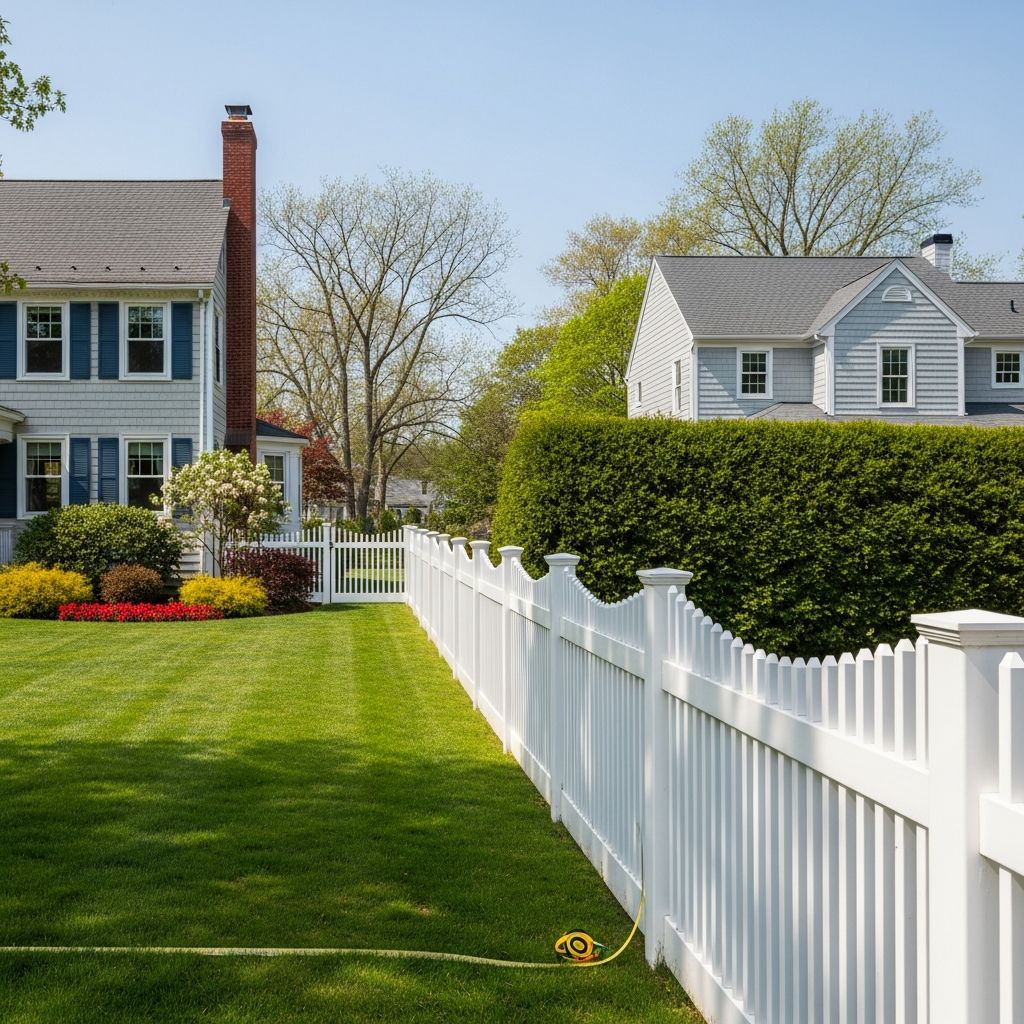
Fences can add privacy, security, and curb appeal, but in New Jersey they are also tightly connected to property line rules, zoning ordinances, and long-standing state fence laws. Before digging a post hole, it is critical to understand where your land begins and ends, what heights and locations are allowed, and how to handle shared or disputed boundaries.
This guide explains the main concepts behind New Jersey property line and fence rules, how local ordinances fit together with state law, and what practical steps you can take to avoid neighbor conflicts and legal trouble.
1. Property Lines: The Starting Point for Any Fence
Every fence rule in New Jersey ultimately comes back to one question: where is the property line? Tax maps and deeds provide legal descriptions of lots, and state regulations specify how those lines must be shown on official maps.
1.1 How property lines are defined
On official tax maps, property boundaries are drawn with standardized line styles so that each lot can be clearly distinguished from streets, blocks, and adjacent parcels. These maps are usually created or overseen by municipal engineers or tax assessors.
- Deed descriptions identify boundaries using measurements, directions, and references to markers.
- Tax maps provide a visual layout of individual lots within a municipality.
- Surveys pinpoint the line on the ground using professional measurements.
1.2 Why you should confirm your boundary before building
Many New Jersey towns require that fences be installed entirely within the owner’s lot, not inside a public right-of-way and not on a neighbor’s land. Building even a few inches over the line can trigger disputes and may lead to demands to remove or move the fence.
Practical steps before installation:
- Review your deed and any prior surveys.
- Order a new survey if the boundary is unclear or stakes are missing.
- Ask your town zoning office whether a survey is required with your fence permit application.
2. State Fence Law vs. Local Zoning Ordinances
New Jersey fence rules come from two main sources:
- State statutes that define what counts as a lawful fence, especially for agricultural and boundary fences.
- Municipal ordinances that set height limits, locations, appearance standards, and permit procedures in each town.
2.1 State law on lawful fences and agricultural land
New Jersey statutes describe when a fence is considered “lawful” for purposes such as enclosing lands and containing animals. A fence may be legally sufficient if it meets a minimum height and strength standard, especially in agricultural areas.
- For agricultural or pasture lands, law requires boundary fences to reach a specified minimum height (a little over four feet) and be strong enough to contain livestock.
- Where neighboring lands are both used for animals, owners can be required to share responsibility for a partition fence between them.
2.2 Local ordinances: where most residential rules live
For typical residential neighborhoods, local zoning codes provide the most important rules. These ordinances commonly address:
- Maximum fence heights for front, side, and rear yards.
- Whether fences are allowed in front yards at all.
- Requirements that fences be built inside the lot line and outside of public rights-of-way.
- Special conditions for corner lots and sight visibility near driveways and intersections.
- Restrictions on barbed wire, electric fences, and industrial-style materials in residential districts.
Homeowners should always treat the statewide rules as a floor and check their specific town’s code, because local regulations are often more detailed and restrictive.
3. Typical Height and Location Limits in New Jersey Towns
Although each municipality writes its own ordinance, many New Jersey towns follow similar patterns for residential fence limits.
| Yard Area | Common Max. Height (Residential) | Typical Restrictions |
|---|---|---|
| Front yard | 3–4 feet | May be limited or prohibited; often lower to preserve visibility and streetscape. |
| Side yard (behind front building line) | Up to 6 feet | Must usually stay behind the front building line; may abut property line if inside owner’s lot. |
| Rear yard | Up to 6 feet | Installed along rear and interior side boundaries; must not be in a right-of-way. |
| Corner lots / visibility areas | Often 3 feet within sight triangle | Lower heights near street intersections to protect driver visibility. |
3.1 Inside the property line requirement
Many New Jersey towns state that all fences must be fully inside the property line and cannot extend into public streets or rights-of-way. In practice this means:
- The fence posts and rails must sit within your lot limits, not on municipal land.
- Some ordinances also require that the “finished” or more attractive side of the fence face outward toward the neighbor or street.
- Living fences such as hedges may be required to be set back a few feet from the line.
3.2 Setbacks for non-residential and special uses
Where properties are zoned for commercial, industrial, or cluster residential uses, fence rules can change significantly. In some towns, fences in these zones must be placed back to at least the building setback line, and cannot be built in front yards unless a site plan approval says otherwise.
4. Permits, Approvals, and Construction Codes
New Jersey does not have a single statewide residential fence permit system. Instead, zoning permits and sometimes construction permits are issued at the municipal level.
4.1 When you need a zoning or building permit
Many townships require an owner to obtain a zoning permit before starting any new fence, regardless of height. A separate construction permit may be triggered if the fence exceeds a specified height or forms part of a pool barrier.
- Zoning permits confirm that the location, height, and style comply with local land-use ordinances.
- Construction permits apply when a fence is tall enough or performs a safety function such as enclosing a pool, requiring review under New Jersey’s Uniform Construction Code.
4.2 Pool fences and safety standards
Where a fence is used as part of a pool enclosure, it must meet state building safety standards in addition to local zoning rules. These typically require:
- A minimum height of at least four feet around the pool area.
- Self-closing, self-latching gates located at the proper height to prevent child access.
- No large openings that a child could easily pass through or climb.
Because these requirements stem from the Uniform Construction Code, they are enforced by local construction or building departments.
5. Shared Boundaries, Partition Fences, and Neighbor Relations
Fences often sit near or along a line between two properties, raising issues about cost-sharing, maintenance, and consent. New Jersey law and local practice address these questions differently depending on whether the land is used for agriculture or ordinary residence.
5.1 Partition fences for agricultural and livestock uses
Where adjoining lands are both used to pasture animals, New Jersey statutes recognize a duty to share in the maintenance of a partition fence between the properties. In this context:
- Each owner has an obligation to keep their part of the boundary adequately fenced, unless they mutually agree to leave the lands open.
- The fence must meet state standards for height and strength to be considered lawful.
5.2 Residential boundary fences and cooperation
For typical residential lots, there is generally no automatic statewide requirement that neighbors share the cost of a privacy or decorative fence unless a local ordinance or written agreement requires it. However, many practical issues still arise:
- If a fence sits fully on one owner’s land, that owner typically bears responsibility for initial construction and upkeep.
- Where neighbors decide to share a boundary fence, documenting cost-sharing and maintenance duties in writing can prevent later disputes.
- Some local practices recommend installing a fence slightly inside the owner’s side (for example, several inches) to avoid any claim that it was built on shared property.
5.3 Spite fences and excessive height
New Jersey does not rely on a single state statute explicitly defining spite fences, but local ordinances and general nuisance law can restrict fences built primarily to annoy or harm a neighbor.
- Local codes may cap maximum heights and restrict solid barriers in a way that indirectly prevents spite fences.
- If a fence violates a local height limit or safety rule, the town may order modification or removal regardless of the owner’s motive.
6. Trees, Vegetation, and Living Fences Along Property Lines
Boundary issues are not limited to wood or vinyl structures. Trees, hedges, and shrubs can all create friction between neighbors, especially when branches or roots cross the line.
6.1 Trimming overhanging branches
New Jersey property owners are generally allowed to trim branches and vegetation that extend over their land, but only up to the property line and without entering the neighbor’s property without permission.
- You may cut back limbs that overhang your side, so long as the work does not unnecessarily damage or kill the tree.
- You are not permitted to go onto the neighbor’s land to trim without consent.
6.2 Living fences and setback rules
Some local ordinances treat hedges or dense plantings as living fences, imposing minimum setbacks from the property line and maintenance requirements.
- Living screens may need to be planted several feet back from the boundary.
- They must often be kept neatly trimmed to avoid encroachment or safety issues.
7. Drainage, Sight Lines, and Other Safety Considerations
Even when a fence is on your land and within height limits, it still must not create hazards for others. New Jersey municipalities frequently address safety issues such as drainage and visibility in their ordinances.
7.1 Maintaining clear sight triangles
To protect drivers and pedestrians, many towns restrict fence height in sight triangles near intersections and driveways.
- Within a defined distance of a street corner, fences may be limited to about three feet in height.
- Similar rules can apply where driveways meet the sidewalk or road, to preserve clear views when backing out.
7.2 Drainage and runoff
Some ordinances require fences to be installed so that they do not block natural drainage or cause water to pond on neighboring properties.
- Solid walls or close-boarded fences at the bottom of a slope may need gaps or design features to allow water passage.
- Owners can be asked to modify fencing if it creates flooding or erosion issues.
8. Practical Steps Before You Build a Fence in New Jersey
Because so many rules intersect, careful planning is the best protection against future disputes and enforcement actions.
8.1 Checklist for homeowners
- Confirm your property line through a survey or reliable documentation before selecting a fence line.
- Read your town’s zoning ordinance or call the zoning office to learn specific height, location, and material restrictions.
- Apply for the required permit(s) and include any surveys or site plans requested by the municipality.
- Discuss plans with affected neighbors, especially if the fence runs near a shared boundary.
- Consider future maintenance access; leaving a small interior setback can make repairs easier.
- Respect drainage and visibility rules so the fence does not create safety hazards.
Frequently Asked Questions (FAQs)
Q1: Can I put a fence directly on the property line in New Jersey?
A: Many New Jersey towns require fences to be placed fully inside your lot and prohibit any part of the fence from extending into a public right-of-way. Some owners still choose to set fences slightly inside the line to avoid future disputes. Always verify your town’s exact rule and confirm the boundary with a survey.
Q2: Do I need my neighbor’s permission to build a fence?
A: If the fence is built entirely on your side and complies with local ordinances, you typically do not need the neighbor’s permission. However, if the fence will straddle the line or you want to share costs or maintenance, a written neighbor agreement is advisable. Agricultural partition fences may involve shared legal responsibilities under state law.
Q3: How high can my backyard fence be?
A: In many New Jersey municipalities, residential fences in side and rear yards can be up to six feet tall, while front-yard fences are restricted to about three or four feet or may not be allowed at all. Check your specific town’s ordinance for exact limits and corner-lot rules.
Q4: What if my neighbor’s tree branches hang over my yard?
A: You may trim branches and vegetation that cross into your property, but only up to the property line and without going onto your neighbor’s land without consent. You must avoid damaging or killing the tree. If the situation is severe, consider discussing it with the neighbor or seeking legal advice.
Q5: Are barbed wire or electric fences allowed on residential lots?
A: Many New Jersey towns prohibit barbed wire and electrified fences in standard residential zones, reserving them for agricultural or industrial settings if allowed at all. Always review your local ordinance before considering these materials.
References
- N.J. Admin. Code § 18:23A-1.11 – Property lines — New Jersey Division of Taxation. 2003-02-03. https://www.law.cornell.edu/regulations/new-jersey/N-J-A-C-18-23A-1-11
- New Jersey Fence Laws (N.J. Stat. Ann. Title 4, Ch. 20) — National Agricultural Law Center. 2018-01-01. https://nationalaglawcenter.org/wp-content/uploads/assets/fencelaw/newjersey.pdf
- Fence Permits and Regulations in New Jersey: A Homeowner’s Guide — DiPasquale Fence. 2023-06-15. https://dipasqualefence.com/fence-permits-and-regulations-in-nj/
- § 150.14 Fence Regulations, Voorhees Township Code — Voorhees Township, NJ. 2020-07-01. https://codelibrary.amlegal.com/codes/voorheestwp/latest/voorheestwp_nj/0-0-0-33933
- Fence and Buffer Regulations, Township of Freehold — Freehold Township, NJ. 2021-05-10. https://ecode360.com/9104275
- Fences — Township of East Brunswick, NJ. 2022-08-01. https://www.eastbrunswick.org/174/Fences
- Understanding New Jersey Fence Laws: Navigating Boundaries, Spite Fences, and Tree Trimming — BLACKlineHHP. 2023-04-03. https://blacklinehhp.com/understanding-new-jersey-fence-laws-navigating-boundaries-spite-fences-and-tree-trimming/
Similar Articles








Read full bio of Sneha Tete


