
New Jersey’s Historic Death Penalty Abolition
How New Jersey led the nation in abolishing the death penalty.
Before New Jersey’s landmark decision, the American capital punishment system had experienced significant turbulence and decades of entrenched political support. Following the 1972 United States Supreme Court ruling in Furman v. Georgia, which temporarily invalidated death penalty statutes nationwide due to their arbitrary and capricious application, states scrambled to rewrite their legal frameworks. In 1976, Gregg v. Georgia reinstated the practice, ushering in the modern era of capital punishment. For over three decades subsequently, state legislatures primarily focused on expanding or streamlining executions rather than ending them. New Jersey’s legislative action in 2007 dramatically reversed this momentum, signaling a profound shift in American jurisprudence and political bravery.
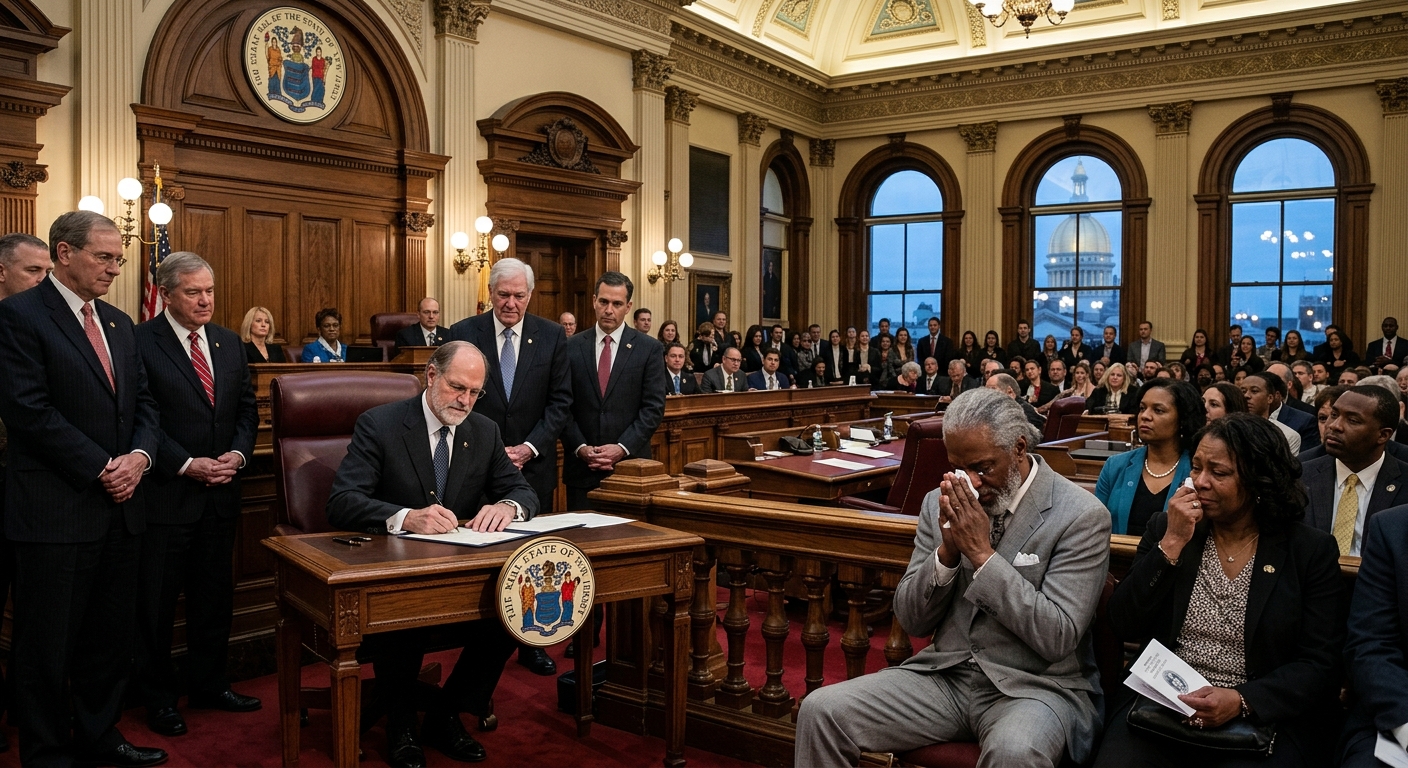
In the final weeks of 2007, the state of New Jersey fundamentally altered the landscape of American criminal justice. By enacting legislation to abolish the death penalty, New Jersey became the first state in the modern era of capital punishment to legislatively dismantle its execution apparatus. When Governor Jon Corzine signed the historic bill into law on December 17, 2007, he simultaneously exercised his executive clemency authority to commute the sentences of the eight men then residing on the state’s death row, converting their ultimate punishments to life imprisonment without the possibility of parole.
This monumental policy shift was not an overnight phenomenon, nor was it a spontaneous political maneuver. Rather, it was the culmination of years of rigorous legal scrutiny, exhaustive legislative study, and a profound evolution in public sentiment regarding the morality, efficacy, and financial viability of state-sponsored executions. New Jersey’s decision provided a definitive, evidence-based blueprint for other states grappling with the deep-seated flaws inherent in the capital punishment system, proving that legislative repeal was not only politically feasible but deeply aligned with the principles of human rights, public safety, and fiscal responsibility.
The Catalyst for Change: The New Jersey Death Penalty Study Commission
The turning point in New Jersey’s journey toward abolition occurred in early 2006, when the state legislature passed a resolution establishing the New Jersey Death Penalty Study Commission. Recognizing that the state had not actually executed a single prisoner since 1963—despite reinstating the death penalty statute in 1982—lawmakers sought a comprehensive and objective analysis of the system’s practical realities. The commission was intentionally diverse and highly credentialed, comprising thirteen members that included law enforcement veterans, a former state attorney general, active county prosecutors, religious leaders, defense attorneys, and advocates representing the families of murder victims.
Tasked with a sweeping mandate, the commission spent months holding extensive public hearings across the state. They solicited expert testimony from a wide array of professionals, including criminologists, sociologists, constitutional scholars, and forensic psychologists. Furthermore, they listened to harrowing personal accounts from those directly impacted by the system, reviewing voluminous empirical data spanning decades of legal proceedings. In January 2007, they released a watershed report that would serve as the foundational intellectual argument for legislative repeal. The commission’s primary recommendation was unequivocal: the death penalty should be abolished and immediately replaced with a mandatory sentence of life in prison without parole.
- Lack of Penological Intent: The commission concluded that capital punishment did not rationally serve any legitimate penological goal, failing to provide tangible benefits to the criminal justice system or the broader public.
- Risk of Executing the Innocent: Acknowledging the inherent fallibility of the legal system, the commission determined that the state’s interest in executing a small number of guilty individuals was not compelling enough to justify the irreversible risk of executing an innocent person.
- Financial Inefficiency: The extensive economic costs associated with capital litigation were found to be disproportionately higher than the costs of lifelong incarceration, diverting essential funds from other public safety needs.
- Impact on Victims’ Families: Countering traditional societal narratives, the commission found that the prolonged and highly publicized appeals process inherently tied to capital cases actually exacerbated the emotional trauma experienced by the surviving family members of murder victims.
Evaluating the Economic Burden: The High Cost of Capital Punishment
One of the most pragmatic and universally understood arguments that propelled the abolition movement in New Jersey was the staggering financial burden that the death penalty imposed on taxpayers. Capital punishment cases are inherently more complex, resource-intensive, and expensive than non-capital cases. From the initial investigation through the trial, and into the exhaustive, multi-tiered appeals process, the financial costs multiply exponentially.
In a capital trial, jury selection (voir dire) takes significantly longer due to the necessity of finding “death-qualified” jurors—individuals who are willing to impose a death sentence if required by law. Additionally, these trials are bifurcated into two distinct phases: a guilt phase and a penalty phase, essentially requiring two full trials for a single defendant. The defense and the prosecution must rely on a battery of high-priced expert witnesses, forensic specialists, and mitigation experts, all of which drive up the financial toll.
The appellate process alone consumes an immense amount of state resources. In death penalty jurisdictions, appeals are virtually always mandatory and multi-tiered, involving direct appeals to the state supreme court, state post-conviction review, and subsequent federal habeas corpus petitions. This labyrinthine legal process can easily span twenty to thirty years, during which the state must continuously fund specialized defense attorneys and appellate prosecutors. Furthermore, once sentenced, inmates on death row are housed in segregated, high-security facilities that require specialized staffing protocols, dramatically increasing daily operational budgets.
| Expense Category | Capital Punishment System | Life Without Parole System |
|---|---|---|
| Pre-Trial & Trial Phase | Bifurcated trials, extensive expert testimony, prolonged and complex jury selection. | Single-phase trial, standard evidentiary requirements, expedited jury selection. |
| Appellate Process | Mandatory state supreme court review, decades-long federal habeas corpus petitions. | Standard appellate review, significantly shorter duration, fewer specialized legal filings. |
| Incarceration Protocol | Segregated death row units, elevated security measures, increased staff-to-inmate ratios. | Integration into the general maximum-security population, utilizing standard protocols. |
By shifting to a system of life without parole, New Jersey lawmakers prudently recognized that they could redirect millions of dollars previously allocated to an expensive, non-functioning death penalty system toward more effective crime prevention initiatives, comprehensive victim support services, and advanced law enforcement training programs.
Debunking the Myth of Deterrence and Reevaluating Public Safety
For decades, staunch proponents of capital punishment have argued that the ultimate penalty serves as a vital deterrent to violent crime, theorizing that potential offenders will reconsider their actions if their own lives are at risk. However, the New Jersey Death Penalty Study Commission, drawing on extensive criminological research and statistical data, found no credible empirical evidence to support this assertion. The notion that a potential murderer engages in a rational, calculated cost-benefit analysis prior to committing a homicide is largely disconnected from the grim reality of violent crime.
Most homicides are impulsive acts, driven by acute emotional distress, profound substance abuse, or severe, untreated mental health crises—scenarios where the distant threat of future legal consequences holds absolutely no psychological weight. Furthermore, the commission noted that the extreme delay between a death sentence and an actual execution completely neutralizes any theoretical deterrent effect. A punishment that is perceived as distant, abstract, and highly unlikely to be carried out cannot effectively influence immediate human behavior.
By analyzing crime statistics across the United States, lawmakers and researchers repeatedly observed a compelling trend: states without the death penalty consistently reported homicide rates equal to, or in many cases significantly lower than, states that actively executed prisoners. For instance, regions with the highest execution rates simultaneously struggled with the highest violent crime rates. This geographical data reinforced the logical conclusion that public safety is best served through the certainty and swiftness of punishment—qualities inherent in a sentence of life without parole—rather than the hollow, delayed threat of an execution.
The Human Element: Victims’ Families and the Risk of Irreversible Error
Perhaps the most emotionally resonant and paradigm-shifting aspect of New Jersey’s repeal effort was the amplification of voices from victims’ families. Historically, the American criminal justice system has often presumed that the families of murder victims universally desire the execution of the perpetrator as a mandatory requirement for achieving closure. The legislative hearings in New Jersey entirely dismantled this monolithic assumption.
Numerous family members courageously testified that the death penalty process actually hindered their ability to heal. Every scheduled court date, every filed appeal, and every sensationalized media report detailing the impending execution forced families to repeatedly relive the worst moments of their lives. The agonizing uncertainty of a decades-long legal battle left them trapped in a state of perpetual emotional limbo. For many of these families, a definitive sentence of life without parole offered an immediate, comforting sense of finality. The offender would be permanently removed from society, the legal spectacle would immediately cease, and the families could finally begin the deeply private process of grieving without the glare of courtrooms.
Equally critical to the ethical debate was the growing national awareness of wrongful convictions, spearheaded by organizations utilizing modern forensic science. The advent of advanced DNA testing in the late 20th and early 21st centuries exposed critical, sometimes fatal, flaws in the criminal justice system. This technological breakthrough led to the exoneration of dozens of individuals who had been wrongfully convicted and sentenced to die across the country, some of whom came within days of execution. The New Jersey legislature recognized that no human institution, no matter how rigorously constructed, is infallible. The inherent risk of executing an innocent citizen was deemed an intolerable violation of fundamental civil liberties. Replacing the death penalty with life imprisonment ensures that if new, exculpatory evidence comes to light, the state retains the ability to correct its error and release the innocent party.
The Domino Effect: How New Jersey Paved the Way for National Reform
New Jersey’s 2007 legislative repeal was a historical watershed moment that shattered a long-standing political taboo. Prior to this decision, many elected officials across the nation feared that voting to abolish the death penalty would result in severe political backlash and damaging accusations of being “soft on crime.” By passing abolition legislation, New Jersey lawmakers powerfully demonstrated that a principled, evidence-based approach to criminal justice reform could withstand intense public scrutiny and align perfectly with evolving standards of human decency.
The impact of New Jersey’s bold decision reverberated far beyond its geographical borders. It served as a vital catalyst for a modern wave of state-level abolitions, breaking the ice for legislatures nationwide. In 2009, New Mexico successfully legislated the end of its capital punishment system, citing similar fiscal and moral concerns. Illinois, which had famously implemented a governor-mandated moratorium on executions due to a distressingly high rate of wrongful convictions, officially abolished the practice in 2011. Connecticut followed suit in 2012, and Maryland did the same in 2013. The political momentum continued to build over the next decade, culminating prominently in 2021 when Virginia became the very first Southern state to abolish the death penalty—a profoundly historic milestone given the region’s heavy historical reliance on the practice.
Today, New Jersey’s courageous legislative action is widely viewed by historians and legal scholars as the definitive dawn of the modern abolition movement in the United States. It provided a comprehensive, thoroughly researched, and highly dignified framework that subsequent states successfully utilized to navigate the complex legal, economic, and moral hurdles associated with ending state-sponsored executions once and for all.
Frequently Asked Questions
When did New Jersey officially abolish the death penalty?
New Jersey officially abolished the death penalty on December 17, 2007, when Governor Jon Corzine signed the legislative repeal into law. This monumental act made New Jersey the first state to legislatively end capital punishment since the U.S. Supreme Court reinstated it in 1976.
What happened to the inmates who were already on death row in New Jersey?
On the day before the repeal bill was officially signed, Governor Jon Corzine exercised his constitutional executive clemency power to commute the death sentences of all eight individuals then confined to the state’s death row. Their capital sentences were immediately converted to life in prison without the possibility of parole.
Why did the state decide that the death penalty was no longer viable?
The historic decision was heavily influenced by the exhaustive findings of the New Jersey Death Penalty Study Commission. The commission ultimately found that the system was incredibly costly to taxpayers, utterly failed to deter violent crime, subjected victims’ families to prolonged emotional trauma through endless legal appeals, and carried the profoundly unacceptable risk of executing an innocent person.
Did other states follow New Jersey’s example in abolishing the death penalty?
Yes. New Jersey’s legislative repeal acted as a vital catalyst for a broader national movement. In the years that immediately followed, several other states, including New Mexico (2009), Illinois (2011), Connecticut (2012), Maryland (2013), and ultimately Virginia (2021), also passed landmark legislation to permanently abolish capital punishment.
References
- New Jersey Death Penalty Study Commission Report — New Jersey Legislature. 2007-01-02. As the primary historical document initiating the repeal, this original record remains uniquely authoritative. https://www.njleg.state.nj.us/
- Timeline: The Death Penalty in New Jersey — eRepository @ Seton Hall Legislative Journal. 2008-04-14. https://scholarship.shu.edu/shlj/
- New Jersey Abolishes the Death Penalty — Equal Justice Initiative. 2007-12-17. https://eji.org/news/new-jersey-abolishes-death-penalty/
- Wasteful & Inefficient: The Alarming Cost of the Death Penalty — Equal Justice USA. 2010. https://ejusa.org/resource/wasteful-inefficient/
Similar Articles








Read full bio of medha deb




