
Neon Underglow Car Lights: Laws, Safety, and Tickets
Understand how U.S. neon underglow laws work, what colors and setups trigger tickets, and how to customize your car without breaking the law.
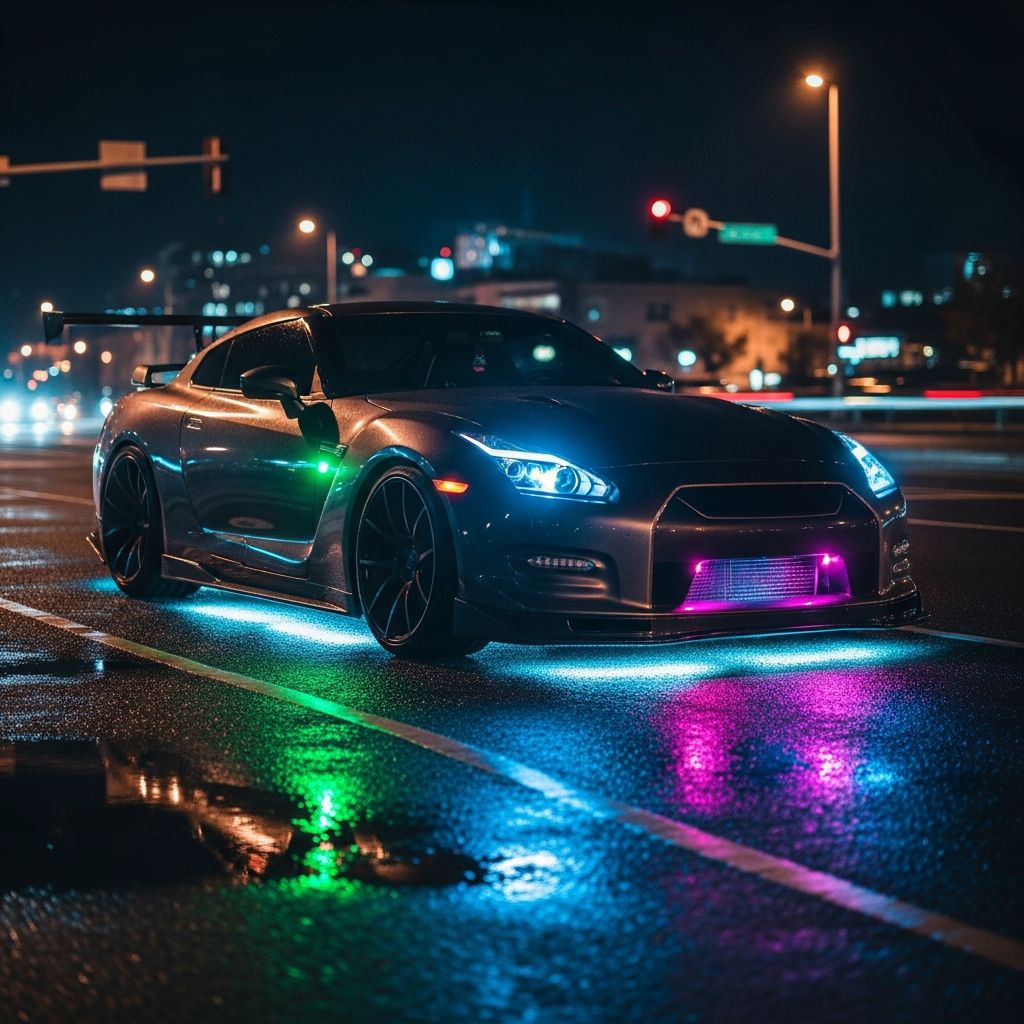
Neon and LED underglow lights are a popular way to give a car, truck, or motorcycle a standout look. But turning your vehicle into a rolling light show can also attract attention from law enforcement. Because lighting directly affects visibility and can be confused with emergency signals, most states limit or heavily regulate decorative lighting on public roads.
This guide breaks down how neon underglow laws generally work in the United States, what colors and setups are usually prohibited, how tickets are handled, and what you can do to lower your risk of a citation.
Why Underglow Lighting Is Regulated
Almost every U.S. state has detailed standards for required vehicle lights (headlamps, tail lamps, turn signals, etc.) and for any additional lamps that can be legally used while driving. Decorative lighting like underglow has to fit into that framework. Lawmakers and safety agencies focus on three key concerns:
- Driver distraction – Bright or fast-changing lights can pull attention away from the road.
- Confusion with official vehicles – Red, blue, or combinations that resemble police/emergency vehicles are often restricted to authorized vehicles only.
- Glare and visibility – Lights that shine directly into other drivers’ eyes or wash out required lamps can reduce contrast and make it harder to see hazards.
Because of these safety concerns, underglow tends to be more tolerated for show use on private property and far more restricted on public streets.
Public Roads vs. Private Property
Most traffic codes apply only on public roads, highways, and sometimes publicly accessible parking lots. That distinction matters for underglow users:
- On public roads: Vehicle codes and lighting rules apply, and illegal underglow can result in citations and fines.
- On private property: Traffic laws usually do not apply, but other rules might, such as nuisance ordinances, HOA regulations, or property-owner restrictions.
If you plan to use dramatic or clearly non-compliant lighting, many enthusiasts limit that to shows, events, or off-road areas where traffic codes do not govern normal operation.
Common Legal Themes Across States
Each state writes its own lighting rules, so exact language varies. However, several patterns show up repeatedly in state statutes and enforcement practices.
Typical Color Restrictions
Most states limit the colors and locations of light visible from a moving vehicle:
- Red and blue are frequently reserved for emergency, police, or certain official vehicles only.
- Front-facing lights often must be white or amber only.
- Rear-facing lights generally must be red, with white only permitted for reverse lamps and license plate lamps.
- Other colors (green, purple, etc.) are often banned if they are visible from the front or rear while driving.
Because underglow typically casts light around the vehicle’s perimeter, any color that is visible to the front or rear can trigger a violation in states that only allow specific colors by direction.
Flashing, Rotating, or Animated Lights
Even if the color itself is allowed, many states prohibit any non-emergency vehicle from displaying lights that:
- Flash
- Rotate or oscillate
- Change intensity or pattern continuously
For example, New York law bars attaching or displaying any non-required lights that revolve, flash, or oscillate, including white underglow. Similar rules in other states target “attention-getting” lighting that might be confused with warning or hazard signals.
Brightness and Glaring Light
Some vehicle codes include explicit brightness limits and glare rules. California, for instance, permits certain auxiliary lamps only if the light is diffused and below a specified candela per square inch, and must not interfere with required lamps or reflectors. Even where there is no specific measurement standard, officers can cite drivers if lights are judged to produce “glaring” or “dazzling” light.
State-Level Approaches: From Lenient to Strict
While this article cannot catalog every state, a few examples illustrate the range of approaches. Always verify the current law in your own state before relying on any generalized description.
| Example State | General Treatment of Underglow | Key Limitations (Illustrative) |
|---|---|---|
| California | Conditionally allowed with strict limits | Diffused, non-glaring light; no red visible from the front; may not interfere with required lamps. |
| New York | Highly restricted | Most underglow banned; only steady white light allowed, and attaching non-required colored or flashing lights is illegal. |
| Arizona / Kansas | Permits some underglow | Allow narrow color ranges (often white or amber) and ban flashing or exposed tubes. |
| New Jersey | No specific underglow ban | All visible lights still must comply with color-by-location rules (front: white/amber; rear: red). |
| Michigan / Illinois | Generally disallow decorative lighting on road | Only statutorily listed lamps are authorized; decorative underglow is not among them. |
These examples show two important points:
- Some states expressly address underglow in statutes or guidance.
- Others treat underglow as illegal by default when it does not fit within the list of permitted auxiliary lighting.
How Police Typically Enforce Underglow Laws
For most drivers, the central question is not abstract legality but what happens during a real-world traffic stop. Sources that discuss enforcement practices and case outcomes show several common threads.
Moving Violation vs. Equipment (Non-Moving) Violation
In many jurisdictions, improper lighting is treated as an equipment or “non-moving” violation rather than a traditional moving violation. That often means:
- The ticket is classified similarly to an issue with a burned-out taillight or missing mirror.
- It may not add points to your driving record in some states.
- Fines are usually lower than for speeding or reckless driving, though they still cost money and time.
Correctable or “Fix-It” Tickets
States frequently allow illegal lighting tickets to be handled as correctable violations if you remove or modify the equipment and show proof of correction:
- You might receive a citation instructing you to repair or remove the offending lights.
- After correcting the issue, you may need a law enforcement officer or authorized inspector to sign off.
- Fines may be reduced or dismissed once proof of correction is filed.
This approach encourages compliance without imposing the same long-term consequences associated with major traffic offenses.
When Illegal Lighting Can Aggravate Liability
In a collision or injury case, non-compliant lighting can become evidence of negligent vehicle modification. If an insurance company or injured party can show that distracting or confusing lighting contributed to an accident—by, for example, obscuring brake lights or being mistaken for an official signal—that can complicate liability and raise the stakes well beyond a simple traffic ticket.
Practical Tips to Reduce Ticket Risk
If you want to personalize your vehicle without constant worry about traffic stops, consider these practical guidelines drawn from how states write and enforce lighting laws.
1. Research Your State and Local Rules
- Read your state vehicle code sections on lighting, auxiliary lamps, and prohibited colors.
- Check for local ordinances in large cities, which sometimes add stricter rules.
- Be cautious relying on summaries—always confirm with the actual statutory text or official guidance from your DMV or state police.
2. Keep Colors Conservative on the Street
- Prefer white or soft amber for any light that might be visible from the front or sides.
- Avoid red, blue, or red/blue combinations entirely on public roads unless specifically permitted for your vehicle type.
- If using multicolor LED kits, disable or lock out restricted colors while driving.
3. Avoid Flashing and Complex Patterns
- Use steady, non-flashing lighting modes on the street.
- Save strobes, chasing patterns, and music-reactive modes strictly for shows on private property.
- Double-check that your controller cannot accidentally cycle into prohibited modes while driving.
4. Control Brightness and Placement
- Mount underglow so that the tubes or LED elements are not directly visible; only the reflected glow should show.
- Avoid forward-facing beams that can compete with headlights or confuse oncoming drivers.
- Moderate brightness so the effect is noticeable but not glaring, especially in states with explicit candela or glare limits.
5. Keep Documentation Handy
- If your kit is marketed as street-legal in certain modes, save installation instructions and product information.
- Know how to quickly turn the system off or switch to a compliant mode if stopped.
- Being able to demonstrate good-faith efforts at compliance can sometimes influence how a stop is handled.
Underglow and Other Vehicle Modifications
States that tightly regulate underglow usually do so as part of a broader concern with aftermarket vehicle modifications. Lighting, window tint, exhaust, lifts, and other alterations are often addressed in the same or neighboring code sections.
Key principles that apply across many types of modifications include:
- Required safety equipment cannot be obscured. Decorative lights must not block or overpower brake lights, turn signals, or reflectors.
- Only listed devices are permitted. If a state enumerates what lamps may be used, anything else is presumed prohibited unless expressly allowed.
- Show-only setups (air suspension extremes, ultra-dark tint, aggressive lighting) are often acceptable at events but illegal on public roads.
Understanding underglow rules in the context of overall equipment laws can help you design a cohesive, compliant build instead of addressing each accessory in isolation.
Frequently Asked Questions (FAQs)
Q: Is neon underglow legal everywhere in the United States?
A: No. Some states allow limited underglow in specific colors and placements, while others effectively prohibit decorative underbody lighting on public roads by restricting lights to those listed in the vehicle code.
Q: Can I get a ticket if I only use underglow in a parking lot?
A: If the lot is privately owned and not generally treated as a public road, traffic lighting rules usually do not apply, but local nuisance or trespass rules still might. In publicly accessible lots treated as roadways, normal traffic regulations may still be enforced.
Q: Are white underglow lights always legal?
A: No. Some states restrict any non-required lights, regardless of color, or prohibit mounting additional white lights that flash or oscillate. New York, for example, bans attaching non-required white lights that revolve or flash, including underglow.
Q: What happens if I receive an underglow ticket?
A: In many states, you will face a civil or equipment violation with a fine. Often, the citation can be treated as a correctable offense, meaning you may reduce or avoid the fine by removing or modifying the lights and proving compliance by the deadline.
Q: Will an illegal lighting ticket affect my insurance or driving record?
A: Many underglow violations are non-moving equipment violations, which may have less impact on your driving record than moving violations. However, states differ, and repeated violations or accidents involving illegal lighting can draw more scrutiny from insurers.
Q: How can I check whether my setup is legal?
A: Start by reading your state’s vehicle code sections on lighting and auxiliary lamps, then confirm with official resources like your state DMV or highway patrol website. When in doubt, choose conservative colors, steady patterns, and moderate brightness for use on public roads.
References
- Is Underglow Illegal? Neon Lighting Laws By State (2026) — ConsumerShield. 2024-08-15. https://www.consumershield.com/injuries-accidents/car-accidents/is-underglow-illegal
- Are neon underglow lights legal? — Orant Neon. 2023-11-02. https://orantneon.com/blogs/news/are-neon-underglow-lights-legal
- New Jersey Neon Underglow Laws — NeonLaws.com (quoting N.J. Stat. § 39:3-50, § 39:3-54). 2023-05-10. https://www.neonlaws.com/new-jersey/
- Can I Use Underglow Lights in New York and Avoid a Ticket? — Law Offices of Sergey Davydov (discussing NY VTL § 375). 2022-09-20. https://newyorkmotorcycleaccidentlawyer.com/equipment/can-i-use-under-glow-lights
- What Are The Underglow Laws In New Jersey? — Oznium. 2021-06-03. https://www.oznium.com/blog/what-are-the-underflow-laws-in-new-jersey/
- Are Underglow Lights Legal? — CarParts.com. 2022-03-18. https://www.carparts.com/blog/are-underglow-lights-legal/
Similar Articles








Read full bio of Sneha Tete


