
Neighbor Tree Disputes: Rights, Risks, and Practical Solutions
Understand your legal rights and practical options when a neighbor’s trees block views, drop debris, or threaten your property.
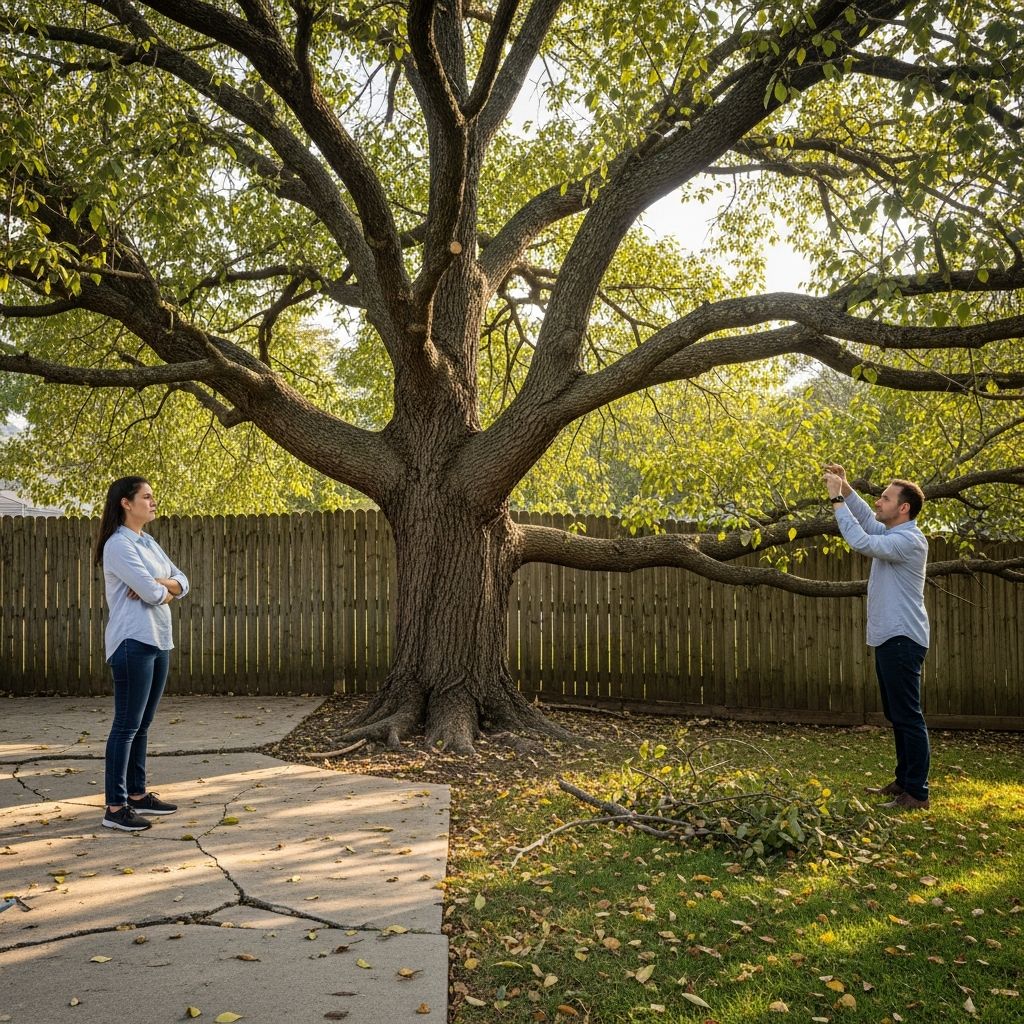
Disagreements over trees are one of the most common sources of conflict between neighbors. Trees can provide shade and beauty, but they can also block light and views, drop debris, threaten structures, and raise complex questions about legal rights and responsibilities. This guide explains the key concepts that typically govern tree disputes, while emphasizing that specific outcomes depend on the law in your state or locality.
1. Who Owns the Tree? Understanding Basic Ownership Rules
Most tree disputes begin with a simple but crucial question: who owns the tree? Ownership usually depends on where the tree’s trunk is located.
- Tree trunk entirely on one property: The owner of that land is typically considered the legal owner of the tree and controls major decisions such as removal or major pruning.
- Tree trunk directly on the property line (“boundary tree”): Many courts treat the tree as jointly owned by both neighbors. Decisions to cut down or significantly alter the tree often require agreement from all co-owners.
- Public trees: Trees planted in public rights-of-way or on government land may be controlled by a city, county, or other public authority, subject to local ordinances.
Because property boundaries are not always obvious, it can be important to check a survey, deed, or local records before taking serious action regarding a disputed tree.
2. Overhanging Branches and Encroaching Roots
Branches and roots often cross property lines even when the trunk does not. Many jurisdictions allow the affected neighbor some limited “self-help” rights.
2.1 Typical Self-Help Rights
Across many states, a common rule is that a property owner may cut off branches and roots that intrude into their airspace or underground onto their land, as long as they only cut back to the property line and do not destroy the tree.
- You may usually trim overhanging branches back to the boundary line at your own expense.
- You may generally remove encroaching roots on your side, again without crossing the boundary.
- You usually cannot enter your neighbor’s land to perform the work without permission, unless special emergency or statutory exceptions apply.
- You must act reasonably and avoid killing or seriously damaging the tree, especially if the tree is healthy and valuable.
Court decisions often describe this as an extension of the basic principle that a landowner has rights to the airspace and subsurface within their boundary.
2.2 Risks of Careless Trimming
Even if you have the right to cut back branches or roots, doing so carelessly can expose you to liability. In some states, statutes or case law allow for treble damages or other enhanced remedies if someone unlawfully cuts or destroys another person’s trees.
- Excessive trimming that destabilizes or kills the tree can lead to claims for the tree’s replacement value, lost shade, or diminished property value.
- Damaging a jointly owned boundary tree without the co-owner’s consent may create additional liability.
- Using unqualified workers or failing to follow industry standards can make negligence easier to prove.
Because of these risks, many attorneys and arboriculture experts recommend consulting a professional arborist before doing any major cutting near the property line.
3. Boundary Trees: Shared Rights and Shared Duties
When a tree’s trunk sits right on the line between two properties, it is often treated as a boundary tree and, in many jurisdictions, as the common property of both neighbors.
| Issue | Common Approach to Boundary Trees* |
|---|---|
| Ownership | Each neighbor is considered a co-owner of the tree. |
| Routine pruning | Each owner may generally trim branches on their side, provided they do not unreasonably injure the tree. |
| Removal or major alteration | Often requires consent of all co-owners; removing without consent can result in damages. |
| Liability for hazards | Responsibility may be shared if both owners have control; courts examine who knew or should have known of the risk. |
*Exact rules vary by state and local law.
Because boundary trees involve more than one decision-maker, written agreements about maintenance, cost-sharing, and removal can help prevent later disputes.
4. Common Sources of Neighbor Tree Conflicts
Not all tree-related issues lead to lawsuits, but the same themes recur in many disputes: blocked views, debris, structural damage, and safety concerns.
4.1 Blocked Views, Sunlight, and Solar Access
Many homeowners value their view, natural light, or solar panels. Trees can interfere with these interests, but the law often does not guarantee a right to a view or to sunlight unless a specific statute, easement, or agreement says otherwise.
- Traditional common law generally does not recognize an automatic right to an unobstructed view.
- Some states or municipalities have solar access laws or tree and shade ordinances that protect solar collectors or limit certain types of plantings.
- Private agreements, such as view easements or covenants in a homeowners’ association (HOA), may create enforceable rights regarding views and tree height.
Because legal protection for views and sunlight is highly location-specific, homeowners concerned about blocked views should review local codes and, if needed, consult a real estate attorney.
4.2 Leaf, Fruit, and Sap Droppings
Leaves, seeds, needles, fruit, and sap are frequent sources of annoyance. Yet in many cases, this type of natural debris is treated as a normal incident of property ownership rather than a legal wrong.
- Courts often regard typical seasonal debris as an inconvenience that each property owner must manage, not as grounds for damages.
- Local ordinances or HOA rules may impose additional obligations, such as keeping sidewalks free of fallen branches or fruit.
However, when droppings combine with other issues—such as root damage to foundations or blocked gutters causing water intrusion—they may become part of a broader negligence or nuisance claim.
4.3 Damage to Structures, Driveways, and Utilities
Tree roots and branches can crack foundations, lift sidewalks, clog sewer lines, and damage roofs or fences. Liability often depends on whether the tree owner took reasonable care.
- If a neighbor knows or should know that a tree poses a significant risk and fails to address it, they may be held liable for resulting property damage.
- If the tree is healthy and reasonably maintained, some courts treat storm-related damage as an “act of God” for which no one is legally at fault.
- Utility companies usually have specific rights and procedures for trimming trees near power lines, which can affect what homeowners are allowed to do.
Documenting visible problems with photos and written communication before major damage occurs can be important if later legal disputes arise.
5. Falling Trees and Limbs: Who Pays for the Damage?
Storms, disease, or old age can cause trees to fall or drop large limbs, sometimes across property lines or onto structures. In these situations, courts often distinguish between foreseeable hazards and unavoidable accidents.
- If the tree was obviously dead, diseased, or leaning dangerously, and the owner ignored the condition, they may be found negligent and responsible for resulting damage.
- If the tree appeared healthy and well-maintained, and a severe storm or other unexpected event caused it to fail, the damage is often treated as a no-fault loss, typically handled through each owner’s property insurance.
- Homeowners’ insurance policies vary, but in many cases, your own insurer covers removal of a fallen tree and related repairs, sometimes seeking reimbursement from the negligent neighbor if justified.
Independent arborist reports and insurance adjuster findings frequently play a key role in determining whether a fall was foreseeable or truly accidental.
6. Practical Steps Before You Call a Lawyer
Even when the law is on your side, lawsuits are costly and may permanently harm neighbor relationships. Many disputes can be resolved with a structured, practical approach.
6.1 Communicate Early and Clearly
- Start with a calm, in-person conversation describing the problem and the impact on your property.
- Follow up in writing (email or letter) summarizing what you discussed and any agreements reached.
- Offer practical solutions, such as sharing the cost of professional pruning, installing root barriers, or replacing a problematic tree with a more suitable species.
6.2 Use Professionals Wisely
- Consider hiring a certified arborist to evaluate the health of the tree, the extent of root or branch intrusion, and options for mitigation.
- Obtain written reports that can be shared with your neighbor and, if needed, with lawyers or insurers.
- If the dispute involves significant risk to structures or injury, consult a real estate or property law attorney familiar with local tree law.
6.3 Explore Mediation and Local Programs
- Some communities offer mediation services to help neighbors resolve disputes before they escalate to litigation.
- Homeowners’ associations may have internal procedures or committees that handle landscaping and tree issues.
- Local government offices, such as planning or public works departments, may provide guidance or enforce applicable tree and property-maintenance ordinances.
7. When Legal Action May Be Necessary
In some cases, informal solutions fail and legal intervention becomes necessary to protect property or safety.
- Injunctions: Courts can sometimes order a neighbor to remove or trim a hazardous tree or to cease harmful conduct.
- Damages: If a neighbor unlawfully cuts down your tree or negligently allows a hazardous tree to cause damage, you may seek monetary compensation.
- Statutory penalties: Some states impose enhanced damages for wrongful tree cutting, especially for valuable or protected trees.
Before starting a lawsuit, gather documentation such as photographs, arborist reports, correspondence with your neighbor, and insurance records. These materials help your lawyer evaluate the strength of your case and potential remedies.
8. Preventing Future Tree Disputes
Proactive planning can reduce the chance that trees will become legal problems.
- Plant the right tree in the right place: Consider mature height, root spread, and local regulations before planting near property lines or structures.
- Maintain your trees: Regular pruning, inspections, and prompt treatment of disease or structural defects can lower the risk of damage and liability.
- Clarify property lines: Surveys and clear boundary markers help avoid misunderstandings about ownership of existing or new trees.
- Use written agreements: If you and your neighbor share a boundary tree or are planting new trees near the line, consider a written agreement addressing maintenance, cost-sharing, and removal.
9. Frequently Asked Questions (FAQs)
Q1: Can I cut down my neighbor’s tree if it bothers me?
Generally no. If the tree’s trunk is entirely on your neighbor’s property, the tree legally belongs to them. You usually cannot remove it without their permission, though you may be allowed to trim branches or roots that cross onto your property line, as long as you do not kill or seriously damage the tree.
Q2: Am I responsible if my healthy tree falls on my neighbor’s house during a storm?
Often not, if the tree was healthy and properly maintained and the fall was caused by an extraordinary event, many courts treat the loss as an “act of God” handled through insurance rather than fault. However, if you ignored obvious signs that the tree was dangerous, you may be held liable for resulting damage.
Q3: Can my neighbor force me to cut my tree because it blocks their view?
In many places, there is no automatic right to a view, so a neighbor usually cannot compel you to cut a tree solely for blocking scenery. Exceptions may apply if there are specific local ordinances, solar access laws, recorded easements, or HOA rules that limit tree height or protect views.
Q4: Who pays to remove branches that fall from my neighbor’s tree into my yard?
If fallen branches are the result of ordinary weather and the tree is otherwise healthy, you may be responsible for cleanup on your side of the property. If the neighbor knew the tree or limb was hazardous and failed to act, they may be liable for damage, and insurance coverage may apply.
Q5: When should I talk to a lawyer about a neighbor’s tree?
You should consider consulting a lawyer when a tree is causing or is likely to cause significant property damage or personal injury, when your neighbor has cut or removed one of your trees without consent, or when substantial financial losses are involved and informal discussions have not resolved the problem.
References
- Trees Between Two Properties — City of Stevens Point, WI. 2023-06-01. https://stevenspoint.com/1294/Trees-Between-Two-Properties
- BOUNDARY LINE TREES: KEEP IT CIVIL — City of Neenah, WI (Corpus Juris Secundum excerpts). 2015-01-01. https://www.ci.neenah.wi.us/wp-content/uploads/2015/01/Boundary-Line-Trees.pdf
- What Can You Legally Do About Neighbor Disputes Over Trees? — Super Lawyers / Thomson Reuters. 2022-08-15. https://www.superlawyers.com/resources/real-estate/real-estate-disputes/what-can-you-legally-do-about-neighbor-disputes-over-trees/
- Tree Law: What Homeowners Need to Know — JPMorgan Chase Bank, N.A. 2023-04-10. https://www.chase.com/personal/mortgage/education/owning-a-home/tree-law
- Trees and neighbors: an overview of the rights of Wisconsin property owners — Knoll & Greller, S.C. 2021-09-30. https://www.knollgreller.com/post/trees-and-neighbors-an-overview-of-the-rights-of-wisconsin-property-owners
Similar Articles








Read full bio of medha deb


