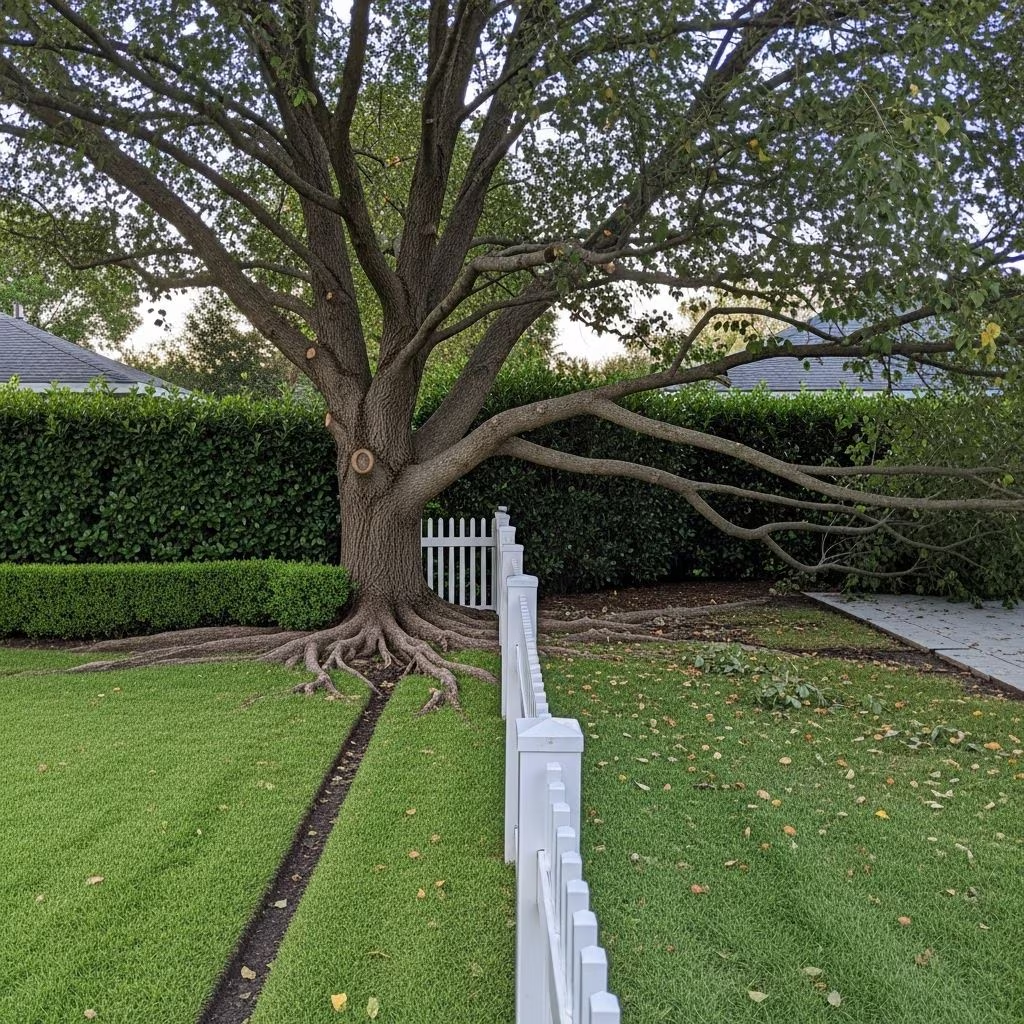
Trees add shade, beauty, and value to a property, but they also cause some of the most common and emotionally charged disputes between neighbors. Questions arise about who owns a tree, who pays for damage, and what you can legally cut when branches or roots cross the boundary line. This guide explains the typical legal rules that apply in many U.S. jurisdictions, practical strategies for avoiding conflict, and when it is time to speak with a lawyer.
1. Who Owns the Tree? Understanding Basic Legal Principles
Before any dispute can be solved, it is essential to identify who legally owns the tree. Ownership determines who controls major decisions such as removal, major pruning, or replacement after damage.
1.1 Trees Located Entirely on One Property
In most states, the owner of the land where the trunk is located owns the entire tree, even if branches or roots extend into a neighbor’s yard.1 Courts and state statutes often treat the trunk as the decisive point of reference for ownership.2
- If the trunk is fully on your land, you generally own the tree.
- Overhanging branches or encroaching roots do not change ownership.
- The owner usually decides on removal, major pruning, or replacement.
1.2 Boundary or “Line” Trees
A tree whose trunk sits directly on the property line is often considered a boundary tree (sometimes called a “line tree”). Many state laws treat such trees as the joint property of both neighbors.23
Consequences of joint ownership commonly include:
- Both neighbors share rights in the tree.
- Significant actions (like removal or drastic pruning) normally require consent from all owners.
- Costs and responsibility for maintenance and risk may be shared, depending on local law and any agreements between the owners.
1.3 Why Ownership Matters
Ownership affects:
- Who decides whether the tree stays or goes.
- Who can be liable if the tree is wrongfully cut down.
- Whether damages may be higher if someone destroys a tree without permission. Some states allow double or triple damages for wrongful cutting in order to deter intentional harm to trees.4
2. Overhanging Branches and Encroaching Roots
Even if your neighbor owns the tree, you do not have to tolerate branches or roots indefinitely invading your property. Many states follow a common-law rule that allows you to cut back vegetation that encroaches onto your land, subject to important limits.15
2.1 The General Right to Trim Back to the Property Line
In many jurisdictions, you may:
- Trim branches that cross onto your side of the property line.
- Cut roots that are encroaching under your property, particularly if they are causing concrete cracks, foundation issues, or other damage.25
- Do this work at your own expense, unless local law, contracts, or association rules say otherwise.
2.2 Reasonableness and Avoiding Damage to the Tree
Even where you are allowed to trim, the law usually imposes a standard of reasonableness:
- You may cut only what is on your side of the boundary unless you have permission to enter the neighbor’s land.
- You must take reasonable care not to kill or seriously injure the tree.
- Courts may look at whether other, less harmful solutions were available, such as using root barriers or less aggressive pruning.2
If your trimming is excessive and causes the tree to die, you may be responsible for the owner’s loss and, in some states, enhanced damages.4
2.3 When Trimming May Not Be Enough
In some cases, simple trimming does not solve the problem. For example:
- Roots continue to damage underground pipes or foundations.
- Branches remain unstable and pose a safety risk.
- The tree is diseased or structurally unsound.
Where a genuine safety hazard exists, courts may consider ordering removal, heavy pruning, or cost-sharing, depending on state law and the facts of the case.5
3. Common Sources of Tree-Related Conflict
Neighbor disputes over trees arise from many different situations. Understanding the patterns can help you address the root cause rather than just the symptom.
| Type of Problem | Typical Complaint | Legal Focus |
|---|---|---|
| Overhanging branches | Leaves, shade, blocked gutters, fear of falling limbs | Right to trim, duty to prevent unreasonable risk |
| Encroaching roots | Cracked pavement, damaged pipes, foundation movement | Root cutting, nuisance or trespass claims |
| Falling branches or whole tree | Injury, vehicle damage, roof damage, downed fences | Negligence, notice of hazard, insurance coverage |
| Blocked views or sunlight | Loss of scenic view, shaded solar panels or gardens | Local view ordinances, no general “right to a view” |
| Unauthorized cutting | Neighbor removes or severely prunes a tree without consent | Damages, possible statutory penalties |
3.1 Nuisance and Trespass Concepts
Tree disputes often involve the legal ideas of nuisance and trespass:
- Nuisance concerns substantial and unreasonable interference with the use and enjoyment of land (for example, persistent damage from invasive roots).
- Trespass can involve physical invasion of property, including roots or branches that cause direct, tangible harm.
Whether a tree problem qualifies as a legal nuisance or trespass depends on state law, the severity of the harm, and whether the owner acted reasonably once notified of the issue.5
4. When Trees Cause Damage or Injury
Severe storms, disease, and neglect can cause trees or limbs to fall, sometimes with serious consequences. Liability usually depends on what the owner knew (or should have known) and how they cared for the tree.
4.1 Duty to Maintain Trees Safely
Property owners generally have a duty to act reasonably to prevent foreseeable harm. That may include:
- Inspecting large or aging trees periodically, especially near structures or power lines.
- Addressing obvious problems such as dead limbs, severe lean, visible decay, or prior storm damage.
- Following local requirements or utility notices about hazardous vegetation.
If a property owner ignores clear warning signs of danger and a tree causes harm, they are more likely to be found negligent and responsible for resulting damages.
4.2 Natural Conditions vs. Negligence
Some courts draw a distinction between unavoidable natural events and preventable hazards. If a healthy tree falls in an extraordinary storm, the incident may be treated as an “act of nature,” making liability less likely. If the tree was clearly diseased, dead, or unstable for some time, failing to remove or treat it may be considered negligence.
4.3 Insurance Considerations
Homeowners’ insurance policies often cover damage caused by falling trees or branches, subject to deductibles and exclusions. Policies may apply differently depending on:
- Whether the tree was healthy or poorly maintained.
- What was damaged (home, fence, vehicle, landscaping).
- Whether the policyholder took reasonable steps to mitigate known risks.
Because policy language varies, it is wise to review coverage details or consult an insurance professional after any serious incident.
5. Views, Sunlight, and Privacy Concerns
Disputes are not limited to physical damage. Neighbors also clash over blocked views and reduced sunlight. In many jurisdictions, there is no automatic legal right to a view or to uninterrupted sunlight across a neighbor’s property. Courts in several states have held that an owner may allow trees to grow tall even if they obstruct a neighbor’s scenic outlook or garden, unless a specific law or agreement says otherwise.4
5.1 Exceptions: Local Ordinances and Solar Access Laws
There are important exceptions and variations:
- Some cities and counties adopt view protection ordinances, especially in coastal or hillside communities, that can limit tree height or require trimming.
- Certain states have solar access laws that protect installed solar energy systems from unreasonable shading, sometimes giving solar owners special rights to request trimming or removal.
- Homeowners’ association (HOA) rules may restrict tree height or require neighbors to maintain views or sunlight corridors.5
Because these rules are highly local, owners should check municipal codes, county ordinances, or HOA covenants to see whether any special protections apply.
6. Practical Strategies to Resolve Tree Disputes
Legal rights matter, but most neighbors prefer solutions that preserve both property and relationships. Many disputes can be settled with planning and communication rather than lawsuits.
6.1 Start with Direct, Calm Communication
Before hiring lawyers or cutting branches, try to talk with your neighbor:
- Choose a neutral time and avoid making accusations.
- Explain the specific problem: damage, safety concerns, or maintenance costs.
- Share practical ideas, such as cost-sharing for pruning or hiring a certified arborist.
- Follow up in writing (email or letter) to create a clear record if the issue continues.
6.2 Use Professionals: Surveyors and Arborists
Two types of experts are often helpful:
- Surveyor: can precisely locate the property line and confirm whether a tree is entirely on one property or straddling the boundary.
- Certified arborist: can evaluate tree health, safety risks, and appropriate pruning methods, and provide written reports that may be useful in negotiations or court.
6.3 Mediation and Community Programs
Many areas offer low-cost or free mediation services for neighbor disputes, sometimes through community organizations or court-connected programs. Mediation allows both sides to negotiate with the help of a neutral facilitator and often results in creative, customized solutions that courts might not order.
6.4 When to Consult a Lawyer
It is wise to seek legal advice when:
- Significant property damage or injury has occurred.
- The dispute involves a valuable or historic tree.
- There is a risk of criminal trespass or statutory penalties for wrongful cutting.4
- Local rules, HOA covenants, or complex easements affect tree rights.
A real estate or property-law attorney can explain state-specific tree laws, evaluate potential liability, and help negotiate or, if necessary, file a lawsuit.
7. Preventing Future Disputes: Planning and Documentation
Good planning can reduce the risk of tree conflicts before they begin.
7.1 Smart Planting Choices
- Avoid planting very large species near property lines, foundations, sidewalks, or driveways.
- Consider root behavior and mature height when selecting trees.
- Consult local extension services or arborists for tree species that are compatible with urban or suburban lots.
7.2 Maintenance Records and Written Agreements
Maintaining documentation can help if disagreements arise later:
- Keep records of pruning, inspections, and arborist reports.
- Save correspondence with neighbors about tree concerns.
- For shared or boundary trees, consider a simple written agreement covering maintenance schedules, cost-sharing, and how major decisions will be made.
Frequently Asked Questions (FAQs)
Q1: Can I cut down my neighbor’s tree if it bothers me?
No. If the trunk is on your neighbor’s property, the tree legally belongs to them in most states. You generally cannot remove or severely prune the tree without the owner’s permission, even if branches extend into your yard.17
Q2: Am I allowed to trim branches that hang over my yard?
In many jurisdictions, you may trim branches and sometimes roots that encroach onto your property, as long as you do not go onto your neighbor’s land without consent and do not unreasonably damage or kill the tree.15 Because rules vary, it is wise to confirm state law and, if possible, discuss your plans with your neighbor first.
Q3: Who pays if my neighbor’s tree falls on my house?
Responsibility often depends on whether your neighbor acted reasonably in maintaining the tree and whether there were visible warning signs of danger. In many cases, your own homeowners’ insurance may cover the damage, and the insurer may later seek reimbursement if your neighbor was negligent. Insurance policies differ, so review your coverage or speak with your insurer after an incident.
Q4: Do I have a right to keep my view or sunlight?
Generally, there is no automatic common-law right to a view or to unrestricted sunlight across a neighbor’s land. However, local ordinances, solar access laws, or homeowners’ association rules may grant specific protections in some communities, so it is important to check local regulations.4
Q5: What should I do first if I have a tree problem with my neighbor?
Start with calm, direct communication and try to propose practical solutions, such as shared pruning costs or hiring an arborist. If that fails or significant damage is involved, consider consulting a mediator, surveyor, arborist, or attorney to understand your rights and options under local law.57
References
- Disputes Involving Your Neighbor’s Trees — MBK Chapman. 2023-05-01. https://mbkchapman.com/hoa-neighbor-disputes-trees/
- Nuisance Trees — Kimball, Tirey & St. John LLP. 2022-04-15. https://www.kts-law.com/nuisance-trees/
- What is Boundary Tree Law in California? — Artemis Law Group. 2022-11-10. https://artemislawapc.com/insights/what-is-boundry-tree-law-in-california/
- Tree Law – All You Need to Know — Dale Alberstone, AOAUSA. 2021-06-01. https://aoausa.com/tree-law-all-you-need-to-know-updated-by-dale-alberstone/
- California Tree Law — Equity Legal LLP. 2023-02-20. https://www.equitylegalllp.com/california-tree-law/
- State of California Tree Encroachment Laws — Ventura Tree Services. 2022-08-05. https://www.venturatreeservices.com/state-of-california-tree-encrochment-laws
- What Can You Legally Do About Neighbor Disputes Over Trees? — Super Lawyers. 2023-03-10. https://www.superlawyers.com/resources/real-estate/real-estate-disputes/what-can-you-legally-do-about-neighbor-disputes-over-trees/