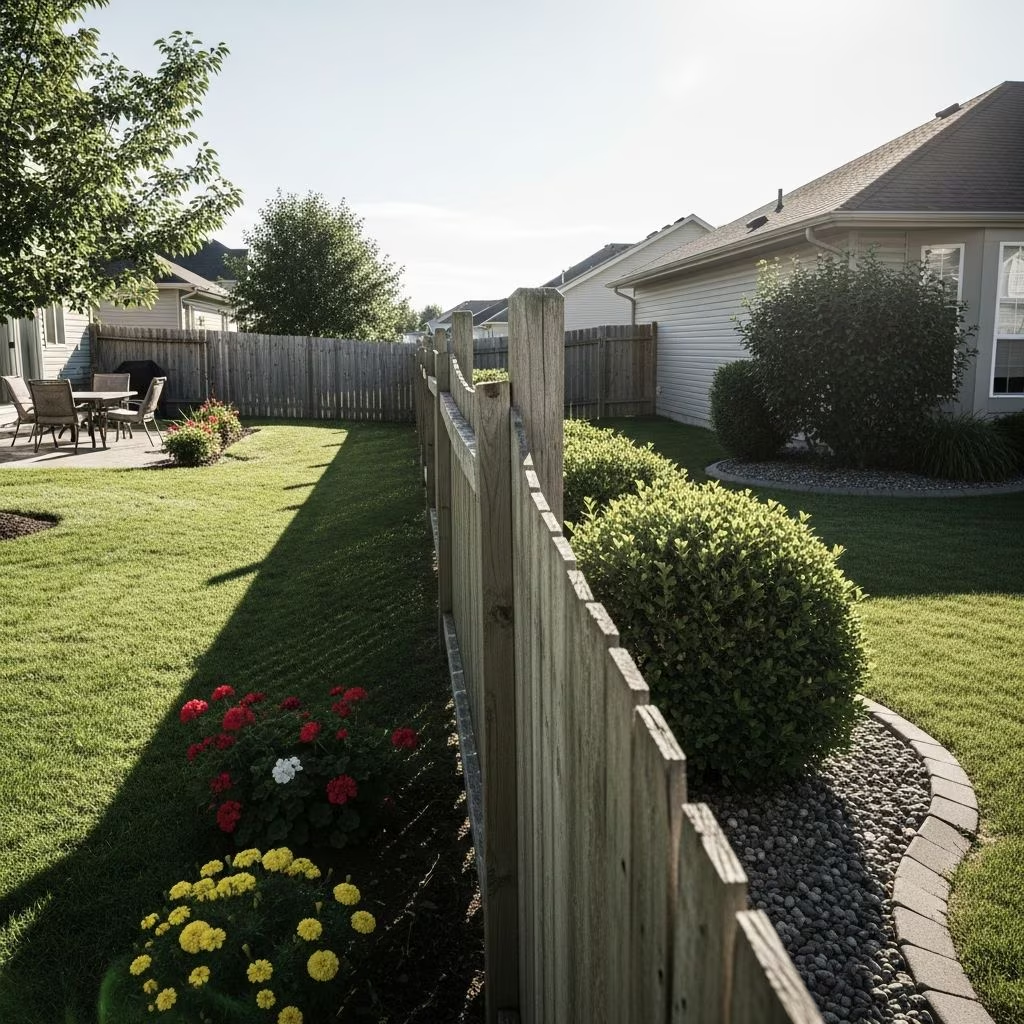
Boundary fences can protect privacy and improve curb appeal, but they also cause some of the most common disputes between neighbors. This guide explains how fence laws typically work, how property lines affect your rights, and what to do when you and your neighbor cannot agree.
Because fence rules come from state and local law, you should always confirm the specific requirements where your property is located. The principles below will help you understand the main issues to discuss with a local attorney or building department.
1. Who Owns a Boundary Fence?
Ownership of a fence usually depends on where it is built and what local law says about boundary fences (sometimes called division or partition fences).
- Fence entirely on your land: Typically you own it and control decisions about maintenance, replacement, and style, subject to height and zoning limits.
- Fence exactly on the property line: Many states presume that both neighbors benefit and therefore share ownership and responsibility, unless a written agreement states otherwise.
- Fence clearly on your neighbor’s land: Your neighbor is usually the owner, even if you helped pay for construction.
When state law presumes shared benefit from a boundary fence, each neighbor is often presumed equally responsible for the reasonable cost of construction, repair, and necessary replacement.
2. Cost Sharing: When Must Neighbors Split Fence Expenses?
Many jurisdictions have “good neighbor” or partition fence statutes that address cost sharing. A common pattern is:
- Adjoining landowners are presumed to receive equal benefit from a boundary fence.
- They are therefore presumed to be equally responsible for reasonable costs of building, maintaining, or replacing the fence, absent a different written agreement.
- The neighbor who initiates work often must provide advance written notice describing the problem, proposed solution, estimate, and timeline.
If one neighbor refuses to contribute despite notice and clear benefit from the fence, the other may be able to recover the non-paying neighbor’s share in civil court. Because procedures vary by state, legal advice is important before filing any claim.
Typical Elements of a Cost-Sharing Notice
While the exact requirements depend on local law, a thorough written notice often includes:
- Statement that the fence is on or near the property line and serves both properties
- Description of the current issue (rotting posts, storm damage, missing sections, etc.)
- Proposed work (repair versus full replacement)
- Estimated total cost and each neighbor’s proposed share
- Reasonable timeline for starting and completing the work
3. Height Limits, Permits, and Local Zoning Rules
Even if you and your neighbor agree about a fence, you must still comply with building and zoning regulations. States and cities often regulate maximum fence heights, front-yard restrictions, and visibility at intersections.
| Location on Lot | Common Height Rules (Example Patterns) | Permit Requirement (Typical) |
|---|---|---|
| Front yard | Often limited to about 3–4 feet to preserve sight lines for drivers and pedestrians. | Short fences may not require a permit but must meet zoning rules. |
| Side and back yards | Frequently allowed up to about 6 feet; taller fences may require special approval or a variance. | Fences over a set height often require a building permit. |
| Corner lots / near streets | Extra limits may apply to protect intersection visibility and traffic safety. | Review with the planning or zoning department before building. |
Some jurisdictions also treat hedges, dense shrubs, and masonry walls as “fences” for height and placement purposes.
4. Avoiding “Spite Fences” and Nuisance Claims
Many states have laws prohibiting so-called spite fences. These are fences or similar structures built primarily to annoy or harm a neighbor instead of serving a legitimate purpose.
- Spite fences are often defined as structures over a certain height (commonly over 10 feet) erected maliciously with the intent to disturb a neighbor.
- They can be made of traditional materials or even a tightly planted row of trees or shrubs acting like a wall.
- Courts may treat a spite fence as a private nuisance, giving the affected neighbor potential claims for damages or court orders to reduce or remove the structure.
Intent is critical. A tall fence built for privacy, security, or noise reduction is usually lawful; a fence built solely to block a view or punish a neighbor may trigger liability.
5. Property Lines: Why Accurate Boundaries Matter
Disagreements about fences are frequently rooted in uncertainty over the exact property line. Building a fence directly on the boundary without the neighbor’s consent can create long-term legal problems.
Before building or replacing a fence, it is often wise to:
- Review your deed and any recorded subdivision or plat maps
- Check markers or monuments referenced in legal descriptions
- Consider hiring a licensed land surveyor to locate the true line, especially where records are unclear or past fences may have been incorrectly placed
Some local public works or planning departments also publish guidance confirming that a fence on the property line requires the consent of both owners, while a fence entirely on one owner’s land can usually be built without the other’s permission, as long as it is set back from the line and meets height and zoning limits.
6. Can You Build a Fence Without Talking to Your Neighbor?
Legally, your ability to build a fence without your neighbor’s consent depends on where the fence will sit and what state and local laws require.
- Fence fully on your property: You often may build it unilaterally, provided that you comply with setback, height, and permit rules.
- Fence on the property line: Many jurisdictions require mutual agreement or treat the fence as a shared structure subject to cost-sharing rules.
- Common interest communities: Homeowners associations can impose additional design standards and approval processes, even for fences entirely on your land.
Even when not strictly required, building without prior discussion is rarely wise. Early communication can prevent misunderstandings, reduce the risk of legal disputes, and make permit review easier.
7. Repairing or Replacing an Existing Fence
When a long-standing fence deteriorates, neighbors often disagree about who must fix or replace it. Where good-neighbor or boundary-fence statutes apply, the default rule may be:
- Both neighbors share responsibility for necessary repair or replacement of a fence that sits on or near the property line and provides mutual benefit.
- The neighbor initiating work must provide advance written notice and a reasonable estimate.
- If the fence benefits only one property—for example, a decorative fence facing a single yard—different rules may apply.
Insurance may cover repairs when the damage is caused by a covered event, such as a windstorm or falling tree, but coverage varies by policy, and insurers rarely pay for upgrades beyond restoring the prior condition.
8. What if Your Neighbor Refuses to Pay?
If the law presumes shared cost and you follow the required notice process, a neighbor’s refusal to contribute does not necessarily end your options. Common approaches include:
- Trying mediation through a community mediation center or local bar association
- Offering to choose a less expensive design or materials
- Documenting all communications and costs in case a court claim becomes necessary
- Consulting a real estate or property lawyer about recovering the non-paying neighbor’s share through litigation
Courts will typically look at whether the fence was reasonably necessary, whether the costs were fair, whether you complied with notice requirements, and whether the fence truly benefits both properties.
9. Practical Tips to Prevent Fence Disputes
Most fence problems can be minimized with careful planning and open communication.
- Talk before you build: Show sketches or contractor proposals and ask for input early.
- Confirm the boundary: Use records or a survey so no one feels land is being taken.
- Put agreements in writing: Even a simple letter or email confirming cost sharing, future maintenance, and location can prevent confusion later.
- Respect aesthetics: Discuss height, materials, and which side faces which property to keep both yards attractive.
- Maintain the fence: Regular maintenance reduces expensive repairs and helps avoid safety hazards or nuisance claims.
10. When to Consult a Lawyer or Local Officials
You should consider legal or official guidance when:
- There is a serious disagreement over where the property line is
- Your neighbor threatens to sue or has already started litigation
- You suspect a fence may qualify as a spite fence or private nuisance
- You are planning an unusually tall fence, retaining wall, or structure close to the boundary that may affect visibility or safety
Local planning or building departments can explain permitting, maximum height, and setback rules. Real estate and land-use attorneys can advise on boundary disputes, cost-sharing laws, and available remedies if a neighbor refuses to cooperate.
Frequently Asked Questions About Neighbor Fence Laws
Q1: Can my neighbor build a fence directly on the property line without asking me?
Often, no. Many jurisdictions treat a fence on the boundary as a shared structure requiring the agreement of both owners, or at least subject to cost-sharing and notice rules. Your neighbor can usually build a fence entirely on their own side of the line, within local height and zoning limits, but not right on the property line without your consent.
Q2: Do I have to pay for a fence even if I did not ask for it?
Possibly. Where a boundary fence law presumes that both properties benefit from a division fence, each neighbor can be held responsible for a fair share of necessary construction, repair, or replacement costs, as long as statutory notice and reasonableness requirements are satisfied. If the fence clearly benefits only one property, different rules may apply.
Q3: What can I do if my neighbor’s fence is dangerously unstable?
Start by documenting the condition with photos and written observations. Notify your neighbor in writing and request repair. If the fence presents a safety hazard or violates local building or property maintenance codes, you can also contact the local building or code-enforcement office, which may issue a notice of violation requiring repairs.
Q4: Is blocking my view with a tall fence illegal?
In most places, you do not have a general legal right to a view. However, if a neighbor builds an unusually tall structure—such as a fence or dense hedge—primarily to annoy you, and it exceeds height thresholds defined in a spite-fence or nuisance statute, you may have legal remedies. View-protection rules, if any, are usually found in local ordinances or subdivision covenants rather than in general fence laws.
Q5: How do I find out the exact fence rules where I live?
Fence rules are usually found in a mix of state statutes, local zoning ordinances, and building codes. You can:
- Search your state’s statutes for boundary or partition fence laws
- Review your city or county planning and zoning code for height and placement limits
- Call or visit your local building department or planning office for permit requirements
- Consult a local real estate attorney for help applying these rules to your specific facts
References
- Property Line Fence Laws in California — JLee Realty. 2019-06-10. https://julianalee.com/reinfo/property-line-fence-laws.htm
- Public Works FAQ: Fence on Property Line — Los Angeles County Public Works. 2023-01-05. https://pw.lacounty.gov/general/faq/?FaqID=JSNNPzRRTTQgCg%3D%3D
- Fences and Walls Up to 8 Feet in Height (CP-2075.1) — Los Angeles City Planning Department. 2015-02-25. https://planning.lacity.gov/odocument/1ba030a3-a15e-431c-9fbb-c3086286a1fc/Fences_and_Walls_Up_To_8_Feet_F.pdf
- Understanding California’s Property Line and Fence Laws — Law Offices of Justin H. King. 2022-08-18. https://levinelawyer.com/blog/understanding-californias-property-line-and-fence-laws/
- California Good Neighbor Fence Law Explained — Duce Construction. 2023-07-14. https://duceco.com/california-good-neighbor-fence-law/
- California Fence Laws: Good Neighbor & Local Laws — Ergeon. 2024-03-01. https://www.ergeon.com/blog/post/what-you-need-to-know-about-california-fence-laws
- Fenced In or Breaking Boundaries? Decoding California Fence Laws — J&J Legal. 2023-10-09. https://www.jlegal.org/blog/fenced-in-or-breaking-boundaries-decoding-california-fence-laws/