
Navigating Solano County Superior Court Procedures
Practical guidance for attorneys and self-represented litigants working with the Superior Court of California, County of Solano.
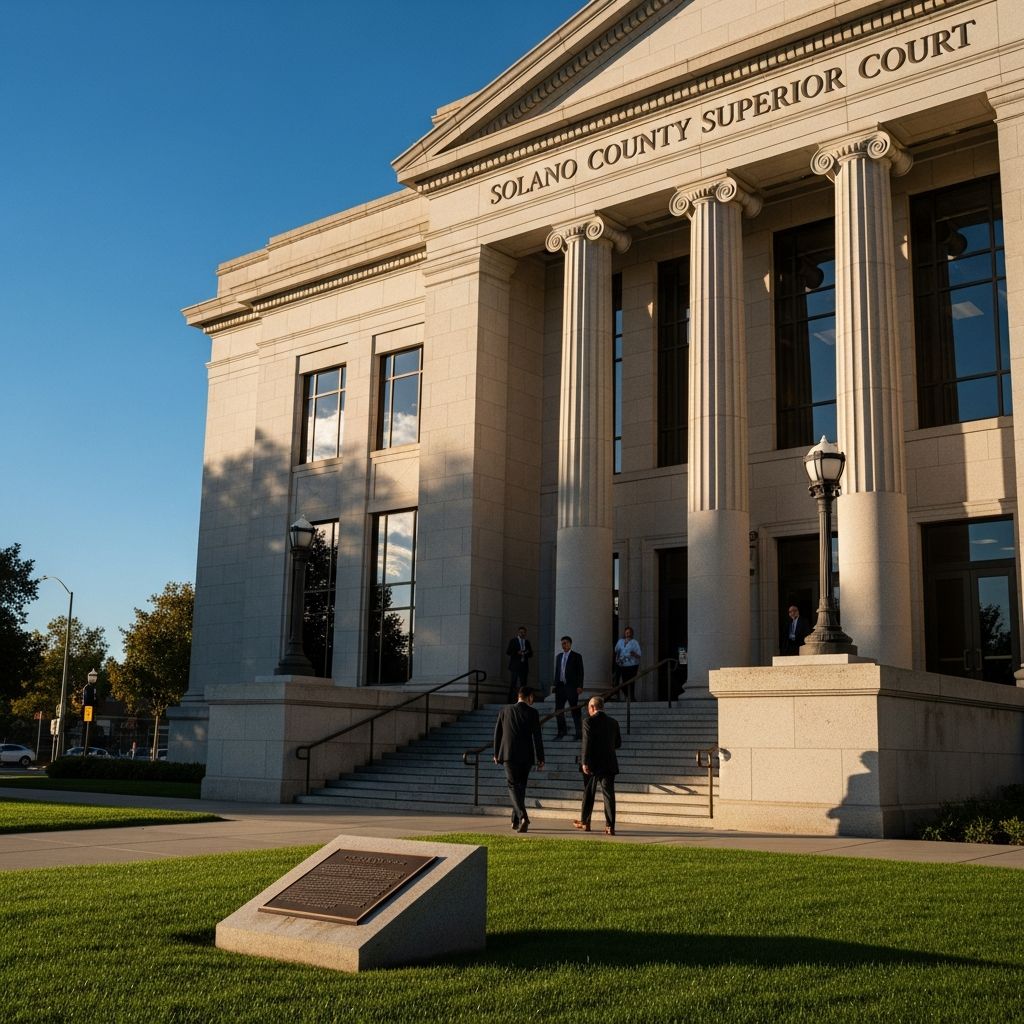
The Superior Court of California, County of Solano, serves as the primary trial court for residents of Solano County, handling everything from traffic tickets and small claims disputes to felony criminal cases and complex civil litigation. This guide offers a practical overview of how the court is organized, how to access its services, and what both attorneys and self-represented litigants should know before filing documents or appearing for hearings.
1. Overview of the Solano County Superior Court
The Solano County Superior Court is part of California’s unified trial court system, which consolidated municipal and superior courts into a single level of trial court across the state. Within this framework, Solano’s court exercises general jurisdiction over:
- Civil cases (limited and unlimited)
- Criminal matters (misdemeanors and felonies)
- Family law (divorce, child custody, support)
- Probate (estates, guardianships, conservatorships)
- Juvenile (dependency and delinquency)
- Small claims and certain traffic and infraction matters
California’s Constitution and statutes assign these trial courts broad authority over local disputes and criminal prosecutions, subject to review by higher appellate courts.
2. Court Locations and Basic Logistics
Solano County Superior Court operates multiple courthouse facilities, primarily in Fairfield and Vallejo, to serve its population. Understanding where each type of matter is heard is essential for planning filings and appearances.
2.1 Key Courthouse Sites
| Courthouse | City | Primary Focus (Typical) |
|---|---|---|
| Hall of Justice | Fairfield | Criminal, family, juvenile, law library, various support divisions |
| Law and Justice Center | Fairfield | Additional trial courtrooms and administrative functions |
| Old Solano Courthouse | Fairfield | Civil, small claims, mediation, selected civil courtrooms |
| Solano Justice Building | Vallejo | Branch courthouse for various case types serving the Vallejo area |
2.2 Hours and Clerk’s Office Access
Most courthouse buildings are open to the public from 8:00 a.m. to 5:00 p.m., with clerk’s office counter hours more limited, typically in the morning and by appointment in the afternoon. Litigants should verify:
- Public building hours
- Clerk’s counter hours for in-person filing
- Any holiday or emergency closure notices
The court’s general information pages provide up-to-date details on hours, locations, and contact information.
3. Case Types and Divisional Structure
The court is organized into divisions that specialize in particular case types, allowing staff and judicial officers to develop expertise and handle caseloads efficiently.
3.1 Civil and Small Claims
Civil matters include personal injury, contract disputes, property claims, and other non-criminal disputes. In Solano County:
- Limited civil generally covers disputes up to $25,000.
- Unlimited civil involves larger or more complex matters.
- Small claims offers a streamlined forum for modest disputes, typically with simplified procedures and no attorneys for parties at the hearing.
Civil and small claims filings and hearings are often centered at the Old Solano Courthouse and other designated civil locations.
3.2 Criminal and Traffic
The criminal division handles both felony and misdemeanor prosecutions, while traffic matters cover infractions and some misdemeanor traffic offenses. Local public defender resources provide step-by-step descriptions of the stages of the criminal court process in Solano County, from arraignment through trial and sentencing.
3.3 Family, Juvenile, and Probate
- Family law addresses dissolution, legal separation, parentage, child custody, visitation, and support orders.
- Juvenile courts oversee cases involving minors in dependency (abuse or neglect) and delinquency matters.
- Probate deals with wills, estates, trusts, conservatorships, and guardianships.
Many of these matters are heard at the Hall of Justice in Fairfield, which houses divisions and support services for family and juvenile cases.
4. E-Filing and Traditional Filing in Solano County
Like many California trial courts, Solano has expanded electronic filing (eFiling) for increased efficiency and access, particularly in civil and family-related matters.
4.1 Mandatory eFiling for Attorneys
Effective January 2, 2025, attorneys in civil, family, and probate cases must file documents electronically, with limited exceptions.
- Who must eFile: Attorneys representing parties in applicable case types.
- Who is encouraged but not required: Self-represented litigants and non-parties.
- What must be filed electronically: Most documents, except where personal service is required by statute or rule or where explicitly exempted.
4.2 When Paper Filing Is Still Used
Physical court filing remains available for documents that are excluded from mandatory eFiling or where an exception applies. Examples can include certain ex parte materials, confidential items, or documents expressly directed to be filed in paper form by statute or local rule. Filers should consult local rules and, when in doubt, contact the relevant clerk’s office.
4.3 Practical eFiling Tips
- Confirm the correct case type and division before submitting.
- Use consistent document titles that match Judicial Council or local rule naming conventions when possible.
- Check file size and format limitations and ensure legibility of scanned exhibits.
- Allow time before deadlines for technical issues or rejections.
- Retain electronic confirmation of submission and acceptance for your records.
5. Online Services and Case Access
Solano County Superior Court has developed a variety of online tools to reduce the need for in-person visits and streamline common tasks.
5.1 Core Online Services
Through the court’s official website, users can typically:
- Pay traffic citations and some fines online
- Access forms and instructions for common case types
- Check jury duty status and obtain juror information
- Schedule appointments with the clerk’s office for civil and family law matters
5.2 Case Search and the Court Portal
The court’s online portal allows registered users to search case data and, for authorized users, access certain electronic case files.
- General public access typically includes basic docket information.
- Expanded access for specified government agencies is provided in line with California Rule of Court 2.540.
- Attorneys and certain parties may qualify for enhanced remote access to records under California Rules of Court 2.515–2.522, subject to identity verification.
Users must create an account to search and view case information in the portal, and should understand that, under Rule 2.504(b), electronically accessible records are not the official court record unless specially certified.
6. Appeals and the Appellate Structure
Decisions from the Solano County Superior Court can be reviewed by higher courts through the appellate process. The path for appeal depends on the type of case.
6.1 What an Appeal Is (and Is Not)
An appeal is a review of the trial court’s decision by another court. The appellate court examines whether a legal error occurred that affected the outcome, based on the existing record. Except in small claims appeals, appeals are not new trials; new evidence is generally not allowed, and appellate courts do not reweigh conflicting evidence.
6.2 Appellate Division of the Solano Superior Court
The Appellate Division of the Solano County Superior Court hears appeals in certain limited matters, such as:
- Misdemeanor criminal cases
- Traffic appeals
- Limited civil jurisdiction matters
The Appellate Division convenes for oral argument, typically on the third Thursday of the month, at the Hall of Justice in Fairfield.
6.3 Higher-Level Appeals
Appeals from felony, probate, family law, and unlimited civil cases arising in Solano County are heard by the First District Court of Appeal, headquartered in San Francisco. This intermediate appellate court is part of the statewide California Courts of Appeal system, which in turn is subject to review by the California Supreme Court in selected cases.
7. Governance, Judges, and Administration
Like other California superior courts, the Solano court is overseen by a combination of judicial leadership and an appointed Court Executive Officer.
7.1 Presiding Judge and Court Leadership
Under statewide court rules, each superior court with at least three judges selects a Presiding Judge to lead the court for a term of at least two years. The Presiding Judge, assisted by the Court Executive Officer, is responsible for:
- Managing court operations and policies
- Allocating judicial and administrative resources
- Ensuring public access to justice and compliance with statewide standards
7.2 Court Executive Officer Role
The Court Executive Officer manages personnel, budgeting, contracts, technology, and other administrative functions. California Rules of Court (such as Rule 10.610) define this role, emphasizing:
- Efficient calendar and jury management
- Implementation of eFiling and digital access initiatives
- Coordination with county agencies and external stakeholders
8. Practical Tips for Attorneys and Self-Represented Litigants
Successfully navigating the Solano County Superior Court involves understanding both formal rules and practical realities.
8.1 Before You File
- Review applicable California statutes and rules of court, as well as Solano’s local rules, which govern formatting, deadlines, and procedures.
- Confirm whether eFiling is mandatory for your case type and status (attorney or self-represented).
- Gather required Judicial Council forms and any local forms used in Solano County.
8.2 Preparing for Hearings
- Arrive early to allow time for security screening and locating the correct courtroom.
- Bring multiple copies of key documents for the court, opposing parties, and yourself.
- Dress and behave professionally; maintain respect for the court and all participants.
- If you have a disability or language need, request accommodations in advance when possible.
8.3 Using Online and Remote Tools
- Check the court’s website before traveling; many tasks, such as paying certain fines or scheduling clerk appointments, can be handled online.
- Use the case portal to monitor filings, orders, and hearing dates where available.
- Confirm whether any hearings will be conducted remotely (e.g., via video) and review technical requirements in advance.
9. Frequently Asked Questions (FAQs)
Q1: Do I have to eFile my documents in Solano County?
For civil, family, and probate cases, attorneys are generally required to eFile documents as of January 2, 2025, subject to limited exceptions. Self-represented parties are exempt from the mandatory requirement but are encouraged to use eFiling where possible.
Q2: How can I find out where my hearing will be held?
Check your notice of hearing, your case docket in the court’s online portal, or contact the relevant division’s clerk’s office. The court’s locations page lists addresses and general information for the Hall of Justice, Law and Justice Center, Old Solano Courthouse, and Vallejo’s Solano Justice Building.
Q3: Where are appeals from my case heard?
It depends on the type of case. Appeals from misdemeanor, traffic, and limited civil cases are heard by the Solano Superior Court Appellate Division. Appeals from felony, family, probate, and unlimited civil matters are heard by the California Court of Appeal, First Appellate District in San Francisco.
Q4: Can I access my case records online?
Many case dockets and limited records can be accessed through the court’s online portal after creating an account. Enhanced access to electronic case files is available for certain parties, attorneys, and agencies under the California Rules of Court, subject to identity verification.
Q5: What are the basic hours of operation for the courthouses?
Courthouse buildings are generally open from 8:00 a.m. to 5:00 p.m., with clerk’s offices providing drop-in services in the morning and appointments available into the afternoon. Always check current hours on the court’s website before visiting, as schedules can change due to holidays or local conditions.
References
- Solano County Superior Court — Wikipedia (summarizing court structure and courthouses; used for historical and organizational context). 2024-10-01. https://en.wikipedia.org/wiki/Solano_County_Superior_Court
- Appellate Division – Superior Court of California, County of Solano — Superior Court of California, County of Solano. 2024-08-15. https://solano.courts.ca.gov/divisions/appellate-division
- Home – Superior Court of California, County of Solano — Superior Court of California, County of Solano. 2024-07-10. https://solano.courts.ca.gov
- Locations Information – Superior Court of California, County of Solano — Superior Court of California, County of Solano. 2024-07-10. https://solano.courts.ca.gov/general-information/locations-information
- Online Services – Superior Court of California, County of Solano — Superior Court of California, County of Solano. 2025-01-02. https://solano.courts.ca.gov/online-services
- Solano Superior Court Portal — Superior Court of California, County of Solano. 2024-02-26. https://portal.solano.courts.ca.gov
- Stages of the Court Process — Solano County Public Defender, County of Solano. 2023-06-30. https://www.solanocounty.gov/government/public-defender/public-defender-clients/stages-court-process
Similar Articles








Read full bio of Sneha Tete


