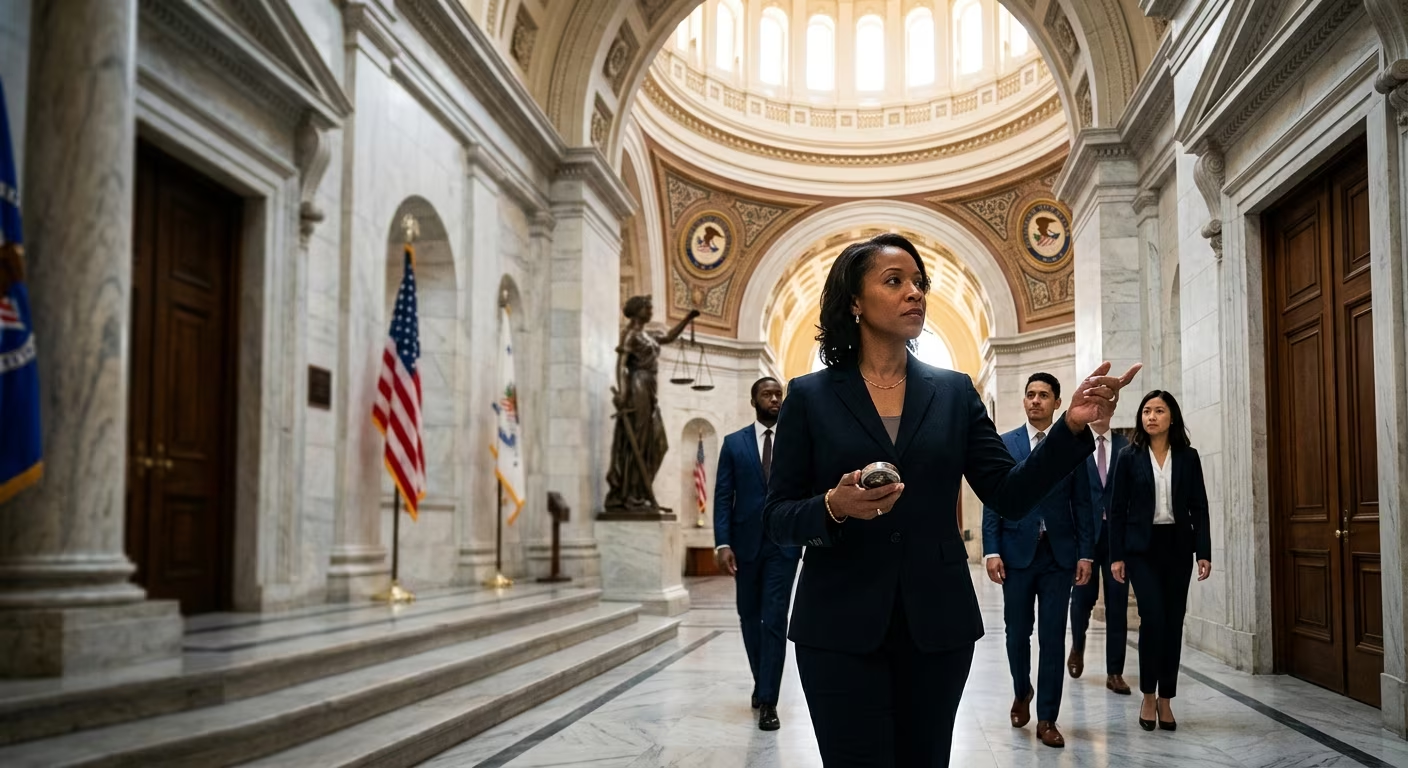
Introduction: The Weight of the DOJ’s Civil Rights Mandate
The Department of Justice (DOJ) serves as the primary legal apparatus of the United States government, and within its vast bureaucracy, the Civil Rights Division stands out as the institutional guardian of American liberties. Tasked with prosecuting discrimination and upholding constitutional protections, the division operates at the volatile intersection of law, policy, and societal values. Because its mandate is inherently tied to the interpretation of civil rights, the division’s priorities are highly susceptible to the ideological leanings of the administration in power. When leadership transitions occur, they often trigger profound philosophical shifts in how federal statutes are enforced, sparking intense legal and political discourse across the nation.
Recent leadership appointments, notably the confirmation of Harmeet Dhillon as Assistant Attorney General for Civil Rights, have illuminated this dynamic perfectly. Such appointments often signify a redefining pivot point for the division, steering federal resources away from traditional interpretations of civil rights expansions and toward a conservative legal framework. Understanding the implications of these administrative shifts requires a deep dive into the historical purpose of the division, the specific legal battlegrounds being redefined, and the internal friction that such transitions inevitably cause.
Historical Context and the Division’s Blueprint
Established by the Civil Rights Act of 1957, the Civil Rights Division was created to serve as the federal government’s primary mechanism for enforcing laws prohibiting discrimination. Over the decades, its purview expanded significantly through landmark legislation, including the Civil Rights Act of 1964, the Voting Rights Act of 1965, and the Americans with Disabilities Act of 1990. The division’s foundational blueprint mandates the enforcement of equitable treatment in housing, voting, employment, education, and public accommodations.
Historically, the division has utilized pattern-or-practice investigations to hold local municipalities and police departments accountable for systemic civil rights violations. It has also wielded immense power in shaping electoral maps and striking down discriminatory voting laws. However, the definition of what constitutes a “civil right” is not static. It is a living concept, relentlessly debated in federal courts and redefined by the executive branch’s policy directives. The division’s resources—while formidable—are finite, meaning the Assistant Attorney General must prioritize certain types of enforcement actions over others, effectively shaping the nation’s civil rights landscape through discretionary action.
The Pendulum Swing: Administrative Priorities in Action
When leadership changes hands at the DOJ, the pendulum of enforcement priorities often swings dramatically. A new Assistant Attorney General brings specific legal philosophies that trickle down to every section of the Civil Rights Division. In recent times, there has been a noticeable transition from prioritizing systemic racial and gender discrimination to a heightened focus on religious liberties, ideological speech, and reversing initiatives previously deemed progressive.
This ideological whiplash is most evident in how the division approaches highly polarized issues. Instead of focusing heavily on maximizing ballot access, new directives may prioritize strict voter roll maintenance. Instead of defending corporate diversity programs, the division may view them as vehicles for reverse discrimination. These changing paradigms highlight how administrative authority can fundamentally alter the interpretation and application of decades-old civil rights statutes.
Reassessing Electoral Integrity and Voting Access
Perhaps no area of civil rights law is as heavily contested as voting access. For decades, the traditional focus of civil liberties organizations and previous iterations of the DOJ was to dismantle barriers to the ballot box, challenging voter ID laws, gerrymandered districts, and restrictions on mail-in voting. The prevailing legal theory held that maximizing access was the core function of the Voting Rights Act.
Under new leadership paradigms, the DOJ’s focus has frequently pivoted toward “electoral integrity.” This approach involves aggressive investigations into state voter rolls, pushing municipalities to purge inactive or deceased voters, and heavily scrutinizing alleged non-citizen voting. Proponents argue these measures are essential to maintaining public trust in democratic institutions and preventing systemic fraud. Critics, however, contend that such enforcement priorities disproportionately disenfranchise minority communities and weaponize federal power to intimidate local election officials. The tension between securing the ballot and ensuring equitable access remains one of the most defining conflicts in modern civil rights enforcement.
The Reevaluation of Diversity, Equity, and Inclusion (DEI)
The corporate, academic, and governmental embrace of Diversity, Equity, and Inclusion (DEI) programs has recently met fierce resistance at the federal level. Historically, the DOJ often defended affirmative action and targeted diversity programs as necessary remedies for historical marginalization and systemic inequality. These initiatives were viewed as crucial tools for achieving true equal opportunity in the workplace and higher education.
Recent ideological shifts have turned the Civil Rights Division into a skeptic—and sometimes an adversary—of DEI frameworks. Aligning with recent Supreme Court rulings that severely curtailed affirmative action in college admissions, new DOJ leadership has signaled an intent to aggressively pursue “reverse discrimination” claims. Programs that prioritize demographics in hiring, contracting, or educational admissions are increasingly scrutinized under the Equal Protection Clause. This pivot reflects a strict colorblind interpretation of the Constitution, arguing that any policy classifying individuals by race, even for remedial purposes, is inherently discriminatory.
Balancing Religious Liberty and LGBTQ+ Protections
The intersection of religious freedom and LGBTQ+ protections represents a deeply fractured legal battleground. Prior administrations utilized the Civil Rights Division to expand protections for sexual orientation and gender identity, particularly in schools and healthcare settings, interpreting Title IX and Title VII as comprehensive shields against discrimination.
Conversely, conservative leadership reorients the division to heavily champion First Amendment religious liberties. This includes defending the rights of religious institutions, businesses, and individuals to operate according to their deeply held beliefs, even when those beliefs conflict with anti-discrimination ordinances regarding LGBTQ+ individuals. Furthermore, the division has seen shifts in its stance on gender-affirming care and policies regarding transgender athletes in scholastic sports, often siding with arguments prioritizing biological sex definitions and parental rights over expanded gender identity protections. These legal maneuvers significantly alter the federal government’s posture in high-stakes civil litigation.
The Role of First Amendment Litigation
Free speech arguments have become increasingly interwoven with civil rights enforcement. While the Civil Rights Division has historically focused on the Fourteenth Amendment’s equal protection guarantees, modern leadership has actively elevated First Amendment claims. This shift addresses contemporary anxieties over ideological suppression, particularly on college campuses and within the digital public square.
Enforcement actions now frequently target university speech codes that allegedly stifle conservative viewpoints or religious expression. Furthermore, the DOJ has taken a keen interest in the moderation policies of large technology companies, exploring civil rights frameworks to address alleged ideological censorship. By framing free speech as a foundational civil right that requires aggressive federal protection, the division broadens its traditional scope, entering complex debates about misinformation, academic freedom, and the power of private platforms.
Internal Dynamics: The Bureaucratic Ripple Effect
The friction between incoming political appointees and long-standing career attorneys is a hallmark of shifting DOJ priorities. Career staff—lawyers who serve across multiple administrations—often operate under a consistent, institutional interpretation of civil rights laws. When political leadership introduces rapid, sweeping changes to enforcement objectives, it can create a volatile internal environment.
Reports of mass exoduses and plummeting morale within the Civil Rights Division frequently surface during these ideological transitions. Career attorneys may find themselves ordered to abandon long-standing investigations, withdraw from carefully negotiated consent decrees with local police departments, or adopt legal positions they personally view as hostile to the division’s original intent. Conversely, incoming leadership often views this internal resistance as an entrenched bureaucracy obstructing the lawful policy directives of a duly elected administration. This bureaucratic churn significantly impacts the division’s efficiency and continuity.
Stakeholder Pushback and the Broader Legal Ecosystem
The reorientation of the DOJ does not occur in a vacuum; it catalyzes massive responses from the broader legal ecosystem. Traditional civil rights organizations, advocacy groups, and progressive legal coalitions rapidly mobilize to counter federal policy changes. When the Civil Rights Division withdraws from certain enforcement areas, non-governmental organizations (NGOs) and state attorneys general often step in to fill the void, utilizing impact litigation to challenge the federal government’s new posture.
This dynamic creates a fragmented landscape where the enforcement of civil rights relies heavily on private litigation rather than federal intervention. The courts become the ultimate arbiters, forced to reconcile the administration’s new enforcement guidelines with decades of established precedent. The ongoing tug-of-war between conservative legal organizations supporting the DOJ’s new direction and civil rights groups opposing it ensures that every major policy shift is tested through grueling legal scrutiny.
Conclusion: A Continual Battle for the Definition of Equality
The trajectory of the DOJ’s Civil Rights Division is a mirror reflecting the broader societal polarization regarding what equality under the law truly means. Whether prioritizing systemic racial equity or championing strict constitutional colorblindness and religious freedom, the division’s actions have profound consequences for marginalized communities, corporate structures, and electoral systems. As legal philosophies continue to clash and administrative pendulums swing, the definition of civil liberties in the United States remains an ongoing, fiercely contested evolution.
Frequently Asked Questions (FAQs)
- What is the primary role of the Assistant Attorney General for Civil Rights?
The Assistant Attorney General for Civil Rights leads the DOJ’s Civil Rights Division, dictating the federal government’s enforcement priorities regarding laws that prohibit discrimination in voting, employment, housing, and public services. - How does the DOJ balance career attorneys with political appointees?
Political appointees set the overarching policy goals and ideological direction, while career attorneys handle the day-to-day litigation and investigations. This dynamic can cause friction when political directives rapidly change long-standing enforcement norms. - What are the main statutes enforced by the Civil Rights Division?
Key statutes include the Civil Rights Act of 1964, the Voting Rights Act of 1965, the Americans with Disabilities Act, and various federal hate crime laws. - Why do administrative changes affect civil rights enforcement so heavily?
Because civil rights laws often require interpretation regarding complex societal issues, the ideological framework of an administration dictates which cases are pursued, which legal theories are advanced in court, and how federal resources are allocated.
References
- Civil Rights Division – Department of Justice — U.S. Department of Justice. 2024-01-01. https://www.justice.gov/crt
- DOJ’s Civil Rights Division: Opportunities Exist to Improve Its Case Management System — U.S. Government Accountability Office (GAO). 2009-09-30. https://www.gao.gov/products/gao-09-938r
- Civil Rights Office | Home — Office of Justice Programs (OJP). 2024-01-01. https://www.ojp.gov/program/civil-rights/home
- Why Harmeet Dhillon Should Not Be Elevated — The Leadership Conference on Civil and Human Rights. 2026-04-07. https://civilrights.org/