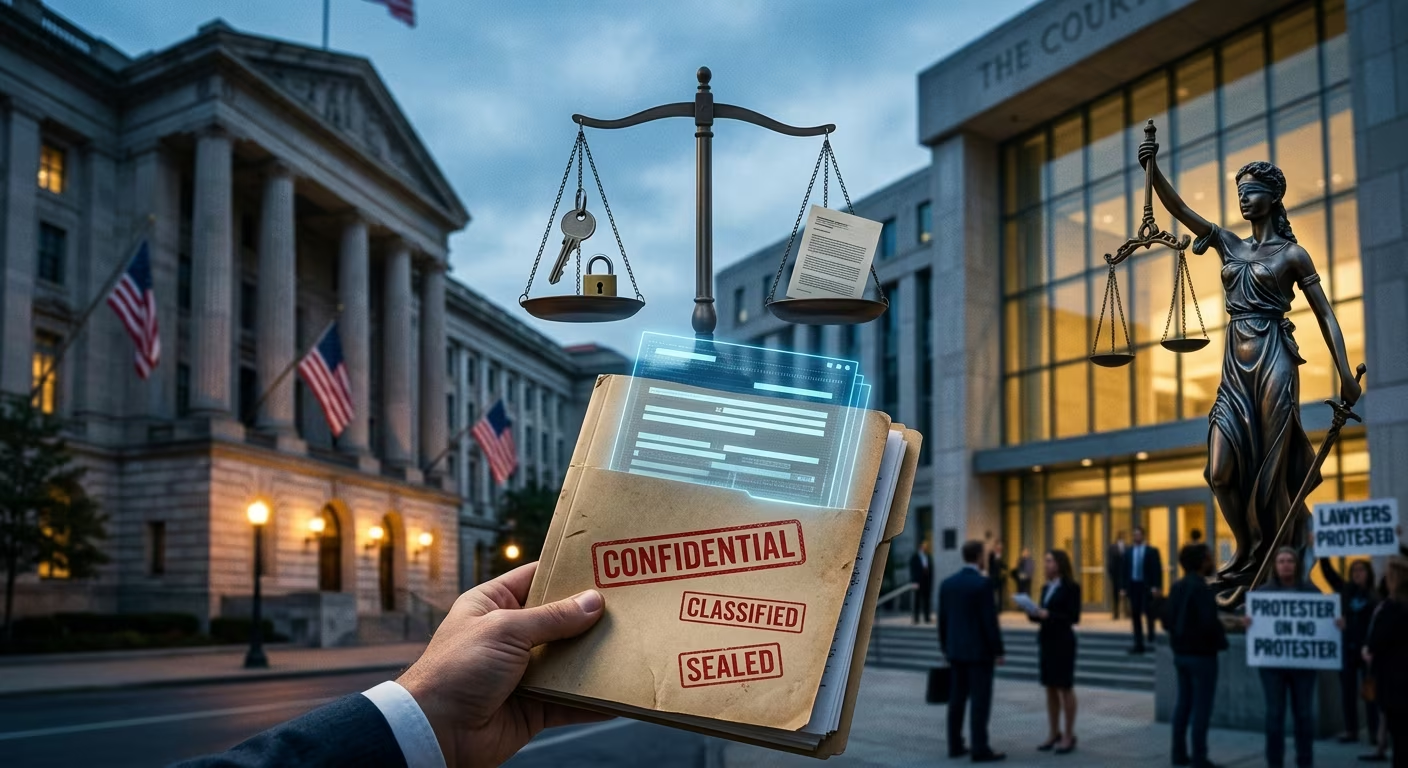
Imagine standing in an airport terminal, luggage in hand, ready to board a flight for a crucial business meeting or a family gathering, only to be informed by a ticketing agent that you are forbidden from traveling. When you ask for the reason, the response is a bureaucratic wall of silence. You have been placed on a government list, and the rationale for your placement is classified. This scenario is not a work of fiction; it is a harsh reality for thousands of individuals who find themselves ensnared at the fraught intersection of national security and civil liberties. The ability of a state to label a citizen a threat—and to base that life-altering label on evidence the accused is never allowed to see—presents one of the most profound challenges to modern constitutional democracy.
The Bedrock of American Jurisprudence: Notice and Opportunity
The foundation of the American judicial system is the concept of due process, a right enshrined in the Fifth Amendment of the United States Constitution. At its absolute core, due process requires two fundamental elements: notice of the charges and a meaningful opportunity to be heard. If the government intends to deprive an individual of life, liberty, or property, it must provide a clear, factual explanation of the accusations and the evidence supporting them. This transparent process ensures that the accused can mount a vigorous defense, challenge factual inaccuracies, and prevent arbitrary or discriminatory government action.
In criminal proceedings, the Sixth Amendment’s Confrontation Clause explicitly guarantees the right of the accused to cross-examine witnesses and scrutinize evidence. However, counter-terrorism measures such as watchlist placements are legally categorized as administrative or civil actions rather than criminal prosecutions. Consequently, the rigorous protections of the Sixth Amendment do not apply. Individuals are left reliant solely on the more flexible balancing tests of the Fifth Amendment. Courts often weigh the individual’s liberty interest against the government’s interest. When the government places “national security” on its side of the scale, the balance invariably tips in its favor. The result is a legal paradox: an individual is theoretically afforded an opportunity to be heard, but they must defend themselves blindfolded, completely unable to examine or refute the secret intelligence used against them.
National Security Watchlists and the Limbo of “No Fly” Status
One of the most highly publicized manifestations of this secret evidence regime is the federal government’s reliance on aviation watchlists, most notably the No Fly List. Maintained by the Federal Bureau of Investigation’s (FBI) Threat Screening Center, this list is utilized by the Transportation Security Administration (TSA) to screen airline passengers. Individuals designated on the No Fly List are entirely barred from flying into, out of, or over United States airspace.
Citizens and lawful residents rarely receive advanced notice of their inclusion. Instead, they typically discover their blacklisted status at the airport ticket counter. Upon denial of boarding, the path to clearing one’s name is notoriously opaque and convoluted. The Department of Homeland Security’s Traveler Redress Inquiry Program (DHS TRIP) serves as the primary mechanism for filing grievances. Historically, this program provided individuals with vague bureaucratic letters that neither confirmed nor denied their presence on the list, let alone the reasons why. If a person cannot review the derogatory information that placed them on a watchlist—whether resulting from a typographical error, a case of mistaken identity, or flawed intelligence—they cannot possibly rebut the allegation. The affected individual remains trapped in an indefinite administrative limbo, continuously presumed to be a security threat without ever having faced an impartial tribunal.
The Wall of Silence: Understanding the State Secrets Privilege
When individuals inevitably turn to the federal judicial system to challenge their erroneous placement on a watchlist or to seek damages for unconstitutional government surveillance, they frequently collide with an insurmountable legal barrier: the state secrets privilege. This common-law evidentiary doctrine permits the executive branch to block the discovery of information in litigation if its public disclosure would ostensibly harm national security.
The modern judicial framework for this privilege stems from the landmark 1953 Supreme Court case, United States v. Reynolds. The widows of three civilian engineers who died in a military plane crash sued the government for negligence. The government refused to turn over the official accident report, insisting it contained highly classified details about secret military equipment. The Supreme Court established a precedent requiring courts to grant immense deference to the executive branch’s assertion of national security risks, allowing the government to withhold the documents.
Decades later, when the Reynolds accident report was finally declassified, a chilling truth emerged: the document contained no sensitive military secrets but instead revealed glaring evidence of the government’s own negligence regarding aircraft maintenance. This historical revelation highlights the inherent danger of unchecked executive secrecy. Over the years, what began as a narrow evidentiary privilege to withhold specific sensitive documents has expanded into a sweeping shield used to dismiss entire lawsuits from the outset. Plaintiffs find themselves in an impossible catch-22: to prove their civil rights were violated, they require evidence; but the necessary evidence is deemed a state secret, and the court will not compel its production. This dynamic effectively immunizes the government from accountability.
The Intersection of Technology, Data, and Secret Evidence
In our increasingly digital era, the concept of “secret evidence” extends far beyond human informants and redacted paper documents. Today, the intelligence apparatus relies heavily on bulk data collection, algorithmic risk assessments, and predictive analytical profiling to populate counter-terrorism databases. When complex algorithms flag an individual as a potential threat, the underlying evidence often consists of aggregated metadata, communication patterns, and digital footprints. This introduces a novel layer of opacity. Not only is the source data classified, but the technological mechanism utilized to interpret that data operates as a highly classified, proprietary “black box.” Challenging an algorithm’s conclusion without access to its training parameters or data sets renders the pursuit of due process extraordinarily difficult. It demands that legal professionals overcome both classification hurdles and the complexities of automated, opaque decision-making models.
The Human Cost: Marginalized Communities Bear the Brunt
The heavy burden of these secretive security policies is not distributed equally across the American populace. Historically, national security watchlists and the deployment of secret evidence have disproportionately impacted specific ethnic and religious minority groups. In the post-9/11 landscape, Arab, Middle Eastern, and Muslim communities in the United States have endured heightened scrutiny, pervasive surveillance, and frequent placement on restrictive travel watchlists.
Because the evidentiary threshold for inclusion in the Terrorism Screening Database requires only a “reasonable suspicion” rather than the stricter standard of probable cause, the barrier for blacklisting is alarmingly low. Individuals can be flagged for entirely innocent associations, travel to certain foreign countries, or even misunderstood social media commentary. The economic and psychological consequences for these communities are devastating. Being permanently grounded from air travel results in lost employment opportunities, missed family milestones, and severe reputational damage. Furthermore, the persistent fear of being secretly listed creates a profound chilling effect on First Amendment rights, stifling lawful free speech and religious expression.
Charting a Course Toward Reform and Accountability
Balancing the legitimate imperative to protect national security with the absolute necessity of preserving civil liberties is an immense challenge. However, legal scholars and civil rights advocates have proposed several robust reforms to mitigate the severe harms inflicted by secret evidence.
One highly viable solution is the expanded utilization of “cleared counsel.” Under this model, attorneys representing plaintiffs are granted rigorous security clearances, permitting them to review the classified evidence against their clients within a Sensitive Compartmented Information Facility (SCIF). Although the attorneys are strictly prohibited from sharing the classified specifics with their clients, they can vigorously cross-examine the government’s assertions, identify administrative errors, and contextually argue the case before a judge. This mechanism is already successfully employed in federal criminal terrorism prosecutions under the Classified Information Procedures Act (CIPA), and adapting it for civil watchlist challenges would inject a vital measure of adversarial fairness.
Additionally, Congress could mandate stricter judicial scrutiny over executive branch claims of secrecy. Instead of affording blanket deference to agency affidavits, federal judges could be required to conduct independent, in camera reviews of the allegedly sensitive documents to verify whether disclosure genuinely poses a grave national security threat. Establishing independent review boards to audit the watchlists would further ensure that intelligence tools are not utilized as instruments of unchecked bureaucratic overreach.
Conclusion: Preserving Liberty in an Era of Security Threats
The inherent tension between governmental secrecy and democratic transparency will undoubtedly persist as long as nations face complex security threats. Nevertheless, a society committed to the rule of law cannot permit “national security” to function as an unassailable magic phrase that extinguishes fundamental constitutional rights. When the state is empowered to restrict movement, damage reputations, and infringe upon individual liberties based on evidence concealed entirely in the shadows, the essence of justice is compromised. Guaranteeing that every individual possesses a meaningful, transparent opportunity to challenge the evidence against them is not merely a legal technicality; it is the ultimate defense against the arbitrary exercise of authoritarian power.
Frequently Asked Questions (FAQs)
- What is the state secrets privilege?
The state secrets privilege is a legal doctrine that allows the U.S. government to refuse the disclosure of information in legal proceedings if the executive branch determines that revealing the evidence would pose a significant threat to national security. - Can I find out exactly why I was placed on the No Fly List?
Historically, it has been extremely difficult. While you can file a complaint through the DHS Traveler Redress Inquiry Program (TRIP), the government often provides limited information. You are rarely allowed to see the specific classified intelligence or evidence that led to your placement. - How does secret evidence violate due process?
The Fifth Amendment guarantees due process, which fundamentally requires notice of charges and a fair opportunity to defend oneself. Secret evidence violates this principle because an individual cannot effectively rebut, challenge, or disprove allegations if they are not permitted to see the evidence forming the basis of the government’s actions.
References
- Role of the No Fly and Selectee Lists in Securing Commercial Aviation — Department of Homeland Security Office of Inspector General. 2009-07-15. https://www.oig.dhs.gov/
- Keeping Government Secrets: A Pocket Guide on the State-Secrets Privilege — Federal Judicial Center. 2013-01-01. https://www.fjc.gov/sites/default/files/2014/Secrets2.pdf
- United States v. Reynolds, 345 U.S. 1 (1953) — Library of Congress. 1953-03-09. https://tile.loc.gov/storage-services/service/ll/usrep/usrep345/usrep345001/usrep345001.pdf
- Examining the State Secrets Privilege — United States Senate Committee on the Judiciary. 2008-02-13. https://www.govinfo.gov/content/pkg/CHRG-110shrg44365/html/CHRG-110shrg44365.htm
- Secret Evidence and the Due Process of Terrorist Detentions — Columbia Law School Scholarship Archive. Daphne Barak-Erez & Matthew C. Waxman. 2009-01-01. https://scholarship.law.columbia.edu/
- Classified Information Procedures Act (CIPA) — U.S. Department of Justice. 2020-01-17. https://www.justice.gov/archives/jm/criminal-resource-manual-2054-synopsis-classified-information-procedures-act-cipa