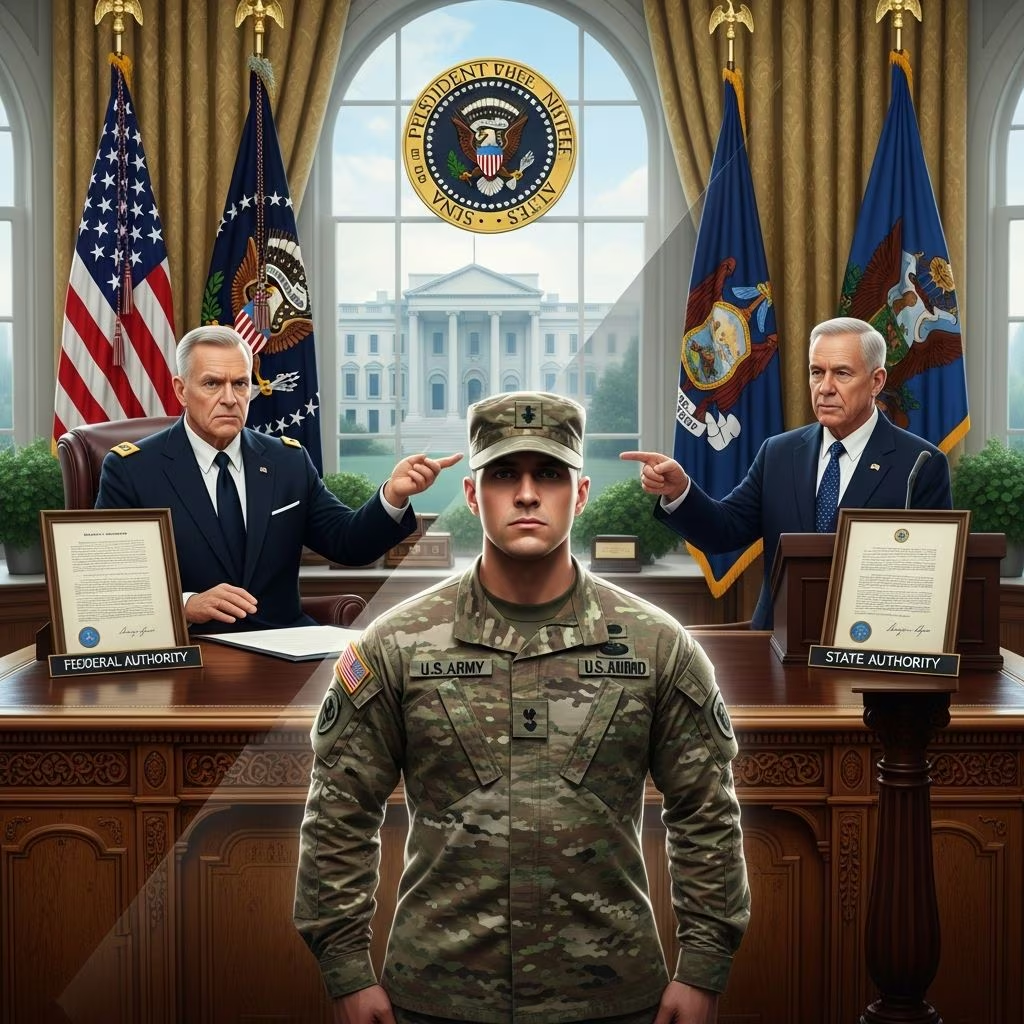
Understanding the National Guard’s Unique Command Framework
The National Guard represents one of the most distinctive elements of the American military system, operating within a framework that fundamentally differs from traditional active-duty military forces. Unlike the Army, Navy, and Air Force, which answer exclusively to federal authority, the National Guard maintains a dual nature that allows it to serve both state and federal interests. This complex arrangement creates a command structure that shifts depending on circumstances and operational needs, making it essential to understand how authority flows through this system.
With military units stationed across all 50 states, three territories (Guam, Puerto Rico, and the U.S. Virgin Islands), and Washington, D.C., the National Guard maintains a presence unmatched by any other military component. This geographic distribution directly influences its governance model, as each location operates under slightly different command relationships that reflect constitutional principles and federal law.
State-Level Governance and Gubernatorial Authority
At the foundation of the National Guard command structure lies state-level control, where each state’s governor functions as the supreme military commander within their jurisdiction. This arrangement stems from constitutional provisions that recognize states as entities with their own military forces, distinct from federal armed services. The governor’s role as commander-in-chief of state military forces grants them direct authority over National Guard operations when units remain in their militia status.
Below the governor sits the adjutant general, a senior military officer who serves as the principal military advisor and operational commander of that state’s National Guard forces. The adjutant general handles day-to-day administration, training, readiness, and operational command of all Guard units assigned to the state. This officer reports directly to the governor and implements military policy at the state level.
State-controlled National Guard missions encompass a wide range of domestic responsibilities that directly serve state populations. When natural disasters strike—whether hurricanes, wildfires, earthquakes, or floods—state governors mobilize National Guard personnel to assist with rescue operations, humanitarian relief, and infrastructure recovery. During civil unrest or public emergencies, Guard units maintain public order and security under gubernatorial direction. Examples of state-level operations include:
- Texas National Guard conducting border security and enforcement operations
- California National Guard responding to catastrophic wildfires and providing emergency assistance
- Guard units nationwide assisting with hurricane response and disaster recovery
- Emergency management during power outages, pandemics, and other domestic crises
The focus of state control remains centered on protecting the health, safety, and welfare of that state’s residents. Governors can call up National Guard members for state active duty without requiring federal approval, though such calls must comply with federal law and the Constitution.
Federal-Level Activation and Presidential Command
While the National Guard’s primary identity reflects its role as a state military force, the organization simultaneously functions as a federal reserve component of the Army and Air Force. This dual designation permits the President of the United States to assume control of National Guard units under constitutionally specified circumstances. Federal activation represents a fundamental shift in the command chain, removing Guard units from state control and integrating them into federal military operations.
Presidential authority to federalize the National Guard derives from constitutional provisions granting the President command of the armed forces. The chief executive may activate Guard forces to repel invasion, suppress rebellion, or enforce federal laws. Additionally, the President possesses authority to mobilize Guard units for overseas military operations, as permitted under federal statute.
When the President exercises this federal authority, operational control transfers from state adjutant generals to unified combatant commanders—senior generals who command all U.S. military forces within their geographic area of responsibility. The Secretary of Defense becomes the immediate overseer of federalized Guard units, ensuring they operate within the same command structure as active-duty military forces. Guard personnel activated at the federal level then answer to their military chain of command up through the Secretary of Defense rather than their state governor.
The National Guard Bureau: Bridging State and Federal Authority
Between state governors and the President sits the National Guard Bureau, a unique organization that serves as the administrative and communications link between state and federal authority. The Chief of the National Guard Bureau holds the rank of four-star general and serves as a member of the Joint Chiefs of Staff, advising the President, Secretary of Defense, and National Security Council on Guard matters.
The Chief of the National Guard Bureau functions as the Department of Defense’s official channel of communication to state governors and adjutants general. This position ensures coordination between federal and state interests while maintaining the Guard’s readiness to fulfill both roles. The Bureau administers federal programs, policies, and resources for all National Guard components and oversees more than 430,000 Army and Air National Guard personnel across the nation.
Notably, neither the Chief of the National Guard Bureau nor the director of the Army or Air National Guard directly commands Guard units in their militia status. This authority rests with state adjutant generals during peacetime. However, this arrangement changes when federal activation occurs, at which point unified combatant commanders assume operational control.
Dual-Status Command: Managing Concurrent State and Federal Operations
The National Guard’s operational complexity reaches its most sophisticated level through the concept of dual-status command, an arrangement where a single commander receives orders from both a state governor and the President simultaneously. This structure proves particularly valuable during emergencies that require coordinated state and federal response but do not necessitate complete federal takeover of Guard forces.
Dual-status command arrangements typically emerge during large-scale disasters affecting multiple jurisdictions or requiring federal assistance. Hurricane response operations exemplify this model: National Guard units operate under their state commander’s authority while addressing state-level recovery needs, yet simultaneously coordinate with Federal Emergency Management Agency (FEMA) initiatives and federal disaster relief operations. The dual-status commander ensures seamless cooperation between state and federal objectives without creating confusion about the chain of command.
This arrangement permits Governor-directed operations to continue while also enabling federal coordination and resource allocation. It prevents the inefficiency that might result from separating state and federal responses during crises requiring integrated action. For complex emergencies involving multiple states or significant federal involvement, dual-status command provides a proven framework for managing competing authorities.
Special Considerations: The District of Columbia National Guard
Washington, D.C. presents a unique situation within the National Guard command structure due to its status as a federal district without a governor. Absent a state executive, the D.C. National Guard reports directly to the President of the United States rather than to a governor. This arrangement reflects the district’s constitutional status and federal character, differentiating it from state-based Guard forces.
The D.C. National Guard nevertheless maintains operational command through a commanding general, similar to state adjutant generals, but this officer answers to federal authority rather than a state governor. This distinctive arrangement ensures that even in peacetime, the D.C. Guard operates under federal oversight distinct from the typical governor-adjutant general relationship found in the states.
How Command Authority Transitions
Understanding when and how command authority shifts between state and federal levels proves crucial for appreciating the National Guard’s operational framework. During normal circumstances, governors exercise complete command of their state’s Guard forces. Governors determine when to mobilize Guard units for state emergencies, disaster response, and domestic security needs. This peacetime state control allows the Guard to serve as an extension of state government authority focused on citizen protection and state resilience.
Federal activation occurs through presidential action, typically through executive order or in response to federal statute provisions. The activation process formally transfers command authority from state to federal control, placing Guard units on active federal service. During this transition, Guard personnel legally shift from state military service to federal military service, changing their status and duties.
The process remains reversible: when federal activation concludes, authority returns to state governors and adjutant generals. This cyclical nature of command authority reflects the Guard’s foundational purpose as a flexible military resource capable of serving multiple levels of government depending on circumstances.
Organizational Structure Under State Control
Each state maintains its own National Guard force structure organized under the state adjutant general’s authority. Larger states may operate multiple command headquarters overseeing regionally distributed units. The state organization parallels active-duty Army and Air Force structures but remains subordinate to state governors rather than to the Secretary of Defense or active-duty military commanders.
State Guard organizations include both Army and Air National Guard components. The Army National Guard provides ground forces capable of rapid deployment for emergencies, while the Air National Guard supplies aerial capabilities for reconnaissance, transport, and support missions. Both components operate under unified state command during state-level activation, though they maintain separate administrative structures.
Comparison: State vs. Federal Control Characteristics
| Aspect | State Control | Federal Control |
|---|---|---|
| Commander | State Governor | President of the United States |
| Operational Authority | State Adjutant General | Unified Combatant Commander |
| Immediate Oversight | State Government | Secretary of Defense |
| Primary Missions | Disaster response, civil emergencies, state security | National defense, overseas operations, federal law enforcement |
| Activation Authority | Governor’s discretion | Presidential authority under constitutional/statutory provisions |
| Duty Status | State Active Duty or Militia Status | Federal Active Duty |
Frequently Asked Questions
Q: Can a state governor refuse a presidential order to federalize the National Guard?
A: No. The President possesses constitutional authority to federalize National Guard forces. While the Supreme Court has recognized limits on federal authority over state militias, the President’s power to activate Guard units for constitutional purposes remains established law. Governors cannot override presidential federalization orders.
Q: How often does the President federalize the National Guard?
A: Federal activation remains relatively rare during peacetime but occurs regularly for significant emergencies, major disasters, or federal law enforcement needs. Overseas deployments for military operations represent another common reason for federal activation. Many Guard units also maintain federally funded operational roles distinct from state service.
Q: What happens to National Guard personnel when federal activation occurs?
A: Guard members transition from state military service to federal active duty. Their pay, benefits, and command structure change to align with active-duty military status. They become subject to the Uniform Code of Military Justice and active-duty regulations rather than state-specific military laws.
Q: Can the National Guard operate in multiple states simultaneously under different commanders?
A: Yes. Each state maintains separate Guard forces under its governor’s authority. However, during federal activation, units from multiple states operate under unified federal command. Some Guard units maintain federally-funded missions that may involve cross-state coordination.
Q: Who pays for National Guard operations under state control?
A: Funding sources vary. State governments fund certain state-level operations, while the federal government provides substantial funding for personnel, training, and equipment even during state activation. This shared funding reflects the Guard’s dual nature and federal-state partnership model.
Q: What training and qualifications must an adjutant general possess?
A: State adjutant generals are senior military officers, typically holding general officer rank. They must possess extensive military experience, leadership credentials, and knowledge of both military operations and state government functions. Governors select adjutant generals based on military qualifications and professional background.
References
- Who Controls the National Guard & When Do They Control It? — USA Military Museum. 2024. https://www.usamm.com/blogs/news/who-controls-the-national-guard-when
- Army National Guard — Wikipedia. 2025. https://en.wikipedia.org/wiki/Army_National_Guard
- Chief, National Guard Bureau – Leadership — National Guard Bureau. U.S. Department of Defense. 2025. https://www.nationalguard.mil/Leadership/CNGB/
- Army National Guard — U.S. Army. 2025. https://www.goarmy.com/explore-the-army/army-structure/national-guard
- The U.S. Army’s Command Structure — U.S. Army. 2025. https://www.army.mil/organization/