
Command Authority Over the National Guard
Unraveling the dual command structure of the National Guard: state governors vs. federal oversight in emergencies and beyond.
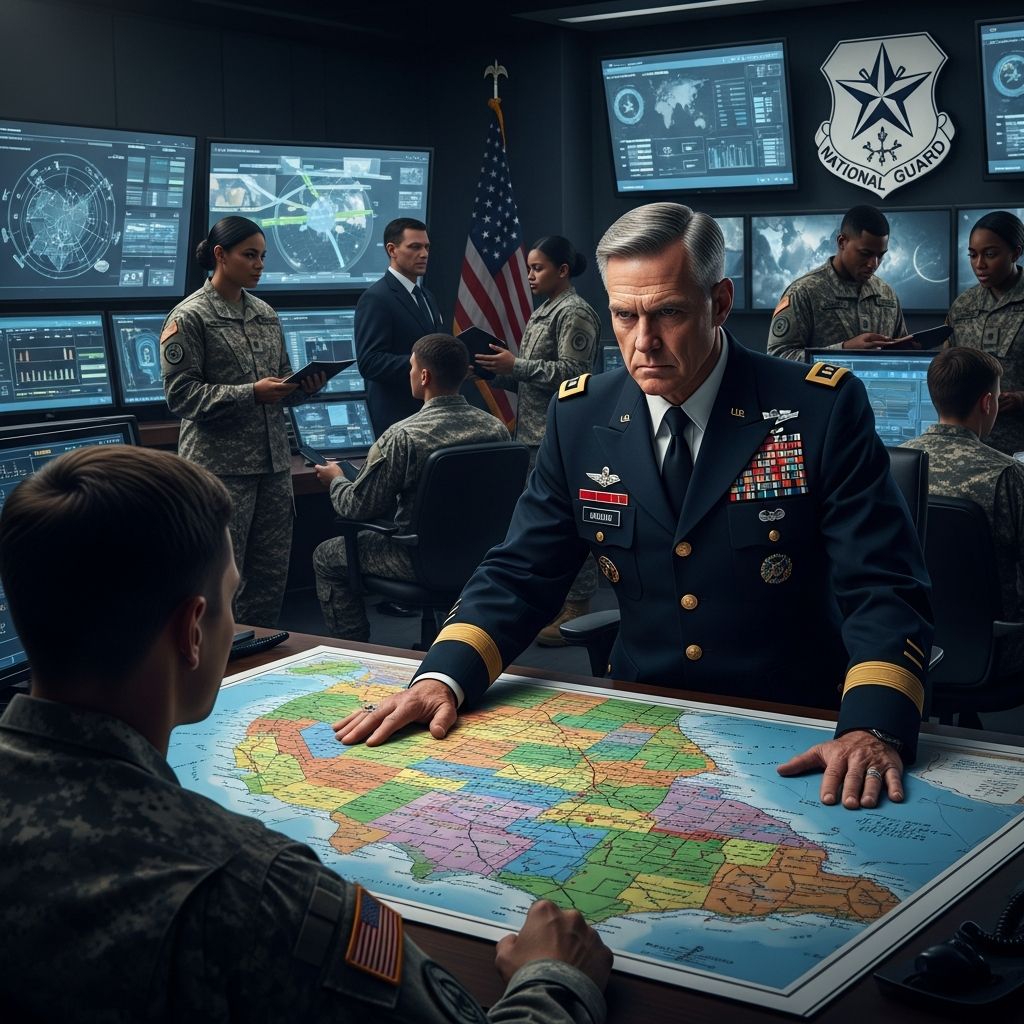
The National Guard stands as a cornerstone of America’s defense strategy, uniquely positioned to serve both state and federal interests. Comprising over 430,000 personnel across Army and Air components in all 50 states, three territories, and the District of Columbia, it embodies a hybrid military force capable of rapid response to domestic emergencies while supporting global operations. This duality stems from constitutional provisions and federal statutes that delineate control between governors and the President, ensuring flexibility in crises ranging from natural disasters to national security threats.
The Constitutional Roots of Dual Command
The U.S. Constitution lays the foundation for the National Guard’s divided authority. Article I, Section 8 grants Congress powers to organize, arm, and discipline the militia, while reserving to states the appointment of officers and training authority. Article II designates the President as Commander-in-Chief when militias are called into federal service. This framework, evolved through laws like the Militia Acts and modern Title 10 and Title 32 statutes, creates a seamless bridge between local and national needs.
Under state control, governors act as commanders-in-chief, directing Guard units through their Adjutant Generals—senior officers appointed by the governor. This structure allows immediate mobilization for state active duty, focusing on civilian protection without federal involvement. In contrast, federal activation integrates Guard forces into the Department of Defense chain, under the Secretary of Defense.
State-Level Operations: Governors at the Helm
In its primary role, the National Guard operates under gubernatorial command, responding to localized threats with remarkable speed. Governors can activate units for missions such as hurricane relief, flood control, wildfire suppression, and civil disorder management. For instance, the Texas National Guard supports border security operations, while California’s units battle annual wildfires, safeguarding communities and infrastructure.
The Adjutant General serves as the key operational leader, overseeing training, readiness, and deployment within state boundaries. State active duty missions are funded by state budgets, emphasizing self-reliance. This control preserves the Guard’s community ties, with personnel often hailing from the areas they protect. During the COVID-19 pandemic, governors nationwide deployed Guard members for vaccination drives, testing sites, and medical support, exemplifying state-led efficiency.
- Key State Missions: Disaster response (hurricanes, floods, earthquakes), search and rescue, public health emergencies, and law enforcement augmentation during riots or strikes.
- Advantages: Rapid activation without federal approval, tailored to local conditions, and maintenance of state sovereignty.
- Limitations: Restricted to state borders unless interstate compacts like the Emergency Management Assistance Compact are invoked.
Federal Mobilization: Presidential Power in Action
When national interests demand, the President federalizes the National Guard under Title 10 of the U.S. Code, shifting command to the federal level. This authority, exercised via executive orders, places units under the Secretary of Defense and integrates them with active-duty forces. Historical examples include deployments to Iraq and Afghanistan during Operations Iraqi Freedom and Enduring Freedom, where Guard troops comprised significant portions of rotations.
Federal control is invoked for insurrection suppression (per the Insurrection Act), border security reinforcements, or overseas contingencies. The President must issue a call-up order, often with congressional oversight for extended deployments. Once federalized, Guard members receive federal pay, benefits, and follow uniform military justice under the Uniform Code of Military Justice.
| Activation Type | Authority | Funding | Command Chain | Example |
|---|---|---|---|---|
| State Active Duty | Governor | State | Adjutant General | Wildfire response in California |
| Title 32 | Governor (with federal approval) | Federal | Adjutant General | Hurricane Katrina support |
| Title 10 | President | Federal | Secretary of Defense | Iraq deployments |
Title 32: The Hybrid Activation Model
Bridging state and federal realms, Title 32 status allows governors to retain command while receiving federal funding and resources. Activated by the President or Secretary of Defense with gubernatorial consent, it supports missions like drug interdiction or disaster recovery where federal support enhances state efforts. This model was pivotal in responses to Hurricanes Katrina and Sandy, enabling coordinated FEMA integration without full federalization.
Title 32 preserves state control over operations, crucial for maintaining local accountability, while leveraging federal logistics and pay scales. Personnel remain subject to state military codes, fostering dual loyalty.
Dual-Status Command: Unified Leadership in Crisis
For complex disasters spanning state and federal scopes, dual-status command appoints a single officer to report to both the governor and President. This innovative structure, formalized in the 1990s, streamlines coordination during events like major hurricanes or pandemics. The commander issues unified orders, reducing confusion and enhancing efficiency.
Implemented via presidential memorandum, it requires mutual agreement and has proven effective in operations like the 2017 Hurricane Maria response in Puerto Rico, where Guard forces delivered aid under joint directives.
Role of the National Guard Bureau and Leadership
The National Guard Bureau (NGB), headquartered in Arlington, Virginia, serves as the federal conduit to state forces. Led by the Chief of the National Guard Bureau—a four-star general and Joint Chiefs member—it ensures readiness, training standards, and resource allocation. Current Chief Gen. Steven S. Nordhaus advises the President, Secretary of Defense, and governors on Guard matters, overseeing 430,000 personnel.
At state levels, Adjutants General mirror this role, managing daily operations. For example, Missouri’s Maj. Gen. Charles D. Hausman leads joint Army and Air components. The D.C. National Guard uniquely reports directly to the President, bypassing a governor.
Historical Milestones in Command Evolution
The National Guard’s command structure has adapted through key events. The 1903 Dick Act formalized it as a reserve component, while World War I and II federalizations expanded its role. Post-9/11, the Global War on Terror saw unprecedented overseas deployments. Recent domestic uses, like 2020 civil unrest responses, highlight ongoing tensions between state sovereignty and federal intervention.
Legal challenges, such as those under the Posse Comitatus Act limiting domestic law enforcement, further define boundaries, ensuring Guard missions align with civil liberties.
Challenges and Future Considerations
Navigating dual command poses logistical hurdles: differing pay systems, training variances, and potential conflicts during transitions. Modern threats—cyber attacks, climate disasters, pandemics—demand enhanced interoperability. Proposals for streamlined activation and increased Title 32 usage aim to bolster resilience.
Cyber units and space components are emerging, requiring updated command protocols. Balancing state autonomy with national readiness remains paramount.
Frequently Asked Questions
Who is the primary commander of a state’s National Guard?
The governor serves as commander-in-chief, delegating to the Adjutant General for operations.
Can the President activate the National Guard without a governor’s consent?
Yes, under Title 10 for federal service, though Title 32 requires consent.
What is the difference between Title 10 and Title 32 duty?
Title 10 transfers full federal control; Title 32 keeps state command with federal funding.
How does the D.C. National Guard differ?
It reports directly to the President, lacking a governor.
What role does the Chief of the National Guard Bureau play?
Advises national leaders and coordinates with states on readiness.
References
- Who Controls the National Guard & When Do They Control It? — USAMM. 2023. https://www.usamm.com/blogs/news/who-controls-the-national-guard-when
- Chief, National Guard Bureau – Leadership — NationalGuard.mil. 2024-10. https://www.nationalguard.mil/Leadership/CNGB/
- National Guard (United States) — Wikipedia (citing U.S. Code). 2026. https://en.wikipedia.org/wiki/National_Guard_(United_States)
- The U.S. Army’s Command Structure — Army.mil. 2025. https://www.army.mil/organization/
- Missouri National Guard > About Us > Our Leadership — MOGuard.ngb.mil. 2025. https://www.moguard.ngb.mil/About-Us/Our-Leadership/
Similar Articles








Read full bio of Sneha Tete


