
Lane Splitting on Motorcycles: Laws and Safety Guide
Navigate the legal status of motorcycle lane splitting across U.S. states and master essential safety practices for riders.
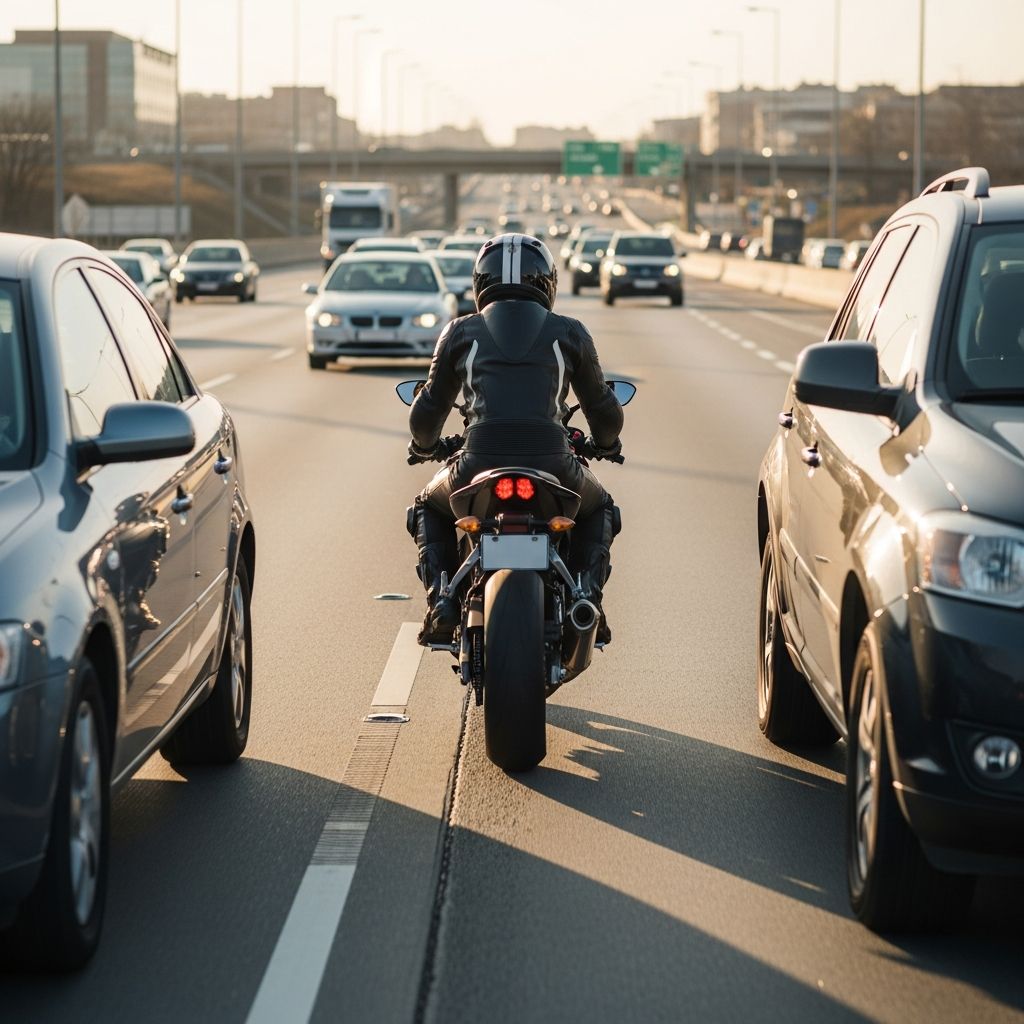
Motorcycle lane splitting allows riders to navigate between lanes of slow or stopped traffic, a practice that enhances mobility but sparks debates on legality and risks. While permitted in select states under strict conditions, it demands heightened awareness to prevent collisions.
Defining Lane Splitting and Lane Filtering
Lane splitting occurs when a motorcycle travels between rows of vehicles moving in the same direction within the same lane, typically on multi-lane roads. This differs from lane filtering, a subset limited to situations where traffic is fully stopped, often at low speeds. California Vehicle Code § 21658.1 explicitly defines lane splitting as operating a two-wheeled motorcycle between such rows on divided or undivided roads.
These maneuvers improve traffic flow for riders and reduce rear-end crash exposure, but they require precise control and environmental scanning. Riders must maintain balance, anticipate sudden vehicle movements, and adhere to posted limits.
Current Legal Status Across the United States
As of 2026, lane splitting laws vary widely, with full permission rare and most states imposing bans or ambiguities enforced via general lane-use statutes. California stands alone in broadly authorizing the practice, while others permit limited filtering.
| State | Status | Key Restrictions |
|---|---|---|
| California | Legal (Full Lane Splitting) | Guidelines by CHP; no specific speed bans but safety emphasized. |
| Arizona | Lane Filtering Legal | Traffic stopped, speed 6le;15 mph, speed limit 6le;45 mph, multi-lane roads. |
| Utah | Lane Filtering Legal | Similar to AZ: stopped traffic, 6le;15 mph, 6le;45 mph limit. |
| Montana | Limited Filtering | Overtake vehicles 6le;10 mph if lanes wide enough. |
| Hawaii | Restricted Shoulder Use | Limited to shoulders under specific conditions. |
| Minnesota | Filtering Legal (Since 2025) | 6le;25 mph motorcycle speed, 6le;15 mph differential from traffic. |
Numerous states explicitly prohibit lane splitting. For instance, Massachusetts bans operation between lanes under General Laws Chapter 89, Section 4A, requiring vehicles to stay within marked boundaries. Illinois (625 ILCS 5/11-709), Nevada (NRS 486.351), and Virginia (6 46.2-841) mandate single-lane adherence, treating splitting as passing within the same lane.
In gray-area states like Kentucky and Missouri, no explicit permission exists, and general rules against unsafe operation prevail, often leading to citations. Texas enacted HB 4122 in 2023 to formally ban it. Riders in prohibited areas risk fines, license points, or liability in crashes.
California’s Pioneering Approach to Lane Splitting
California legalized lane splitting via Assembly Bill 51 in 2016, empowering the California Highway Patrol (CHP) to create safety guidelines in consultation with safety organizations and agencies like the DMV. Vehicle Code § 21658 requires vehicles to stay in lanes ‘as nearly as practical,’ but § 21658.1 carves out an exception for motorcycles.
A 1978 court ruling in People v. Butler reinforced that lane changes must be safe, applying to splitters who must yield and avoid recklessness. This framework positions California as the national leader, influencing debates elsewhere.
Safety Guidelines for Responsible Lane Splitting
Even where legal, lane splitting heightens crash risks if mishandled. CHP recommends:
- Split only when traffic speed is 6le;30 mph and rider speed 6le;10 mph faster.
- Avoid high-traffic zones with sudden accelerations.
- Use both lanes fully; no shoulder riding.
- Wear visible gear and use headlights.
Drivers share responsibility: scan mirrors, signal early, and maintain gaps. Studies link proper splitting to fewer rear-end incidents for riders, but side-swipes remain a threat.
Risks and Statistics on Motorcycle Crashes
Lane splitting correlates with specific hazards. Improper execution triples side-collision odds, per safety analyses. In legal states, compliant riders see reduced heat-related stops and exhaust exposure.
General motorcycle stats underscore vigilance: NHTSA reports motorcyclists face 28 times higher fatality rates than car occupants. Lane-related incidents often stem from driver unawareness. Insurance data shows splitters in California experience comparable claim rates to non-splitters when following guidelines.
Insurance and Liability Implications
Legal splitting rarely voids policies, but reckless acts do. In accidents, riders must prove caution; at-fault drivers bear primary liability under comparative negligence. Prohibited-state violations can shift fault to the rider, inflating premiums or denying claims.
Document everything post-crash: photos, witnesses, police reports. Consult attorneys specializing in motorcycle personal injury for compensation covering medical bills, lost wages, and pain.
State Variations in Enforcement and Penalties
Enforcement varies; urban California sees routine splitting without stops if guideline-compliant. Prohibited states issue tickets under reckless driving statutes, with fines $100$1,000 plus points. Emerging filtering states like Minnesota mandate strict speed adherence, with violations escalating to misdemeanors.
Riders crossing states should app local laws via DMV sites or apps. AMA advocates for uniform safety education.
Best Practices for Motorcyclists Everywhere
- Complete advanced training like MSF courses.
- Equip with ABS brakes, protective armor.
- Communicate via hand signals, horn.
- Avoid splitting in rain, night, or near semis.
Technology aids: rearview cameras, radar detectors for blind spots.
Frequently Asked Questions (FAQs)
Is lane splitting legal nationwide?
No, only California permits full lane splitting; states like Arizona and Utah allow limited filtering.
What speed is safe for lane splitting in California?
CHP advises no more than 10 mph over traffic speed, ideally under 30 mph ambient.
Can cars be ticketed for hitting a lane-splitting motorcycle?
Yes, if the driver failed to yield or check mirrors, sharing fault.
Does lane splitting increase insurance rates?
Not inherently if legal and safe; claims history matters more.
What’s the difference between lane splitting and sharing?
Splitting is between lanes; sharing is two bikes abreast in one lane, allowed if safe.
Training and Advocacy for Safer Roads
Organizations like the AMA push for evidence-based laws, citing European data where splitting cuts congestion without spiking crashes. Riders should join for lobbying and resources. Local clubs offer group rides emphasizing etiquette.
Legislative momentum grows; monitor bills for expansions. Prioritize skill-building over shortcuts.
References
- California Lane Splitting Laws 6mdash; Roberts | Jeandron Law. 2023. https://www.robertslawfirm.net/lane-splitting-laws-ca/
- Motorcycle Lane Splitting and the Law 6mdash; JDSupra. 2023-10-01. https://www.jdsupra.com/legalnews/motorcycle-lane-splitting-and-the-law-7344811/
- Motorcycle Lane Splitting Laws: Legal States & Rider Guide 6mdash; Inszone Insurance. 2025. https://inszoneinsurance.com/blog/motorcycle-lane-splitting
- What is the Motorcycle Lane Splitting Law in California? 6mdash; Lawyers in Lafayette. 2025-05-01. https://www.lawyersinlafayette.com/blog/2025/may/motorcycle-lane-splitting-law-in-california/
- Where Is Lane Splitting Legal? State by State Guide 6mdash; Kryder Law. 2025. https://www.kryderlaw.com/blog/where-is-lane-splitting-legal/
- Lane Splitting | American Motorcyclist Association 6mdash; AMA. 2023. https://americanmotorcyclist.com/rights/ama-board-position-statements/lane-splitting/
Similar Articles








Read full bio of Sneha Tete


