Guide to Mississippi District Attorneys
In Mississippi, district attorneys (DAs) are the primary public prosecutors responsible for bringing criminal cases in the state’s trial courts of general jurisdiction, known as circuit courts.[10] They represent the State of Mississippi in serious criminal matters and some limited civil cases where the state has an interest.
This guide explains how Mississippi’s district attorneys are organized, what they do on a daily basis, how cases move through the system, and how the DA’s office fits within the broader court structure.
Where District Attorneys Fit in Mississippi’s Court System
To understand the role of a district attorney, it helps to see where the office sits in the state’s judicial framework.
- Supreme Court of Mississippi – The state’s highest court; reviews decisions from lower courts and interprets state law and the state constitution.[10]
- Mississippi Court of Appeals – Handles many appeals assigned by the Supreme Court, including criminal appeals from circuit courts.[10]
- Circuit Courts – Trial courts of general jurisdiction over felonies and serious civil cases; this is where district attorneys prosecute most criminal cases.[10]
- Chancery, County, Justice, Municipal, and Youth Courts – Handle family law, probate, misdemeanors, traffic, local ordinance violations, and youth matters; DAs may coordinate with county and municipal prosecutors in some matters.[10]
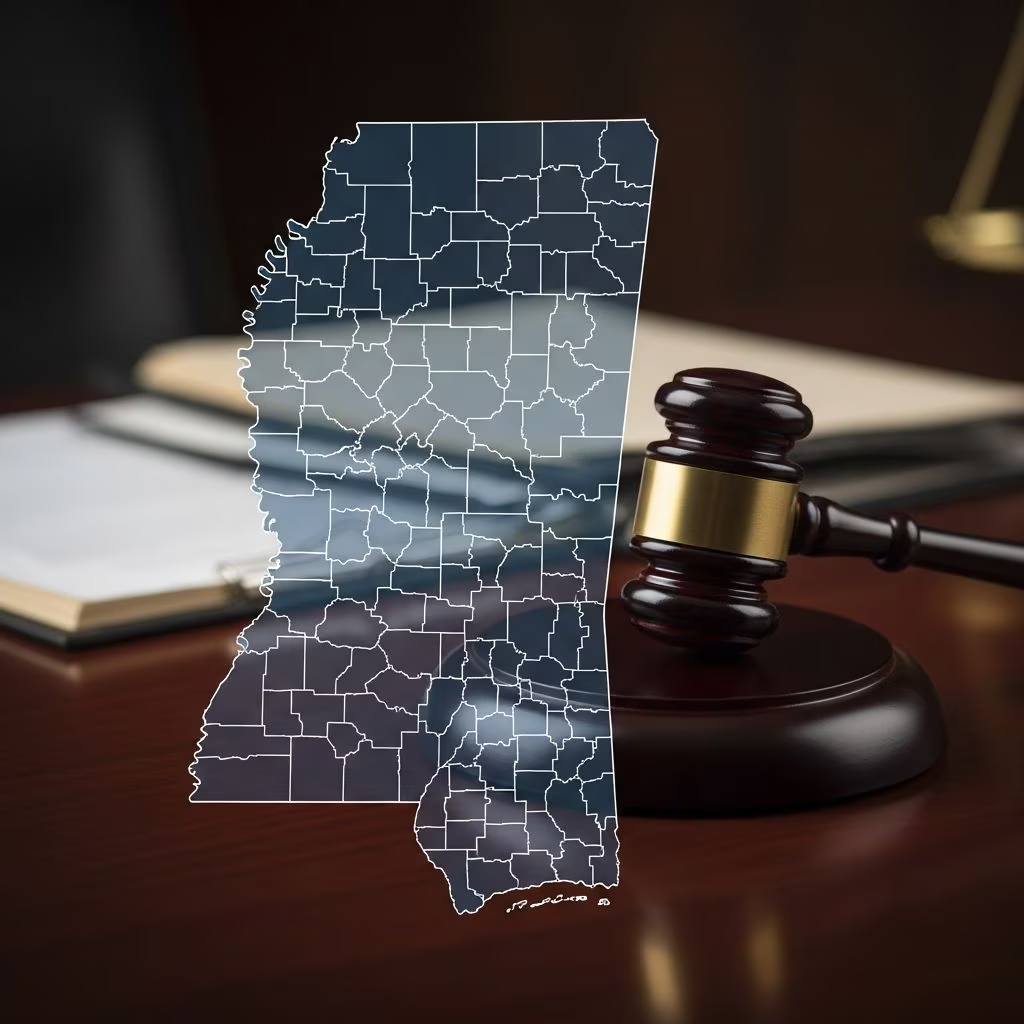
Mississippi is divided into 22 circuit court districts, and each district elects a district attorney who prosecutes criminal cases within that geographic area.[10]
Mississippi’s 22 Circuit Court Districts
Every circuit court district includes a group of counties and is served by one elected district attorney.[10] The table below summarizes the basic structure.
| District No. | General Area / Example Counties | Type of Area |
|---|---|---|
| 1–3 | North & Northeast (e.g., Lee, Lafayette, Hancock, Harrison) | Mixed urban–rural |
| 4–6 | Delta & Southwest (e.g., Washington, Leflore, Adams, Amite) | Predominantly rural |
| 7–9 | Metro Jackson & West (e.g., Hinds, Warren) | Urban and suburban |
| 10–13 | East & Central (e.g., Lauderdale, Forrest, Jasper) | Mixed |
| 14–18 | South & Pine Belt (e.g., Lincoln, Pike, Jones) | Rural and small cities |
| 19–23 | Coastal & Northwest (e.g., Jackson County, DeSoto) | Coastal & suburban growth areas |
Each of these districts has one district attorney and, depending on caseload, multiple assistant district attorneys, investigators, and victim assistance staff.
Election and Independence of District Attorneys
Mississippi district attorneys are independently elected officials, separate from county and city governments.
- Term length: District attorneys are elected to a four-year term.
- Constituency: Each DA represents all the counties within their circuit court district, not just a single county.[10]
- Non-federal role: District attorneys prosecute state law violations, while U.S. Attorneys handle federal crimes in the federal district courts.
Because DAs are elected, they exercise substantial discretion in how aggressively to pursue certain types of crimes, which diversion programs to support, and how to allocate limited resources.
Core Responsibilities of a Mississippi District Attorney
The district attorney’s office is primarily a prosecuting office. Its work is broad but centers on representing the state in criminal matters in circuit court.
1. Prosecuting Felony Crimes
Circuit courts have jurisdiction over felonies such as homicide, robbery, burglary, and serious drug offenses.[10] District attorneys:
- Review investigative reports from law enforcement for potential felony charges.
- Present felony matters to the grand jury for indictment.
- Prepare and try cases before a jury or judge in circuit court.
- Negotiate plea agreements, when appropriate, with defense counsel.
2. Representing the State in Certain Civil Matters
Although the criminal docket is the main focus, district attorneys in Mississippi may also handle limited civil cases involving the state’s interests, such as recovery of funds or enforcement-related proceedings, depending on statute and local practice.
3. Working with County and Municipal Prosecutors
Mississippi law also provides for county prosecuting attorneys, who handle most misdemeanors, youth court matters, and other lower-level cases.
- County prosecutors represent the state in justice court and county court and can assist the district attorney in criminal and civil matters when requested.
- They may present matters to the grand jury and can be designated to appear on behalf of the district attorney under a written agreement filed with the circuit clerk.
- When a misdemeanor case is later elevated or modified into a felony within circuit court jurisdiction, responsibility shifts to the district attorney.
4. Victim Assistance and Community Communication
Modern district attorney offices in Mississippi commonly employ victim assistance coordinators to help victims navigate the criminal justice process.
- Explaining court dates, hearing purposes, and potential outcomes.
- Collecting victim impact information for sentencing.
- Serving as a communication bridge between victims, law enforcement, and prosecutors.
From Arrest to Trial: How a Criminal Case Proceeds
While every case is unique, felony prosecutions in Mississippi generally follow a similar path from investigation through trial.[10]
Step 1: Investigation and Arrest
- Local or state law enforcement investigate suspected criminal activity.
- If probable cause exists, officers may arrest a suspect or seek an arrest warrant.
- The case file is then forwarded to the district attorney’s office for review in serious felony matters.
Step 2: First Appearance and Counsel
- The defendant appears before a judge for a first appearance, where the charges are explained and bond may be considered.
- The judge inquires whether the defendant has or needs an attorney; low-income defendants may qualify for a court-appointed lawyer.
- Typically, no formal plea is entered on felony charges at this stage, unless the defendant waives indictment and pleads guilty with counsel present.
Step 3: Grand Jury Review
Mississippi law requires that only a grand jury can formally charge a person with a felony through an indictment.[10]
- All felony cases are presented to a grand jury in the county where the crime allegedly occurred.
- The district attorney presents evidence and calls witnesses in a closed proceeding.
- If the grand jury finds probable cause, it issues an indictment, and the defendant is bound over to stand trial or enter a guilty plea.
Step 4: Pre-Trial Proceedings
- Defendants are formally arraigned and enter a plea (usually not guilty at first).
- Both sides engage in discovery, exchanging evidence and filing motions, such as motions to suppress evidence or dismiss charges.
- Plea negotiations may occur, with the district attorney weighing public safety, evidence strength, and victim input.
Step 5: Trial and Sentencing
If no plea agreement is reached, the case goes to trial in circuit court.
- The DA must prove the defendant’s guilt beyond a reasonable doubt to all 12 jurors.[10]
- If the jury finds the defendant guilty, the circuit court judge imposes sentence, considering statutory ranges, prior record, and any sentencing recommendations.
- Sentencing may include imprisonment, probation, fines, restitution, or a combination.
Staffing and Resources in a District Attorney’s Office
Mississippi’s 22 district attorneys rely on a range of staff to manage their caseloads.
- Assistant District Attorneys – Handle day-to-day prosecutions, motion hearings, plea negotiations, and many trials.
- Investigators – Work with law enforcement, locate and interview witnesses, and help prepare evidence for trial.
- Victim Assistance Coordinators – Guide victims and witnesses through the process and ensure their voices are heard at key stages.
- Support Staff – Legal secretaries, docket clerks, and administrators keep cases organized and filings timely.
Strategic planning documents for Mississippi prosecutors emphasize fulfilling their constitutional and ethical duties while managing increasing caseloads and limited budgets, and supporting initiatives such as diversion and specialty courts.
District Attorneys and Alternative Approaches
Although the traditional role of a district attorney is to prosecute crimes, Mississippi DAs also frequently engage in broader initiatives:
- Drug and problem-solving courts: Circuit courts may operate specialized dockets—such as drug courts—that emphasize treatment and supervision over incarceration in suitable cases, often with DA input.[10]
- Community outreach: Many offices engage with schools, civic groups, and local coalitions on crime prevention and victim awareness.
- Policy collaboration: DAs may work with legislators, the Attorney General, and law enforcement agencies to improve criminal justice policies and practices.
How Mississippi DAs Differ from Federal Prosecutors
It is easy to confuse state district attorneys with federal prosecutors, but they operate in distinct systems.[10]
| Feature | Mississippi District Attorney | U.S. Attorney (Federal) |
|---|---|---|
| Type of Law | State criminal law (e.g., state-level felonies) | Federal criminal and civil law (e.g., federal drug, fraud cases) |
| Court Level | State circuit courts, with appeals to state appellate courts[10] | U.S. district courts, appeals to U.S. courts of appeals and U.S. Supreme Court |
| Selection | Elected locally for four-year terms | Appointed by the President and confirmed by the Senate |
| Primary Role | Prosecute violations of Mississippi law | Prosecute violations of federal law and represent the United States |
Frequently Asked Questions About Mississippi District Attorneys
Q: How many district attorneys does Mississippi have?
A: Mississippi has 22 district attorneys, one for each circuit court district. Each DA is responsible for prosecuting state criminal cases within the counties that make up that district.[10]
Q: Who decides what charges to file in a felony case?
A: Law enforcement may arrest on probable cause, but the district attorney reviews the evidence, decides what charges to present to the grand jury, and only a grand jury can issue a felony indictment in Mississippi.
Q: Can the district attorney drop or reduce charges?
A: Yes. The DA has broad discretion to dismiss, amend, or reduce charges based on the evidence, legal issues, victim input, and the interests of justice, subject to court approval of plea agreements.
Q: What is the difference between a district attorney and a county prosecuting attorney?
A: The district attorney prosecutes felonies and certain other matters in circuit court across a multi-county district, while the county prosecuting attorney handles most misdemeanors, youth court cases, and prosecutions in justice and county courts within a single county.[10]
Q: How can I contact my local district attorney’s office?
A: Each circuit court district maintains contact information, usually through county government or dedicated district attorney websites. You can identify your district by your county and then look up the corresponding DA’s office contact details.
References
- Court Structure — The Mississippi Bar. 2020-01-01. https://www.msbar.org/for-the-public/court-structure/
- District Attorney — Amite County, Mississippi. 2023-01-01. https://www.amitecounty.ms/district-attorney
- Judicial Process — Office of the District Attorney, Fourth Circuit Court District (Mississippi). 2022-01-01. https://msdeltada.com/judicial-process/
- District Attorney — Neshoba County Board of Supervisors. 2021-01-01. https://www.neshobacounty.net/district-attorney
- Duties and Responsibilities of the County Attorney — Hinds County, Mississippi. 2002-01-01. https://www.hindscountyms.com/elected-offices/county-attorney
- State of Mississippi Circuit Court Map by District — Mississippi Office of the Attorney General / Mississippi Judiciary. 2025-02-01. https://attorneygenerallynnfitch.com/wp-content/uploads/2025/02/State-of-Mississippi-Circuit-Court-Map-by-District.pdf
- Introduction to the Federal Court System — U.S. Department of Justice. 2016-09-28. https://www.justice.gov/usao/justice-101/federal-courts
- Understanding the Court System (Brochure) — Mississippi Judiciary. 2018-01-01. https://courts.ms.gov/aoc/courtinterpreter/Translated%20Forms/understanding-the-court-system-brochure.pdf
- District Attorneys and Staff 5-Year Strategic Plan FY 2023–2027 — Mississippi Legislative Budget Office. 2023-01-01. https://www.lbo.ms.gov/misc/strategic/FY23/087-00-plan.pdf