
Missed Legal Deadlines: Consequences, Recovery, and Prevention
Understand what happens when legal deadlines are missed, how to respond quickly, and concrete systems to prevent costly timing mistakes.
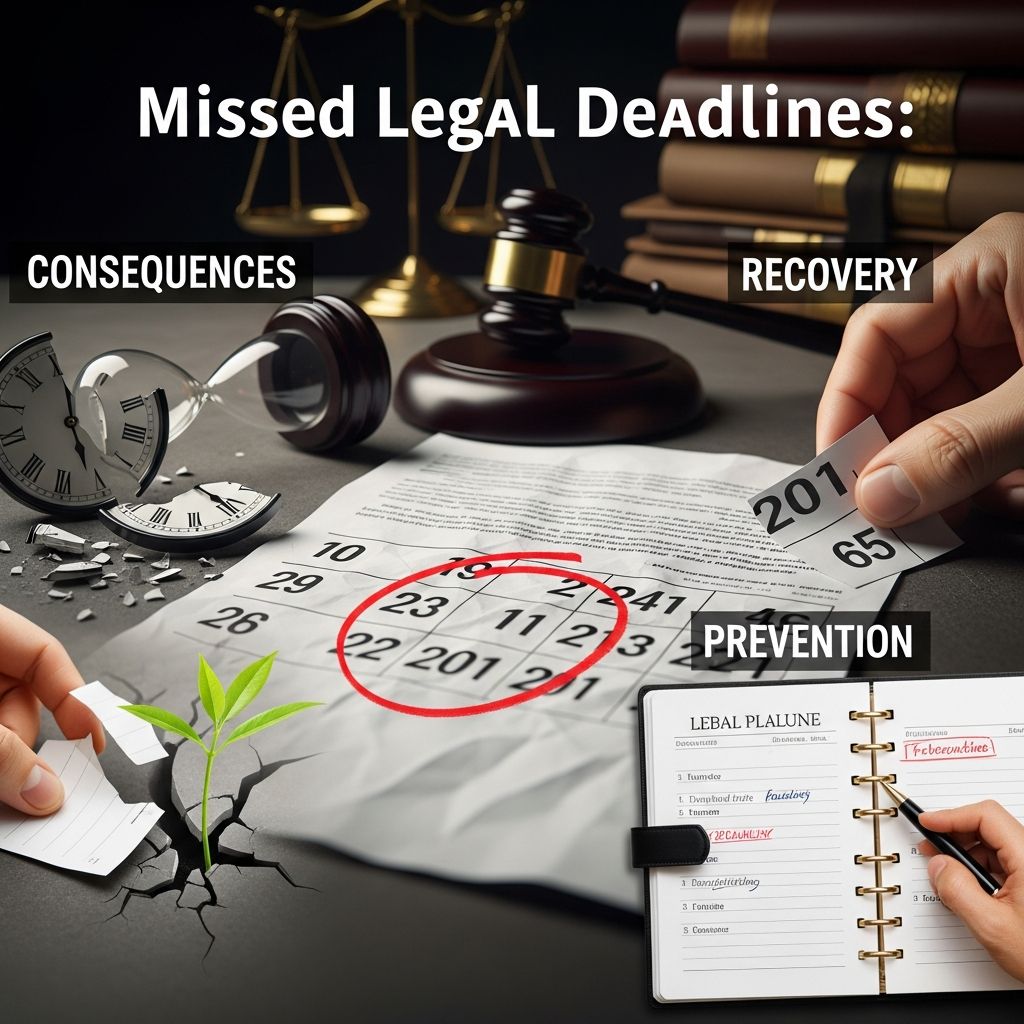
Deadlines are the backbone of modern litigation. Courts, legislatures, and procedural rules set strict time limits for filing lawsuits, responding to motions, disclosing evidence, and appealing judgments. When those deadlines are missed, the impact can range from a minor inconvenience to the complete loss of a client’s legal rights.
This guide explains what missed legal deadlines mean, how they can affect clients and lawyers, when a mistake crosses the line into malpractice, and what systems can sharply reduce the risk of timing errors.
Why Legal Deadlines Matter So Much
Legal systems use deadlines to promote fairness, efficiency, and finality. Several types of time limits appear in civil practice:
- Statutes of limitations – Laws that set how long a person has to file a lawsuit from the date of injury or discovery of harm. If you file too late, the court generally must dismiss the case regardless of its merit.
- Statutes of repose – Absolute outer limits that bar claims after a fixed number of years, even if the injury is discovered later (common in products liability and construction).
- Procedural and court-imposed deadlines – Time limits for serving complaints, responding to motions, completing discovery, or filing expert reports and pretrial documents.
- Administrative and government-claim deadlines – Short windows to file notices or claims against public entities or administrative agencies before a lawsuit may proceed.
- Appellate deadlines – Strict timing for filing notices of appeal and appellate briefs; missing these often ends appellate rights entirely.
Some deadlines are flexible and can be extended by agreement or court order. Others—especially statutes of limitations and many appellate time limits—are effectively non-negotiable.
Common Ways Deadlines Get Missed
Missed deadlines usually result from a combination of human error and weak systems, rather than a single dramatic oversight. Frequent causes include:
- Incorrect interpretation of the law – Misreading how a statute of limitations applies, miscalculating the start date, or assuming the wrong limitations period for a particular claim or jurisdiction.
- Faulty calendaring – Failing to enter a deadline, entering the wrong date, or not tying all dependent tasks to that deadline.
- Procrastination and backlog – Knowing the deadline but waiting too long to prepare filings, leaving no margin for emergencies or client delays.
- Breakdowns in communication – Delayed client responses, missing documents, or misunderstandings about who is responsible for a filing.
- Staff turnover or role confusion – When responsibility for a case shifts without a clear transfer of deadline ownership.
In most jurisdictions, lawyers are expected to maintain reliable calendaring and workflow systems to guard against these predictable risks.
Consequences of Missing a Legal Deadline
The impact of a missed deadline depends heavily on what kind of deadline was ignored and how central it is to the case. Outcomes span a wide spectrum.
1. Loss of the Right to Bring or Continue a Case
When a statute of limitations expires before a complaint is filed, courts typically must dismiss the lawsuit. This can mean:
- Permanent loss of the underlying claim, even if the facts and evidence strongly favor the plaintiff.
- No ability to refile the action in the same court or another jurisdiction, absent a valid tolling rule.
- Loss of settlement leverage, because opposing parties know the claim is no longer enforceable in court.
Similarly, missing an appeal deadline usually ends any chance of appellate review, even where strong arguments existed to overturn the judgment.
2. Dismissals, Default Judgments, and Sanctions
When procedural or court-ordered deadlines are missed, judges may respond with escalating consequences, such as:
- Striking pleadings or excluding late-filed evidence (e.g., expert reports that arrive after a disclosure cutoff).
- Monetary sanctions against the party or counsel, including attorney’s fees and costs incurred by the other side.
- Adverse rulings on motions, such as granting summary judgment when no timely opposition is filed.
- Dismissal or default where the failures are serious or repeated, effectively ending the litigation in favor of the opposing party.
Even when a case technically survives, lost evidence, excluded testimony, or negative credibility impressions can severely weaken the client’s position.
3. Financial and Professional Repercussions
For clients, the cost of a missed deadline often includes lost recovery, unreimbursed expenses, and additional attorney’s fees to repair the damage or pursue malpractice relief. For lawyers, consequences may involve:
- Legal malpractice claims seeking the value of the lost underlying case or other damages.
- Bar grievances and potential disciplinary action.
- Increased professional liability insurance premiums or coverage disputes.
- Reputational harm that can affect referrals and long-term practice viability.
When a Missed Deadline Becomes Legal Malpractice
Not every late filing is malpractice. To establish a malpractice claim in most jurisdictions, a client typically must prove four elements:
| Element | What It Means in Deadline Cases |
|---|---|
| Duty | An attorney-client relationship existed, creating a duty to use reasonable care, skill, and diligence in managing the case. |
| Breach | The lawyer failed to act as a reasonably competent attorney would—for example, by miscalculating a statute of limitations, ignoring a court deadline, or failing to maintain an adequate calendaring system. |
| Causation | The missed deadline directly caused harm, such as dismissal of a lawsuit or loss of the ability to appeal. |
| Damages | The client suffered financial loss, often measured by the value of the claim that was lost or diminished due to the error. |
In practice, the most contested issues are usually causation and damages—i.e., whether the client probably would have obtained a better result if the deadline had been met.
Deadlines Within Deadlines: Malpractice Time Limits
Ironically, malpractice claims themselves are subject to their own statutes of limitations, often ranging from one to several years from when the client knew or reasonably should have known about the attorney’s error. Clients who suspect a missed deadline need to act promptly to avoid a second, compounding time-bar.
Options for Clients After a Deadline Is Missed
If you believe your lawyer missed a critical deadline, the next steps should be measured but swift. Common actions include:
- Request a clear written explanation – Ask your current or former lawyer to outline what happened, which rule or deadline was involved, and what they believe the impact is.
- Obtain your file – Secure copies of pleadings, correspondence, and calendar entries to allow an independent lawyer to review the situation.
- Consult independent counsel – Speak with an attorney who focuses on legal malpractice or professional responsibility to evaluate whether your rights were harmed and what remedies may exist.
- Explore corrective motions – In limited situations, courts may grant relief from a missed deadline upon a showing of excusable neglect or other grounds, particularly where no prejudice would result to the other side.
- Consider a malpractice claim or bar complaint – If the error appears to meet the elements of negligence and caused measurable loss, a malpractice claim or disciplinary complaint may be appropriate.
Because both the underlying case and any malpractice claim are time-sensitive, delaying these steps can narrow or eliminate available options.
Preventing Missed Deadlines: Systems and Best Practices
Most deadline-related problems are preventable with thoughtful practice management. Courts and risk-management experts emphasize diligence and robust calendaring systems as the core defense.
Core Features of a Reliable Deadline System
- Centralized calendaring – Maintain a single authoritative calendar for the firm or practice group, rather than scattered individual systems.
- Redundancy – Enter every critical date in at least two places (e.g., practice management software plus personal calendar) with synchronized reminders.
- Trigger and follow-up dates – Record not just the final due date but interim checkpoints for drafting, client review, and finalizing filings.
- Rules-based automation – Where possible, use software that can calculate deadlines based on court rules and automatically adjust for weekends and holidays.
- File opening protocols – At intake, systematically identify all likely statutes of limitations, administrative deadlines, and early procedural dates.
Team Habits That Reduce Risk
Systems are only as strong as the people using them. Effective firms cultivate:
- Clear ownership – Each case has a designated attorney and support person responsible for monitoring all pending deadlines.
- Regular review meetings – Weekly or biweekly check-ins to review upcoming deadlines and adjust workloads.
- Written procedures – Documented steps for entering new dates, updating when continuances are granted, and handling staff absences.
- Training and cross-coverage – Staff are trained on the calendaring system, and there is backup coverage when key personnel are out.
Client-Facing Practices
Clients themselves can assist in avoiding timing problems when they are informed and engaged:
- Early engagement – Encouraging potential clients to seek advice promptly after an event rather than near the end of a limitations period.
- Transparent communication – Letting clients know about major deadlines and what information is needed from them to meet those dates.
- Written confirmations – Summarizing in writing major timing decisions, such as decisions not to file certain claims or to withdraw an appeal.
Special Timing Issues in Modern Practice
Civil litigation today often involves additional timing complexities beyond basic filing and response dates.
Government and Administrative Claims
Claims against governmental entities or through administrative schemes may involve:
- Short notice-of-claim periods, sometimes as brief as a few months from the incident.
- Separate deadlines for filing an internal claim, waiting for agency action, and then filing suit.
- Different limitation periods depending on whether the claim is in tort, contract, employment, or another category.
Failure to appreciate these layers can jeopardize both the administrative remedy and any subsequent lawsuit.
Discovery and Expert Disclosure Deadlines
Complex civil cases typically feature detailed scheduling orders governing discovery. Common cutoff dates include:
- Last day to serve written discovery.
- Deadlines for fact and expert witness disclosures.
- Completion dates for depositions.
Court rules often give judges broad discretion to sanction parties who ignore these timelines, including excluding late experts—sometimes effectively ending a claim where expert testimony is essential.
Appellate Timelines
Appellate courts are particularly strict about timing. Missing a deadline to file a notice of appeal or opening brief typically results in dismissal, regardless of the strength of the legal issues. Lawyers handling appeals must track not only the initial notice deadline, but also cross-appeals, record preparation, and briefing schedules.
Frequently Asked Questions (FAQs)
Q1: If my lawyer missed a filing deadline, is my case automatically over?
Not always. Some missed deadlines can be cured by stipulation or a motion asking the court for relief, especially where the delay is short and does not prejudice the other side. However, missing a statute of limitations or a jurisdictional appellate deadline often cannot be fixed and may end the case.
Q2: How can I tell whether the deadline my lawyer missed was critical?
The most serious mistakes typically involve statutes of limitations, jurisdictional requirements, appeal notices, or orders that expressly warn of dismissal for noncompliance. A lawyer experienced in malpractice or civil procedure can review the docket and rules to assess the significance.
Q3: Can I sue my lawyer for missing a deadline?
In many jurisdictions, you can bring a legal malpractice claim if you can show duty, breach, causation, and damages, and if the missed deadline caused you to lose value or rights in your underlying case. Consulting an independent attorney promptly is essential because malpractice claims themselves are subject to time limits.
Q4: What evidence should I gather if I think a deadline was missed?
Collect engagement letters, emails discussing timing, court notices, case management orders, calendar entries (if accessible), and all filed documents showing when actions were taken. These materials help another lawyer reconstruct the timeline and evaluate responsibility.
Q5: As a client, how can I help prevent deadline problems?
Contact lawyers promptly after a dispute arises, respond quickly to information and document requests, keep your own record of key case dates, and ask for written updates when major deadlines are approaching. While lawyers are responsible for legal timing, informed clients are an added safeguard.
References
- 5 Ways Missed Legal Deadlines Impact Personal Injury Claims — The Law Offices of Justin L. Mason, APC. 2024. https://justinforjustice.com/5-ways-missed-legal-deadlines-impact-injury-claims/
- Legal Malpractice and Missed Deadlines: What to Do When Your Attorney Lets the Statute of Limitations Expire — Henderson Law. 2023. https://www.hendersonlawllc.com/legal-malpractice-and-missed-deadlines-what-to-do-when-your-attorney-lets-the-statute-of-limitations-expire/
- How to Know When Lawyer Deadlines Are Important? 7 Most Common Legal Deadlines Princeton Attorneys Miss in Civil Cases — Thaddeus Law. 2024. https://thaddeuslegal.com/what-are-the-7-most-common-legal-deadlines-princeton-attorneys-miss-in-civil-cases/
- Can You Sue Your Lawyer for Missing a Deadline? (5 Steps to Protect Yourself) — Stalwart Law Group. 2023. https://stalwartlaw.com/can-you-sue-your-lawyer-for-missing-a-deadline-5-steps-to-protect-yourself/
- Missed Deadlines: A Litigator’s Constant Fear – How to Curb It — CARET Legal. 2023. https://caretlegal.com/blog/malpractice-for-missed-deadlines-a-litigators-constant-fear-how-to-curb-it/
- Missed Deadline Leads to Dismissal of the Case — Mass Law Blog. 2014. https://www.masslawblog.com/litigation/missed-deadline-leads-to-dismissal-of-the-case/
- Deadlines, Diligence, and the Practice of Law — Federal Bar Association. 2014. https://www.fedbar.org/wp-content/uploads/2014/12/feature7-dec14-pdf-1.pdf
Similar Articles








Read full bio of Sneha Tete


