
Minnesota Controlled Substance Laws: Charges, Penalties, and Key Rules
Understand Minnesota’s controlled substance schedules, types of drug crimes, penalties, and key legal protections for people charged under Chapter 152.
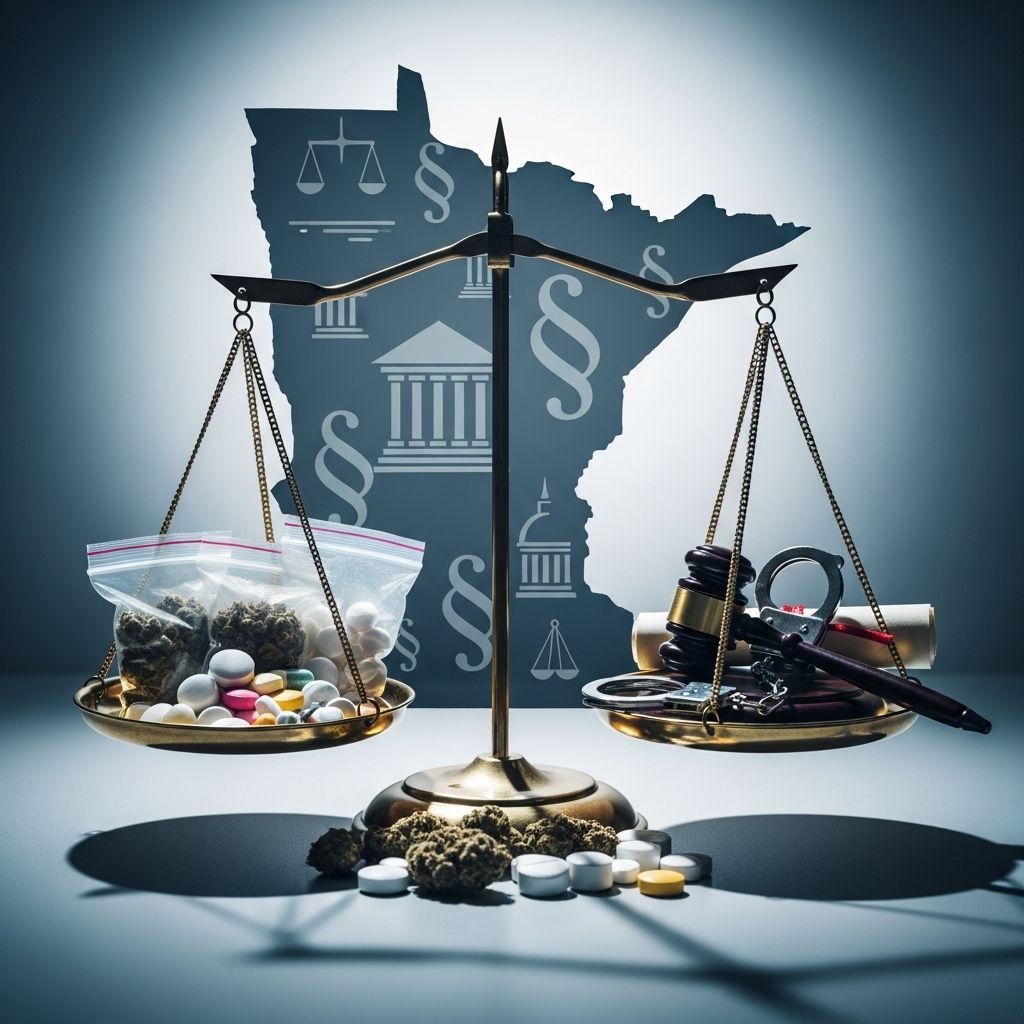
Minnesota has a detailed set of drug laws collected in Chapter 152 of the Minnesota Statutes, which define what counts as a controlled substance, how drugs are classified into schedules, and what penalties apply for possession, sale, or manufacture. If you live in Minnesota, are facing charges, or simply want to understand your rights and obligations, it is important to know the basic structure of these laws and how they are enforced.
This guide explains the core features of Minnesota controlled substance laws in plain language, using the statutes and related state resources as a foundation.
What Minnesota Means by a “Controlled Substance”
Under Minnesota law, a controlled substance is broadly defined as any drug, substance, or immediate precursor that appears in one of the state’s formal schedules (Schedules I through V). These schedules are set out in Minn. Stat. § 152.02.
Key points about controlled substances in Minnesota include:
- They are listed by statute in specific schedules (I–V) based on medical use and abuse potential.
- The definition covers certain analogs (chemically similar substances) that are intended to have effects similar to scheduled drugs.
- Both illegal drugs (like heroin or non-prescribed methamphetamine) and many prescribed medications (like oxycodone or benzodiazepines) are controlled substances when they appear in the schedules.
How Minnesota Classifies Drugs: The Five Schedules
Minnesota divides controlled substances into five schedules, each reflecting the substance’s accepted medical use and potential for abuse. These are formally created in § 152.02.
| Schedule | General Characteristics | Examples (Non-Exhaustive) |
|---|---|---|
| Schedule I | High potential for abuse; no accepted medical use under Minnesota or federal classifications. | Heroin, certain hallucinogens, some synthetic analogs. |
| Schedule II | High abuse potential but with accepted medical uses under strict controls. | Cocaine, methamphetamine, many strong opioid pain medications (e.g., oxycodone). |
| Schedule III | Lower abuse potential than Schedule I or II; accepted medical use. | Some codeine combinations, certain steroids and depressants. |
| Schedule IV | Lower abuse risk than Schedule III; widely used in medicine. | Many anti-anxiety and sleep medications (e.g., some benzodiazepines). |
| Schedule V | Lowest abuse potential; often low-strength preparations containing narcotics. | Cough syrups or medications with very small quantities of controlled ingredients. |
The exact list of substances is technical and includes not only specific drugs but also their salts, isomers, derivatives, and related chemical forms.
Common Controlled Substance Offenses in Minnesota
Most drug-related cases in Minnesota fall into a few broad categories, all governed by Chapter 152:
- Possession of a controlled substance (with or without intent to sell).
- Sale or distribution, which includes giving drugs to someone else, not only selling for money.
- Manufacture or cultivation of controlled substances.
- Prescription-related offenses, such as obtaining controlled medications by fraud or diversion from medical facilities.
Each offense is graded in degrees (first through fifth degree) or as a separate crime, based largely on:
- The schedule and type of controlled substance.
- The weight or number of dosage units involved.
- Whether there was intent to sell or actual distribution.
- Location factors (school or park zones, treatment facilities, correctional facilities).
Degrees of Controlled Substance Crimes: How Serious Is the Charge?
Minnesota organizes most serious drug crimes into five degrees, with first-degree being the most serious and fifth-degree the least. Although the exact thresholds and elements are detailed in multiple sections of Chapter 152, the general pattern is consistent.
First- and Second-Degree Drug Crimes
These are the most severe levels and typically involve:
- Large quantities of controlled substances, especially heroin, cocaine, methamphetamine, or high-dose hallucinogens.
- Evidence of sale, distribution, or intent to sell.
- Aggravating factors such as transactions across county or state borders or multiple separate deals over time.
Convictions can carry lengthy prison terms and large fines, especially when aggravating factors are present under the statute.
Third- and Fourth-Degree Drug Crimes
Middle-degree offenses generally involve:
- Intermediate quantities of controlled substances (e.g., a smaller but still substantial amount of cocaine, methamphetamine, or opioids).
- Possession with intent to sell, often inferred from packaging, cash, or paraphernalia.
- Sales of smaller quantities, especially in cases involving repeat conduct or sensitive locations like schools or parks.
These degrees still constitute felonies and expose a person to significant incarceration and fines.
Fifth-Degree and Lower-Level Offenses
Fifth-degree cases usually involve:
- Possession of smaller amounts of a controlled substance without clear evidence of sale.
- Certain lesser distribution or transfer situations covered explicitly in the statutes.
Although fifth-degree crimes can sometimes be charged as gross misdemeanors under specific circumstances, they are frequently prosecuted as felonies, especially when there is a prior record.
Aggravating Factors That Increase Penalties
Even when the quantity of drugs is relatively modest, Minnesota law provides a list of aggravating factors that can substantially increase the severity of a drug case or justify longer sentences.
Examples of aggravating circumstances under Chapter 152 include:
- The offense was committed for the benefit of a criminal gang.
- The crimes took place in three or more different counties.
- Drugs were transferred across state or international borders into Minnesota.
- The case involves at least three separate transactions in which controlled substances were sold or transferred.
- The manufacturing, possession, or sale occurred in a school zone, park zone, correctional facility, or drug treatment facility.
- The defendant or accomplice had equipment, paraphernalia, documents, or money showing the operation involved substantially larger quantities than the minimum required for the underlying offense.
When such factors are proven, judges may impose higher sentences within the statutory range or apply special penalty enhancements.
Controlled Substances and Prescription Rules
Many controlled substances are also prescription medications. Minnesota strictly regulates how these drugs may be prescribed and dispensed.
Who May Prescribe Controlled Substances
Certain licensed professionals can prescribe controlled substances, including:
- Doctors of medicine and osteopathic medicine.
- Dentists.
- Podiatrists.
- Veterinarians.
They must hold appropriate state licensure and a current registration with the federal Drug Enforcement Administration (DEA) to prescribe Schedule II–IV substances.
Dispensing Schedule II–IV Drugs
Minn. Stat. § 152.11 sets out strict rules for dispensing many controlled substances, especially opioids and other narcotic pain relievers.
- A Schedule II drug generally cannot be dispensed without a valid prescription from an authorized prescriber.
- Prescriptions must include specific information such as the prescriber’s signature, address, DEA number, and the date of issuance.
- There are limits on refills and on how long certain prescriptions remain valid.
Additional Minnesota legislation restricts the quantity and days’ supply for some opioid and narcotic prescriptions to reduce misuse and diversion.
Drug Diversion and Health Care Settings
Drug diversion—when controlled substances are stolen, misused, or redirected from legitimate medical channels—is a serious concern for Minnesota regulators. The Minnesota Department of Health tracks and addresses diversion incidents in medical facilities.
- Commonly diverted substances include hydrocodone, oxycodone, hydromorphone, morphine sulfate, and fentanyl.
- Facilities are expected to maintain strict inventory controls, report thefts and losses, and implement safeguards to protect patients and staff.
When diversion occurs, individuals involved may face both professional discipline and criminal charges under Chapter 152.
Recent Changes and Legislative Trends
Minnesota’s controlled substance laws have been revised multiple times to respond to changing drug trends, public health concerns, and criminal justice priorities.
- The Legislature periodically updates the schedules in
§ 152.02to add new synthetic substances or adjust classifications. - Session laws have modified threshold quantities for certain cocaine and methamphetamine crimes and created new categories for cannabis-related offenses.
- Separate legislation has permitted certain low-potency hemp-derived THC products for adults while keeping higher-THC products tightly controlled under drug laws.
Because of these ongoing changes, it is important to consult the most recent version of Chapter 152 or seek legal advice rather than relying on outdated summaries.
Collateral Consequences of a Drug Conviction
A controlled substance conviction in Minnesota does more than create the possibility of incarceration and fines. It can also have significant long-term consequences, including:
- Loss or restriction of professional licenses in fields like health care, education, or law.
- Eligibility problems for some public benefits or housing programs.
- Immigration issues for non-citizens, including potential removal or inadmissibility.
- Difficulty passing background checks for employment or rental applications.
For these reasons, people facing drug charges should understand not only the statutory penalties but also the broader effects of a conviction on their lives.
Defenses, Mitigation, and Alternatives
Every drug case is different, but several types of arguments and strategies regularly arise in Minnesota controlled substance prosecutions:
- Challenging the search or seizure – If officers lacked lawful grounds to stop, search, or detain a person, evidence may be suppressed under constitutional protections.
- Disputing possession – The state must show the defendant knowingly possessed or controlled the substance; this can be contested in cases involving shared spaces or vehicles.
- Questioning intent to sell – Prosecutors sometimes infer intent from packaging or cash; the defense may argue the drugs were for personal use.
- Testing and weight issues – Lab analysis must confirm the substance and its weight or dosage; errors or contamination can affect the degree of the charge.
- Treatment and diversion programs – In some cases, courts may consider treatment, probation, or specialty court programs instead of or in addition to incarceration, especially for people with substance use disorders.
Legal advice is essential to evaluate which of these strategies, if any, may apply in a particular situation.
Practical Tips if You Are Facing a Controlled Substance Charge
- Do not ignore court paperwork. Missing a court date can lead to additional warrants and charges.
- Speak with a qualified attorney who understands Minnesota drug law and sentencing practices under Chapter 152.
- Gather documents such as prescriptions, medical records, or treatment history if they are relevant to the case.
- Avoid discussing the case on social media or with anyone other than your lawyer; statements can be used as evidence.
- Explore treatment options if substance use is an ongoing issue, as genuine efforts at recovery can influence outcomes in some courts.
Frequently Asked Questions About Minnesota Controlled Substance Laws
Q1: Are prescription pain medications considered controlled substances in Minnesota?
Yes. Many pain medications, especially opioids like hydrocodone, oxycodone, and morphine, are listed in the controlled substance schedules and are tightly regulated. They can only be dispensed with a valid prescription from a properly licensed prescriber.
Q2: Is possession of a small amount of drugs always a felony?
Not always, but many controlled substance possession cases are charged as felonies. The outcome depends on the type and quantity of the substance, prior criminal history, and whether there is evidence of sale or intent to sell. Fifth-degree offenses may sometimes be handled at a lower level, but this is highly fact-specific.
Q3: How does Minnesota treat marijuana and hemp-derived THC products?
Minnesota has modified its approach to cannabis over time, including authorizing medical cannabis and allowing certain low-potency hemp-derived THC edibles and drinks for adults under separate laws. However, high-THC products and unauthorized possession or sale can still result in controlled substance charges depending on the amount and context, and the statutory framework continues to evolve.
Q4: What makes a drug case “aggravated” under Minnesota law?
Aggravating factors under Chapter 152 include conduct such as committing the offense for the benefit of a gang, carrying out multiple transactions across several counties, importing drugs from out of state, or dealing in school, park, or treatment facility zones. When proven, these factors can justify more severe penalties.
Q5: Where can I read the official Minnesota drug statutes?
The complete text of Minnesota’s controlled substance laws is available in Chapter 152 of the Minnesota Statutes, which can be accessed for free on the Minnesota Office of the Revisor of Statutes website. This includes detailed definitions, schedules, and penalty provisions.
References
- Chapter 152 – Drugs; Controlled Substances — Minnesota Office of the Revisor of Statutes. 2024-01-01. https://www.revisor.mn.gov/statutes/cite/152
- Minn. Stat. § 152.02 – Schedules of Controlled Substances — Minnesota Office of the Revisor of Statutes. 2024-01-01. https://www.revisor.mn.gov/statutes/cite/152.02
- Minn. Stat. § 152.11 – Prescription Requirements for Controlled Substances — Minnesota Office of the Revisor of Statutes. 2024-01-01. https://www.revisor.mn.gov/statutes/cite/152.11
- Controlled Substances – Research Guide — Minnesota State Law Library. 2024-06-01. https://mncourts.libguides.com/controlled-substances
- Controlled Substances and Drug Diversion — Minnesota Department of Health. 2023-09-15. https://www.health.state.mn.us/facilities/patientsafety/drugdiversion/index.html
- Laws Affecting People Who Use Drugs — Minnesota Department of Health. 2022-03-01. https://www.health.state.mn.us/people/syringe/ssplaws.pdf
- Minnesota Session Laws 2024 – Chapter 121 (HF 4757 and related) — Minnesota Legislature. 2024-05-24. https://mncourts.libguides.com/controlled-substances/mnsessionlaws2024
Similar Articles








Read full bio of medha deb


