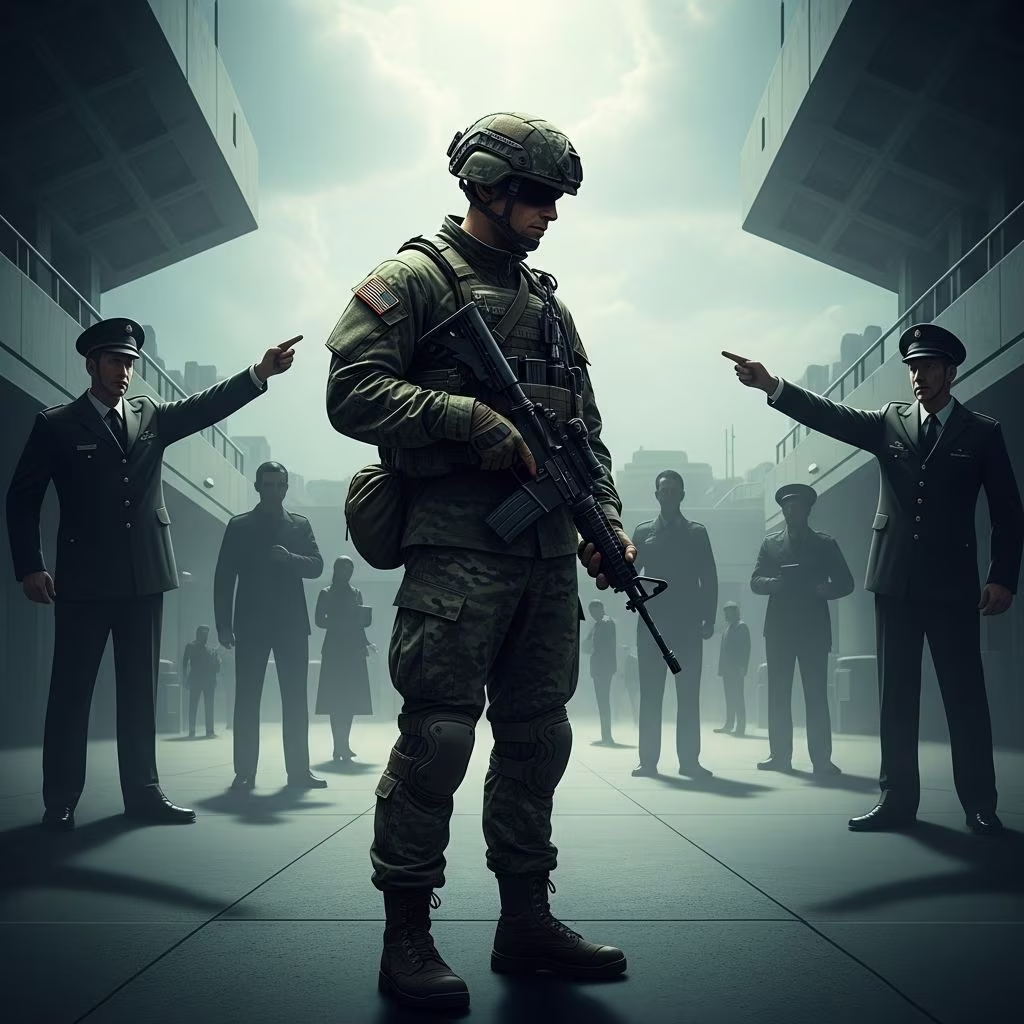
The U.S. military demands strict adherence to the chain of command, yet this obedience is not absolute. Service members bear a profound legal responsibility to refuse directives that are clearly illegal, a principle enshrined in both domestic military law and global standards. This duty safeguards ethical conduct, protects against war crimes, and upholds constitutional values during operations.
Foundational Principles of Obedience in the Armed Forces
Discipline forms the bedrock of military effectiveness, with the Uniform Code of Military Justice (UCMJ) mandating compliance with lawful orders. Article 92 UCMJ explicitly criminalizes failure to obey any lawful general order, regulation, or directive tied to military duty. This creates a clear expectation: personnel must follow instructions from superiors unless those instructions cross into illegality.
However, the law presumes all orders are lawful, placing the onus on the recipient to prove otherwise. This presumption maintains operational efficiency, as split-second decisions in combat cannot hinge on prolonged debate. Only orders that are manifestly unlawful—obvious violations apparent to any reasonable person—trigger the duty to disobey.
Defining Manifestly Unlawful Orders
An order qualifies as manifestly unlawful if it demands actions that contravene the U.S. Constitution, federal statutes, international treaties, or inherent moral standards recognized in military doctrine. The Manual for Courts-Martial (MCM) Rule 916(d) clarifies that obedience to such orders offers no defense if the individual knew or should have known of their illegality.
Common categories include:
- Directing harm to non-combatants, such as intentional civilian targeting.
- Authorizing torture, cruel treatment, or inhumane interrogation methods like waterboarding.
- Requiring falsification of reports, evidence tampering, or cover-ups of misconduct.
- Ordering engagement in unauthorized domestic policing or political interference.
These examples stem from established case law and executive guidance, emphasizing that no rank shields the giver from accountability.
UCMJ Articles Governing Obedience and Disobedience
The UCMJ delineates specific offenses related to orders, balancing punishment for insubordination with protections against illegality. Here’s a breakdown:
| Article | Description | Key Punishments | Applies To |
|---|---|---|---|
| Article 90 | Willful disobedience of a superior commissioned officer’s lawful command. | Confinement, forfeiture of pay, dishonorable discharge (severe in wartime). | Enlisted to officers. |
| Article 91 | Insubordination toward warrant officers, NCOs, or petty officers. | Reduction in rank, confinement, bad-conduct discharge. | Enlisted personnel. |
| Article 92 | Failure to obey lawful general orders, regulations, or dereliction of duty. | Court-martial directed punishment, including punitive discharges. | All service members. |
These provisions underscore that lawful orders must be followed, but refusal of unlawful ones is not only permitted but obligatory.
Historical Foundations: From Nuremberg to Modern Doctrine
The post-World War II Nuremberg Trials crystallized the rejection of the “superior orders” defense. Prosecutors established that individuals retain personal responsibility for atrocities, even under command pressure, provided a moral choice existed. This principle permeates U.S. military law today, as affirmed in the MCM and appellate rulings.
In the Vietnam-era My Lai massacre prosecutions, U.S. courts reinforced that manifestly illegal orders—like massacring civilians—offer no impunity. Lieutenant William Calley’s conviction highlighted accountability, though commutation debates illustrated tensions between discipline and justice.
More recently, detainee abuse scandals at Abu Ghraib invoked these standards, with courts-martial upholding liability for both perpetrators and enablers despite claims of following orders.
Practical Scenarios: Recognizing and Responding to Illegality
In high-stakes environments, distinguishing lawful from unlawful requires training and judgment. Consider these hypotheticals grounded in real precedents:
- Combat Zone Directive: An order to fire on surrendering enemy combatants violates Geneva Conventions and UCMJ Article 99 (misbehavior before the enemy). Refusal is mandatory.
- Interrogation Order: Commands for enhanced techniques breaching Army Field Manual 2-22.3 demand immediate halt and reporting.
- Administrative Task: Falsifying readiness reports contravenes Article 107 (false official statements), warranting disobedience.
Service members should first seek clarification if ambiguity exists, then escalate via the chain of command or Inspector General if concerns persist. Documentation is crucial for post-incident defense.
Risks and Protections for Those Who Refuse
Refusing an order—even a manifestly unlawful one—carries immediate risks: administrative sanctions, career derailment, or courts-martial if the order is later deemed lawful. A military judge determines legality, not a jury, heightening stakes.
Yet protections exist. 10 U.S.C. § 1034 shields whistleblowers reporting unlawful orders from reprisal. Boards like the Board for Correction of Military Records (BCMR) offer remedies for wrongful punishment. Successful refusals have led to exonerations, affirming the system’s checks.
Commanders issuing unlawful orders face graver consequences: direct liability for crimes (e.g., Article 93 maltreatment), dereliction under Article 92, or conduct unbecoming (Article 133).
Training and Ethical Imperatives for Military Professionals
Military ethics training emphasizes moral autonomy. Officers, bound by oaths to the Constitution, must weigh orders against national interests and subordinate welfare. Dissent is justified when obedience risks institutional harm outweighing benefits, such as needless casualties or mission failure.
Leaders foster climates encouraging ethical challenges without fear. Annual Law of Armed Conflict instruction reinforces these duties, preparing troops for real-world dilemmas.
Frequently Asked Questions (FAQs)
What constitutes a manifestly unlawful order?
A directive obviously illegal, like ordering civilian harm or torture, known or obvious to a reasonable person. All orders are presumed lawful otherwise.
Can personal beliefs justify disobeying a lawful order?
No; conscience, religion, or philosophy cannot excuse lawful commands.
What if I’m unsure about an order’s legality?
Seek clarification from the issuer or superior, then comply unless manifestly illegal. Report suspicions through proper channels.
Who decides if an order was unlawful after refusal?
A military judge in courts-martial proceedings.
Are there protections for whistleblowers?
Yes, under 10 U.S.C. § 1034, with appeal options via BCMR.
Broader Implications for National Security and Accountability
This framework prevents abuses that erode public trust and international standing. By mandating refusal of illegal acts, the U.S. military aligns with democratic principles, ensuring forces remain instruments of just policy rather than blind executors. Ongoing reforms in training and oversight continue to refine this balance, adapting to evolving threats like cyber operations or hybrid warfare where unlawful temptations may arise.
In sum, while obedience ensures cohesion, the duty to disobey unlawful orders preserves the military’s moral core. Service members equipped with knowledge of UCMJ, precedents, and reporting mechanisms can navigate these challenges effectively, protecting themselves, their units, and the nation.
References
- Under both U.S. military law and international standards, service members are legally required to refuse unlawful orders — Law Offices of David P. Sheldon. 2023. https://www.militarydefense.com/tag/military-duty-to-disobey/
- ORDERS: lawful and illegal — Court-Martial.com. Accessed 2026. https://www.court-martial.com/orders-lawful-and-illegal/
- When Can a Soldier Disobey an Order? — War on the Rocks. 2017-07-01. https://warontherocks.com/2017/07/when-can-a-soldier-disobey-an-order/
- Explainer: Can military members refuse orders? — ABC News. 2024. https://abcnews.go.com/Politics/explainer-military-members-refuse-orders/story?id=127865412
- CORE CRIMINAL LAW SUBJECTS: Crimes: Article 91 — U.S. Army Court of Criminal Appeals. Accessed 2026. https://www.armfor.uscourts.gov/digest/IIIA15.htm
- Breaking Ranks: Dissent and the Military Professional — U.S. Army. 2013-10-21. https://www.army.mil/article/47175/breaking_ranks_dissent_and_the_military_professional