
Military Limits in U.S. Border Law Enforcement
Examining the boundaries of military operations in domestic border security.
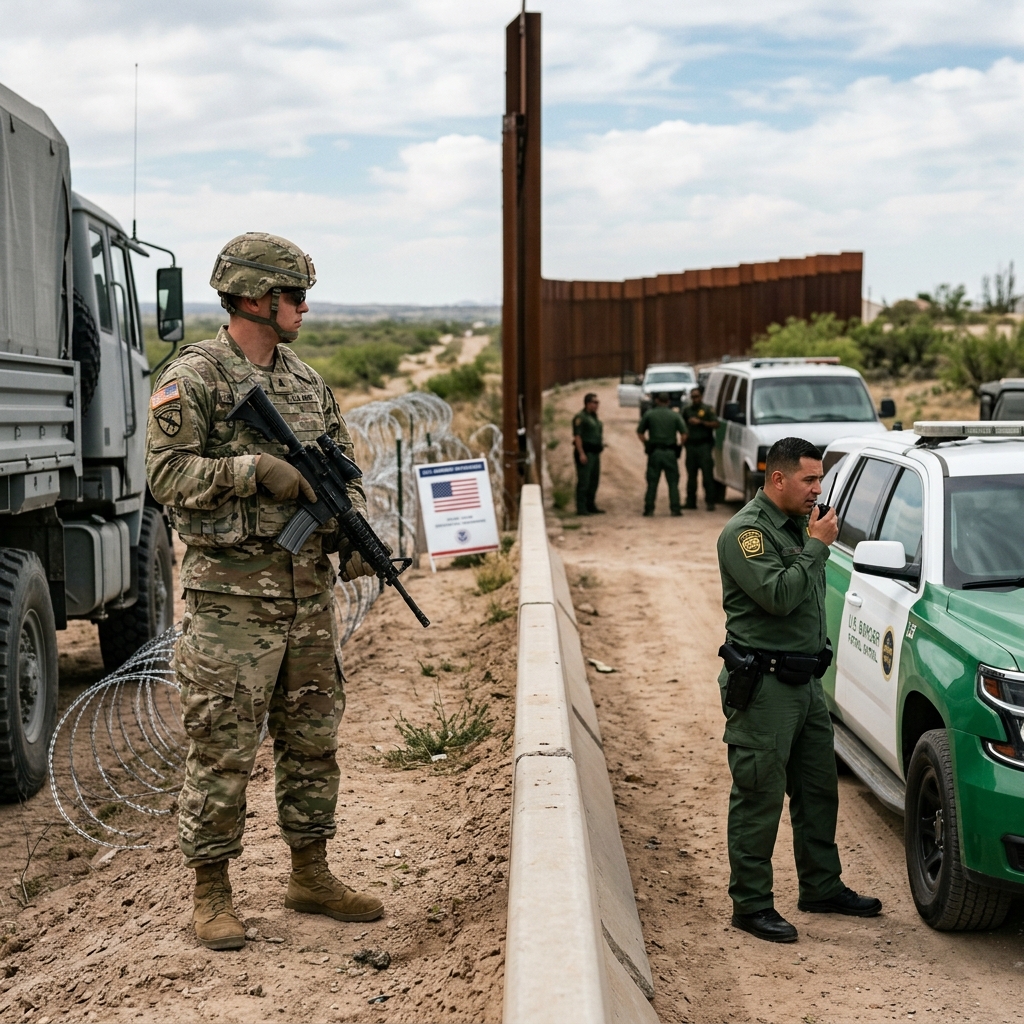
The Line Between Defense and Enforcement: Evaluating Military Involvement in Border Security
The geographic boundaries of the United States are highly complex regions that require a delicate balance of national security, international commerce facilitation, and the preservation of civil liberties for millions of daily commuters. Over the past few decades, the political conversation surrounding border management has grown increasingly contentious. This environment has led to policies that heavily rely on the active-duty military and the National Guard to bolster security efforts along the borders. While the United States armed forces possess unparalleled logistical capabilities, aerial surveillance assets, and operational discipline, deploying them to execute tasks traditionally reserved for civilian law enforcement agencies raises profound constitutional alarms. Actions such as initiating routine traffic stops, checking civilian immigration documents, or physically searching vehicles cross a critical boundary. This practice blurs the historical line between military defense against foreign adversaries and domestic policing of civilian populations. This comprehensive analysis explores the foundational legal frameworks that intentionally separate the military from civilian law enforcement, the distinct statutory authorities granted to border agencies, and the severe implications of allowing military personnel to engage in direct policing actions.
The Foundation of Domestic Law Enforcement
Defining the Boundaries: The Posse Comitatus Act
At the very core of the American legal system lies a deeply ingrained philosophy that strictly forbids the federal military from operating as a domestic police force. The primary legal vehicle ensuring this separation is the Posse Comitatus Act of 1878. Enacted during the post-Civil War Reconstruction era, the Act generally prohibits the direct use of the U.S. Army and Air Force in executing domestic laws. The Navy and Marine Corps are subject to identical restrictions through comprehensive Department of Defense (DoD) regulations. The fundamental rationale behind this separation is that military forces are uniquely trained for combat—specifically, the application of overwhelming and lethal force to defeat an enemy. In stark contrast, domestic law enforcement is theoretically designed to maintain public order, protect constitutional rights, and utilize the absolute minimum force necessary to de-escalate situations. Allowing the military to enforce civilian laws introduces a dangerous combat paradigm into domestic civilian spaces, which inherently threatens civil liberties.
The Importance of Civilian Authority
Maintaining clear civilian control over domestic policing is a non-negotiable cornerstone of a functioning democracy. When military personnel are injected into routine law enforcement roles, the inherent power dynamics between the state and the individual shift dramatically. Civilians interacting with the government are constitutionally guaranteed certain protections, including the presumption of innocence, the right to due process, and the right to be free from unreasonable searches and seizures. A militarized policing environment fundamentally alters how border communities interact with the government, often fostering a climate of intimidation rather than genuine safety. Furthermore, soldiers are generally not trained in the complex nuances of domestic criminal procedure, the intricate limits of probable cause, or the delicate de-escalation tactics required during civilian encounters. Their deployment into domestic policing roles is a mismatch of training, mandate, and constitutional authority.
Customs and Border Protection (CBP) vs. Military Deployment
The Statutory Role of Border Agents
To fully comprehend why military personnel must not conduct vehicle searches or identity checks, it is essential to distinguish their restricted role from the expansive authority of U.S. Customs and Border Protection (CBP). CBP operates under precise statutory authorities granted by Congress. These powers are primarily located in Title 8 of the United States Code, which regulates immigration and nationality, and Title 19, which governs customs duties and international trade. These specific federal statutes empower designated, civilian CBP agents to conduct immigration inspections, examine commercial cargo, and, under specific legal conditions, search vessels and vehicles at the border. Border Patrol agents undergo rigorous, specialized training academies focused exclusively on immigration statutes, civil rights law, and the parameters of the Fourth Amendment as they apply to unique border enforcement environments.
How Military Support Operates in Theory
When the Department of Defense deploys troops to the southern or northern borders, their role is legally constrained to providing logistical, administrative, and technological support. Under the framework of 10 U.S.C. Chapter 15, which outlines military support for civilian law enforcement agencies, and Department of Defense Instruction (DoDI) 3025.21, military personnel are authorized to assist civilian agencies strictly in non-confrontational capacities. Authorized tasks include maintaining fleet vehicles, analyzing remote surveillance footage, operating aerial drones to spot unauthorized crossings, and constructing or repairing physical barriers. The critical legal distinction is that these permissible support roles absolutely do not involve direct, face-to-face enforcement encounters with civilians. The military’s presence is intended solely to handle backend logistical burdens, thereby freeing up highly trained civilian CBP agents to perform the actual, public-facing law enforcement duties on the frontline.
When Support Crosses the Line: Direct Enforcement
Traffic Stops, Document Checks, and Searches
Constitutional friction rapidly ignites when the legal boundaries of ‘logistical support’ are breached, and military personnel find themselves engaging directly with the public in an enforcement capacity. There have been documented, concerning incidents where armed service members, rather than authorized civilian agents, have approached civilian vehicles, demanded identification, and conducted physical searches of personal property. Such actions directly violate the foundational principles of the Posse Comitatus Act and specific DoD directives limiting military cooperation with civilian law enforcement. A service member in full combat uniform demanding travel documents or rummaging through the trunk of a civilian vehicle on a public American highway is a severe departure from established domestic legal norms. Military personnel possess no statutory authority to temporarily detain civilians, interrogate them regarding their immigration status, or execute physical searches of their personal belongings.
Implications for the Fourth Amendment
The Fourth Amendment of the U.S. Constitution protects all individuals within the United States against unreasonable searches and seizures by government actors. While federal courts have historically recognized a ‘border search exception’ that grants CBP agents significantly broader latitude to conduct warrantless searches at international boundaries and their functional equivalents, this powerful legal exception is exclusively granted to authorized civilian agents enforcing specific customs and immigration laws. It absolutely does not grant carte blanche to the Department of Defense. When a military member conducts a physical search or seizes property, they bypass the intricate constitutional safeguards and legal accountability structures painstakingly built around domestic civilian law enforcement. This renders any such search highly invasive, legally precarious, and vulnerable to severe civil rights challenges in federal court.
The Human and Constitutional Cost
Impact on Border Communities
Beyond abstract legal and constitutional theories, the physical presence of armed military personnel conducting ad-hoc police work has a tangible, often highly detrimental, impact on border communities. The border region is not merely a barren security zone; it is a vibrant, interconnected environment where millions of people live, attend school, and conduct cross-border commerce daily. Injecting combat-equipped military units into the daily lives of these civilian residents creates an undeniable atmosphere of intimidation and suspicion. Routine commutes to work or trips to the grocery store can become fraught with anxiety when residents are unexpectedly confronted by soldiers rather than local police or recognized CBP agents. This militarization deeply disrupts the social and economic fabric of border cities, risking the dangerous normalization of a state resembling martial law in peacetime America.
Accountability and Legal Recourse
Perhaps the most dangerous aspect of utilizing the military for domestic policing operations is the severe lack of legal accountability for civilians whose rights are violated. If a civilian CBP agent conducts an unconstitutional search or utilizes excessive force, civilians have established, albeit complex, legal pathways to seek justice. This includes filing civil rights lawsuits, such as Federal Tort Claims Act (FTCA) claims or Bivens actions, against the individual agents or the federal agency. Military personnel, however, operate entirely outside this framework. They are governed by the Uniform Code of Military Justice (UCMJ) and are heavily shielded from civil liability when acting under official military orders. This dynamic creates an alarming accountability vacuum, leaving innocent civilians with virtually no viable mechanism to seek redress for constitutional violations committed by soldiers operating on domestic soil.
Historical Precedents and Policy Shifts
The debate over border militarization is not an entirely new phenomenon; however, the scope and nature of military deployments have shifted dramatically across different presidential administrations. While providing heavy military hardware, aircraft, and surveillance support to CBP has been a bipartisan practice for several decades, recent policy shifts have increasingly pushed the limits of these deployments. Modern operations occasionally place troops dangerously close to direct civilian interaction, testing the absolute limits of the Posse Comitatus Act. Ensuring that the military remains strictly in a background support capacity requires constant congressional oversight and a firm executive commitment to respecting domestic legal boundaries.
| Permissible DoD Support Roles | Prohibited Direct Enforcement Actions |
|---|---|
| Operating aerial surveillance equipment (drones, helicopters). | Conducting physical searches of civilian vehicles or property. |
| Providing vehicle maintenance and logistical transportation for CBP. | Detaining or arresting civilians suspected of immigration violations. |
| Constructing physical barriers or clearing access roads. | Demanding identification or travel documents from commuters. |
| Data analysis and intelligence sharing with civilian agencies. | Conducting interrogations or acting as undercover informants. |
Reassessing Security Policies for the Future
Achieving true and lasting border security does not require the sacrifice of foundational constitutional principles or the militarization of civilian spaces. Policymakers must rigorously reassess current enforcement strategies by prioritizing investments in modernizing official ports of entry, deploying advanced, non-intrusive scanning technology, and ensuring that civilian law enforcement agencies like CBP are adequately staffed, funded, and trained. Relying on the armed forces as a stopgap measure for civilian law enforcement duties not only stretches vital national defense resources thin but fundamentally undermines the civil liberties that the government is sworn to protect. A secure and functional national border is fully compatible with a strict adherence to the rule of law and the absolute preservation of civilian authority over domestic affairs.
Frequently Asked Questions (FAQ)
- What is the Posse Comitatus Act?
The Posse Comitatus Act is a foundational United States federal law enacted in 1878 that generally prohibits the use of the federal active-duty military to execute domestic laws. It was designed to ensure that domestic law enforcement is handled exclusively by civilian agencies rather than armed combat forces. - Can the U.S. military search civilian vehicles at the border?
No. Military personnel deployed to the border do not possess the statutory or constitutional authority to conduct physical searches of civilian vehicles, demand immigration documents, or detain individuals. These law enforcement tasks are legally reserved for trained civilian officers, such as CBP agents. - What is the difference between Title 10 and Title 32 military deployments?
Title 10 refers to federal active-duty military personnel operating under the direct command of the President, who are strictly bound by the Posse Comitatus Act. Title 32 refers to National Guard units operating under the command of state governors. While state-controlled guardsmen have slightly different operational parameters, Department of Defense policies still heavily restrict them from participating in direct civilian law enforcement actions. - Who has the legal authority to enforce border laws?
U.S. Customs and Border Protection (CBP), an agency operating within the Department of Homeland Security, has the primary legal authority to enforce border and customs laws. Under Title 8 and Title 19 of the U.S. Code, CBP civilian agents are strictly authorized to conduct immigration inspections and examine international cargo.
References
- DoDI 3025.21: Defense Support of Civilian Law Enforcement Agencies — U.S. Department of Defense. 2013-02-27. https://www.esd.whs.mil/Portals/54/Documents/DD/issuances/dodi/302521p.pdf
- DoD Directive 5525.5: DoD Cooperation with Civilian Law Enforcement Officials — U.S. Department of Defense. 1986-01-15. https://irp.fas.org/doddir/dod/d5525_5.htm
- 10 U.S.C. Chapter 15 – Military Support for Civilian Law Enforcement Agencies — Office of the Law Revision Counsel. 2024-01-01. https://uscode.house.gov/view.xhtml?path=/prelim@title10/subtitleA/part1/chapter15&edition=prelim
- Title 19 of the CFR — Customs Duties — Electronic Code of Federal Regulations (eCFR). 2024-05-01. https://www.ecfr.gov/current/title-19
- Border Searches of Electronic Devices at Ports of Entry — U.S. Department of Homeland Security. 2024-11-26. https://www.dhs.gov/sites/default/files/2024-12/24_1126_cbp_border_searches_of_electronic_devices_at_poes.pdf
Similar Articles








Read full bio of medha deb




