Michigan Power of Attorney: Legal Requirements & Execution
Complete guide to Michigan POA requirements, execution standards, and agent responsibilities under the updated UPOAA.
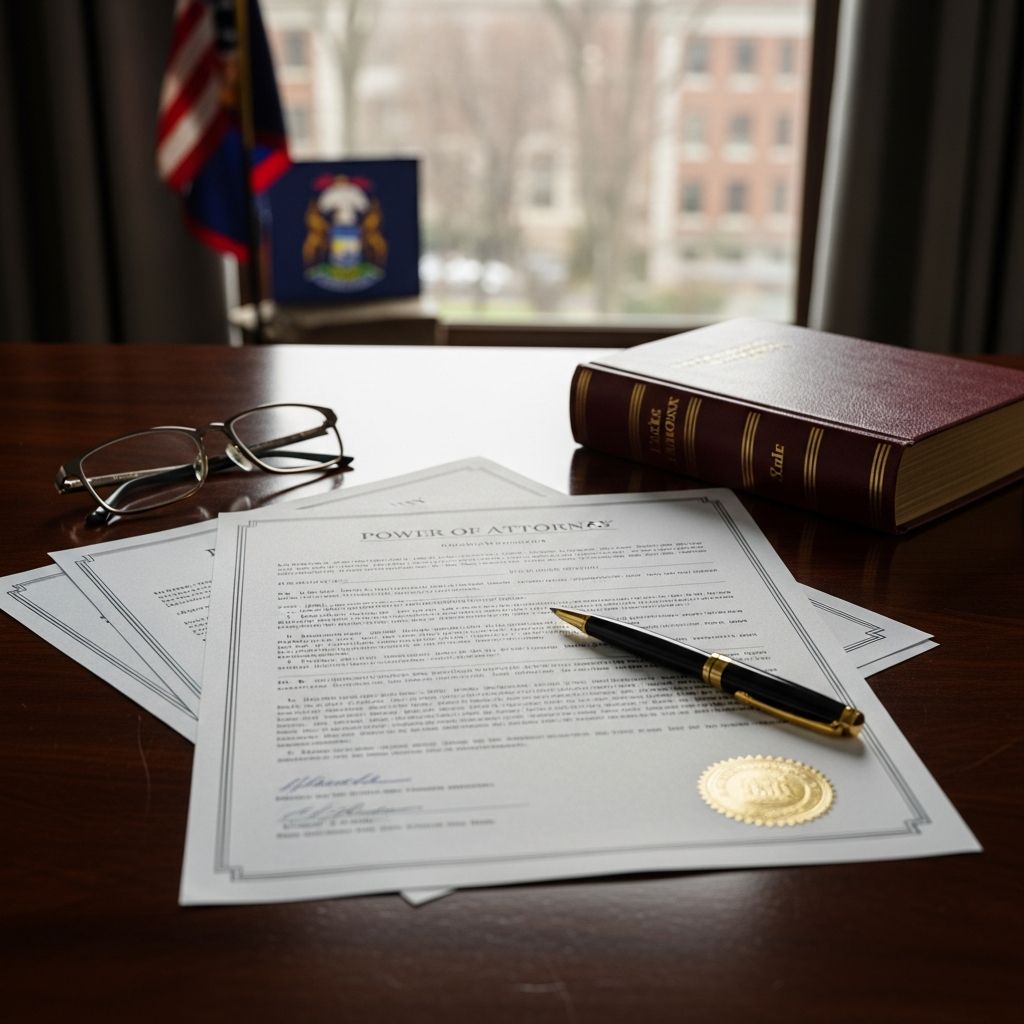
Understanding Power of Attorney in Michigan
A power of attorney (POA) is a legal instrument that enables one person to grant decision-making authority to another person, known as an agent or attorney-in-fact. In Michigan, this document has become increasingly important as part of comprehensive estate and financial planning. The state recognizes two primary categories of power of attorney: those dealing with financial and legal matters, and those addressing healthcare decisions. This guide focuses on financial and legal powers of attorney, which allow your designated representative to manage monetary affairs and conduct business transactions on your behalf.
Michigan significantly modernized its approach to powers of attorney by adopting the Uniform Power of Attorney Act (UPOAA), with changes becoming effective on July 1, 2024. These updates standardize requirements across the state and align Michigan with the frameworks used in numerous other states, creating a more predictable legal environment for both principals and third parties who must evaluate and accept these documents.
Fundamental Requirements for Creating a Valid Power of Attorney
Before executing a power of attorney in Michigan, you must satisfy certain foundational criteria. The law requires that you be at least 18 years of age and possess the legal and mental capacity to understand the implications of the document you are creating. Capacity means you comprehend that the POA transfers decision-making power to another person, understand what specific decisions your agent will be able to make, and recognize how these delegated powers might affect your personal and financial interests.
The concept of capacity is central to POA validity. Michigan law emphasizes that you must fully grasp the nature and consequences of your actions at the moment of signing. This requirement protects against exploitation and ensures that the document reflects your genuine intentions rather than the result of coercion or diminished understanding.



The Future of AI: Preventing a Big Tech Monopoly >

Execution Standards and Documentation Procedures
Michigan’s updated standards for executing a power of attorney represent a significant evolution in the state’s legal framework. Your signature on the POA document must be authenticated through one of two methods: notarization or witnessing by two individuals. This dual-path approach provides flexibility while maintaining document integrity and helping prevent fraud.
When choosing the notarization route, you must appear before a Michigan-licensed notary public who will verify your identity and witness your signature. The notary then affixes their official seal and signature to the document, creating an official record that the document was executed in their presence.
Alternatively, if you opt for witness authentication, you must sign the document in the presence of two witnesses who are not the agent you are designating and who have no financial interest in the document’s execution. Both witnesses must then add their own signatures, certifying that they observed you sign the document and that you appeared to possess the necessary capacity.
Michigan law now requires that powers of attorney be prepared in English to facilitate universal acceptance by third parties. This language requirement ensures that financial institutions, healthcare providers, and other entities can readily understand and evaluate the document’s contents without requiring translation services.
Defining Agent Powers and Scope of Authority
One of the most important decisions in creating a power of attorney involves determining precisely which powers you wish to grant your agent. Michigan law recognizes that principals need not transfer all decision-making authority; instead, you can select specific powers from a comprehensive menu of available options.
The official Michigan power of attorney form includes checkboxes that allow you to customize your agent’s authority. You might authorize your agent to handle banking and financial account transactions while withholding authority over real estate matters. Alternatively, you could grant broad authority across multiple categories. Common powers you can delegate include:
- Managing bank accounts and conducting financial transactions
- Handling securities and investment accounts
- Making decisions regarding real property
- Conducting business operations related to a company or partnership
- Filing and managing tax documents and filings
- Managing government benefits and retirement accounts
- Accessing electronic communications and digital accounts
- Exercising authority over foreign financial accounts
This granular approach to authority delegation ensures that you retain maximum control over what decisions your agent can make. You are not required to grant comprehensive authority simply because you trust the individual; instead, you can tailor the delegation to your specific circumstances and comfort level.
The Durable Power of Attorney Framework
Michigan law establishes that a power of attorney is presumed to be durable unless the document explicitly states otherwise. A durable power of attorney continues to remain effective even if the principal becomes incapacitated, mentally incompetent, or unable to manage their affairs. This durable quality is what makes the document particularly valuable for long-term planning.
Without durable language, a POA would terminate the moment you became incapacitated, which is precisely when you would most need someone to manage your affairs. By contrast, a durable POA maintains its force through your incapacity, allowing your agent to continue managing financial matters on your behalf without the need for court intervention through guardianship or conservatorship proceedings.
If you wish to create a non-durable power of attorney that terminates upon your incapacity, you must explicitly include language stating this limitation. Such non-durable documents are less common and are typically used for limited, temporary purposes rather than comprehensive estate planning.
Agent Responsibilities and Fiduciary Duties
Under Michigan’s updated law, agents assume significant legal responsibilities when they accept authority under a power of attorney. The law imposes strict fiduciary duties on agents, meaning they must prioritize your interests above their own and act with the highest standards of honesty and care.
Specific agent duties include:
- Acting solely in the principal’s best interest and avoiding conflicts of interest
- Maintaining detailed, accurate records of all transactions conducted on the principal’s behalf
- Disclosing actions and decisions to the principal or designated third parties upon request
- Avoiding commingling of principal and agent funds unless expressly authorized
- Providing transparency regarding the use of the principal’s assets
- Declining to accept any benefit or compensation beyond what was authorized in the POA document
These duties exist to prevent abuse and ensure that agents use their authority responsibly. An agent who violates these fiduciary duties can be held liable for damages and may face removal by a court. The transparency requirements are particularly important; agents cannot simply take actions and keep them private. Upon request, they must account for their activities and explain how they have managed the principal’s affairs.
Formal Acceptance of Agent Authority
Under Michigan’s revised framework, an agent must formally acknowledge acceptance of the delegated authority in writing before taking any action on behalf of the principal. This acknowledgment serves several purposes: it confirms that the agent understands their responsibilities, demonstrates that they voluntarily accept the role, and creates a clear record of when the agent’s authority became active.
The written acceptance requirement prevents situations where someone is named as an agent without their knowledge or consent. It also allows agents to decline the responsibility if they feel unable or unwilling to fulfill the fiduciary duties the role entails. Once an agent formally accepts, they become subject to all applicable legal duties and responsibilities.
Termination and Revocation of Powers of Attorney
A power of attorney may terminate under several circumstances. The primary grounds for termination include:
- The principal’s death
- Revocation by the principal while they retain capacity
- Court order
- The agent’s resignation or death
- The agent’s own incapacity
- Expiration of a time period specified in the document, if applicable
You retain the right to revoke your power of attorney at any time as long as you possess legal capacity to do so. Revocation must be executed in writing, and you should provide copies to your agent, relevant financial institutions, and any other parties who may have relied on the POA. Failure to notify relevant parties of revocation can create complications if your agent continues to act after revocation and third parties remain unaware of the document’s termination.
Alternatively, you might specify in the original POA document that the agent’s authority will terminate on a particular date or upon the occurrence of a specific event. This approach provides predetermined termination without requiring a separate revocation document.
Third-Party Acceptance and Legal Protections
One of the most significant improvements in Michigan’s 2024 revisions addresses how third parties must treat valid powers of attorney. Banks, investment firms, healthcare providers, insurance companies, and other entities can no longer arbitrarily refuse to accept a properly executed POA simply because they prefer different documentation or have internal policies favoring guardianship alternatives.
Michigan law now provides robust protections for principals by establishing that third parties must accept a notarized power of attorney prepared in English, unless they have a legitimate reason to believe the document is invalid or has been revoked. Legitimate reasons for refusing a POA are limited and might include knowledge that the principal has passed away, actual knowledge that the principal revoked the document, or credible evidence of fraud.
If a third party unreasonably refuses to accept a valid POA, they may be held liable for damages caused by their refusal, and a court can order them to accept the document and pay your legal fees associated with enforcement. This protection encourages third parties to cooperate with agents who present properly executed documents, reducing delays and frustration.
When a third party has genuine questions about a POA’s validity, Michigan law provides a reasonable accommodation period. The third party may take up to seven days to consult with an attorney or request a certified statement from the agent before deciding whether to accept the document.
Official Michigan Power of Attorney Forms
Michigan has developed an official power of attorney form that serves as a standardized template for the state. This form, prepared by the Kimble Center for Legal Drafting at Cooley Law School, includes fillable sections, explanatory language, and comprehensive checkbox options for different powers. Using the official form provides several advantages: it is more likely to be accepted by third parties since they recognize it as complying with Michigan standards, it reduces the risk of inadvertently omitting important legal language, and it is often available free or at minimal cost.
The official form is available in both fillable digital format and paper versions. Many individuals choose to complete the form themselves, while others work with an attorney to ensure their specific circumstances and wishes are properly reflected in the document.
Comparing Powers of Attorney and Alternative Planning Tools
| Planning Tool | Effective Period | Requires Court Involvement | Best Used For |
|---|---|---|---|
| Durable Power of Attorney | Immediately and through incapacity | No | Financial management and decision-making delegation |
| Guardianship | From court order forward | Yes | When no POA exists or principal lacks capacity to grant one |
| Conservatorship | From court order forward | Yes | Protecting assets when no POA exists |
| Advance Directive | When principal cannot make healthcare decisions | No | Healthcare decision-making and end-of-life preferences |
Practical Implementation and Best Practices
Creating an effective power of attorney requires thoughtful consideration of multiple factors. Begin by identifying someone you trust implicitly—this person will have significant authority over your financial and legal affairs. Have frank conversations with your prospective agent about their willingness to serve and their understanding of the responsibilities involved.
Document your wishes clearly in the POA itself. If certain powers are particularly important or sensitive, you might consider creating multiple POAs for different purposes, allowing you to delegate authority more precisely. For example, you might create one POA for real estate matters, another for business operations, and a third for general financial management.
Keep your POA in a safe location where your agent can access it when needed. Provide copies to relevant financial institutions and healthcare providers before you need them, so they are already familiar with the document and your agent’s authority. This proactive approach minimizes delays if your agent needs to act urgently.
Review your POA periodically, particularly if your circumstances change, you move to a different state, or if significant changes occur in Michigan law. A document that was appropriate when your children were young might need revision as they age and your financial situation evolves.
Frequently Asked Questions
Q: Can I create a power of attorney that becomes effective only if I become incapacitated?
A: Yes. This is called a springing power of attorney, though Michigan law presumes POAs are immediately effective unless you specify otherwise. You can include language requiring that the POA only become active upon a specific event, such as a physician certifying your incapacity. However, be aware that springing POAs can create complications because third parties must verify that the triggering event has occurred before accepting the agent’s authority.
Q: What happens to my power of attorney after I pass away?
A: Your power of attorney terminates automatically upon your death. Your agent no longer has authority to act on your behalf. For matters requiring continued management after your death, your estate will need to go through probate or be handled through other estate planning mechanisms like trusts. An advance directive or will addresses what happens after death; a POA does not.
Q: Can I name multiple agents on my power of attorney?
A: Yes. Michigan law allows you to name co-agents or successor agents. Co-agents typically must act together, while successor agents assume authority only if the primary agent cannot serve. Clearly specify in the document how you want multiple agents to operate—whether they must agree on decisions or can act independently.
Q: Is a notarized POA more important than one witnessed by two people?
A: Both methods are equally valid under Michigan law for execution purposes. However, a notarized POA may be more readily accepted by third parties since notarization creates an official record and the notary has verified your identity. The notarization method may streamline acceptance by financial institutions and other entities.
Q: Can I restrict my agent’s authority to specific accounts or transactions?
A: Absolutely. The Michigan POA form includes checkboxes allowing you to grant or withhold specific powers. You can authorize management of one bank account while excluding real estate transactions, or limit investment authority while granting healthcare decision-making power. This granular control is a primary advantage of using a customized POA rather than a guardianship.
Q: What should I do if a bank refuses to accept my properly executed power of attorney?
A: Under Michigan’s current law, you or your agent should first provide the bank with information about the updated UPOAA requirements. Explain that notarized POAs prepared in English must be accepted as of July 2024. If the bank continues to refuse, you can file in court to compel acceptance and recover your legal fees. Most institutions now understand the new requirements, but educating them about the law is often the first step.
References
- Recent Changes to the Michigan Uniform Power of Attorney Act — Hertz Schram. Accessed February 2026. https://www.hertzschram.com/recent-changes-to-the-michigan-uniform-power-of-attorney-act/
- Making a Power of Attorney for Legal and Financial Decisions — Michigan Legal Help. Accessed February 2026. https://michiganlegalhelp.org/resources/wills-and-life-planning/making-power-of-attorney-legal-and-financial-decisions
- Michigan Adopts the ‘Uniform Power of Attorney Act,’ Effective July 1 — Michigan Farm News. Accessed February 2026. https://www.michiganfarmnews.com/michigan-adopts-the-uniform-power-of-attorney-act-effective-july-1
- Power of Attorney and Advance Directive Resources — State of Michigan Office of Retirement Services. Accessed February 2026. https://www.michigan.gov/orsstatedb/after-retirement/power-of-attorney-and-advance-directive-resources
Similar Articles








Read full bio of medha deb