
May the 4th: Fun, Fandom, and the Practice of Law
Explore how Star Wars Day can spark creativity, connection, and a fresh perspective on life in the legal profession.
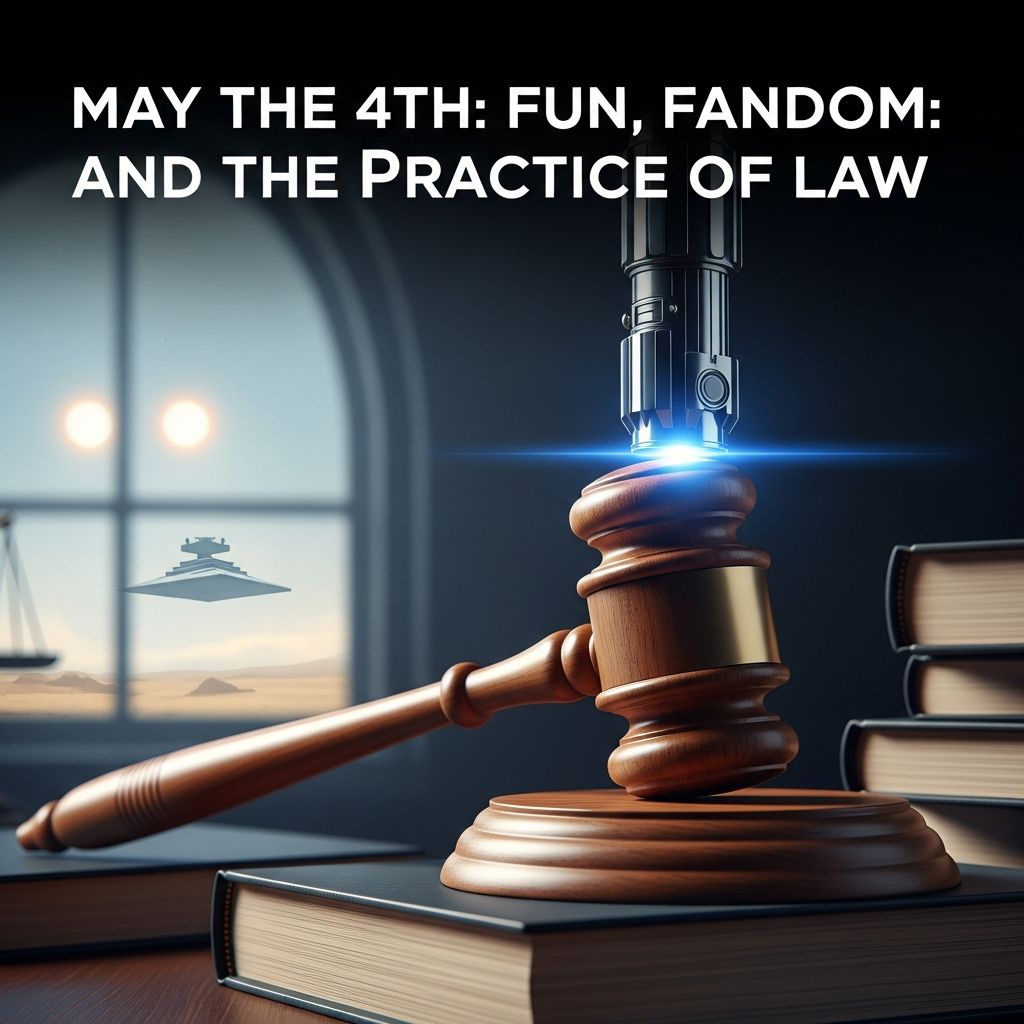
Each year, Star Wars fans celebrate “May the 4th” as a day to honor a beloved universe of heroes, villains, and epic courtroom-worthy conflicts. For legal professionals, this playful holiday can be more than just a pun; it is an opportunity to reflect on ethics, technology, mentorship, and wellbeing in the practice of law.
This article explores how the stories and symbols of Star Wars can illuminate real-world issues that lawyers face every day, from staying calm under pressure to embracing new legal technologies.
From Galaxy Far Away to the Courthouse Hallway
The Star Wars saga revolves around justice, power, and the choices individuals make when confronted with difficult decisions. Those same themes appear in statutes, courtrooms, and negotiations across the world. While the films are fantasy, the questions they raise are deeply practical for anyone who has sworn to uphold the rule of law.
- Conflict and resolution: Disputes over territory, contracts, and governance echo real-world litigation and negotiation.
- Institutions and legitimacy: The Galactic Senate, Jedi Order, and Imperial regime offer a fictional backdrop for thinking about judicial independence and institutional trust.
- Individual responsibility: Characters repeatedly face the tension between following orders and doing what is right—an enduring issue in legal ethics.
Thinking about these stories in a lighthearted way can refresh how lawyers view their own professional roles and obligations.
The Jedi Code and Legal Ethics
Many lawyers are drawn to the image of the Jedi: professionals with specialized training, deep ethical obligations, and power that must be exercised responsibly. While the Jedi Code is fictional, it parallels core duties that lawyers owe to clients, courts, and society.
Shared ideals of restraint and integrity
Legal ethics rules worldwide stress duties of loyalty, competence, confidentiality, and candor toward tribunals. Codes of professional conduct emphasize that lawyers must act with integrity, avoid conflicts of interest, and maintain client confidences except in limited, legally defined circumstances. These principles are not cinematic, but they are the real-life counterpart of a Jedi’s commitment to self-discipline and responsibility.
- Self-control: Like Jedi trained to avoid anger, lawyers are expected to remain professional even in highly adversarial proceedings.
- Impartiality toward the process: Courts rely on advocates who advance their clients’ interests while respecting procedural fairness and the rule of law.
- Guardians of trust: Clients entrust lawyers with sensitive information, comparable to how Jedi are entrusted with crucial knowledge and artifacts.
Avoiding the “Dark Side” of practice
The Star Wars “dark side” is an exaggerated version of temptations that do appear in legal practice—cutting corners on discovery, misleading opponents, or letting personal animosity drive litigation. Professional misconduct rules and disciplinary systems exist precisely to deter such behavior and to protect the public.
Using this pop culture framing can help law students and newer attorneys remember that seemingly minor shortcuts can erode credibility, harm clients, and damage the broader perception of the legal system.
Technology in Law: Droids, Databases, and Due Diligence
Star Wars is famous for its droids—loyal helpers that speak thousands of languages, repair ships, and analyze data. In modern legal practice, technology serves a parallel role: powerful, sometimes misunderstood, and increasingly essential.
Modern “droids”: AI and legal automation
Over the last several years, law firms have rapidly adopted tools that automate research, contract review, and document drafting. Surveys of legal technology use show that artificial intelligence (AI) has moved from experiment to mainstream, with generative AI now integrated into many legal research and drafting platforms.
- Document review: AI tools can flag unusual clauses, risky terms, or missing provisions in contracts much faster than manual review.
- Legal research: Machine learning systems analyze vast legal databases to help identify relevant cases, statutes, and secondary sources.
- Predictive analytics: Some tools estimate litigation timelines or likely case outcomes based on historical data, helping lawyers advise clients more precisely.
Far from replacing lawyers, these tools act like capable assistants—similar to a protocol droid that can handle routine tasks while the human professional focuses on strategy and judgment.
Cloud-based practice: Lawyering from any star system
As in the Star Wars universe, where communication and navigation between planets is routine, lawyers today increasingly work from multiple locations while staying connected to case files and colleagues. Cloud-based practice management platforms give secure, remote access to documents, calendars, and billing records.
| Traditional Approach | Cloud-Enabled Practice |
|---|---|
| Paper files stored in a single office | Encrypted digital files accessible from approved devices |
| Manual scheduling and deadline tracking | Automated reminders and shared calendars |
| Physical meetings for most client interactions | Video conferences, secure portals, and e-signatures |
Research on law firm performance indicates that practices making strategic investments in technology often see improved productivity and client satisfaction, especially when paired with clear workflows and training.
Guarding against cyber threats: Shields up
With increased digital capability comes increased risk. Law firms hold sensitive data on individuals, businesses, and high-stakes disputes, making them targets for cyberattacks. Reports on legal industry trends stress that cybersecurity and data protection have become top priorities for firms of all sizes.
- Implementing strong encryption and secure document management systems
- Using multi-factor or biometric authentication on devices and applications
- Regularly training staff on phishing, password hygiene, and data handling policies
These measures are the real-world equivalent of shields and encrypted transmissions, protecting confidential client information from unauthorized access.
Mentors, Padawans, and Legal Apprenticeship
The mentor–apprentice relationship is central to the Star Wars narrative, and it has long been fundamental to the legal profession as well. Behind every seasoned advocate there are usually mentors who shared techniques, war stories, and guidance during challenging cases.
Why mentorship matters in law
Professional organizations and bar associations emphasize that mentoring helps young lawyers develop skills, manage stress, and internalize ethical norms in ways that formal courses alone cannot achieve.
- Practical wisdom: Mentors explain how to handle difficult clients, negotiate with opposing counsel, and prepare for hearings.
- Career navigation: Experienced lawyers can provide perspective on transfers, specialization, and work–life choices.
- Ethical judgment: Real-world examples shared by mentors help clarify grey areas in confidentiality, conflicts, and advocacy.
Building a culture of teaching and learning
While not every senior lawyer needs to be a Yoda-like figure, building a culture where questions are welcomed and learning is continuous benefits the entire firm. Structured programs—such as pairing new associates with designated mentors, hosting skills workshops, and giving feedback after hearings—can make this culture more intentional.
In the spirit of May the 4th, some firms use themed events or informal gatherings as occasions for storytelling, where senior lawyers recount memorable cases and lessons learned. Such traditions humanize the profession and make it easier for younger lawyers to seek guidance.
Balancing Heroism and Health in Legal Practice
Star Wars frames its heroes as constantly in motion, taking on impossible missions and stretching themselves to the brink. Many lawyers will recognize this pattern in their own schedules. Yet research and professional bodies increasingly stress that sustainable practice requires realistic workloads, mental health support, and time away from work.
Wellbeing as a professional responsibility
Studies on lawyer wellbeing have documented elevated rates of stress, depression, and problematic substance use among legal professionals, sometimes linked to long hours, high-stakes matters, and adversarial environments. In response, courts, bar associations, and law schools have developed guidelines and resources aimed at promoting mental health, including confidential counseling services and lawyer assistance programs.
- Encouraging reasonable boundaries on availability to clients
- Normalizing use of mental health resources and peer support
- Redesigning workflows to reduce unnecessary emergencies
Integrating these practices into firm culture helps ensure that lawyers do not feel pressured to be “heroes” at the expense of their own wellbeing.
Finding moments of levity and connection
Celebrations like May the 4th can provide low-stakes, inclusive opportunities for team-building. Small, thoughtful gestures—a themed trivia lunch, a friendly costume contest, or a movie night—can strengthen relationships and reduce day-to-day tension.
Used thoughtfully, these events:
- Give colleagues a chance to see one another beyond job titles
- Help remote and hybrid teams feel more connected
- Signal that creativity and humor have a place in professional life
When paired with serious commitments to wellbeing and fair workloads, such traditions contribute to a healthier, more resilient legal culture.
Clients, Credibility, and the Public Image of Law
In Star Wars, public trust shifts as institutions rise and fall, sometimes manipulated by misinformation. Similarly, public confidence in courts and legal systems depends on transparency, fairness, and effective communication.
Communicating like a trusted guide
Clients often experience legal matters as confusing and overwhelming. Lawyers who communicate clearly, explain options, and set realistic expectations can act as guides through a complicated landscape. Studies of client satisfaction routinely highlight responsiveness and plain-language explanations as key drivers of positive experiences.
- Avoiding jargon where possible
- Checking for understanding during meetings
- Providing concise written summaries of options and next steps
Using analogies and stories—sometimes even respectfully drawing on pop culture when appropriate—can make complex legal concepts more approachable without diminishing their seriousness.
Ethical marketing and transparency
Just as characters in Star Wars grapple with propaganda and hidden motives, real-world clients worry about whether they are getting full information about legal fees, risks, and likely outcomes. Professional conduct rules typically require that advertising be truthful, that fee arrangements be clearly communicated, and that conflicts of interest be disclosed.
In practice, this means being candid about timelines, costs, and uncertainty rather than overpromising. In the long term, such transparency strengthens a lawyer’s reputation and contributes to public trust in the legal system overall.
Practical Ideas for Bringing May the 4th Into Legal Life
For those interested in celebrating Star Wars Day within a law office or legal department, there are many low-key ways to incorporate the theme while maintaining professionalism.
Simple, inclusive activities
- Themed lunch-and-learn: Pair a short ethics or technology presentation with lighthearted Star Wars references.
- Trivia break: Host a brief virtual or in-person trivia session covering both legal and Star Wars knowledge.
- Decorations: Allow tasteful desk or background decorations for the day, especially in internal meetings.
- Reading list: Share articles or book chapters on legal ethics, technology, or wellbeing with playful subject lines.
Linking fun to professional growth
With a bit of planning, May the 4th can double as a professional development moment:
- Use the theme to introduce new legal tech tools, framed as “droids” supporting the practice.
- Connect film scenarios to real-world issues like due process, emergency powers, and the separation of powers.
- Invite mentors to share a “most difficult decision” story that highlights ethical judgment and courage.
By blending levity with learning, firms can reinforce their values while giving staff something to look forward to.
Frequently Asked Questions (FAQs)
Q: Is it appropriate to celebrate Star Wars Day in a law office?
A: Yes, as long as celebrations remain inclusive, respectful, and compatible with client expectations. Many organizations encourage occasional themed events to support morale, provided that professional standards and confidentiality are maintained.
Q: Can pop culture references help clients understand legal concepts?
A: Carefully chosen analogies can make complex ideas more accessible, particularly for clients unfamiliar with legal terminology. Lawyers should avoid trivializing serious matters but can sometimes use familiar stories to clarify rights, processes, and potential outcomes.
Q: How is technology changing day-to-day legal practice?
A: Technology now supports many routine tasks, including research, scheduling, billing, and document review. Recent reports indicate that firms leveraging AI and cloud tools often gain efficiency and better client service, though they must also invest in data security and staff training.
Q: Does using AI in law threaten client confidentiality?
A: Confidentiality remains a core obligation, regardless of tools used. Lawyers must ensure that any technology provider maintains robust security, complies with data protection laws, and offers appropriate contractual safeguards. Guidance from professional bodies typically advises lawyers to understand how tools handle data before adoption.
Q: What is one concrete step a firm can take to improve wellbeing?
A: A practical starting point is to review workload expectations and after-hours communication norms, then adjust them to reduce unnecessary urgency. Pairing that with visible support for mental health resources signals that wellbeing is treated as a shared priority, not just an individual concern.
References
- Top Legal Technology Trends: The Ultimate Guide (2025) — SpeakWrite. 2025-01-10. https://speakwrite.com/blog/legal-technology-trends/
- Model Rules of Professional Conduct — American Bar Association. 2020-08-12 (current as of latest update). https://www.americanbar.org/groups/professional_responsibility/publications/model_rules_of_professional_conduct/
- Legal Technology Trends to Watch in 2025 — Clio. 2025-02-03. https://www.clio.com/blog/legal-technology-trends/
- 2025 Clio Legal Trends Report Outlines Firms’ Tech and AI Use — Illinois Supreme Court Commission on Professionalism. 2025-01-21. https://www.2civility.org/2025-clio-legal-trends-report/
- 2025 Report on the State of the Legal Market: Top Takeaways — Thomson Reuters Institute and Georgetown Law. 2025-01-15. https://www.thomsonreuters.com/en-us/posts/innovation/2025-report-on-the-state-of-the-legal-market-top-takeaways/
Similar Articles








Read full bio of Sneha Tete


