
Mastering Attachments in Contracts: Schedules, Exhibits, Addendums
Unlock the power of schedules, exhibits, and addendums to create airtight contracts that clarify terms and prevent disputes effectively.
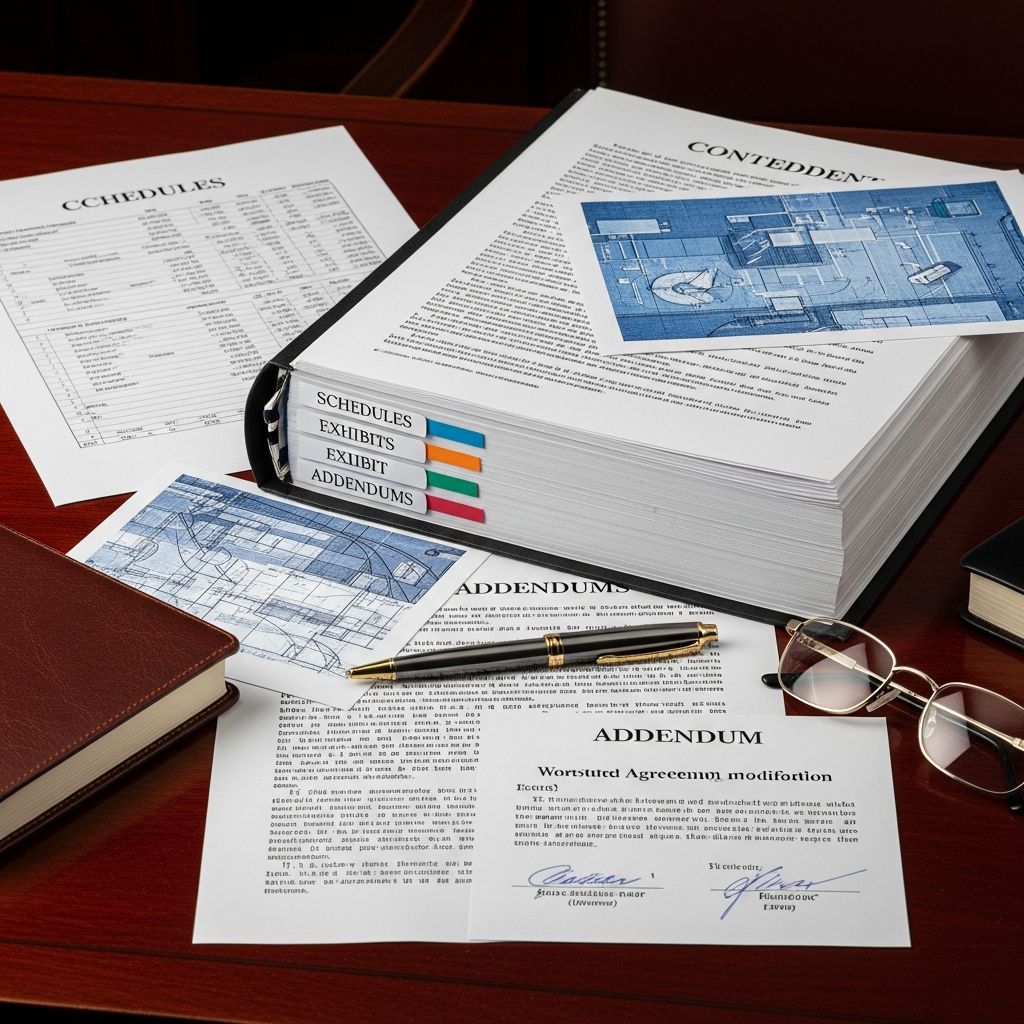
Attachments like schedules, exhibits, and addendums serve as vital extensions to core contract language, housing detailed information that keeps the main document concise while providing comprehensive support for obligations and expectations.
Why Attachments Strengthen Contract Clarity
In complex business transactions, the primary contract body often cannot accommodate every nuance without becoming unwieldy. Attachments address this by organizing supplementary data logically. Schedules outline timelines or payment structures, exhibits present supporting documents like maps or specifications, and addendums modify or expand terms post-signing. This division enhances readability and reduces misinterpretation risks, as emphasized in contract drafting principles that prioritize structured organization for business users.
By segregating details, parties can reference specifics without cluttering operative clauses. For instance, a software development agreement might attach a schedule of milestones in the main text while exhibiting code samples separately. This approach fosters trust and streamlines negotiations, leading to fewer revisions.
Defining Core Attachment Types
Understanding distinctions ensures proper usage:
- Schedules: These integrate seamlessly into the contract, forming part of its operative terms. They typically detail repeatable elements like pricing tiers, delivery sequences, or personnel lists, treated as if written directly into the agreement.
- Exhibits: Supportive in nature, exhibits provide evidence or references such as blueprints, financial statements, or product catalogs. They clarify without altering core obligations.
- Addendums: Executed after the original contract, these amend or append new provisions, requiring mutual consent and often separate signatures to maintain validity.
Precise labeling prevents confusion; always number or letter them sequentially (e.g., Schedule A, Exhibit 1) and cross-reference explicitly in the main body.
Strategic Integration Techniques
To embed attachments effectively, draft clear incorporation language. A sample clause might read: “The terms of Schedule A are hereby incorporated by reference as if fully set forth herein.” This binds the attachment legally.
Use consistent formatting across documents: matching fonts, numbering, and headers aid navigation. Place attachments immediately after the signature page or in appendices for easy access. In digital contracts, hyperlinks to attachments enhance usability without printing burdens.
| Attachment Type | Purpose | Incorporation Example | Best For |
|---|---|---|---|
| Schedule | Operational details | “Party A shall perform per Schedule B.” | Payment plans, timelines |
| Exhibit | Reference materials | “Conforming to Exhibit C specifications.” | Drawings, lists |
| Addendum | Post-execution changes | “Amended by Addendum 1 dated [date].” | New terms, extensions |
This table illustrates optimal applications, promoting precise drafting.
Drafting Schedules for Precision
Schedules demand meticulous detail to avoid disputes. Begin with a title mirroring the referenced clause, e.g., “Schedule of Deliverables and Deadlines.” Employ tables for data-heavy content:
For a construction contract:
| Phase | Description | Deadline | Milestone Payment |
|---|---|---|---|
| Foundation | Site prep and pouring | 30 days from start | 20% |
| Framing | Structural build | 90 days | 30% |
Define variables explicitly; if “Net 30” appears, specify “payment within 30 days of invoice.” Active voice ensures accountability: “Buyer shall pay Supplier per this Schedule” over passive constructions.
Review for consistency with main terms, anticipating changes by including amendment protocols within the schedule itself.
Leveraging Exhibits for Evidentiary Support
Exhibits shine in technical agreements. For real estate, attach property surveys as Exhibit A; in IP licenses, include patent lists as Exhibit B. Label pages sequentially and include a cover sheet: “Exhibit A – Site Plan, 5 pages.”
Ensure exhibits are complete and current at signing. Reference them obligatorily: “Services shall match Exhibit D prototype.” This ties performance standards directly, minimizing subjectivity. Avoid overloading exhibits with operative language; reserve those for schedules.
Navigating Addendums for Flexibility
Addendums adapt contracts to evolving needs, such as scope expansions or regulatory shifts. Draft as standalone documents: restate original date/parties, specify changes, and reaffirm unchanged terms via “except as modified herein, the Agreement remains in full force.”
Require signatures from all original parties. Number sequentially (Addendum No. 1) and attach to the original. For recurring addendums, reference a master amendment clause: “Amendments must be written and signed.” This upholds the entire agreement doctrine.
Common Pitfalls and Avoidance Strategies
- Unclear References: Vague phrases like “attached hereto” fail; use “as set forth in Schedule 2.1.”
- Inconsistency: Mismatched terms breed disputes; cross-check definitions.
- Missing Signatures: Addendums need execution; include signature blocks.
- Overloading Main Body: Offload details to attachments for brevity.
Employ checklists pre-signing: Are all attachments listed in an index? Do they align with state laws on incorporation?
Best Practices for Digital and Printed Contracts
In e-contracts, embed PDFs or use secure links. Platforms ensure version control, preventing “Exhibit swap” disputes. For prints, staple or bind securely. Always distribute identical copies to parties.
Test readability: Have non-legal staff review for comprehension. Plain language rules apply—short sentences, active voice, no legalese.
Legal Considerations Across Jurisdictions
While generally enforceable if properly incorporated, some states scrutinize extrinsic documents. UCC § 2-202 limits parol evidence, reinforcing attachment necessity for merchants. Consult local counsel for notarization or filing mandates.
Frequently Asked Questions (FAQs)
What is the difference between a schedule and an exhibit?
A schedule forms an integral part of the contract’s terms, while an exhibit provides supplementary reference material without binding operative effect.
Do addendums require new signatures?
Yes, all parties must sign addendums to ensure enforceability and mutual assent.
Can attachments be added after signing without an addendum?
No, post-signing changes demand formal addendums to avoid invalidation under integration clauses.
How should attachments be numbered?
Use letters for schedules (A, B), numbers for exhibits (1, 2), and sequential numbering for addendums, with clear main-body references.
Are digital attachments legally binding?
Yes, if platforms comply with ESIGN Act and parties consent to electronic records.
Advanced Tips for Complex Transactions
In M&A deals, schedules list warranties/exceptions; exhibits include due diligence reports. For SaaS agreements, schedules define SLAs, exhibits show UI mockups. Anticipate reviews by using modular templates customizable via AI tools for consistency.
Version control is crucial: Label drafts (v1.0) and finals. Post-execution, maintain a contract repository indexing all attachments.
By mastering these elements, drafters create robust, navigable agreements that withstand scrutiny and support business goals efficiently.
References
- Top Attorney Tips for How to Write Contracts and Agreements — OneLegal. 2023-05-15. https://www.onelegal.com/blog/top-tips-how-to-writing-contracts-agreements/
- Contract Drafting: How to Avoid Mistakes and Draft Better — Sirion. 2024-02-10. https://www.sirion.ai/de/library/contracts/contract-drafting/?libid=50
- Contract Drafting: Common Pitfalls to Avoid — BARBRI. 2023-11-20. https://www.barbri.com/resources/contract-drafting-common-pitfalls-to-avoid
- Ten Tips for Writing Clear Contracts — Contract Nerds. 2022-08-05. https://contractnerds.com/ten-tips-for-writing-clear-contracts/
- Plain English in Contracts: How to Keep It Simple and Clear — Weagree. 2023-03-12. https://weagree.com/clm/contracts/contract-drafting-principles/plain-english-in-contracts/
- Contract Drafting Best Practices — DocuSign. 2024-01-08. https://www.docusign.com/en-gb/blog/contract-drafting-best-practices-0
Similar Articles








Read full bio of Sneha Tete


