
Mastering Bar Exam Question Types for Law Students
Understand every major bar exam question type, how it is tested, and the practical strategies you need to practice and perform with confidence.
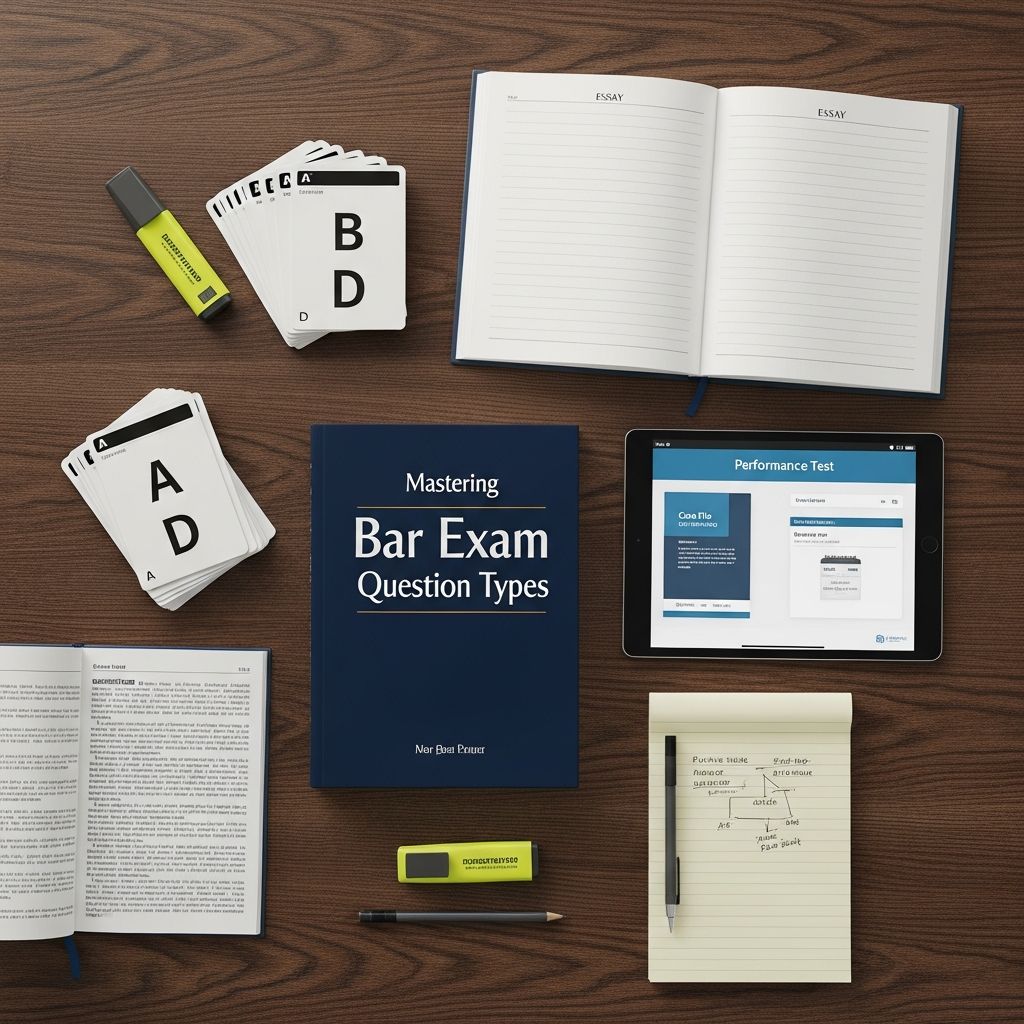
Success on the bar exam depends less on raw intelligence and more on understanding how each question type works, which skills are tested, and how to practice in a structured way. This guide walks through the major formats you will encounter, from multiple-choice questions to performance tests, and shows how to approach them strategically.
Big Picture: How the Bar Exam Is Structured
Most U.S. jurisdictions now use the Uniform Bar Examination (UBE), developed and coordinated by the National Conference of Bar Examiners (NCBE). The UBE combines three components that many states administer over two days: the Multistate Essay Examination (MEE), two Multistate Performance Test (MPT) tasks, and the 200-question Multistate Bar Examination (MBE). These components are uniformly administered and scored, and the resulting score can usually be transferred among UBE jurisdictions.
Even in non-UBE states, you will almost always see the same core formats:
- Multiple-choice questions (MBE-style)
- Essay questions (often based on MEE-style prompts)
- Performance test tasks (MPT-style lawyering exercises)
Understanding what each format demands helps you target your study time and avoid treating all practice questions as if they test the same skills.
Multiple-Choice Questions: The MBE Core
The Multistate Bar Examination (MBE) is a six-hour, 200-question multiple-choice exam that appears in almost every U.S. jurisdiction. It usually accounts for about half of your total bar score in UBE states. The MBE focuses on fundamental doctrinal knowledge and precision in applying rules to fact patterns.
Subjects Tested on the MBE
The MBE currently tests seven primary subjects:
- Civil Procedure
- Constitutional Law
- Contracts (including Sales under UCC Article 2)
- Criminal Law and Criminal Procedure
- Evidence
- Real Property
- Torts
Questions are designed so that each subject receives equal weight; a typical exam contains 25 scored questions per subject, along with unscored pretest questions.
Timing and Exam Day Format
The MBE is administered as two three-hour sessions with 100 questions each, usually on the second day of the exam. You will not know which questions are unscored, so you must assume every question counts.
What MBE Questions Are Really Testing
Although the MBE looks like a pure memorization test, it is designed to measure several distinct abilities:
- Rule recall: Can you state the black-letter rule accurately enough to distinguish among closely related options?
- Precise reading: Can you pick out legally significant facts and ignore red herrings?
- Application under time pressure: Can you perform rule application in about 1.7–1.8 minutes per question?
- Error recognition: Can you eliminate attractive-but-incorrect distractors consistently?
Strategies for MBE Question Practice
- Drill by subject first: Early in your study period, complete question sets focused on a single subject to reinforce core rules.
- Always review explanations: Treat explanations as mini-lessons in doctrine and exam logic, even for questions you got right.
- Track error patterns: Note whether your misses are due to rule gaps, misreading, or second-guessing, and adjust accordingly.
- Introduce mixed sets later: Closer to the exam, work multi-subject sets to mimic the real test environment.
Essay Questions: Demonstrating Legal Analysis
The essay component of the bar exam evaluates your ability to identify legal issues, organize an answer, apply law to facts, and communicate in clear written English under tight time constraints. In UBE jurisdictions, essays are drawn from the Multistate Essay Examination (MEE), which typically consists of six 30-minute questions.
Common Essay Subjects
Essay questions may focus on one doctrine or combine multiple areas in a single fact pattern. UBE essays can test:
- All MBE subjects (Civil Procedure, Constitutional Law, Contracts, Criminal Law and Procedure, Evidence, Real Property, Torts)
- Business Associations (Agency, Partnerships, Corporations, LLCs)
- Family Law
- Trusts and Estates (wills, trusts, future interests)
- Secured Transactions (UCC Article 9)
- Conflict of Laws
Skills Essays Are Designed to Test
Essay questions do more than ask whether you know rules; they test whether you can think and write like a lawyer:
- Issue spotting: Seeing both obvious and subtle legal issues embedded in a dense fact pattern.
- Organization: Presenting your answer in a logical structure (commonly IRAC or a variant) that graders can follow quickly.
- Analysis: Linking specific facts to specific legal elements rather than reciting memorized outlines.
- Time management: Producing a coherent answer in roughly 30 minutes per question, without perfect editing.
High-Yield Essay Writing Habits
- Outline before writing: Spend a few minutes identifying issues and sub-issues. A short outline prevents you from missing major points.
- Lead with conclusions: Clearly state your conclusion for each issue, then explain your reasoning. Graders reward clarity.
- Anchor analysis in facts: Quote or paraphrase key facts to show how they match (or fail to meet) rule elements.
- Prioritize breadth over perfection: It is better to address more issues briefly than to write a polished but incomplete answer to only part of the question.
Performance Tests: Simulated Lawyering Tasks
The Multistate Performance Test (MPT) is often unfamiliar to students but can be an efficient way to earn points. It requires no outside legal knowledge; instead, it provides a closed universe of law and facts and asks you to complete a real-world lawyering task. UBE jurisdictions administer two 90-minute MPT tasks, typically weighted at 20% of the overall score.
What a Performance Test Looks Like
An MPT problem generally contains two packets:
- File – factual materials such as client letters, deposition excerpts, police reports, contracts, exhibits, or news articles.
- Library – legal authorities such as statutes, regulations, or cases, some of which may be relevant and some not.
You may be asked to produce documents such as:
- Objective memorandum to a supervising attorney
- Persuasive brief or motion
- Client letter explaining options or risks
- Outline for examination of a witness, a contract clause, or a settlement proposal
Skills Emphasized on Performance Tests
- Reading comprehension: Quickly digesting a large volume of materials and distinguishing relevant from irrelevant documents.
- Legal analysis in context: Interpreting and applying the provided authorities, even if they differ from your law school jurisdiction.
- Task responsiveness: Following instructions about tone, audience, format, and objectives.
- Professional writing: Producing clear, logically organized work product within a 90-minute window.
Approach to a Performance Test
- Start with the task memo: Identify the precise document you must produce, your audience, and the questions you must answer.
- Skim the library strategically: Identify controlling authorities, key rules, and any conflicts between cases.
- Pull facts from the file: Match facts to elements laid out in the authorities as you read.
- Draft using a simple structure: Follow any formatting guidance, and use clear headings or paragraphs to separate issues.
Common Bar Exam Formats: UBE vs. State Variations
While many jurisdictions use the UBE format directly, others adopt only some components or add state-specific elements. Understanding your jurisdiction’s exact structure is essential for planning your study schedule.
| Exam Component | Typical Use in UBE Jurisdictions | Key Features |
|---|---|---|
| MBE | Required; 200 questions over 6 hours | Multiple-choice; 7 core subjects; usually 50% of total score |
| MEE | 6 essays, 30 minutes each | Tests both MBE and additional subjects; combined or single-subject scenarios |
| MPT | 2 tasks, 90 minutes each | Closed-universe performance tasks simulating practice documents |
Non-UBE states may use the MBE plus locally drafted essays or performance tasks, and may test additional topics such as state-specific procedure, community property, or local distinctions. Always review your jurisdiction’s bar admissions site for the most current structure and scoring weights.
Ethics Questions: The MPRE and Professional Responsibility
In addition to the main bar exam, nearly all U.S. jurisdictions require passage of the Multistate Professional Responsibility Examination (MPRE). The MPRE is a separate two-hour, 60-question multiple-choice test that focuses on legal ethics and professional conduct.
The MPRE draws heavily on:
- ABA Model Rules of Professional Conduct
- ABA Model Code of Judicial Conduct
- Constitutional decisions and leading cases governing lawyer discipline and judicial ethics
Many students take the MPRE before graduating law school so that bar prep can focus primarily on the MBE, essays, and performance tests.
Building a Study Plan Around Question Types
Because each component tests different skills, a balanced study plan should allocate time based on both the weight of the component and your personal strengths and weaknesses.
Balancing Your Time
- MBE-heavy practice: Plan to complete thousands of practice questions spread across the study period, with full-length simulated sessions closer to the exam.
- Essay rotation: Write or outline several essays each week, covering a rotating mix of subjects, to keep analysis skills sharp.
- Dedicated MPT sessions: Practice full 90-minute performance tests periodically; they require stamina and familiarity with the format.
- Ethics early: If you still need to pass the MPRE, schedule that exam and devote a focused block of time to ethics rules and practice questions.
Using Feedback Effectively
- Self-critique essays and MPTs: Compare your work to released sample answers or scoring guidelines where available.
- Seek structured feedback: If possible, submit practice answers to professors, bar review programs, or academic support offices for critique.
- Adjust based on data: If MBE scores are lagging, shift more time to doctrinal review; if essays are weak, focus on organization and rule statements.
Frequently Asked Questions (FAQs)
Q: Do I need to memorize different law for each jurisdiction?
A: For the MBE, the law is national and uniform across jurisdictions. Essays and performance tests in UBE states also use common law principles and generally applicable rules. Non-UBE states may test state-specific variations, so consult your jurisdiction’s official bar exam information page for local distinctions.
Q: How many MBE questions should I aim to complete during bar prep?
A: Many commercial bar courses recommend several thousand practice questions over the course of preparation. The key is not only volume but also thorough review of explanations and tracking of recurring weaknesses, so that each question improves your understanding and timing.
Q: Are performance tests really worth spending time on if they are only part of the score?
A: Yes. Because performance tests require no outside legal knowledge, they can be a relatively efficient way to gain points if you understand the format and practice a structured approach. Many students under-prepare for this component, so solid MPT performance can significantly strengthen your overall score.
Q: How is the bar exam changing with the NextGen format?
A: The NCBE is in the process of developing a NextGen bar exam that integrates multiple-choice and written components more closely and focuses on lawyering skills. Early outlines indicate that it will still assess core subjects while combining doctrinal knowledge with applied tasks, similar in spirit to existing performance tests. Always rely on the latest information from your jurisdiction and from the NCBE.
Q: When should I take the MPRE relative to the bar exam?
A: Many students take the MPRE in the spring or fall of their final year of law school, after completing a professional responsibility course. Passing the MPRE before starting full-time bar prep allows you to focus exclusively on the MBE, essays, and performance tests.
References
- About the UBE — National Conference of Bar Examiners (NCBE). 2024-02-01. https://www.ncbex.org/exams/ube/about-ube
- Uniform Bar Examination (UBE) Overview — Alabama State Bar Admissions. 2023-06-15. https://admissions.alabar.org/uniform-bar-examination-overview
- Bar Exam Format & Subjects: UBE, Non-UBE & NextGen — UWorld Legal. 2024-01-10. https://legal.uworld.com/bar-exam/format-and-subjects/
- Alabama State Bar Exam Components — University of Alabama School of Law Library. 2023-08-30. https://guides.library.law.ua.edu/c.php?g=1439497&p=10690042
- About the Exam — Columbus School of Law, Catholic University of America. 2023-05-01. https://www.law.edu/academics/office-of-academic-affairs/bar-exam/bar-exam-about-the-exam.html
- What Is the Bar Exam? — BARBRI. 2023-09-20. https://www.barbri.com/resources/what-is-the-bar-exam
- The Format of the New Bar Exam — JD Advising. 2024-03-05. https://jdadvising.com/the-format-of-the-new-bar-exam/
Similar Articles








Read full bio of medha deb


