
Service Animals In Massachusetts: Rights, Housing, And Travel
Comprehensive guide to Massachusetts laws on service dogs, emotional support animals, rights in housing, public access, work, and more.
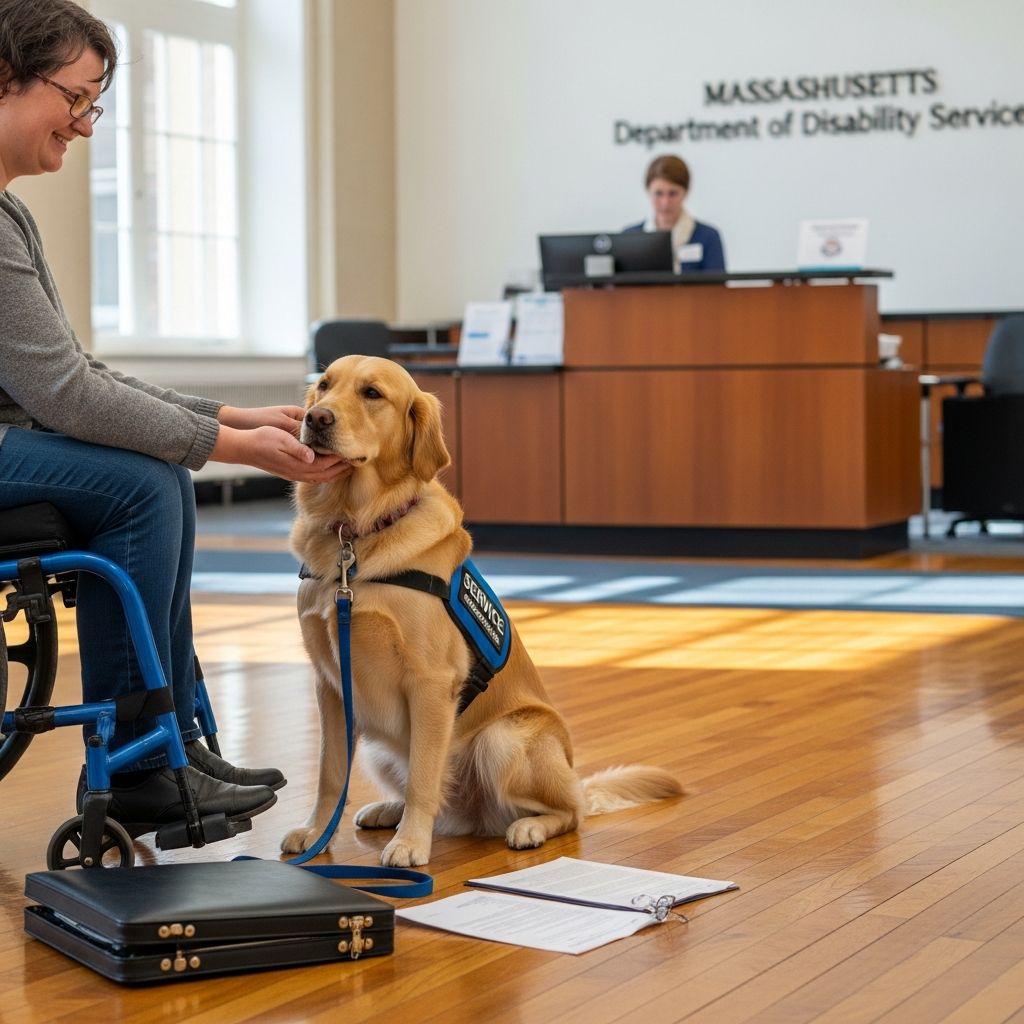
Massachusetts provides robust protections for individuals with disabilities who rely on service animals and emotional support animals (ESAs). These laws ensure access to public spaces, housing, employment, and transportation while distinguishing between trained service dogs and animals offering emotional comfort. This guide breaks down definitions, rights, responsibilities, and recent developments.
Key Definitions: Service Animals vs. Emotional Support Animals
Service animals are defined under both federal and state law as dogs (and in limited cases, miniature horses) trained to perform specific tasks directly related to a person’s disability. These tasks might include guiding the blind, alerting to seizures, or retrieving items for mobility-impaired individuals.
Emotional support animals, by contrast, provide comfort and alleviate symptoms of mental or emotional disabilities but lack specific task training. ESAs receive protections primarily in housing under fair housing laws, not in public access scenarios.
- Service Animal Criteria: Must be a dog or miniature horse; individually trained for disability-related work or tasks.
- ESA Criteria: Any animal species; provides emotional support without task training.
- Key Distinction: Public businesses can only inquire about service animals’ tasks, not ESAs.
Public Access Rights for Service Animals
In Massachusetts, service animals have broad access rights to public accommodations, including restaurants, stores, hotels, and government buildings. State law MGL c. 272, § 98A prohibits denial of entry to physically handicapped persons accompanied by dog guides.
Handlers must maintain control via leash or harness, except when the equipment interferes with the animal’s tasks. Businesses may exclude animals that are out of control or pose a direct threat, such as aggressive behavior.
| Allowed Locations | Restrictions |
|---|---|
| Retail stores, theaters, restaurants | Animal must be under control; no disruption |
| Hospitals, doctor’s offices | Subject to infection control policies if applicable |
| Public transportation | Follow carrier rules; leashed unless task-related |
Staff may ask two questions only: (1) Is this a service animal required due to a disability? (2) What task or work does it perform? No proof, certification, or demonstrations required.
Housing Protections for Assistance Animals
The Fair Housing Act (FHA) and Massachusetts anti-discrimination laws mandate reasonable accommodations for assistance animals in housing, even in no-pet properties. Landlords cannot charge pet fees or deposits for verified ESAs or service animals.
Requests require documentation, such as a healthcare provider’s letter confirming the need. There is no state registry or certification for these animals; all dogs must be locally registered.
- No breed, size, or weight restrictions unless the animal poses a direct threat based on behavior.
- Service animals in training may qualify under reasonable accommodation processes.
- Denials possible for uncontrolled animals or undue burden (rare).
For ESAs, HUD guidelines emphasize reliable documentation over vests or online certificates, which hold no legal weight.
Service Animals in Employment Settings
Under the ADA and Massachusetts law (MGL c. 151B), employers with 6+ employees must allow service animals as a reasonable accommodation in workplaces. The employee bears care and supervision responsibilities.
Employers can exclude disruptive animals but must engage in an interactive process to explore accommodations. Massachusetts extends protections to service animals in training, unlike federal ADA.
Air Travel Rules for Animals
Federal regulations under 14 CFR 382 restrict service animals on flights to dogs only; ESAs lost cabin access in 2021 updates. Airlines may require forms like the DOT Service Animal Air Transportation Form.
Miniature horses are not permitted in air travel under these rules. Passengers must ensure animals do not block aisles or encroach on seats.
Training, Registration, and State-Specific Rules
Massachusetts does not require certification or special registration for service animals beyond standard dog licensing. Laws protect trainers’ rights (MGL c. 129, §§ 39F, 39D).
Hearing dog businesses must be licensed (MGL c. 129, § 39C). Blind pedestrians receive crossing protections (MGL c. 90, § 14A).
Addressing Misrepresentation and Fraud
Fake service animal misuse prompts legislative action. Bill H.4917 proposes a commission to study penalties for fraud and feasibility of certification, with a report due April 1, 2026.
Over 25 states eye similar reforms. Current law lacks specific civil penalties, but disruptions allow exclusion.
Frequently Asked Questions
Can any animal be a service animal in Massachusetts?
No, only dogs and miniature horses qualify as service animals; others are pets or ESAs.
Do I need papers for my service dog in public?
No certification is required; businesses can only ask the two permitted questions.
Are emotional support animals allowed in no-pet housing?
Yes, with proper documentation as a reasonable accommodation.
What if my service animal is aggressive?
Businesses or landlords can exclude it if it poses a direct threat or is uncontrollable.
Do workplaces have to allow service dogs?
Yes, as a reasonable accommodation under ADA and state law for qualifying employers.
Responsibilities of Handlers
Owners must ensure animals are housebroken, vaccinated, and well-behaved. Damages from attacks or thefts are recoverable under MGL c. 272, § 85B.
In schools, students with guide dogs cannot be excluded (MGL c. 151C, § 2(e)).
Recent Federal and State Developments
The PAWS Act (P.L. 117-37) expands VA grants for service dogs to veterans. DOJ FAQs clarify ADA rules, emphasizing no registration needed.
Massachusetts continues aligning with federal standards while offering state enhancements, like trainer protections.
References
- Massachusetts Could Penalize Owners of Fake Service Animals — WBSM. 2023. https://wbsm.com/massachusetts-penalize-owners-fake-service-animals/
- Massachusetts law about service animals — Mass.gov. 2023-10-01. https://www.mass.gov/info-details/massachusetts-law-about-service-animals
- Employer Responsibilities with Service Animals — AIMNET. 2023. https://aimnet.org/employer-responsibilities-with-service-animals/
- Assistance animals in housing — Mass.gov. 2023-10-01. https://www.mass.gov/info-details/assistance-animals-in-housing
- Emotional Support Animal Laws in Massachusetts (2026) — Pettable. 2026. https://pettable.com/blog/massachusetts-esa-laws
- Bill H.4917: An Act relative to a commission to study the intentional misrepresentation of a service animal — MA Legislature. 2023. https://malegislature.gov/Bills/193/H4917
Similar Articles








Read full bio of medha deb


